In the comments of Diane Ravitch's recent EdWeek Bridging Differences, "Why I Am Marching on July 30," one comment captures the bankrupt support for the new reformer movement coming from Secretary Duncan, Bill Gates, and Michelle Rhee.
paulhoss@hotmail.com takes this swipe at those such as Ravitch challenging the new reformers:
"What to say about SOS? In theory it could have promise. In reality SOS will have little to no impact. Jonathan Kozol, Monty Neill, Deborah Meier, Diane Ravitch, etc., are of a common mindset, the bottom line of which is anti-accountability for everyone and everything in our schools."
The problem? This is a classic strawman argument: Misrepresent those you want to demonize and then banter on about your misrepresentation.
To hold someone accountable who has autonomy and has control over outcomes is something everyone supports. Ravitch, et al., would and do support this sort of accountability built on teacher agency—the same sort of accountability that a college professor experiences since colleges hire professors for their expertise and then expect those professors to perform as professionals. Just as we expect of medical doctors, who we hold accountable for their diagnoses and prescriptions, but not for a patient's genetic predispositions or failure to take that medication or follow those doctor's recommendations.
To call for accountability and then PRESCRIBE bad practices for those people AND to hold that group accountable for things over which they have no control is pure political demagoguery. THIS is what Duncan, Gates, Rhee, etc., represent.
Standards, testing, and accountability HAVE NOT WORKED and we have 3 decades of proof:
http://www.nap.edu/catalog.php?record_id=12521
Teacher quality is DWARFED by out of school factors:
Berliner:
http://nepc.colorado.edu/publication/poverty-and-potential
Teacher/school quality = 14%; out-of-school factors = 86%:
http://www.jrf.org.uk/publications/experiences-poverty-and-educational-disadvantage
Ravtich, et al., who are opposing the new reformers are speaking expertise in the face of celebrity and demagoguery.
The new reformers and their supporters have nothing on which to stand so they instead walk arm in arm with a strawman in this ongoing perverse Wizard of Oz show called U.S. education policy. . .
Wednesday, June 22, 2011
Strawman argument is all they have

 “One of the violences perpetuated by illiteracy is the suffocation of the consciousness and the expressiveness of men and women who are forbidden from reading and writing, thus limiting their capacity to write about their reading of the world so they can rethink about their original reading of it.” Paulo Freire, Teachers as Cultural Workers
Tuesday, June 21, 2011
Why Diane Ravitch Is Marching on July 30
From Ed Week:
I will be marching with the Save Our Schools coalition of teachers and parents on July 30 in Washington, D.C. I know you will be, too. I hope we are joined by many thousands of concerned citizens who want to save our schools from the bad ideas and bad policies now harming them.
I am marching to protest the status quo of high-stakes testing, attacks on the education profession, and creeping privatization.
I want to protest the federal government's punitive ideas about school reform, specifically, No Child Left Behind and the Race to the Top. Neither of these programs has any validation in research or practice or evidence. The nation's teachers and parents know that NCLB has been a policy disaster. Race to the Top incorporates the same failed ideas. Why doesn't Congress know?
I want to protest the wave of school closings caused by these cruel federal policies. Public schools are a public trust, not shoe stores. If they are struggling, they should be improved, not killed.
I want to protest the way that these federal programs have caused states and districts to waste billions of dollars on testing, test preparation, data collection, and an army of high-priced consultants.
I want to protest reliance on high-stakes testing, which has narrowed the curriculum, encouraged gaming the system, and promoted cheating.
I want to express my concern about the effects of 12 years of multiple-choice, standardized testing on children's cognitive development, and my fear that this reliance on bubble-testing discourages imagination, creativity, and divergent thinking.
I want to express my opposition to an educational system devoted to constant measurement, ranking, and rating of children, which validates the belief that some of our children are winners, while at least half are losers.
I want to speak out against federal policies that promote privatization of public education.
I want to protest federal efforts to encourage entrepreneurs to make money from education, instead of promoting open-source technology, free to all schools.
I want to protest the federal government's failure to develop long-term plans to improve the recruitment, preparation, and support of the teaching profession.
I want to protest the ill-founded belief that teachers should be evaluated by their students' test scores, which is a direct result of the Race to the Top.
I want to express my disgust at the constant barrage of attacks on teachers, principals, and public education.
I want to urge Congress and the Obama administration to recognize that federal funding should support equity and benefit the nation's neediest students. That was the rationale for passage of the Elementary and Secondary Education Act of 1965, and it should be the rationale for federal funding today.
I want to urge Congress and the Obama administration to acknowledge that school reform cannot be imposed by legislative fiat, but must be led by those who are most knowledgeable about the needs of children and schools: educators, parents, and local communities.
I want to urge Congress and the Obama administration to recognize the constraints of the Constitution and federalism and to stop using the relatively small financial contribution of the federal government to micromanage the nation's schools.
I want to urge Congress and the Obama administration to acknowledge that our nation's public schools have played an essential role in making our nation great. After many historic struggles, their doors are open to all, regardless of race, economic condition, national origin, disability, or language. We must keep their doors open to all and preserve this democratic institution for future generations.
I want to urge Congress and the Obama administration to recognize that our public schools are succeeding, not declining. Since the beginning of the National Assessment of Educational Progress in the 1970s, our students have made slow but steady gains in reading and mathematics. Improvement has been especially notable for African-American students. Progress was greatest, ironically, before the implementation of NCLB.
I call on Congress and the Obama administration to cease spreading false claims of educational decline. Since the first international test in 1964, we have never led the world in test scores, and we have often been in the bottom quartile on those tests. Yet, as President Obama said in his State of the Union Address in January, we have the world's greatest economy, the world's most productive workers, the most inventors, the most patents, the most successful businesses, and the best universities in the world. And all of these great achievements were created by people who are mainly products of our nation's public schools.
I urge Congress and the Obama administration to support programs that help children arrive in school ready to learn: assuring that every pregnant woman has appropriate medical care and nutrition; that children have high-quality early-childhood education; and that parents know they have the support they need to help their children grow up healthy and ready to learn.
I am marching because I want every child to attend a school where they can learn not only basic skills, but history, geography, civics, the sciences, and world languages, and have ample opportunity to engage in the arts.
I am marching to support the dignity of the education profession and to express my thanks to the millions of teachers, principals, and other educators who are in the schools every day, doing their best to educate our nation's children.
I hope the march will revive the morale of our nation's educators. I hope it will remind the American people that the future of our nation depends on our willingness to protect and improve our public schools, the schools attended by nearly 90 percent of our nation's children.
Diane
Duncan Supports Snyder's Privatization Plan for Michigan Schools
Dreamed up by the lawyers to the Billionaire Boys' Club, Gov. Rick Snyder's infamous Public Act 4 grants the Governor or his appointed "emergency" managers "power to fire local officials, cancel contracts, privatize municipal services, and even dissolve whole towns."
Yesterday Snyder applied his new powers to take over, charterize, and further segregate Detroit's poorest schools, and Arne Duncan was on the satellite hookup offering his full support for Snyder's bold action, which is being imposed through the Governor's latest emergency lackey, Roy Roberts, former GM exec trained by the same stooges at Harvard who provide instruction at Eli Broad's corporate training camp for urban superintendents just down the street.
From an excellent piece at HuffPo by Joy Resmovits:
Broad's Detroit's previous emergency manager, Robert "Bonus" Bobb, the DPS debt swelled from by $127 million. Things are obviously bad enough now to declare a crisis and an emergency corporate solution (see The Shock Doctrine).
Here's more on the plan, which is not even mentioning the toxic, segregative, and brutalizing corporate charters that are being planned for Michigan's poorest children:
Segregation, cultural sterilization, behavioral neutering, and cognitive decapitation: welcome to the New Eugenics, the Oligarchs' version.
I started to post this piece below separately, but it makes for good reading here to see the level of debased hypocrisy and deception coming out of the Obama Department of Education. By Nathan Bomey for AnnArbor.com:
Yesterday Snyder applied his new powers to take over, charterize, and further segregate Detroit's poorest schools, and Arne Duncan was on the satellite hookup offering his full support for Snyder's bold action, which is being imposed through the Governor's latest emergency lackey, Roy Roberts, former GM exec trained by the same stooges at Harvard who provide instruction at Eli Broad's corporate training camp for urban superintendents just down the street.
From an excellent piece at HuffPo by Joy Resmovits:
The plan mirrors similar efforts in New Orleans and Tennessee that target the lowest-performing schools. But how Michigan's EAS [Education Achievement System] will live up to its promise to improve Detroit's schools -- and address the district's crippling debt -- has yet to be revealed.Why the incubation for this Alien takeover? Michigan voters are likely to vote down Public Act 4 in a referendum next year, which could leave the privatization plan high and dry. The specifics of the plans are were not elaborated yesterday, but it does includes firing all teachers in "failing" schools, giving school CEOs latitude to set up their own fiefdoms without oversight, and control by the unelected anti-democrats who own the Governor's Office:
What Roberts did say is that the state will run the EAS in partnership with EMU beginning in the 2012-2013 school year. The coming 2011-2012 school year will be an "incubation" period for the development of the system. In addition enveloping schools from DPS, the system is slated to expand to include low-performing schools throughout Michigan.
Schools deemed low-performing based on standardized test scores and student grade point averages will enter the EAS. After five years in the system, an evaluation will determine whether the school can choose to go back to local control.Under
A parent advisory council will be created at each school, and each parent will be required to sign a contract certifying involvement in his or her child's education.
The new authority will function with an 11-member board. Two members will be appointed by DPS, two appointed by the university [Eastern Michigan] and seven by the governor. Five of those board members will make up the system's executive committee, chaired by Roberts.
Here's more on the plan, which is not even mentioning the toxic, segregative, and brutalizing corporate charters that are being planned for Michigan's poorest children:
The plan was developed to mirror earlier efforts by former DPS emergency manager Robert Bobb, as revealed in documents subpoenaed by a lawsuit, said Donna Stern, national representative of BAMN, an activist coalition in Detroit. Bobb's plan called for an aggressive conversion of failing DPS schools into charter schools, but had been since tempered by Roberts.
When asked whether EAS would focus on creating charter schools, Wilbanks pointed to the eight charter schools EMU runs across Michigan. "That's one mechanism we might use to improve performance," he said.
The FAQ on EAS says the system will include input from "top quality charter authorizers" in developing its "objective criteria for identifying high quality schools."
"Performance against these criteria will be the basis for all decisions made within the EAS," the fact sheet reads.
Anthony Adams, president of Detroit's school board, said he had heard bits and pieces of the plan over the last week.
Before Monday's announcement, the school board -- which has been stripped by the emergency manager of its powers -- met with Roberts to learn about the plan's details. That meeting resulted in a heated exchange, Adams said, when one member asked for details on eliminating the district's debt.
"One of our board members wanted more detail regarding the deficit elimination portion of the plan," Adams told The Huffington Post. "The emergency manager didn’t necessarily like the questions. People here are very aggressive."
Requests for comment from Roberts following the news conference were not returned.Response from teachers, students, and parents was immediate and strong:
Some teachers were curious to hear about the changes to their schools, but they were turned away at the door, so they started picketing, forming a crowd of about 20.Unless Michigan citizens act to shut down this plan, it will spread from Detroit to other poor areas of Michigan. With Duncan's stamp of approval to turn around the bottom 5 percent of schools, there will always be a bottom 5 percent as long as schools are measured based on their standardized tests, which is, in fact, a measure of the level of poverty.
Joined by several students, they chanted: "No layoffs, no cuts, Detroit won't get to the back of the bus."
Among the student protesters was Leroy Lewis, a 16-year-old rising senior at Southeastern High School.
"They were holding a press conference to destroy public education, so I wanted to see it," he told HuffPost. "My school is on the list of failing schools. I'm prepared to fight around it and gather up support."
"They took our teachers away, cut our fine arts program. It's very difficult to learn here," he added.
Some critics said the move to create a separate district run by an appointed board invites further privatization of Detroit's schools.
"This is the next level in the attack on public education," said Nicole Conaway, a science teacher at Catherine Ferguson Academy. "They're trying to implement a New Orleans plant model that will have severe brutality and be segregated."
"Classrooms will be overcrowded. Supplies will be shorter. It is like the new Jim Crow in creating a second-class tier of schools," she added.
Segregation, cultural sterilization, behavioral neutering, and cognitive decapitation: welcome to the New Eugenics, the Oligarchs' version.
I started to post this piece below separately, but it makes for good reading here to see the level of debased hypocrisy and deception coming out of the Obama Department of Education. By Nathan Bomey for AnnArbor.com:
In the aftermath of Gov. Rick Snyder's decision to give emergency managers more power to address crises in Michigan's distressed public school districts and municipalities, Snyder faced a barrage of criticism.
Activists ranging from the Michigan Education Association to the Michigan Democratic Party to liberal MSNBC commentator Rachel Maddow slammed Snyder and Michigan Republicans, saying the emergency manager legislation dismissed democracy in favor of dictatorial politics.
But it's becoming increasingly clear that Snyder's emergency managers — whose existence has inspired an effort to place the issue on the ballot in 2012 to allow voters to repeal the legislation — have more political support than previously thought.
Exhibit A: Washtenaw County Board of Commissioners Chairman Conan Smith, a Democrat.
Exhibit B: Flint Mayor Dayne Walling, another Democrat.
Exhibit C: President Barack Obama?
Silly, you say? There's no way that Obama would back Snyder's decision to allow emergency managers to sever union contracts, wrest power away from elected officials and unilaterally reshape budgets and curriculum in the name of fiscal sanity. Right?
Perhaps. But then I ask you this: Why did U.S. Secretary of Education Arne Duncan, an Obama appointee, participate in Snyder's press conference today by satellite, praising Detroit Public Schools emergency manager Roy Roberts' leadership and lauding Snyder's efforts to uproot the "status quo."
Duncan — the third speaker at the press conference, behind Snyder and Roberts — praised the initiative to establish a statewide system to revitalize Michigan's worst public schools by transferring them to a new autonomous authority, requiring teachers to reapply for their jobs and giving principals more authority to make their own decisions.
The new initiative starts with Detroit's approximately 100 failing schools in 2012-13 but it will extend to the other 100 failing schools in Michigan in 2013-14.
"This city has no viable future if the status quo is allowed to stand," Duncan said. "Detroit has the potential to be a model not just for the state, but for the entire country."
Fair enough.
Bad news, though: Without the strengthened emergency manager law, Roberts would find it much harder to make all the changes he wants to make — and that Snyder is supporting.
"I want to be a good partner to folks in Detroit who want to take that school system to a whole new level," Duncan told reporters this morning.
I believe him. Because if he actually opposed the emergency manager powers, he'd basically be opposing Roberts' right to take control of the district, which makes much of these reforms possible.
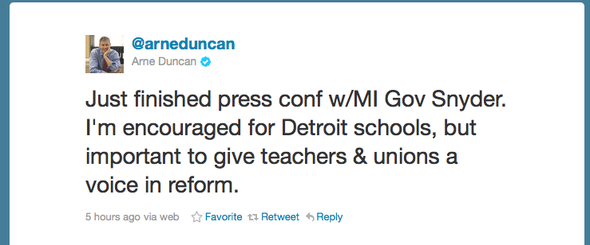
That's why it was startling to see Duncan post this to his Twitter account after the press conference:
Emphasizing that it's "important to give teachers and unions a voice in reform" is a puzzling caveat to add, considering that under Snyder's new Education Achievement System, teachers at Michigan's 200 failing schools will be fired and forced to reapply for their jobs.
It's always fascinating to watch back-tracking occur in real time through the modern lens of social media.
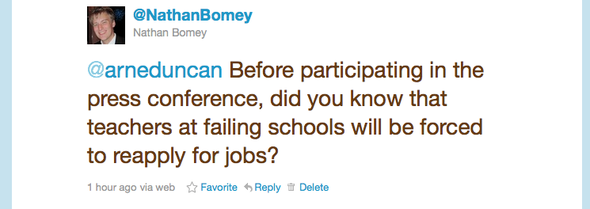
So I directed my questions to Duncan through the same medium he chose to add his caveat:
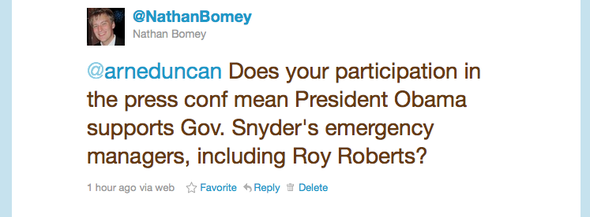
Seems like a fair question, right? No answer. So I pressed further:
Still no answer.
So I decided to go the traditional route. I called his communications office in Washington.
I asked Daren Briscoe, deputy press secretary for the U.S. Department of Education, whether Duncan's participation in the press conference means he supports Snyder's emergency managers.
"The way to understand what the secretary was saying was, more so than endorsing that as a specific blueprint, he was expressing his support of thematically what they’re doing in Michigan, which is taking urgent action, to remedy a situation that is not serving the students there well," Briscoe said.
Duncan participated in the press conference to endorse "the kind of collaboration that you have to have in a situation like that in order to come to the kind of agreement that they’ve come to, which involves administrators, parents and teachers," Briscoe said.
Briscoe added: "That’s what he was endorsing and praising, was the broader-stroke urgency, collaboration and that sort of thing, rather than line by line" approval of Snyder's reform policies.
That's strange: So, you're publicly supporting a theme of change but the details make you uncomfortable?
I asked Briscoe whether Duncan — which, by extension, means the president of the United States — supports forcing teachers in failing public schools to reapply for their jobs as part of a broader reform initiative.
In situations where schools are "persistently failing," the Department of Education sometimes supports "all of the teachers being fired and principals being fired."
"That's not a blanket description for each school, but that is among the options that the department endorses, given a certain set of circumstances," Briscoe said. "Where you have dramatically underperforming schools, persistently underperforming schools, yeah the department does endorse actions that are both dramatic and urgently needed."
Here's my takeaway: President Obama supports firing teachers when schools are failing — and, if he had a big problem with Snyder's emergency managers, he wouldn't have allowed his education secretary to lend his political clout to an event trumpeting one of the biggest education reform initiatives to sweep through Michigan in decades.
What about you?
If Obama despised Snyder's emergency managers and firing bad teachers, why would he allow a key member of his cabinet to sing the praises of a reform initiative that is partly possible because of Snyder's policies?
Contact AnnArbor.com's Nathan Bomey at (734) 623-2587 or nathanbomey@annarbor.com. You can also follow him on Twitter or subscribe to AnnArbor.com's newsletters.
Monday, June 20, 2011
Christie Continues Efforts to Kill Public Education in NJ
HT to Stan Karp:
Joan Whitlow, Star Ledger, 6.18.11
State politics will affect Anderson more than most supers because Newark is a state-controlled district. Gov. Chris Christie has been pushing charter schools, vouchers and, more recently, the privatization of public schools. Mayor Cory Booker has inserted himself into the district's business. Although Booker lacks any legal authority, he has the governor's blessing and a $100 million pledge from Facebook founder Mark Zuckerberg that will grow to $200 million for education if the required matching donations come through. There's potential for political squeeze. It was reasonable to worry that the choice for super might be a rubber stamp for the Booker-Christie agenda. It is reasonable to wonder if anyone good enough to do the job wouldn't pack up her résumé and run.
Examiner.com 6.17.11
Last week, Governor Chris Christie unveiled legislation that would allow private, for-profit companies to take over failing public schools. Christie has also pushed for more charter schools and a New Jersey voucher system. It turns out that our governor has a history of working for Edison Learning, the nation’s largest of these for-profit education companies
Star Ledger, 6.17.11
Private companies may soon gain unprecedented control of five failing New Jersey public schools if a proposal unveiled last week by Gov. Chris Christie is approved by the Legislature. Fewer than 70 public schools across the country are managed privately and many struggle because of restrictive local regulations and feuds between the companies and the communities they serve, education experts said.
Old News Missed But Worth Noting
When Broadie poster boy, Peter Gorman, came out with his plan in the spring for 52 new tests for Charlotte-Mecklenburg students to choke down more than once during coming school years, some called Gorman a visionary, while some called him the corporate whore. As if to prove the latter correct, Gorman has signed on at NewsCorp with Klein and Klein's former NYC Schools COO, Kristen Kane, to run Rupert Murdoch's edu-adventures. The Press Release is too good not to be shared:
. . . . Ms. Kane will become Chief Operating Officer of the group, responsible for driving operations and strategy. Dr. Gorman will be named Senior Vice President and work with school districts to implement the division's programs, as well as review their integrity and effectiveness.
News Corporation's Education Division is focused on individualized, technology-based content and learning opportunities that support world class student and teacher performance, as well as digital assessment tools for K-12 students in the United States that help eliminate the achievement gap. News Corporation recently acquired Brooklyn-based education technology company, Wireless Generation.
"Pete and Kristen are recognized leaders in their field and each brings particular strengths to bear on our growing business," said Joel Klein, CEO of News Corporation's Education Division. "Pete's success running one of the largest schools systems in the United States, combined with his commitment to educational innovation are the perfect complement to our mission. Furthermore, Kristen's proven leadership in shaping and running many of the New York City Department of Education's best programs will benefit us greatly over the years to come."
"I am delighted to have the opportunity to work with Joel and his team in this capacity," said Ms. Kane. "I strongly believe there are more efficient and effective ways to improve the system, and I'm eager to get started."
"I'm thrilled to join News Corporation, and to work with someone of Joel's caliber, and the rest of his team, to transform the educational system through digital technology and other means," said Dr. Gorman. "News Corporation has a reputation for leading significant change across many industries, and I look forward to what lies ahead for the education sector."
Ms. Kane brings a range of experience in both the public and private sectors. At the New York City Department of Education, she served as Chief Operating Officer and was responsible for the development and implementation of the Bloomberg administration's reform strategy as well as oversight of daily operations.
She also served as Chief Executive of the Office of New Schools, which opened 178 new schools and charters in New York City under her leadership. At the Federal Communications Commission, she served as a Director of the National Broadband Plan developing strategies for applying broadband technologies in the education, healthcare, and energy sectors. Earlier in her career, Kristen worked in equity research at JPMorgan covering the education sector. She holds an MBA and Certificate in Public Management from the Stanford Graduate School of Business and a BA from Yale.. . .
Friday, June 17, 2011
NSBA Calls for Universal Relief from AYP, NCLB's IED
As Bryant points out, public schools cannot wait for Gates stooge, Arne Duncan, to figure out a massive extortion plan to insert the BRT's agenda. From HuffPo:
. . . .With so many delays in Congress to introduced and pass the ESEA reauthorization, the National School Boards Association is calling on Duncan and the Department of Education for flexibility now in NCLB to allow more financial resources to be used for the critical purpose of teaching and learning.
We need the regulatory relief this summer before school starts, instead of a new bureaucratic process that the Department of Education is purposing that could take many months to create. And as we need this as a matter of policy -- not state or school district case-by-case waivers. We specifically support suspension of additional sanctions under current AYP requirements, effective for the 2011-12 school year, so that schools currently facing sanctions would remain frozen; no new schools would be labeled as 'In Need of Improvement' or subject to new or additional sanctions.
In the past two years, budget pressures have forced school districts to make significant cuts, some that directly hit classrooms, including teacher and staff layoffs. A recent study by the American Association of School Administrators predicts further teacher and staff cuts of 227,000 school personnel in the coming school year. This comes as NCLB's increases costly reports, data collection, and program mandates forces school districts to take their attention off their core mission and spend time and money to comply with unnecessary regulations.
In essence, schools for the upcoming school year are being forced to lay off teachers and hire data collectors. Does anyone really think that is the best way to run our public schools?
Follow Anne L. Bryant on Twitter: www.twitter.com/@NSBAComm
Thursday, June 16, 2011
Momentum Growing for Save Our Schools Conference and March
Please plan to join us for the SOS events in DC at the end of July -- sign up at: http://www.
FRUSTRATED EDUCATORS AIM TO BUILD GRASSROOTS MOVEMENT
Education Week -- June 15, 2011
By Erik W. Robelen
Thousands of educators, parent activists, and others are expected to convene in the heat and humidity of Washington next month for a march protesting the current thrust of education policy in the United States, especially the strong emphasis on test-based accountability.
Organizers say the effort aims to galvanize and give voice to those who believe policymakers, including U.S. Secretary of Education Arne Duncan and state governors, have gone astray in their remedies for improving American schools. Leaders of the march---current and former educators among them---say they're determined to build a grassroots movement that has staying power beyond the gathering this summer and "restores" a central role for educators, parents, and communities in policy decisions.
How widespread such sentiments are in the K-12 workforce is hard to quantify. The nation has more than 3 million public school teachers, and they're a diverse bunch. And a lot of teachers may not pay much attention to national policy debates.
But march organizers and supporters suggest that many teachers have become increasingly frustrated with the test-driven accountability framework at the heart of the U.S. education system and look with alarm at the wave of teacher-evaluation measures being enacted in some states, pegged in part to student scores on standardized tests.
Such views are shared by Pat Graff, a 34-year teaching veteran who co-chairs the English department at La Cueva High School in Albuquerque, N.M., and is her school's testing coordinator.
"I think it's going down the wrong track fast," Ms. Graff said of the main policy direction she sees. "It ramped up with No Child Left Behind and the push for accountability and [adequate yearly progress]. And then they just keep adding tests. ... Teachers lose the opportunity to teach anything beyond how to fill in the bubbles."
Meanwhile, she said, teachers "feel like the scapegoat ... for everything that's wrong with society."
Nancy Flanagan, a former classroom teacher of 30-plus years who writes an opinion blog hosted on the Teacher section of the Education Week website, said frustration with the federal No Child Left Behind Act's pressure to boost test scores in reading and mathematics has mushroomed among teachers.
"A lot of people were waiting it out," said Ms. Flanagan, a member of the organizing committee for the Save Our Schools March and National Call to Action. "States were complying. Teachers were unhappy. Huge amounts of money were going to the wrong things."
She added: "When [President Barack] Obama was elected, I think it came as a huge shock to people that he was not only going to continue the policies, but exacerbate them."
By exacerbate, she pointed, for example, to incentives in the Obama administration's Race to the Top initiative for states to link teacher evaluations to student test scores.
Tony Bennett, Indiana's state schools superintendent and himself a former teacher and school administrator, voiced skepticism, however, about the aims of the Save Our Schools march, dubbed SOS. "Does it stand for Save Our Schools or Save Our Status Quo?" he said. "They seem to articulate very well everything they're against."
Mr. Bennett, a Republican, defended the need for test-based accountability, suggesting it's vital to ensure students are no longer shuffled through school without adequate preparation, even as he said plenty of work remains in improving assessments. He also said that on the issue of teacher evaluation, test scores are only part of the equation, despite what he calls "fearmongering" from critics who suggest that's all there is to it.
"We are embarking on a journey in education in this country that is a dramatic shift from what we've done in the past," Mr. Bennett said, "but it's the right shift."
Building a Network
Organizers of the Save Our Schools march say they expect 5,000 to 10,000 people to attend the Washington gathering on July 30. Ms. Flanagan, the Michigan teacher of the year in 1993, said the size of the rally isn't the point.
"The point is to start momentum toward a sea change, to bring together---physically and virtually---a network of people who want change," she said.
Social media have been key drivers of the march, with organizers using blogs, an SOS Facebook page, and Twitter to promote it.
The four "guiding principles" for the march are: equitable funding for all public school communities; an end to high-stakes testing used for the purpose of student, teacher, and school evaluation; curriculum developed for and by local school communities; and teacher, family, and community leadership in forming public education policies.
Anthony Cody, one of the lead organizers and a former classroom teacher who is now a science-content coach for teachers in the Oakland, Calif., district, said concern about the uses of standardized tests is at the heart of the matter.
Sabrina Stevens Shupe, in downtown Denver, says she's alarmed to see how testing-based accountability continues to increase. "We were very excited that, 'Oh, we're going to get Obama in office,' ...and we get this bait and switch with Arne Duncan and Race to the Top," says Shupe, a Save Our Schools organizer and former Denver teacher.
"That's really the core thing driving this movement: The understanding that learning is complex, and that it is not captured in a test score; it is not captured in most of the data that is worshiped at the district, state, and federal levels," said Mr. Cody, who, like Ms. Flanagan, writes a teacher-oriented opinion blog at edweek.org. "We want to be held accountable for things that matter, and we've seen test scores create a system of accountability that has a very poor relationship to what really matters for students."
A lot of the Save Our Schools leadership, he said, is drawn from people who have been active "teacher leaders." Several of them, including Mr. Cody and Ms. Flanagan, hold national-board certification.
Confirmed speakers for the rally include education historian Diane Ravitch, who co-authors a blog hosted by edweek.org; the education author and activist Jonathan Kozol; and Superintendent John Kuhn of the Perrin-Whitt district in north-central Texas.
A two-day conference is scheduled before the march and a "congress" the day after to discuss next steps.
Among the organizations to endorse the Save Our Schools march are: the International Reading Association, the National Association of Secondary School Principals, the National Council of Teachers of English, the nonprofit group Parents Across America, and the Virginia School Boards Association. Also, more than 30 state and local teachers' unions, plus the American Federation of Teachers and the National Education Association, have signaled their support.
Organizers say the effort originated with individuals, not unions.
"We are very happy they are on board, but they are not driving the bus," Mr. Cody said.
"What our union liked about this was these are rank-and-file folks from across the country," said aft President Randi Weingarten, even as she cautioned that the union may disagree on some "nuances" of the SOS principles. "There is a frustration about the politics and the policy. And a lot of it is about voice, and the lack of voice."
Interpreting Obama
Debates on the use of standardized tests have been swirling for years. It's no secret that many educators and researchers have long been leery of giving them too much weight in gauging student learning and meting out consequences for schools, students, and teachers.
In fact, a major report just issued by the National Research Council raised questions about the value of tying consequences for schools, teachers, and students to test results. The evidence examined "is not encouraging about the ability of incentive programs to reliably produce meaningful increases in student achievement," it said.
Says Benjamin Van Dusen, a former science teacher and Albert Einstein Fellow, "I'm not opposed to having standardized tests and having them be important. ...I think we need better tests, more authentic assessment."
Some observers and advocates suggest that a variety of factors have combined to ratchet up frustration. For one, more and more public schools are facing sanctions under the NCLB law, as the levels of proficiency required have climbed.Also, the recession has led to cutbacks in aid to schools, with impacts on teacher pay, benefits, and class sizes. And several states recently passed laws to scale back teachers' collective bargaining rights.
Then there's the Obama administration. Some educators and activists who campaigned for Mr. Obama in 2008 say they believed he was intent on making a significant shift in direction on education from the Bush administration, in part to counterbalance the weight of standardized testing in schools. Now, they feel that is not happening.
Stephen H. Lazar, a teacher at the Bronx Lab School in New York City who plans to attend the SOS march, said he's been disappointed with Mr. Obama: "The president's education agenda is a symptom of the 'reform' movement that has managed to capture the national narrative around education." ("In War of Words, 'Reform' a Potent Weapon," March 2, 2011.)
"We were very excited that, 'Oh, we're going to get Obama in office, and the ridiculous things about No Child Left Behind will go away,' " said Sabrina Stevens Shupe, a former teacher in Denver who co-authors a blog called Failing Schools and is on the SOS organizing panel. "And he comes in there, and we get this bait and switch with Arne Duncan and Race to the Top."
. . . .
The U.S. Department of Education did not accommodate a request to speak with Secretary Duncan or another official for this story. But in an email, department spokesman Justin Hamilton wrote: "We believe that teachers are America's unsung heroes. And while there are different opinions on the best ways to boost student achievement, we all agree that reforms are needed."
Mr. Duncan issued an "open letter" to teachers in May, timed to Teacher Appreciation Week, in which he seemed to take pains to offer an olive branch. He noted and echoed some of the concerns expressed by teachers, such as that the NCLB law has prompted schools to "teach to the test" and has led to a narrowing of the curriculum.
"And you are frustrated when teachers alone are blamed for educational failures that have roots in broken families, unsafe communities, misguided reforms, and underfunded school systems," he wrote in the letter, published on the Education Week and Education Department websites.
Mr. Duncan pledged to work with teachers to improve the law and strengthen the teaching profession. "I hear you, I value you, I respect you," he wrote.
But the letter sparked an online backlash, including from some SOS organizers. A common thread was the contention that Mr. Duncan's conciliatory words were belied by his department's agenda, especially with the Race to the Top.
"Your actions have spoken so loudly to America's teachers that we can't hear your words," one commenter wrote.
The $4 billion grant competition has sparked controversy for, among other measures, pushing states to tie teacher evaluations to student test scores, create or expand their charter school sectors, and choose from a set of prescriptive models for turning around the lowest-performing schools, measured mainly by test scores.
Even though the Obama administration has not backed away from using tests to drive accountability, it is pursuing efforts to change them. With $360 million in additional Race to the Top money, it is backing work by states to design new testing systems that it says will measure student growth---rather than capture a snapshot of achievement---supply real-time feedback to teachers to guide instruction, and include performance-based items to gauge more types of learning.
Gauging Teacher Views
Richard Rothstein, a research associate at the Economic Policy Institute, a Washington think tank, also sees a disconnect between the administration's rhetoric and policy.
For example, he said that even as the administration has called for wrap-around supports beyond schools---in areas like health and social services---to help children succeed academically, the president's blueprint for overhauling the NCLB law "holds schools accountable for identical results, whether or not they have these [supports]. It's completely incoherent."
Recent survey data provide some clues as to how educators feel about testing and education policy.
Only about one-quarter of public school teachers believe their states' standardized tests provide "good" or "excellent" information about school quality, according to a 2009 survey co-sponsored by the journal Education Next and the Program on Education Policy and Governance at Harvard University. More than two-thirds of teachers responding said they "somewhat" or "completely" opposed basing a teacher's salary in part on his or her students' academic progress on state tests.
Most of the 40,000 teachers who responded to a 2009 online questionaire sponsored by the Bill & Melinda Gates Foundation and Scholastic said that state standardized tests are far less important in gauging student achievement than formative, ongoing assessments in class, class participation, and performance on class assignments.
Benjamin Van Dusen, who taught high school science for five years and is now working on a doctorate in education at the University of Colorado at Boulder, said that while he believes standardized tests need to be better and "more authentic," he sympathizes with policymakers who desire measurable results.
"I'm not opposed to the idea of having standardized tests and having them be important," said Mr. Van Dusen, who last year was an Albert Einstein Distinguished Educator fellow.
As for teacher evaluations, Mr. Van Dusen said he doesn't object to using tests as part of the equation.
"We need to figure out who is not an effective teacher," he said, "and get them out of there, and figure out who is good and keep them."
Other Voices
Meanwhile, a new nonprofit group in New York City, Educators 4 Excellence, seeks to give teachers more voice in policy debates, but its agenda parts company in some ways with the Save Our Schools march. For example, the group backs tying teacher pay in part to test scores. It also calls for ending "last hired, first fired" teacher-layoffs policies. Morethan 2,600 New York teachers have backed the group's "declaration" of beliefs, said Sydney J. Morris, the co-founder and a former teacher.
Her group receives financial backing from the Gates Foundation and other philanthropies. (Gates has been a funder of Education Week's nonprofit parent corporation.)
For her part, Kaye Thompson Peters, an English teacher at Central High School in St. Paul, Minn., and an active union member, said she hopes to attend the Save Our Schools march. She's had enough of what she sees as an overemphasis on standardized testing and suggests it impedes good teaching.
"It's time someone said the emperor has no clothes," she said. "You need to stand up and you need to fight back."
http://www.edweek.org/ew/articles/2011/06/15/ 35activists_ep.h30.html
Wednesday, June 15, 2011
Public Discourse about Public Discourse: Talking Education Reform
Common among writers is the occasional (or often) distrust of the value of words against the possibility of action. William Shakespeare embedded in his works this angst, powerfully and with humor in A Midsummers Night's Dream. Recently, I wrote a poem about this fear and drew on two works of literature—Shakespeare's Hamlet and William Faulkner's As I Lay Dying.
In Hamlet, Polonius is taunted by the troubled Prince when Polonius asks, "What do you read, my lord?" Hamlet responds with "Words, words, words."
For Faulkner's Addie in As I Lay Dying, the message is much darker and direct: "That was when I learned that words are no good; that words dont ever fit even what they are trying to say at."
These literary truths bode poorly for politicians, pundits, and scholars/academics because they all share one quality—the proclivity to function in the world of ideas as expressed through the medium of words, spoken and written.
The education reform debate that has developed during the Barack Obama administration has entered an Ouroboros stage—public debate about the public debate. While the symbolism of the snake eating its own tail can have positive implications, I fear that this self-consuming debate about education reform is likely to keep everyone entertained by words-as-sideshow while our education system and the children that it serves remain ignored and outside the tent with the teachers.
And so I am trapped, myself an academic compelled to add words to the smouldering fire, prompted by Michael J. Petrilli's discussion of the recent Diane Ravitch/ Jonathan Alter/ Secretary of Education Arne Duncan battle of words as well as Rick Hess's two-cents about a debate between Deborah Meier and Terry Moe.
In Petrilli's response to the Ravitch/ Alter debate, Petrilli appears to step out of his camp to side (somewhat) with Ravitch and take issue with Alter's discrediting of Ravitch and reformers who stress the impact of poverty on education outcomes. Petrilli takes issue with the new reformers like Alter who insist on a "no excuses" ideology about poverty that suggests scholars like Ravitch are preaching "defeatism" (a qualification offered by Petrilli). About Alter's argument, Petrilli rebuts:
While Petrilli should be commended for confronting and discounting the corrosive nature of codifying 100% proficiency among school children entirely under the jurisdiction of the public school system, his olive branch offered instead must raise additional concern: "Rather than get defensive at Diane’s defeatism, we reformers should clarify the ends that education reform can achieve. If not 100 percent proficiency, then what?"
As we should expect, Petrilli's solutions include a laundry list of assumptions that are nothing new, and more troubling, these reform measures have almost thirty years of evidence showing that they simply do not and cannot work.
Instead of 100% proficiency goals, Petrilli offers more reasonable goals, discounting that federal or state mandates do not make anything happen merely by codifying a goal. As well, to suggest a reasonable goal—seeking "9 percent instead of 4 percent," for example—is the solution again falls into the trap of believing that words equal action while also ignoring that placing a goal on one group of students based on a different population of students inherently discounts the very real flaw of comparing apples to oranges (4 percent for population A, for example, may have been truly exceptional while 9 percent for population B may be an utter failure, but comparing B to A gives the appearance that A is a failure and B is a success—the perfect picture of why words fail us if we ignore reality).
[The error here—the simplistic faith in goals and numbers—is recurring over and over in the media; consider this misleading, yet again, international comparison, this time Germany. Germany is succeeding in education reform because they focus on PISA? Nope, once again, it's poverty. When poverty is considered, the U.S. has higher PISA scores than Germany, which has a child poverty rate half of the rate in the U.S.]
More broadly, and this is where at least one portion of the education debate seems deaf and blind, Petrilli maintains the new reformers' focus on in-school reform only. His concession to out-of-school factors is brief (mere words, words, words) and absent in his reasonable reform alternatives.
On balance, however, I believe Petrilli's big picture here is commendable, especially his closing comment:
While Ravitch and Alter sparred over poverty and education, the Meier/ Moe debate focuses on teachers unions, prompting Hess to blog: "To me, it looked like two key fault lines ran through the discussion. One was the notion of 'reform unionism' and professional voice. The second was how to judge whether schools or teachers were doing well."
Hess's work has been inspected recently as concern has grown about Bill Gates's influence on the education reform debate—influence through his words and his enormous wealth. This debate about how the debate is shaped is central to the characteristics of Hess's blog about Meire, Moe, and teachers unions.
First, to suggest a simple duality of positions as personified by Meire and Moe (or Ravitch and Alter) is to ignore a central warning from John Dewey about either/or thinking. But this approach to public discourse and education reform reveals a pattern—epitomized by Fox News and its claim to "fair and balanced"—of masking imbalance as balance.
This is hard to grasp and it certainly causes discomfort in our free society that claims to embrace democracy and freedom of speech, but some times, only one side is credible.
There may be two sides to debates about the Holocaust or slavery in the U.S., and while all sides have the right to voice their positions, one side remains credible. And this is the case in education reform debate as well.
Hess has every right to portray Meier and Moe as "equals" in the debate over unions, but, on balance, I find accepting Moe's stances as credible impossible:
U.S. public education has been criticized as a failure for over a century, from at least the 1890s and the work of The Committee of Ten. Unions have been the root cause of that failure all that time?
More damning to the anti-union drumbeat, however, is a much more obvious fact: States most often identified as typical of the failures we associate with our public schools are non-union, right-to-work states where teachers do not have tenure and teacher working conditions and contracts are not negotiated by unions (South Carolina, for example, my home state and a perennial target of the "worst schools in the country" mantra).
If teachers unions are "the most powerful force in American education," as Moe (and Waiting for "Superman") claims, then how are these non-union states among the proclaimed worst-of-the-worst?
And this, like a snake eating its own tail, circles back to the same issue uncovered in the Ravitch/ Alter debate: The most powerful force in American education is poverty.
And why do we have more than 20% of children living in poverty in the U.S.? Because the ruling elite, at best, tolerate it, and at worst, want it.
This is not an excuse, but a fact. And this is not defeatism or an endorsement of the status quo. We need real education reform and we need it now. But not without serious social reform that addresses poverty in the lives of children and their families.
And the school reform can't be statistical goals, mere words and numbers, but must be actions taken to ensure that our schools stop reflecting the inequities in our society and directly model for a children and our country the equity that every human deserves in a country honoring words such as "freedom" and "justice."
Otherwise, we are left with Addie's lament: "[W]ords dont ever fit even what they are trying to say at."
*Originally posted at Daily Kos, P. L. Thomas
"That would be swell. But it’s not exactly true. Remember the old adage, actions speak louder than words? The No Child Left Behind act is still the law of the land, and it most definitely rests on the principle that poverty is 'no excuse' for low achievement. And it absolutely punishes schools for bad test scores alone."This endorsement of Ravitch—"Diane is on firm ground"—appears to reflect in Petrilli a willingness to set aside partisanship and rise above the flaws of debating about debates. Until we look closely at the rest of his discussion.
While Petrilli should be commended for confronting and discounting the corrosive nature of codifying 100% proficiency among school children entirely under the jurisdiction of the public school system, his olive branch offered instead must raise additional concern: "Rather than get defensive at Diane’s defeatism, we reformers should clarify the ends that education reform can achieve. If not 100 percent proficiency, then what?"
As we should expect, Petrilli's solutions include a laundry list of assumptions that are nothing new, and more troubling, these reform measures have almost thirty years of evidence showing that they simply do not and cannot work.
Instead of 100% proficiency goals, Petrilli offers more reasonable goals, discounting that federal or state mandates do not make anything happen merely by codifying a goal. As well, to suggest a reasonable goal—seeking "9 percent instead of 4 percent," for example—is the solution again falls into the trap of believing that words equal action while also ignoring that placing a goal on one group of students based on a different population of students inherently discounts the very real flaw of comparing apples to oranges (4 percent for population A, for example, may have been truly exceptional while 9 percent for population B may be an utter failure, but comparing B to A gives the appearance that A is a failure and B is a success—the perfect picture of why words fail us if we ignore reality).
[The error here—the simplistic faith in goals and numbers—is recurring over and over in the media; consider this misleading, yet again, international comparison, this time Germany. Germany is succeeding in education reform because they focus on PISA? Nope, once again, it's poverty. When poverty is considered, the U.S. has higher PISA scores than Germany, which has a child poverty rate half of the rate in the U.S.]
More broadly, and this is where at least one portion of the education debate seems deaf and blind, Petrilli maintains the new reformers' focus on in-school reform only. His concession to out-of-school factors is brief (mere words, words, words) and absent in his reasonable reform alternatives.
On balance, however, I believe Petrilli's big picture here is commendable, especially his closing comment:
"Is this making you uncomfortable? Good. If we are to get beyond the '100 percent proficiency' or 'all students college and career ready' rhetoric, these are the conversations we need to have. And if we’re not willing to do so, don’t complain when Diane Ravitch and her armies of angry teachers say that we are asking them to perform miracles."If the new reformers listen to this, then we may be hopeful about the debate-about-the-debate moving from words to actions. But the Hess blog about Meier and Moe suggests any hope gained here must be tempered.
While Ravitch and Alter sparred over poverty and education, the Meier/ Moe debate focuses on teachers unions, prompting Hess to blog: "To me, it looked like two key fault lines ran through the discussion. One was the notion of 'reform unionism' and professional voice. The second was how to judge whether schools or teachers were doing well."
Hess's work has been inspected recently as concern has grown about Bill Gates's influence on the education reform debate—influence through his words and his enormous wealth. This debate about how the debate is shaped is central to the characteristics of Hess's blog about Meire, Moe, and teachers unions.
First, to suggest a simple duality of positions as personified by Meire and Moe (or Ravitch and Alter) is to ignore a central warning from John Dewey about either/or thinking. But this approach to public discourse and education reform reveals a pattern—epitomized by Fox News and its claim to "fair and balanced"—of masking imbalance as balance.
This is hard to grasp and it certainly causes discomfort in our free society that claims to embrace democracy and freedom of speech, but some times, only one side is credible.
There may be two sides to debates about the Holocaust or slavery in the U.S., and while all sides have the right to voice their positions, one side remains credible. And this is the case in education reform debate as well.
Hess has every right to portray Meier and Moe as "equals" in the debate over unions, but, on balance, I find accepting Moe's stances as credible impossible:
"Yesterday, Moe sketched the book's argument, saying, 'Teacher unions are the most powerful force in American education...from the bottom up and the top down.' He said that fully understanding this dynamic is essential to making sense of why education policy 'has been such a disappointment for a quarter century,' because schools are organized like they are largely due to the pressures exerted by teacher unions."Hess will never fully confront the corporate challenge to unionization because Hess has an abiding faith in market dynamics, but to place Moe's arguments in an equal context with Meier's here is, again, to suggest that all perspectives are credible, and Moe's isn't.
U.S. public education has been criticized as a failure for over a century, from at least the 1890s and the work of The Committee of Ten. Unions have been the root cause of that failure all that time?
More damning to the anti-union drumbeat, however, is a much more obvious fact: States most often identified as typical of the failures we associate with our public schools are non-union, right-to-work states where teachers do not have tenure and teacher working conditions and contracts are not negotiated by unions (South Carolina, for example, my home state and a perennial target of the "worst schools in the country" mantra).
If teachers unions are "the most powerful force in American education," as Moe (and Waiting for "Superman") claims, then how are these non-union states among the proclaimed worst-of-the-worst?
And this, like a snake eating its own tail, circles back to the same issue uncovered in the Ravitch/ Alter debate: The most powerful force in American education is poverty.
And why do we have more than 20% of children living in poverty in the U.S.? Because the ruling elite, at best, tolerate it, and at worst, want it.
This is not an excuse, but a fact. And this is not defeatism or an endorsement of the status quo. We need real education reform and we need it now. But not without serious social reform that addresses poverty in the lives of children and their families.
And the school reform can't be statistical goals, mere words and numbers, but must be actions taken to ensure that our schools stop reflecting the inequities in our society and directly model for a children and our country the equity that every human deserves in a country honoring words such as "freedom" and "justice."
Otherwise, we are left with Addie's lament: "[W]ords dont ever fit even what they are trying to say at."
*Originally posted at Daily Kos, P. L. Thomas
“One of the violences perpetuated by illiteracy is the suffocation of the consciousness and the expressiveness of men and women who are forbidden from reading and writing, thus limiting their capacity to write about their reading of the world so they can rethink about their original reading of it.” Paulo Freire, Teachers as Cultural Workers
Tuesday, June 14, 2011
SM Welcomes Paul Thomas
Welcome, P. L.:
P. L. Thomas, Associate Professor of Education (Furman University, Greenville SC), taught high school English in rural South Carolina before moving to teacher education. He is currently a column editor for English Journal (National Council of Teachers of English) and series editor for Critical Literacy Teaching Series: Challenging Authors and Genres (Sense Publishers). Follow his work at http://wrestlingwithwriting.
Poverty and education: New data
The US Department of Education assumes that improving teaching is the way to improve the economy. With better teaching, we will have more learning (higher test scores, according to the feds), and this will improve the economy. Martin Luther King said it worked the other way around:
"We are likely to find that the problems of housing and education, instead of preceding the elimination of poverty, will themselves be affected if poverty is first abolished.” (Martin Luther King, 1967, Final Words of Advice).
Evidence supporting the MLK position has been published previously (e.g Zhao, 2009, Baker, 2007). Here is some new data.
Ananat et. al. reported that greater job losses resulted in lower grade 8 NAEP math scores, but results were not significant for grade 4 scores or for reading scores. The effect of job loss on math scores was substantial: Job losses to 1% of a state's population were estimated to lower math scores about 3 points, and large losses (3.4%) predict a decline of 10 points, an effect size of .25 (curricular interventions generally have maximum effect sizes of .10). Their results also indicate that "downturns affect all students, not just students who experience parental job loss" (p. 24).
Ananat, E., Gassman-Pines, A., Francis, D., and Gibson-Davis, C. 2011. Children left behind: The effects of statewide job less on student acbievement. NBER (National Bureau of Economic Research) Working Paper No. 17104, JEL No. 12,16. http://www.nber.org/papers/w17104
Baker, K. 2007. Are international tests worth anything? Phi Delta Kappan, 89(2), 101-104.
Zhao, Y. 2009. Catching Up or Leading the Way? American Education in the Age of Globalization. ASCD: Alexandria, VA.
Subscribe to:
Posts (Atom)