"A child's learning is the function more of the characteristics of his classmates than those of the teacher." James Coleman, 1972

Saturday, October 22, 2011

NCLB 2.0 and the New Feuderalism

Everybody connected to Washington's corporate legislative process badly needs some good PR.  With approval numbers for Congress in or near single digits, and with both high-rolling presidents of the "teachers' unions" implicated in the destruction of public schools and the teaching profession, and with both legislative bodies suddenly nervous about being ignored by a White House that has calmly showed that it assassinates its enemies if need be, the stars could be coming into alignment for a reauthorization of ESEA, which has been delayed until NCLB's AYP requirements could blow up urban education in America.

Whether or not any bill gets past the Tea Party pledge to block anything that could be construed, even vaguely, as a victory for this Administration,  the best Senators that money could buy have been parading around the Senate Building this past week with whatever amendments the highest bidders were able to purchase.  Apparently, the "teachers' unions" were high bidders on at least one item involving teacher evaluation.

With Dennis (NEA) having sweet-talked NEA delegates this past summer into supporting teacher evaluations based on test scores, and with Randi (AFT) having had a lead backroom role in devising Rhee's byzantine evaluation scheme in DC,  both are working overtime now to reclaim some semblance of respectability from their dwindling memberships after being castigated and denounced by those in DC this summer at the SOS rally for pushing the Chamber of Commerce plan for teacher evaluations.

And so those on the NEA payroll can report a "victory" this weekend, with NCLB 2.0 coming out of Committee without a national plan for teacher evaluation.  Hurrah for Randi and Dennis!, right?  The sad truth is that Dunc's darling plan for national teacher eval would not have been deleted in Committee had it not been aligned with Tea Party interests to end any federal influence in education, as a step toward ending public education altogether.  The sadder truth is that both Randi and Dennis (and Arne) know that pushing the teacher evaluation-crafting responsibility down to the states simply makes it easier and less visible for the oligarchs to buy their agendas, one state at a time--without the national media attention, such as it is.  This the new Feuderalism.

Tennessee is a perfect example of what happens when the Gates Foundation and the creepy TFA are put in charge of state education policy.  And where was the milquetoast NEA affliliate, TEA, as the new plan was rammed through the Tennessee legislature last spring?  Totally and completely emasculated, overrun, outgunned.

Earlier this week, Nashville's NPR station had a story about disappointed teachers in Tennessee who are finding that perfectionism, hard work, and meticulous preparation of previously-successful lessons are not enough to get a top score in the new state teacher evaluation system hastily devised by the former Teach for America cult members who now run the Tennnessee Department of Education.

Half of Tennessee teachers' evaluations are based on test scores, and if you teach outside the core subjects, then half your score must depend upon your school's overall score--which is based on the teaching capacity of someone other than yourself.  Massive lawsuits waiting to happen.  This glaring unfairness, itself, is enough to keep all the best lawyers in Nashville busy with lawsuits for years to come, but this fact hasn't seemed to register with Corp Cult Commish, Kevin Huffman.

The other half of this evaluation scheme comes principally from a series of annual evaluations by hastily-trained evaluators using a non-validated four-page "rubric" designed to make it extremely difficult to score better than a 3.  Apprentice teachers are evaluated 6 times a year, and veterans are clipboarded 4 times a year.  Notice that there is no way, using this rubric, for teachers to analyze which specific areas they may have excelled or fallen short.  Notice, too, the same instrument is used for experienced teachers and apprentice teachers.  Notice, too, that there is one instructional approach for a universe of needs, subjects, styles, and venues.  One size straightjacket fits all, or else.  Notice, also, that the "rubric" follows a pattern of "always or almost always" for a 5, "mostly" for a 3, and "seldom" for a 1.  Wonder what a 4 would be described as?  More than mostly but less than almost always?

If a graduate student turned this rubric in to me as an example of what she would devise for a high-stakes assessment of teaching, I would score this as a big Not Yet.  And yet this kind of ramrodding by educational amateurs is what we can expect if the new Feuderalism takes effect in ed policy.  Instead of capitulating as NEA and AFT have done, in ways they hope will look heroic, they should be calling for national strikes by teachers until the hedge funders, corporate foundations, and ed industry lobbyists are run entirely out of the Department of Education.  Fat chance as long as Randi and Dennis continue to be propped up by the Oligarchs.

The NPR story:
Tennessee overhauled its teacher evaluation system last year to win a grant from the federal Race to the Top program. Now many teachers say they are struggling to shine, and that's torpedoing morale.

For Janna Beth Hunt, who teaches first grade at Norman Binkley Elementary in Nashville, it's been a disappointing process. Tennessee's new observations grade teachers on a scale of 1 to 5. Many are scoring what feels like a C, which under the system isn't enough to get the job security of tenure.

"I definitely feel like I'm better than an average teacher. I'm not happy with a 3, but I told my principal that, and he knows that I'm a perfectionist and that I want a 5. It's just extremely difficult to get a 5," Hunt says.

Some teachers say it feels impossible. To score at the highest levels, students must demonstrate a mastery of the day's lesson. But the four-page checklist used to grade teachers is incredibly detailed, down to how handouts are passed around. That kind of nitpicking is new for every teacher in Tennessee, but especially for veteran educators, who may not have had anyone watching them in years.

"We evaluated tenured teachers twice every 10 years, and virtually every teacher was told that they were at the top end of the scale," says Kevin Huffman, the state's education commissioner.

That's not unusual. A study published last year by the New Teacher Project [administered by former TFAers] pointed out weaknesses in teacher evaluation systems across the country. Race to the Top money pushed through controversial changes in several states, often without the full support of teachers. But Huffman [former TFA exec] says there's no way educators are performing at the top of their game when students aren't.

"I don't understand how you can run an education system where we tell more than half of the children — these are children — in the state of Tennessee, 'Hey, you're not proficient,' but then we're uncomfortable saying to adults, 'Not all of you are great,' " Huffman says.

Teacher Dorcel Benson has 30 years of experience and still puts in long hours.

"I would love for [Huffman] to come and spend a day or two with me. Tell me specifically what I need to do to improve," Benson says.

While other teachers are spending late nights prepping for the new high-stakes observations, Benson has accepted her mediocre marks.

"Life is too short. And my health is much more valuable to me," she says.

Benson says she and most teachers do the best they can, even when they're handed a tough situation, like a student who reaches her fourth-grade class still unable to read. Education officials, she says, don't seem to appreciate the challenge.

'It's Why We Come To School'

Discouraging evaluation scores have shattered teacher morale, says Tim Tackett, a school board member. "Don't forget that these are just big kids. They like to be patted on the back, too," he says.

Tackett is from one of several districts whose school boards have fired off letters to the state asking for a complete review of the new evaluation system. They're also voicing concerns about the workload on administrators.

Principal Barbara Ide says she struggles to find time for answering emails and talking to parents between all the additional observations.

"Nothing was taken off the plate, and a lot was added to it. But the part that was added to it is really the essence of what an instructional leader does. It's why we come to school," Ide says.

Even while principals have some critiques, Ide isn't alone in recognizing the advantages of accountability. Being in classrooms, she says, has led to deeper discussions about teaching techniques.

Lakesha DeJarnett left her job in journalism three years ago to teach. She teaches 8th grade at Thurgood Marshall Middle School outside Nashville.

"There are some who feel like, 'I don't know what I got myself into,' especially some of us first-, second-, third-year teachers, and especially those of us who changed careers to come into this," DeJarnett says.

But she says the challenge is bringing out her best. She just wonders how long she and others can keep up the new pace.
When your "business model" is based on replacing peasant teachers every 2-3 years, who cares?  There's plenty more where those came from.


Thursday, October 20, 2011

The Neolibs Try On OCCUPY: Bad Fit

Nicholas Kristof does his part this morning to neutralize the meaning of OCCUPY, to make is something safe enough to stick on his BMW, or to joke about with his children: Hey, go Occupy your room and study your Mandarin.

And he almost gets the percentages right. 

Below is his column and below that my comment that the NYTimes actually posted:
Occupy Wall Street is shining a useful spotlight on one of America’s central challenges, the inequality that leaves the richest 1 percent of Americans with a greater net worth than the entire bottom 90 [sic] percent.

Most of the proposed remedies involve changes in taxes and regulations, and they would help. But the single step that would do the most to reduce inequality has nothing to do with finance at all. It’s an expansion of early childhood education.


Huh? That will seem naïve and bizarre to many who chafe at inequities and who think the first step is to throw a few bankers into prison. But although part of the problem is billionaires being taxed at lower rates than those with more modest incomes, a bigger source of structural inequity is that many young people never get the skills to compete. They’re just left behind.

“This is where inequality starts,” said Kathleen McCartney, the dean of the Harvard Graduate School of Education, as she showed me a chart demonstrating that even before kindergarten there are significant performance gaps between rich and poor students. Those gaps then widen further in school.

“The reason early education is important is that you build a foundation for school success,” she added. “And success breeds success.”

One common thread, whether I’m reporting on poverty in New York City or in Sierra Leone, is that a good education tends to be the most reliable escalator out of poverty. Another common thread: whether in America or Africa, disadvantaged kids often don’t get a chance to board that escalator.

Maybe it seems absurd to propose expansion of early childhood education at a time when budgets are being slashed. Yet James Heckman, a Nobel Prize-winning economist at the University of Chicago, has shown that investments in early childhood education pay for themselves. Indeed, he argues that they pay a return of 7 percent or more — better than many investments on Wall Street.

“Schooling after the second grade plays only a minor role in creating or reducing gaps,” Heckman argues in an important article this year in American Educator. “It is imperative to change the way we look at education. We should invest in the foundation of school readiness from birth to age 5.”

One of the most studied initiatives in this area was the Perry Preschool program, which worked with disadvantaged black children in Michigan in the 1960s. Compared with a control group, children who went through the Perry program were 22 percent more likely to finish high school and were arrested less than half as often for felonies. They were half as likely to receive public assistance and three times as likely to own their own homes.

We don’t want to get too excited with these statistics, or those of the equally studied Abecedarian Project in North Carolina. The program was tiny, and many antipoverty initiatives work wonderfully when they’re experiments but founder when scaled up. Still, new research suggests that early childhood education can work even in the real world at scale.

Take Head Start, which serves more than 900,000 low-income children a year. There are flaws in Head Start, and researchers have found that while it improved test results, those gains were fleeting. As a result, Head Start seemed to confer no lasting benefits, and it has been widely criticized as a failure.

Not so fast.

One of the Harvard scholars I interviewed, David Deming, compared the outcomes of children who were in Head Start with their siblings who did not participate. Professor Deming found that critics were right that the Head Start advantage in test scores faded quickly. But, in other areas, perhaps more important ones, he found that Head Start had a significant long-term impact: the former Head Start participants are significantly less likely than siblings to repeat grades, to be diagnosed with a learning disability, or to suffer the kind of poor health associated with poverty. Head Start alumni were more likely than their siblings to graduate from high school and attend college.

Professor Deming found that in these life outcomes, Head Start had about 80 percent of the impact of the Perry program — a stunning achievement.

Something similar seems to be true of the large-scale prekindergarten program in Boston. Hirokazu Yoshikawa and Christina Weiland, both of Harvard, found that it erased the Latino-white testing gap in kindergarten and sharply reduced the black-white gap.

President Obama often talked in his campaign about early childhood education, and he probably agrees with everything I’ve said. But the issue has slipped away and off the agenda.

That’s sad because the question isn’t whether we can afford early childhood education, but whether we can afford not to provide it. We can pay for prisons or we can pay, less, for early childhood education to help build a fairer and more equitable nation.
 _________________________

Jim Horn
Cambridge, MA
October 20th, 2011
10:32 am
 
I appreciate Mr. Kristof's attention to some long-ignored facts about early learning interventions, but the real problem is the extreme and growing poverty that is eating this country alive. If any "Occupying" is going to make a difference that we don't have to wait 20 years to measure, then it will be in our public commitment to end poverty, rather than devising prescriptions for its effects. 
 
After all, researchers have found that many of the "achievement gaps" are established by age 3. Will we end up with institutional infant care programs in order to stem the effects of poverty, even as we continue to ignore the causes of poverty? How about some jobs, housing, health care, and a commitment to challenge racism and bigotry. 
 
And how about a challenge to the status quo that preserves the class privileges of well-wishers like Harvard deans who want to raise the literacy levels of more hopeless children?

Wednesday, October 19, 2011

Parents Across America Share Ideas on ESEA

Register your Account

Sign Up with us and Enjoy!


By registering with this blog you are also agreeing to receive email notifications for new posts but you can unsubscribe at anytime.


A password will be e-mailed to you.
From PAA:
This letter is available as a pdf here.  A version of the letter which you can edit to fax to your Senators is here.
A handy chart laying out which provisions in the bill we support and oppose is here. 


October 18, 2011

Re: Reauthorization of ESEA

Dear Senator Harkin:

Your proposed revisions to the Elementary and Secondary Education Act show that you and the HELP Committee have listened to some of the concerns voiced by parents and others about the problems with No Child Left Behind. For example, we strongly support doing away with the adequate yearly progress measurement, and agree that requiring states to adopt unreliable test-based principal and teacher evaluation will only lead to an overemphasis on standardized tests and the further narrowing of the curriculum. Thank you from Parents Across America!

However, we believe that too many of the ineffective, damaging elements of NCLB remain in the Senate proposal, and that it does not address more important, fundamental problems facing our nation’s schools and students.

Specifically, instead of the rigid menu imposed on schools needing improvement, including punitive school closings, privatization, or other set policies imposed from above with no track record of success, solutions should be devised through stakeholder input from the ground up, including parents.

In addition, options should include research-based improvements including class size reduction, expansion of preschool programs, and more parent involvement in decision-making at all levels. Right now, schools with the most at-risk students are being closed or forced to arbitrarily fire half their staff. Not only does this seriously disrupt children’s lives, but it also undermines communities and fatally weakens the effort to recruit and keep high-quality teachers in our neediest schools. Given the harsh school budget cuts being carried out across the U. S., this is simply not the time to throw more precious education funds away on more experimental or damaging policies.

We also feel strongly that parents should have the right to have their children opt out of high-stakes testing—and that any accountability system should include multiple measures of success, including parent and teacher surveys. We oppose the continuation of the risky and damaging Race to the Top and Innovation grant programs. Attached please find a summary of specific recommendations from PAA for a better ESEA.

As the primary stakeholders of the public schools, parents have a deep-rooted understanding of the challenges facing our educational system. We would welcome the opportunity to testify at any hearings called on the topic of ESEA reauthorization.

Thank you so much for your time and attention, and for your service to our children.
Sincerely,

Julie Woestehoff, Legislative Chair, Parents Across America
____
Parents Across America Recommendations for a better ESEA

October 2011

ESEA should NOT:

  • Promote policies that use standardized test scores or graduation data as the primary accountability measures for schools, teachers or students. Overemphasis on such data encourages cheating and manipulation, and has led to narrowing of the school curriculum and replacing important school subjects with math and reading test prep.
  • Limit federally-mandated school improvement models to a narrow set of strategies, including school closings privatization, and/or firing half the staff, which are punitive and have had little verified success. Right now, schools with the highest needs students are being targeted for closure or other damaging prescriptions that disrupt children’s lives and undermine any effort to recruit and keep high-quality teachers in our neediest schools.
  • Mandate charter takeovers or other forms of outsourcing school management that take resources from the schools attended by most students and put them into private hands, with less oversight.
  • Identify those schools needing improvement by means of rigid formulas that do not take into account the need level of the student population.
  • Continue the risky and damaging Race to the Top and Investing in Innovation grant programs.
A better ESEA should include

  • Requirements that ensure fairly distributed, adequate resources in all public schools, so that every child receives a high-quality education.
  • Support for improving schools rather than closing them, by means of evidence-based solutions, including class size reduction and expansion of preK programs, as designed by parents and other stakeholders at the school level.
  • Less emphasis on standardized testing and more reliable accountability and assessment practices including local, teacher-designed assessments supplemented with teacher and parent surveys and site visits.
Programs that encourage the retention of professional, experienced teachers, especially at the most challenged schools.
  • A full range of parent involvement opportunities including a stronger parent voice in decision making at the school, district, state, and national levels.
  • The right of parents to opt their children out of standardized tests.
The full version of the Parents Across America Position Paper on the Reauthorization
of the Federal Elementary and Secondary Education Act (ESEA) can be found at
http://parentsacrossamerica.org/wp-content/uploads/2011/04/ESEApositionFINAL4-20-11.pdf 

For more information please email us at info@parentsacrossamerica.org or visit us online at www.parentsacrossamerica.org

Tuesday, October 18, 2011

Will chess improve school achievement?

Submitted to the NY Times, Oct 18, 2011

The idea that chess will improve academics has made it into the New York Times ("Maybe teach them math, science and chess," Oct 15).

The Times article presents no evidence that chess is helpful. To my knowledge, there is only one study testing this idea: "The Effect of Chess on Reading Scores: District Nine Chess Program Second Year Report" was published by the American Chess Foundation (!!), and claimed that 53 students who voluntarily participated in a chess program in New York improved five percentiles in reading over the year (from the 58th percentile to the 63rd).

Nearly all the gains, however, were from six children who made unbelievable improvements, ranging from 38 to 66 percentiles. If we remove these outliers, the average gain for all 53 students is not impressive, less than two percentiles.

The case for chess, in other words, depends on unusual gains made by six children in one study done about 20 years ago.

Stephen Krashen

http://www.nytimes.com/2011/10/16/us/chess-tournament-in-chicago-teaches-discipline.html?_r=1

Guest Post: No Excuses for obfuscating abysmal attrition data with complex calculations

Dr. John Thompson was an award-winning historian, lobbyist, and guerilla-gardener who became an award-winning inner city teacher after crack and gangs hit his neighborhood.By John Thompson

MacArthur Genius grant recipient Roland Fryer did some complex calculations in "Creating 'No Excuses' (Traditional) Public Schools" to estimate student performance gains during the first year of Houston's "Apollo 20." The massive pilot program extends "No Excuses" instruction to neighborhood schools. Fryer, however, omitted a simple statement of its most important data for that type of experiment. In contrast to "No Excuses" charters, low-income students were not going out of their way to volunteer for 21% more hours of instruction and much more rigorous enforcement of academic and behavioral standards. Some of those charters have had attrition rates of 40% or more. So, an evaluation of whether Fryer's model could be scaled up for neighborhood schools requires an estimate of how many students opted out during the program.

Fryer reported that over 7,000 students were enrolled in nine schools, and that all results were based on the sample of students who remained in school long enough to take the spring tests. He did not reveal how many students took those tests. Or if Fryer did, I could not find it.

Fryer found large gains in math for the two grades where Houston could afford more than $2,500 per student for personalized tutoring, but overall results were disappointing. Middle school students largely declined in reading while high school kids increased for a total effect on reading that was statistically insignificant. Results for "double-dozing" math and reading classes also were discouraging.

Fryer acknowledged, however, that even those modest increases are questionable if his statistical models could not account for challenging students opting out. But he was not very transparent in reporting the students' attrition rate. Back when I was in school, we could turn to the tables at the back of an academic paper and discern that sort of essential information. So, I checked out Table Two on page 71 and looked for something like, "N = x." All I found, however, was that Fryer reported 8,693 "observations" on students who began the school year with Apollo and took two spring tests.

So, I checked out the district's interim report, dated January 2011, which said that 7,385 students were in the program. The Houston Chronicle reported in the fall of 2011, only 6,156 enrolled at the beginning of the second year. But still, it was impossible to tell from Fryer's work whether attrition affected his results. The district's interim report, however, said that the students who entered the Apollo program were 86.6% economically disadvantaged. According to Fryer's report, the sample of students who remained until testing was 61% economically disadvantaged. In other words, Fryer started with nine high-poverty schools, but his conclusions seem to be based on a sample that were not far from average poverty for public schools.

Fryer's report is preliminary and it is categorized as a "working paper," but his "back of the envelope" estimates of return on investment are just as perplexing. He worries that the most effective treatment, where each highly-recruited tutor worked intensively with two students, would be difficult to scale up. Even so, Fryer asserted that the return on investment would be 2-1/2 times as great as the returns that James Heckman found for high-quality pre-school. Heckman, however, evaluated gains that were sustained over time, and clearly Fryer did not. Apparently, Fryer's estimate was based on test score increases, which he compared to increases studied by Alan Krueger due to reducing class size. Even if Fryer is a true believer in data-driven instruction, however, it is hard to understand that how anyone could assume that one-year boosts in math scores, after a diet of interim tests every three weeks, as well as benchmark tests, would be life-transforming.

That gets us to back to the key issue. Fryer claims that if all five characteristics of "No Excuses" schools are implemented with fidelity, then the legacy of poverty can be overcome. What else would it take to scale up his model? "Apollo 20" required the removal of 310 teachers and nine principals. The district replaced 100 instructors with Teach for America teachers, and 60 veterans with a history of increasing test scores. Those transfers received two annual $10,000 bonuses. Replacing nine principals required 200 interviews and one third of those who were hired have since been replaced. A national search attracted 1,200 applicants for tutors. Of the 287 who were hired, thirty left. All three groups were subjected to intense training in "No Excuses" values and techniques and were subjected to detailed and expensive oversight.

It is hard to imagine where Houston, or any other district, could find enough of the type of educators that their experiment requires. The key metric, however, was not the attrition of those carefully-selected adults, but that of the students. The big question is how many high-poverty neighborhood school students stuck out the year, and whether test score gains were inflated by the loss If anyone can find that answer in Fryer's work, or explain why he did not volunteer that information so that everyone could evaluate his evidence for themselves, I'm all ears.

Dr. John Thompson was an award-winning historian, lobbyist, and guerilla-gardener who became an award-winning inner city teacher after crack and gangs hit his neighborhood. He blogs at thisweekineducation.com, and huffingtonpost.com, and is writing a book on 18 years of idealistic politics in the classroom and realistic politics outside.

OccupyLAUSD starts now! Robert D. Skeels interview

Essentially we have a school board that was elected primarily with money from the Coalition from School Reform, which is Eli Broad, Jerry Perenchio, Philip Anshutz... all of these people represent the 1%. Their ideas and their policies are being implemented, while the 99% are being ignored. Parents, community members, students, and educators are shut out of LAUSD. — Robert D. Skeels


Interview Transcript

Subha Ravindhran: Good morning Leslie. Yes, hundreds of people are expected to turn out today. They will be marching to LAUSD headquarters, and they will be joining in with the Occupy LA Movement, they say that they too are part of that 99%, and they want an end to corporate greed. I'm actually standing here with Robert Skeels, he's an activist, and you're going to be joining in on this movement today. Tell me exactly what's going to be happening later on today.

Robert D. Skeels: Later today starting from here at four o'clock the teachers, community members, and other activists interested in defending public education are going to march from this location in order to tie in to the Beaudry Building, to LAUSD Headquarters.

Subha Ravindhran: And what they are demanding?

Robert D. Skeels: What we're demanding is that LAUSD stop being run by the 1%. Essentially we have a school board that was elected primarily with money from the Coalition from School Reform, which is Eli Broad, Jerry Perenchio, Philip Anshutz... all of these people represent the 1%. Their ideas and their policies are being implemented, while the 99% are being ignored. Parents, community members, students, and educators are shut out of LAUSD.

Subha Ravindhran: And you want the District to hire back a lot of people right?

Robert D. Skeels: Absolutely, the District has at least 50 million dollars that they have not used to rehire librarians that have been let off, nurses that have been let off and teachers that have been laid off.

Subha Ravindhran: Robert Skeels, good luck on your march today, thank you so much for the information. Again this march is going to be starting later this afternoon. They'll be holding a rally at LAUSD headquarters at 5:00PM and we understand that they'll be camping out there as well, just as these occupy LA people have. They say they will be pitching tents and staying out there for as long as it's needed.

AYP is to "Continuous Improvement" As Fiat Is to Yugo

The ed industry, the Oligarchs' lawyers, and the purchased politicians of DC are at it again, staying up late at night to sew together another Frankenstein monster to unleash on America's schoolchildren, parents, and teachers.  One thing all self-serving parties seem to agree on is that increasing test scores should be the central component, thus giving new life to the antiquarian idiocy that makes American schools so bad, so irrelevant, so controlled by stupidity, hubris, and arrogance.

Continuous improvement (CI) is the "new" buzz word (see TQM from 40 years ago), or buzz saw, as it will be used to identify, damn, and to cut down the poorest public schools in America and convert them to segregated corporate welfare workhouses for poor children.  Five percent per year, so that in ten years most of the urban poor will be entirely contained in cheap testing madrassas that emulate the total compliance lockdowns based on the KIPP model for psychological sterilization.  

Call your Congressman and Senators today and tell them to start over.

From National Journal:

Research Associate, Economic Policy Institute
As your introductory prompt observes, many supporters of No Child Left Behind are complaining that Senator Harkin’s proposal weakens the NCLB benchmarks by substituting “continuous improvement” for “adequate yearly progress” towards a fixed proficiency goal.

But as I wrote in my Economic Policy Institute blog last week, there is less here than meets the eye. “Continuous improvement” continues the poorly conceived NCLB approach, seeking an unrealizable national whip that will somehow transform American schools for the better. The effort ignores both evidence and common sense.

The proposal developed by Senate Democrats will relieve states of having to meet federally specified achievement goals in math and reading. Instead of requiring all students to be “proficient” in these basic skills by 2014 (as NCLB demands), or to be “college ready” by 2020 (as the Obama Administration proposes), the Harkin bill will require only that schools show "continuous improvement" for all students, and for students from low-income families, those who don’t speak English, minority students, and students with disabilities (see page 52 of the draft bill).

According to a report in Education Week, “state and local officials likely will be exchanging high-fives, since that would give them much of the flexibility they're looking for.”

They are in for a shock. “Continuous improvement” is no more reasonable or achievable than “proficiency for all,” or universal college readiness.

Of course, citizens should expect every public school to strive for its peak level of performance, but some schools have much farther to go to reach this level than others. Unlike present policy, a well-designed accountability system could judge how far each school can and should go, and whether it is on the right track to get there for the several populations it may serve. In each case, this is a difficult judgment to make, and a slogan is no substitute. In this regard, a single one-size-fits-all metric such as “continuous improvement” is no better than “proficiency for all.” The Broader, Bolder, Approach to Education campaign has described the outlines of a more reasonable accountability system, and a book, Grading Education, goes into more detail.

NCLB’s attempt to require all students to be proficient at a challenging level led to the absurd result that nearly every school in the nation was on a path to be deemed failing by the 2014 deadline. The demand ignored an obvious reality of human nature - there is a distribution of ability among children regardless of background, and no single standard can be challenging for children at all points in that distribution.

Expecting all children to be college-ready suffers from the same problem, and more. In a nation where 32% of all young adults now earn bachelor’s degrees, and where the Bureau of Labor Statistics projects that only 30% of job openings by 2018, even in a healthy economy, would require a bachelor’s degree or more, the notion that 100% of students would be able to succeed in an academic college by 2020 is even more fanciful.

So why not “continuous improvement” instead? It’s a nice slogan, borrowed from a management fad promoted by W. Edwards Deming and others who thought this was the key to Japanese auto manufacturing success. But while consistent attention to small improvements makes sense as a management tool, no company has ever continuously improved, overall, indefinitely. There are spurts of improvement, and plateaus, and then the most successful companies fade, to be overtaken by others. No management expert would recommend that firms be dismantled if they are consistently profitable, but just not more profitable year after year after year.

But continuous improvement will now, if Senate Democrats have their way, be the trajectory for every school in the country, by law.

Today, some students and schools already perform at their peak capacities. Many high-performing students and schools should be praised for maintaining high levels of performance, not condemned for not improving further.
Imagine a parent with two children of high natural ability, one of whom is an “A” and the other a “C” student – should the parent have equal expectations of both for improvement? I’m certain that Sen. Harkin and his staff have not made a study of schools and students nationwide to determine that there nowhere exist schools for whom maintenance of quality, rather than improvement, should be our expectation. If there are such schools, they will be the first to be labeled failing under a continuous improvement standard.

More importantly, many “C”-performing schools and students are now achieving at their peak capacities, in view of the external constraints over which public education has no control. Many disadvantaged students, and schools serving them, are low-performing not because of inadequate school efforts, but because children come to school unable to focus because they are hungry or suffer from untreated minor illnesses such as asthma or tooth decay, or with inadequate early childhood literacy preparation because their parents are poorly educated, or with interrupted instruction because of homelessness or displacement from housing instability, or stressed because of parental unemployment shocks, home foreclosure, or neighborhood crime.

It is easy for Senators to issue fiats that schools serving such children should “continuously improve” their math and reading test scores, but many of these schools are already performing gargantuan feats, given their social and economic contexts. Indeed, many (not all) schools with low test scores serving disadvantaged children are having more positive impacts on their students than typical “high-performing” schools serving affluent children who would test well even with the poorest instruction. A Congressional proposal that both types of schools should “continuously improve” is based on no empirical examination of what is possible in different types of schools, and how what is possible might vary.

A new Russell Sage Foundation book edited by economists Greg Duncan and Richard Murnane, Whither Opportunity? Rising Inequality, Schools and Children's Life Chances, notes that growing income inequality in America has been accompanied by a widening gap between the achievement of students from rich and poor families. In a Chicago Tribune op-ed, Duncan and Murnane explain why they (and one of their co-authors, Stanford economist Sean Reardon) think this has occurred:

Growing economic inequality contributes in a multitude of ways to a widening gulf between the educational outcomes of rich and poor children. In the early 1970s, the gap between what parents in the top and bottom quintiles spent on enrichment activities such as music lessons, travel and summer camps was approximately $2,700 per year (in 2008 dollars). By 2005-2006, the difference had increased to $7,500. Between birth and age 6, children from high-income families spend an average of 1,300 more hours than children from low-income families in "novel" places — other than at home or school, or in the care of another parent or a day care facility. This matters, because when children are asked to read science and social studies texts in the upper elementary school grades, background knowledge is critical to comprehension and academic success.

With unemployment now stuck at unacceptably high levels, especially for the parents of minority children, the ranks of students without family-provided enrichment activities can only grow, and the isolation and concentration of such students in schools serving peers without such activities can also only grow. National legislative demands that schools show “continuous improvement,” without any amelioration of the economic hardship faced by parents, would be laughable were it not so tragic.

And then there are the reductions in resources available to schools, a result both of the faltering economy and Republican attacks in many states on public education. Last month alone, 24,000 jobs were eliminated from public schools. Heidi Shierholz of the Economic Policy Institute has calculated that since the recession began in December 2007, nearly 278,000 public school jobs have been eliminated; another 48,000 necessary to keep up with growing enrollment were not created, for a total loss of educators and other public school workers of 326,000. Such reductions will continue until the economy stabilizes.

Some who are hostile to public education cheer this development, seeing it as the shedding of inefficiency. But I’d guess that the Senate Democrats who are drafting the ESEA re-authorization are not among them. Sen. Harkin and his colleagues probably think that counselors, reading specialists, librarians, classroom aides, parent coordinators and teachers whose jobs are being cut make a positive contribution to student achievement. Yet if so, how can Senate Democrats demand that student achievement show “continuous improvement” when these Senators can do nothing to prevent the resources on which that improvement depends from being eliminated?

Some schools, of course, should improve, and dramatically so. Some schools serving low-income students and some schools serving affluent students operate at far below their potential. But those that are doing as much as we should expect cannot be distinguished from those that are doing far less, simply by looking at student test scores or how those scores grow or don’t grow over time. Making such distinctions requires holistic evaluation of school curriculum, leadership, and teacher quality that is expensive, requires trained experts, and is nested in broader community social and economic contexts. States now have no resources or capacity to implement such accountability systems, and proposals for a new Elementary and Secondary Education Act are noticeably silent when it comes to addressing this shortcoming.

If ESEA is re-authorized with a simple requirement that all schools and students show “continuous improvement,” we’ll be back for the next re-authorization in five years with new demands for wholesale waivers from Congressional expectations that had no basis in reality.

"Click, Clack, Moo": Why the 1% Always Wins

"Click, Clack, Moo": Why the 1% Always Wins

As a high school English teacher for nearly two decades, I came to embrace a need to offer students a wide range of lenses for interacting with and learning from many different texts, but I also learned that coming to read and re-read, to write and re-write the world is both a powerful and disorienting experience for young people. So a strategy I now use and encourage other teachers to implement is reading and discussing children's literature, picture books, while expanding the critical lenses readers have in their toolbox.

My favorite book for this activity is Click, Clack, Moo: Cows that Type. This work by Doreen Cronin and art by Betsy Lewin (view in animated format) presents a clever and humorous narrative about Farmer Brown and his suddenly recalcitrant cows who, having acquired a rickety typewriter, establish a strike that inspires the chickens to join and ends with the neutral ducks joining the revolt.

This story is ideal for asking teachers to consider the traditional approach to text in schools, New Criticism (a focus on text in isolation and on the craft in any story, such as characterization, plot, and theme), against Feminist and Marxist criticism, for example.

This fall, while doing the activity with a young adult literature class, I came against yet a new reading of Cronin and Lewin's work: Why the 1% always wins.

Americans Like Farmer Brown

As we explored Click, Clack, Moo recently, the adult members of the class told me they like Farmer Brown, with one student characterizing the striking farm animals as "mean." And here is where I felt the need to consider how this children's book helps us all confront the Occupy Wall Street movement as well as why the 1% continues to own the 99%.

One important element of the story is that the cows and chickens are female workers under the authority of the male Farmer Brown. These female workers produce for the farmer and remain compliant until the cows acquire the typewriter—both a powerful tool of literacy (the cows and chickens cannot effectively strike until they gain access to language) and a representation of access to technology (readers should note that the cows and chickens produce typewritten notes that show they find an old typewriter unlike the cleaner type produced by Farmer Brown).

The cows and chickens, in effect, unionize and strike. Here, members of my classes often fail to notice the unionization, but tend to side with the farmer even when we acknowledge the protest as unionizing—particularly bristling at the duck, as a neutral party, using its access to the negotiation to acquire a diving board for the duck pond.

Like the 1%, Farmer Brown is incensed that the cows and chickens demand basic necessities for comfort, electric blankets, but he eventually secures a compromise, agreeing to give the barn animals the electric blankets for the return of the typewriter (the story ends with the obvious next step that the duck uses the typewriter to trade for the diving board).

What tends to be missed in this story is that Farmer Brown ultimately wins; in fact, the barn animals appear to be eager to abandon their one access to power, the typewriter, for mere material items—the electric blankets as comfort many would see as a basic right and the diving board as frivolous entertainment.

The 1% have the 99% right where Farmer Brown has the barn animals—mesmerized by the pursuit of materialism and entertainment. Consider the recent hordes of consumers lined up to buy the new iPhone 4S, released on the cusp of the passing of Steve Jobs, heralded as a genius for his contribution to our consumer culture.

Just give us our iPhones and we'll be quiet, we'll work longer and harder for the opportunity to buy what the 1% tells us we want.

And when the 1% and their compliant media inform us that the top 20% pays 64% of taxes, we slip back to our barns with our tails between our legs, shamed.

Instead, we should be noting that, yes, the top 20% income earners pay 64% of taxes because they make 59% of income.

We, the 99% who tend to remain silent and compliant, wait patiently for the next generation of technology to occupy our time, our lives reduced to work and amassing the ever-changing and out-dated things that become passe as the next-thing lures us further and further into our sheep lives.

Yes, if we remain eager to trade our voices for things, the 1% will always be the winners.

When we learn to treasure voice over things, however, the chickens may come home to roost.

Monday, October 17, 2011

A Movement Too Big to Fail


Julian Assange, the editor in chief of Wikileaks, addresses protesters at the 'Occupy London' Stock Exchange demonstration, 10/15/11. ( photo: Elizabeth Dalziel / AP)
 
Julian Assange, the editor in chief of Wikileaks, addresses protesters at the 'Occupy London' Stock Exchange demonstration, 10/15/11. ( photo: Elizabeth Dalziel / AP)


A Movement Too Big to Fail

By Chris Hedges, Truthdig
17 October 11

Occupy Wall Street: Take the Bull by the Horns RSN Special Coverage: Occupy D.C. RSN Special Coverage: Occupy America

AP/Ted S. Warren
here is no danger that the protesters who have occupied squares, parks and plazas across the nation in defiance of the corporate state will be co-opted by the Democratic Party or groups like MoveOn. The faux liberal reformers, whose abject failure to stand up for the rights of the poor and the working class, have signed on to this movement because they fear becoming irrelevant. Union leaders, who pull down salaries five times that of the rank and file as they bargain away rights and benefits, know the foundations are shaking. So do Democratic politicians from Barack Obama to Nancy Pelosi. So do the array of “liberal” groups and institutions, including the press, that have worked to funnel discontented voters back into the swamp of electoral politics and mocked those who called for profound structural reform.
Resistance, real resistance, to the corporate state was displayed when a couple of thousand protesters, clutching mops and brooms, early Friday morning forced the owners of Zuccotti Park and the New York City police to back down from a proposed attempt to expel them in order to “clean” the premises. These protesters in that one glorious moment did what the traditional “liberal” establishment has steadily refused to do-fight back. And it was deeply moving to watch the corporate rats scamper back to their holes on Wall Street. It lent a whole new meaning to the phrase “too big to fail.”

Tinkering with the corporate state will not work. We will either be plunged into neo-feudalism and environmental catastrophe or we will wrest power from corporate hands. This radical message, one that demands a reversal of the corporate coup, is one the power elite, including the liberal class, is desperately trying to thwart. But the liberal class has no credibility left. It collaborated with corporate lobbyists to neglect the rights of tens of millions of Americans, as well as the innocents in our imperial wars. The best that liberals can do is sheepishly pretend this is what they wanted all along. Groups such as MoveOn and organized labor will find themselves without a constituency unless they at least pay lip service to the protests. The Teamsters’ arrival Friday morning to help defend the park signaled an infusion of this new radicalism into moribund unions rather than a co-opting of the protest movement by the traditional liberal establishment. The union bosses, in short, had no choice.

The Occupy Wall Street movement, like all radical movements, has obliterated the narrow political parameters. It proposes something new. It will not make concessions with corrupt systems of corporate power. It holds fast to moral imperatives regardless of the cost. It confronts authority out of a sense of responsibility. It is not interested in formal positions of power. It is not seeking office. It is not trying to get people to vote. It has no resources. It can’t carry suitcases of money to congressional offices or run millions of dollars of advertisements. All it can do is ask us to use our bodies and voices, often at personal risk, to fight back. It has no other way of defying the corporate state. This rebellion creates a real community instead of a managed or virtual one. It affirms our dignity. It permits us to become free and independent human beings.

Martin Luther King was repeatedly betrayed by liberal supporters, especially when he began to challenge economic forms of discrimination, which demanded that liberals, rather than simply white Southern racists, begin to make sacrifices. King too was a radical. He would not compromise on nonviolence, racism or justice. He understood that movements-such as the Liberty Party, which fought slavery, the suffragists, who fought for women’s rights, the labor movement and the civil rights movement-have always been the true correctives in American democracy. None of those movements achieved formal political power. But by holding fast to moral imperatives they made the powerful fear them. King knew that racial equality was impossible without economic justice and an end to militarism. And he had no intention of ceding to the demands of the liberal establishment that called on him to be calm and patience. “For years, I labored with the idea of reforming the existing institutions in the South, a little change here, a little change there,” King said shortly before he was assassinated. “Now I feel quite differently. I think you’ve got to have a reconstruction of the entire system, a revolution of values.”

King was killed in 1968 when he was in Memphis to support a strike by sanitation workers. By then he had begun to say that his dream, the one that the corporate state has frozen into a few safe clichés from his 1963 speech in Washington, had turned into a nightmare. King called at the end of his life for massive federal funds to rebuild inner cities, what he called “a radical redistribution of economic and political power,” a complete restructuring of “the architecture of American society.” He grasped that the inequities of capitalism had become the instrument by which the poor would always remain poor. “Call it democracy, or call it democratic socialism,” King said, “but there must be a better distribution of wealth within this country for all of God’s children.” On the eve of King’s murder he was preparing to organize a poor people’s march on Washington, D.C., designed to cause “major, massive dislocations,” a nonviolent demand by the poor, including the white underclass, for a system of economic equality. It would be 43 years before his vision was realized by an eclectic group of protesters who gathered before the gates of Wall Street.

The truth of America is understood only when you listen to voices in our impoverished rural enclaves, prisons and the urban slums, when you hear the words of our unemployed, those who have lost their homes or cannot pay their medical bills, our elderly and our children, especially the quarter of the nation’s children who depend on food stamps to eat, and all who are marginalized. There is more reality expressed about the American experience by the debt-burdened young men and women protesting in the parks than by all the chatter of the well-paid pundits and experts that pollutes the airwaves.

What kind of nation is it that spends far more to kill enemy combatants and Afghan and Iraqi civilians than it does to help its own citizens who live below the poverty line? What kind of nation is it that permits corporations to hold sick children hostage while their parents frantically bankrupt themselves to save their sons and daughters? What kind of nation is it that tosses its mentally ill onto urban heating grates? What kind of nation is it that abandons its unemployed while it loots its treasury on behalf of speculators? What kind of nation is it that ignores due process to torture and assassinate its own citizens? What kind of nation is it that refuses to halt the destruction of the ecosystem by the fossil fuel industry, dooming our children and our children’s children?

“America,” Langston Hughes wrote, “never was America to me.”

“The black vote mean [nothing],” the rapper Nas intones. “Who you gunna elect/ Satan or Satan? In the hood nothing is changing,/ We aint got no choices.”

Or listen to hip-hop artist Talib Kweli: “Back in the ’60s, there was a big push for black … politicians, and now we have more than we ever had before, but our communities are so much worse. A lot of people died for us to vote, I’m aware of that history, but these politicians are not in touch with people at all. Politics is not the truth to me, it’s an illusion.”

The liberal class functions in a traditional, capitalist democracy as a safety valve. It lets off enough steam to keep the system intact. It makes piecemeal and incremental reform possible. This is what happened during the Great Depression and the New Deal. Franklin Delano Roosevelt’s greatest achievement was that he saved capitalism. Liberals in a functioning capitalist democracy are at the same time tasked with discrediting radicals, whether it is King, especially after he denounced the war in Vietnam, or later Noam Chomsky or Ralph Nader.

The stupidity of the corporate state is that it thought it could dispense with the liberal class. It thought it could shut off that safety valve in order to loot and pillage with no impediments. Corporate power forgot that the liberal class, when it functions, gives legitimacy to the power elite. And the reduction of the liberal class to silly courtiers, who have nothing to offer but empty rhetoric, meant that the growing discontent found other mechanisms and outlets. Liberals were reduced to stick figures, part of an elaborate pantomime, as they acted in preordained roles to give legitimacy to meaningless and useless political theater. But that game is over.

Human history has amply demonstrated that once those in positions of power become redundant and impotent, yet retain the trappings and privileges of power, they are brutally discarded. The liberal class, which insists on clinging to its positions of privilege while at the same time refusing to play its traditional role within the democratic state, has become a useless and despised appendage of corporate power. And as the engines of corporate power pollute and poison the ecosystem and propel us into a world where there will be only masters and serfs, the liberal class, which serves no purpose in the new configuration, is being abandoned and discarded by both the corporate state and radical dissidents. The best it can do is attach itself meekly to the new political configuration rising up to replace it.

An ineffectual liberal class means there is no hope of a correction or a reversal through the formal mechanisms of power. It ensures that the frustration and anger among the working and the middle class will find expression now in these protests that lie outside the confines of democratic institutions and the civilities of a liberal democracy. By emasculating the liberal class, which once ensured that restive citizens could institute moderate reforms, the corporate state has created a closed system defined by polarization, gridlock and political charades. It has removed the veneer of virtue and goodness that the liberal class offered to the power elite.

Liberal institutions, including the church, the press, the university, the Democratic Party, the arts and labor unions, set the parameters for limited self-criticism in a functioning democracy as well as small, incremental reforms. The liberal class is permitted to decry the worst excesses of power and champion basic human rights while at the same time endowing systems of power with a morality and virtue it does not possess. Liberals posit themselves as the conscience of the nation. They permit us, through their appeal to public virtues and the public good, to see ourselves and our state as fundamentally good.

But the liberal class, by having refused to question the utopian promises of unfettered capitalism and globalization and by condemning those who did, severed itself from the roots of creative and bold thought, the only forces that could have prevented the liberal class from merging completely with the power elite. The liberal class, which at once was betrayed and betrayed itself, has no role left to play in the battle between us and corporate dominance. All hope lies now with those in the street.

Liberals lack the vision and fortitude to challenge dominant free market ideologies. They have no ideological alternatives even as the Democratic Party openly betrays every principle the liberal class claims to espouse, from universal health care to an end to our permanent war economy to a demand for quality and affordable public education to a return of civil liberties to a demand for jobs and welfare of the working class. The corporate state forced the liberal class to join in the nation’s death march that began with the presidency of Ronald Reagan. Liberals such as Bill Clinton, for corporate money, accelerated the dismantling of our manufacturing base, the gutting of our regulatory agencies, the destruction of our social service programs and the empowerment of speculators who have trashed our economy. The liberal class, stripped of power, could only retreat into its atrophied institutions, where it busied itself with the boutique activism of political correctness and embraced positions it had previously condemned.

Russell Jacoby writes: “The left once dismissed the market as exploitative; it now honors the market as rational and humane. The left once disdained mass culture as exploitative; now it celebrates it as rebellious. The left once honored independent intellectuals as courageous; now it sneers at them as elitist. The left once rejected pluralism as superficial; now it worships it as profound. We are witnessing not simply a defeat of the left, but its conversion and perhaps inversion.”

Hope in this age of bankrupt capitalism comes with the return of the language of class conflict and rebellion, language that has been purged from the lexicon of the liberal class, language that defines this new movement. This does not mean we have to agree with Karl Marx, who advocated violence and whose worship of the state as a utopian mechanism led to another form of enslavement of the working class, but we have to learn again to speak in the vocabulary Marx employed. We have to grasp, as Marx and Adam Smith did, that corporations are not concerned with the common good. They exploit, pollute, impoverish, repress, kill and lie to make money. They throw poor families out of homes, let the uninsured die, wage useless wars to make profits, poison and pollute the ecosystem, slash social assistance programs, gut public education, trash the global economy, plunder the U.S. Treasury and crush all popular movements that seek justice for working men and women. They worship money and power. And, as Marx knew, unfettered capitalism is a revolutionary force that consumes greater and greater numbers of human lives until it finally consumes itself. The dead zone in the Gulf of Mexico is the perfect metaphor for the corporate state. It is part of the same nightmare experienced in postindustrial mill towns of New England and the abandoned steel mills of Ohio. It is a nightmare that Iraqis, Pakistanis and Afghans, living in terror and mourning their dead, endure daily.

What took place early Friday morning in Zuccotti Park was the first salvo in a long struggle for justice. It signaled a step backward by the corporate state in the face of popular pressure. And it was carried out by ordinary men and women who sleep at night on concrete, get soaked in rainstorms, eat donated food and have nothing as weapons but their dignity, resilience and courage. It is they, and they alone, who hold out the possibility of salvation. And if we join them we might have a chance.

Our Education Deformers?

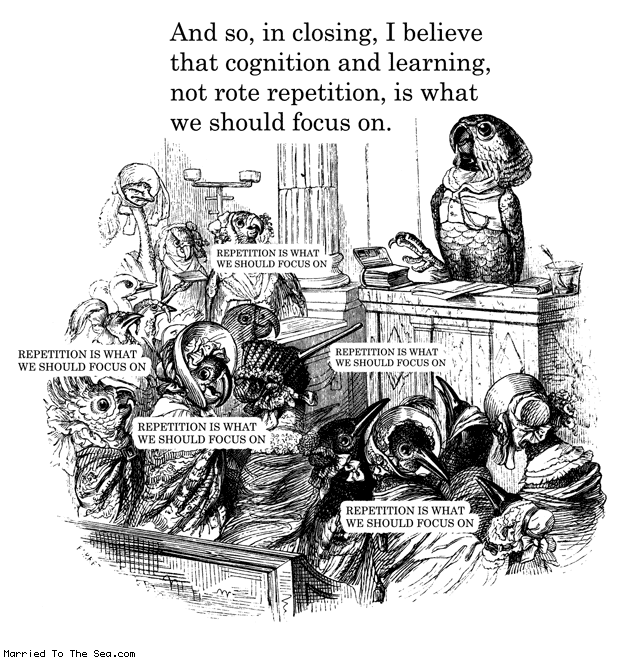
http://www.marriedtothesea.com/101711/talking-bird-consortium.gif