"A child's learning is the function more of the characteristics of his classmates than those of the teacher." James Coleman, 1972

Friday, January 25, 2013

Teachers and CCSS: To Implement or To Resist?

At the Teaching Now blog (Education Week), a recent debate among Larry Ferlazzo, Stephen Krashen, David Cohen, and Paul Thomas has prompted the post:

"Should Teachers Resist the Common Core?"

In a series of blog posts as well as comments on those posts, Ferlazzo and Cohen have offered skepticism about CCSS, but maintain implementation of CCSS and the high-stakes tests to follow are inevitable, and thus the realistic and practical response from teachers must be how to implement CCSS well.

Krashen and Thomas will not concede implementation of CCSS is inevitable, and have called for resistance.

Since this is a powerful debate at the core of the education reform movement and since this debate is among credible practitioners and scholars, I am listing the relevant blog posts in one spot for Schools Matter readers; please be sure to read the comments in these posts as well.

Larry Ferlazzo (@Larryferlazzo)

How Can We Best Prepare Students for Common Core in Language Arts?

Response: Best Ways to Prepare Our Students for CCSS in Language Arts

Response: 'How on Earth Will I Implement' Common Core for Language Arts?


-----

What do Schools Matter readers think?

Thursday, January 24, 2013

Does language acquisition require hard struggle?


Posted as a comment following Larry Ferlazzo’s second column on “How will I implement Common Core for Language Arts’


http://blogs.edweek.org/teachers/classroom_qa_with_larry_ferlazzo/2013/01/response_honoring_struggle_in_common_core_for_language_arts.html?utm_medium=twitter&utm_source=twitterfeed


Re Dina Strasser’s contribution:" In second language acquisition terminology, we refer to Stephen Krashen's theory of "i plus one." It is where we present the student with enough unfamiliarity-- enough challenge-- to have them frown at the page, have to try an oral answer two or three times before getting it right, or have to think silently for a minute or two before writing an answer."


What I have hypothesized is that language acquisition happens when we understand input that contains aspects of language that we have not yet acquired. It does NOT mean a hard struggle to understand and does NOT require grim determination. It does not mean that we deliberately give students texts that make them “frown at the page” because it contains so much unacquired language. Nearly all of our language acquisition happens when we understand easily, without effort, the mountains of listening and reading we have done and continue to do, with our focus on the message, not the form. When readers react by saying “this is hard,” it means that the text is not right for language acquisition.

It couldn’t be any other way. We have all acquired thousands of words, many many highly complex rules of grammar that linguists have yet to describe, complex spelling rules, and subtle principles of text organization. If a struggle were necessary for each of the aspects of language we have acquired, nobody would get very far.


Wednesday, January 23, 2013

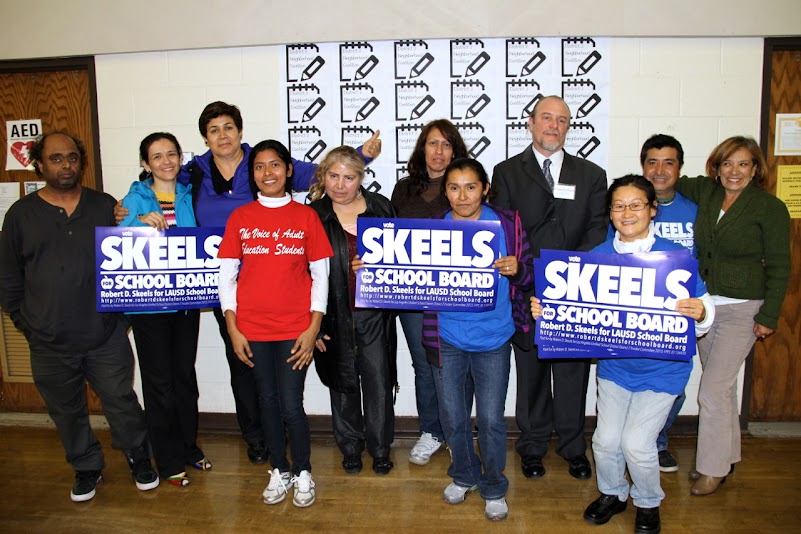
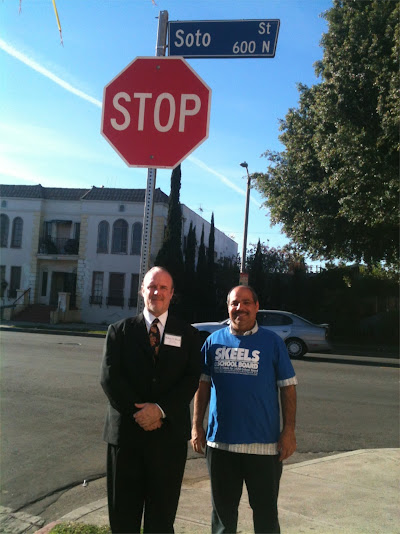
Last week was a busy week for the Robert D. Skeels for LAUSD School Board campaign

Robert D. Skeels and Anne Zerrien-Lee and NEDCMonday saw Robert D. Skeels at the Northeast Democratic Club (NEDC) where he and three other candidates, including the incumbent, were asked a series of questions in addition to making an opening statement. The questions were challenging and policy oriented, allowing each candidate's fundamental principles to show. The incumbent, who easily thought she'd win the endorsement, lost heartily with only 70 of the 110 necessary votes to win. We believe that this vote of open endorsement along with the one earlier this month at the Los Angeles County Democratic Party, demonstrates that Los Angeles Democrats have grown tired of the harmful right wing policies embodied by Democrats for Education Reform (DFER) and anti-public education reform leaders like the incumbent School Board President. We think these open endorsements indicate people had been waiting for a progressive alternative to Los Angeles education politics long dominated by DFER and the like.

On Tuesday, Robert participated in the third of the candidate forums held by the grassroots organizations comprising the District 2 Neighborhood Coalition. Held at the Boyle Heights Senior Center, the forum was somewhat relaxed compared to the previous evenings' NEDC debate. Audience members were able to ask questions and the format allowed the candidates to flesh out their positions.

Robert D. Skeels Speaking at the third D2NC LAUSD Candidate Forum in Boyle HeightsRobert D. Skeels Speaking at the third D2NC LAUSD Candidate Forum in Boyle Heights

On Wednesday Robert D. Skeels learned that he had been endorsed by the Progressive Democrats of Santa Monica Mountains.

Robert D. Skeels and Campaign Manager Sean AbajianOn Friday Robert received exciting news that he had earned another critical endorsement—The Associated Administrators of Los Angeles (AALA), who represent administrators in the Los Angeles Unified School District. Only one District 2 candidate has been endorsed by the unions representing the vast majority of Certificated Personnel. Only Robert D. Skeels is endorsed by United Teachers Los Angeles (UTLA) and Associated Administrators of Los Angeles (AALA). The professionals know who to trust on matters of policy and pedagogy. He has also been endorsed by a broad range of academia, education experts, immigrant rights organizations, veterans, and community groups. A list of featured endorsement appear on his campaign website. That evening Robert attended a meeting of Adult Education Teachers to learn more about Governor Brown's proposed changes that include folding adult education into the already overburdened and underfunded community college system. While a position paper will be released sometime in the future, Robert expressed that he opposes the plan that would make adult adult education less accessible to the community and pulls parents off of their children's K-12 campuses.

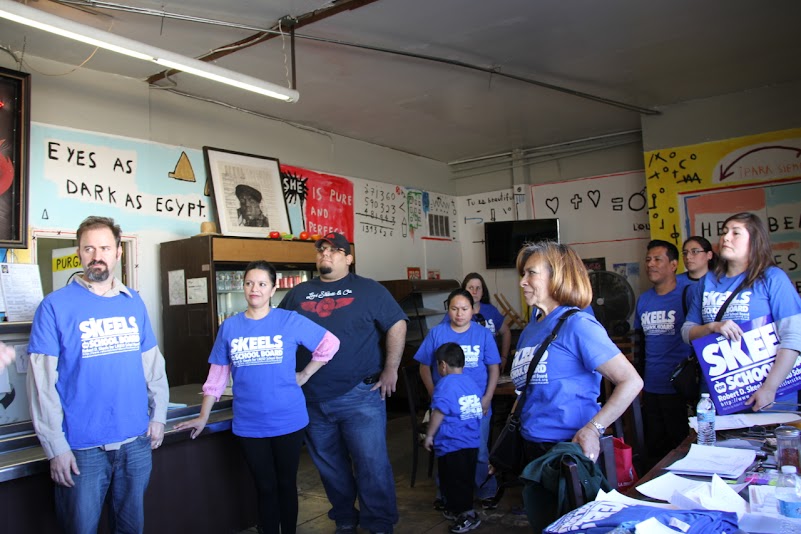
Saturday morning was an exciting time with the campaign's third precinct walk held in Boyle Heights. The first two were in Lincoln Heights, then Historic Filipinotown respectively. Award-winning documentary filmmaker, Chris Hume, captured footage and interviews from the Robert D. Skeels for LAUSD School Board campaign's Boyle Heights precinct walking. Filmed on 1st Street in Boyle Heights at the location of our gracious sponsor, Purgatory Pizza, just prior to the group going out to talk to voters.

Featured in the video are two widely respected educators whose support is greatly appreciated.

  • Dr. John Fernandez — Teacher, Theodore Roosevelt High School (Ret.) and former Director of the Mexican-American Education Commission for the LAUSD.
  • Martha Infante — 2009 CCSS Teacher of the Year, National Board Certified Teacher, Past-President Southern CA Social Science Association, proud public middle school teacher.
Robert D. Skeels for School Board Campaign's Boyle Heights Precinct WalkRobert D. Skeels for School Board Campaign's Boyle Heights Precinct WalkRobert D. Skeels for School Board Campaign's Boyle Heights Precinct Walk

Our group of over twenty-four volunteers canvassed Boyle Heights. We learned that the incumbent's event just south of us had fewer participants. That evening the candidate attended an event held by the Trinational Coalition, CEJ, and PEAC to see educator and author Dr. Lois Weiner and Chicago Teachers Union Staff Director Jackson Potter speak at UTLA.

Ron Gochez speaking at Empowering Communities Through SchoolsRobert D. Skeels speaking at Empowering Communities Through Schools

Sunday afternoon consisted of a group of adult education student volunteers phone banking at Robert and Yoon Jung's house, which has become campaign central for many activities. Another documentarian came to interview Robert during that time. Afterwards, everyone enjoyed pupusas from Pupuseria Menchita, who are staunch supporters and are displaying our campaign placard.

Phone Banking for Robert D. SkeelsPhone Banking for Robert D. SkeelsPupuseria Menchita supports Robert D. Skeels for LAUSD School Board

Over the same weekend the campaign received additional endorsements from Anne Zerrien-Lee, Vik Chaubey, Marcy Winograd, Ingrid Villeda, and Martha Sanchez.

This weekend is shaping up to be as exciting as last. We're having a press conference and precinct walk in Koreatown on Saturday. Hope to see you there.

Feeding the testing-industrial-complex

Published in Education Week: January 23, 2013,

To the Editor:

"Testing Group Selects Exam to Gauge 'College Readiness'" (Jan. 9, 2013) announces yet another test to add to the staggering pile of tests our students must take.

When will this end? Because there is no evidence that adding more tests helps students, and plenty of evidence that increased testing will be very profitable for those who sell the tests and supply the infrastructure for the required online testing, the obvious answer is that testing fever will end only when the greed of the standardized-testing-industrial complex is satisfied.

In other words, never.

Stephen Krashen

Professor Emeritus of Education
University of Southern California
Los Angeles, Calif.
Vol. 32, Issue 18, Page 22

KIPP's Take from Private Sources Since 2003: $308,999,543.00


The post below is from Cloaking Inequity by Julian Vasquez Heilig:

th
Today I will profile Knowledge is Power Program (KIPP) schools on The Teat. The Teat is an ongoing series on Cloaking Inequity (the protuberance through which milk is drawn from an udder or breast) that seeks to trace financial support which various entities receive that are involved in current educational policy debates.
The Teat Cow Haiku for today:
Every cow comes wrapped
in cowhide, but that does not
serve to hide the cow.
Cloaking Inequity exists because of KIPP. (For the full thread on KIPP go here) They released a response to a research study that focused on African American enrollment and leavers that was so erroneous that I had to respond publicly— CI was born.
I wrote at the time:
In April of 2012, KIPP responded to a press release for Is choice a panacea? An analysis of black secondary student attrition from KIPP, other private charters and urban districts, a peer-reviewed paper published in the Berkeley Review of Education (BRE) about African American secondary student attrition from charter schools across the state of Texas. KIPP began their response by criticizing the research on four main points. I will address those points.
screen-shot-2012-09-30-at-11-28-54-pm
One of the issues that KIPP raised was that they disagreed with the revenue that we discussed in our peer-reviewed academic paper. KIPP was just flat out dishonest in saying that they don’t spend more than traditional public schools. That information is available in the internet by double clicking on the numbers below. Texas state law requires that they report their revenues. Here is their charge and my response:
  •  Vasquez Heilig makes the inaccurate claim that KIPP receives $3,361 more in total revenue than the Houston Independent School District, and incorrectly infers that KIPP Houston spends more per pupil than the district. In reality, KIPP Houston, like all public charter schools in Texas, receive less per pupil funding than district schools and no public revenue for facilities. Excluding private funds raised to cover facilities costs, KIPP Houston spends less per student per year than HISD.
KIPP is incorrect. NEPC also thinks so here. Its hard to argue with publicly available data that they themselves are required to report by law. Per student revenue for KIPP Austin ($17,286)and KIPP Houston ($13,488) relative to Austin ISD ($10,667) and Houston ISD ($10,127) is readily available online each year from the State of Texas. However, considering the current school finance debacle in Texas, where approaching $6 billion was cut from education in the last legislature, in retrospect, I think KIPP should be applauded for spending more on education…
The Teat will examine today where KIPP gets all that extra money. Thanks to Sylvia from Austin who pulled the KIPP development data from the Foundation Center in New York and forwarded it.  In sum, across the nation, since 2003, KIPP has received $308,999,543 from foundations, corporations and individuals. You can see the national spreadsheet here. KIPP in Texas has acquired about 25% of those monies— $75,981,765 from foundations, corporations and individuals. You can see the Texas spreadsheet here.
I don’t know Mike Feinberg personally. However, in the forums in which I have observed him, I find him to be eloquent and dedicated to children. I believe KIPP campuses have some redeeming qualities, I especially respect their focus on a college readiness (KIPP Houston came in 5th in the state for college readiness amongst Latina/o majority schools in my analysis— Note only 8 of 64 were charters). However, as the attrition numbers for African Americans reported in our KIPP study in the Berkeley Review of Education showed, and their less than forthright responses to our article and others where KIPP posits incorrect claims about revenue, KIPP just needs to be a little more honest about their operation.

Tuesday, January 22, 2013

The Four Year Expectation

Sent to the Miami Herald, January 22, 2013

To the editor:

The US Department of Education’s announcement that the nation’s high school graduation rate is the highest since 1976, but more than a fifth of students are still failing to get their diploma in four years, (“Study: High school grad rate highest since '76,” Jan 21) sends the message that those who take longer than four years to finish high school are somehow failures.

Graduating in more than four years often requires perseverance and determination. Many students need to work after school, and a longer stay in high school makes sense for them. We must allow working students to take a reduced course load or even an occasional leave of absence. Susan Ohanian has commented that the four year high school expectation is an assault, intended or not, on the working class.

During the depression, the father of a colleague of mine alternated working a year and going to high school a year, because his family needed the money. Another colleague told me that she and her dad graduated high school at the same time. These are not cases of failure but of heroism.


Stephen Krashen

Original article: http://www.miamiherald.com/search_results?aff=1100&q=graduation#storylink=cpy

The Shoddy Methodology of Value-Added Research

The timing of R. Barker Bausell’s “Probing the Science of Value-Added Evaluations” could not have been better.  Writing on the heels of the Gates Foundation’s Measures of Effective Teaching (MET) final report, Bausell, a biostatistics professor emeritus at the University of Maryland, critiques the science methodology of value-added research.  While not mentioning the MET specifically, his commentary explains why the Gates methodology fails to measure up.

Bausell does not argue the pros and cons of value-added teacher evaluations, but he explains what it would take for research to address the policy issues regarding the high stakes use of test score growth for individual teachers.

“From a methodological perspective,” Bausell writes, “both medical and teacher-evaluation trials are designed to generate causal conclusions.”  He further observes that it shouldn’t take a statistics degree to understand how value-added advocates flunk that test. Random assignment is the gold standard in medical research, but public school students cannot be randomly assigned to teachers between schools and are rarely assigned randomly within schools. He writes, “suffice it to say that no medical trial would ever be published in any reputable journal (or reputable newspaper) which assigned its patients in the haphazard manner in which students are assigned to teachers at the beginning of a school year.”

The MET at least tried to address the least important aspect of self-sorting of students by randomly assigning some of their relatively affluent sample of students within their schools.  But, even then, the powerful Gates Foundation made a feeble effort to meet scientific protocol. It did a better job than most high-profile researchers who embrace value-added of following up on circumstances that undercut the randomness, but Bausell writes:

Explicit guidelines exist for the reporting of medical experiments, such as the (a) specification of how many observations were lost between the beginning and the end of the experiment (which is seldom done in value-added experiments, but would entail reporting student transfers, dropouts, missing test data, scoring errors, improperly marked test sheets, clerical errors resulting in incorrect class lists, and so forth for each teacher); and (b) whether statistical significance was obtained—which is impractical for each teacher in a value-added experiment since the reporting of so many individual results would violate multiple statistical principles.

The MET published a separate document that admits that as few as 27% of students remained in their assigned classes.

Bausell then contrasts medical experiments designed to purposefully minimize the occurrence of extraneous events that change outcomes. No comparable procedures are attempted in most (or all?) value-added teacher-evaluation experiments. Bausell lists a number of those factors, including auxiliary tutoring, being helped at home (as is more likely for students in the Gates's relatively affluent sample,) or “any number of naturally occurring positive or disruptive learning experiences.” 

Being an inner city teacher, I am particularly shocked that the MET and others ignore the effect of school-wide disruptions, as well as the damage done by top down Cover Your Asses blame-the-teacher policies (such as more test prep and scripted instruction) that are common in the toughest schools. Did it never occur to the Gates scholars that they needed to control for funerals?  In schools where almost none of the students are being raised in traditional families, the percentages of kids, each year, who bury the grandparents who raised them is not predictable, but it is huge.  How could they not understand the effects of gang wars, as well as the routine ebb and flow of violence in high poverty neighborhood schools? And, how would they account for policies in the toughest schools that make it impossible to enforce academic, behavioral, and attendance policies?

Bausell also notes the effect that team teaching can have in introducing positive learning experiences.  Perhaps that was not a factor in the Gates sample, but neither did the MET account for the uninvited member of the instructional teams in many or most troubled schools. How do you distinguish between the growth – or lack of growth – that was produced by an individual teachers, as opposed to the mandatory remediations that are ubiquitous in troubled schools.  The most influential, undoubtedly, are bogus “credit recovery” programs designed to “pass kids on.”  I doubt the Gates researchers had any idea of the harm done by policies that tell students that they will be awarded credit regardless of whether they come to class, and how they would need to be controlled for.

And when the Gates people descend on a favored school, I doubt that principals are as brazen as they often are in “juking the stats” in ways that undercut instructional effectiveness.

Bausell concludes that even if value-add proponents upgraded the quality of their methodology, that would not change the fact “that a value-added analysis constitutes a series of personal, high-stakes experiments conducted under extremely uncontrolled conditions and reported quite cavalierly.”  He calls for “experimentally oriented professionals” to “argue that experiments such as these (the results of which could potentially result in loss of individual livelihoods) should meet certain methodological standards and be reported with a scientifically acceptable degree of transparency.”

I would also add that those scholars, as well as the MET researchers, need to be willing to do so under oath as teachers fight this junk science in court.

Emboldened Mischief-Makers, Part Four

And lastly, Part Four of "Emboldened Mischief-Makers."

Part One
Part Two
Part Three

It may be hard to believe but I started all of this (the first shall be the last) because I wanted to share a little bit of mischief from a student's pen who attended the Dixwell Preparatory School in Cambridge, MA, graduating in 1855.  (The student is 16-years-old.)

Question:
"What is your favorite virtue? Do you select it, because you delight to practice it, or  because you think you need it, or because you have seen it beautifully exemplified in a Friend?"

(No scantron question this!)

Answer:
"Here the simple question is put to me.  No prevarication, no equivocation will do.  I am not asked to state what my favorite virtue ought to be, nor upon what one I can write the best theme, but, with my hand upon my heart, to tell what it is.

"I have no favorite virtue.  A regular oration, with its Exordium, Proposition, Explication, Arguments, Pathetic Parts, and Conclusion, would hardly add to the strength of this assertion.  I shall take the liberty, therefore, since a theme must be written, of attempting to show that no one ought to have a favorite virtue, and that favoritism is as bad in morals as anywhere else.

"In the first place, then, there are different ways of understanding the words, "your favorite."  If they signify that which is liked best, disregarding its moral claims (of course, the only claims of virtue, as such), the question is answered, at once; for we ought not to disregard the moral claims of virtues in deciding which we like the best.  But if the words mean "which virtue is it your opinion, has the most claim to be liked?", a doubt arises as to the meaning of the word, virtue.

"For there are two kinds of virtues--moral states, and moral acts of the soul.  Of the virtues of the first kind, it is not a matter of opinion, which has the most moral claim, (as I shall show below) and therefore it is not a matter for favoritism;--we might as well have a favorite between the dollar and the dime.

"If, then, the other kind is intended, I wish to inquire, in what the moral claim of an act upon our admiration consists.  Does it lie in the origin of the act, in the act itself of the soul, or in its effect?

"The effects of acts have only intellectual claim, for morality does not deal in effects; and acts, in themselves considered, have only an aesthetical claim, for the same act may be moral and immoral, instructive & deceptive, politic & impolitic, in different circumstances.  It is only the origin of acts, then, which have a moral claim.  And what is the origin of acts but states of the soul?  And as to these, there abide, Faith, Hope, Charity--these three--and the greatest of these is charity.

***
Having thus accurately--and arrogantly--called his teacher stupid for asking a silly question and then concluding with a sophistical twist of phrase that he deserved charity for doing so, Peirce expressed his contempt for the majority of his...education.  (Brent, Joseph. Charles Sanders Peirce: A Life. 55-56.)


Emboldened Mischief-Makers, Part Three

Part Three of "Emboldened Mischief-Makers"

Part One
Part Two

Concerning "the why" of Creationism and such.

The two primary "books" for Lincoln, nearly committed to memory, The Bible and Shakespeare.  So too, primarily, for Melville.

If one is to "suffer" the discipline of only a few books then they'd better be good ones!  They'd better foster imagination, creativity, and linguistic virtuosity.  I wonder if one gets that in the "informational text" heavy "common core"?

Concerning the spate of states proposing to legislate educators "to create an environment that encourages students to intelligently and respectfully explore scientific questions and learn about scientific evidence related to biological and chemical evolution, global warming, and human cloning,"
Tim Swarens, writing in the Indianapolis Star (December 7, 2012), offered a prediction about the bill: "Perhaps it's an article of faith, but I choose to believe that Bosma [the speaker of the Indiana House of Representatives], Behning [the chair of the House Education Committee] and a majority of lawmakers will see that Kruse is badly misguided in pushing a bill that, if implemented, would undercut educators, embolden classroom mischief-makers, and send the wrong message to the rest of the nation about a state that wants to grow its science and technology sectors."  
Please tell me you laughed out loud at the assertion that the bill will "embolden classroom mischief-makers."  I just remembered a scene from My Dog Skip where one of the "hicks" in the class was reading aloud a favorite passage from The Bible.  He said the world "ass" over and over again to the general glee of all but the teacher!  The Bible emboldened him verily.

Nearly every argument against this bill offers the failure of the technology business sector as one of the primary factors to oppose it.  Again, let us recall that those proposing these bills are in the main Republicans.  This is one of those confusing moments.  The "party" of business interests is undercutting business interests?

I don't think so.  The reality is that the masses being educated in public schools are NOT the bright lights who will lead us shiningly into the glorified technological future (you know, the one where some of us live in space and others live under ground and the rest revert to beasts fighting for water and shelter).  Rather, these are the minions who will at best only need field the masters a competent servant class.

That is to say, no one believes that states which teach creationism will "destroy" their tech economy...rather they will simply offer a more obedient workforce!  Ta-da!  Creationism is the belief in being an obedient creation after all.


Emboldened Mischief-Makers, Part Two

Part Two of "Emboldened Mischief-Makers" (Here is Part One.)

Concerning those "advocating" "Academic Freedom" via state legislatures across the country, that is to say, concerning those pushing "freedom" in legalese devised to create the opportunity for the dissemination of ideologies via a process that codifies action into law.

Here is an example of the way legislative "mischief" is made.  It is important to note that this is indeed the very meat and effect of the process we hold so much stock in--that is to say, the system of representative government in which we profess to believe a good and noble and democratic system.

What follows is from the Lord Charnwood biography of Lincoln.


Stephen Douglas, who was four years younger than Lincoln, had come to Illinois from the Eastern States just about the time when Lincoln entered the Legislature. He had neither money nor friends to start with, but almost immediately secured, by his extraordinary address in pushing himself, a clerkship in the Assembly. He soon became, like Lincoln, a lawyer and a legislator, but was on the Democratic side. He rapidly soared into regions beyond the reach of Lincoln, and in 1847 became a Senator for Illinois, where he later became Chairman of the Committee on Territories, and as such had to consider the question of providing for the government of the districts called Kansas and Nebraska, which lay west and north-west of Missouri, and from which slavery was excluded by the Missouri Compromise. He was what in England is called a "Jingo," and was at one time eager to fight this country for the possession of what is now British Columbia. His short figure gave an impression of abounding strength and energy which obtained him the nickname of "the little Giant." With no assignable higher quality, and with the blustering, declamatory, shamelessly fallacious and evasive oratory of a common demagogue, he was nevertheless an accomplished Parliamentarian, and imposed himself as effectively upon the Senate as he did upon the people of Illinois and the North generally. He was, no doubt, a remarkable man, with the gift of attracting many people. A political opponent has described vividly how at first sight he was instantly repelled by the sinister and dangerous air of Douglas' scowl; a still stronger opponent, but a woman, Mrs. Beecher Stowe, seems on the contrary to have found it impossible to hate him. What he now did displayed at any rate a sporting quality.

In the course of 1854 Stephen Douglas while in charge of an inoffensive Bill dealing with the government of Kansas and Nebraska converted it into a form in which it empowered the people of Kansas at any time to decide for themselves whether they would permit slavery or not, and in express terms repealed the Missouri Compromise. With the easy connivance of President Pierce and the enthusiastic support of the Southerners, and by some extraordinary exercise of his art as demagogue and Parliamentarian, he triumphantly ran this measure through.

Just how it came about seems to be rather obscure, but it is easy to conjecture his motives. Trained in a school in which scruple or principle were unknown and the man who arrives is the great man, Douglas, like other such adventurers, was accessible to visions of a sort. He cared nothing whether negroes were slaves or not, and doubtless despised Northern and Southern sentiment on that subject equally; as he frankly said once, on any question between white men and negroes he was on the side of the white men, and on any question between negroes and crocodiles he would be on the side of the negroes. But he did care for the development of the great national heritage in the West, that subject of an easy but perfectly wholesome patriotic pride with which we are familiar. It must have been a satisfaction to him to feel that North and South would now have an equal chance in that heritage, and also that the white settlers in the West would be relieved of any restriction on their freedom. None the less his action was to the last degree reckless. The North had shown itself ready in 1850 to put up with a great deal of quiet invasion of its former principle, but to lay hands upon the sacred letter of the Act in which that principle was enshrined was to invite exciting consequences.

The immediate consequences were two-fold. In the first place Southern settlers came pouring into Kansas and Northern settlers in still larger numbers (rendered larger still by the help of an emigration society formed in the North-East for that purpose) came pouring in too. It was at first a race to win Kansas for slavery or for freedom. When it became apparent that freedom was winning easily, the race turned into a civil war between these two classes of immigrants for the possession of the Territorial government, and this kept on its scandalous and bloody course for three or four years.

In the second place there was a revolution in the party system. The old Whig party, which, whatever its tendencies, had avoided having any principle in regard to slavery, now abruptly and opportunely expired. There had been an attempt once before, and that time mainly among the Democrats, to create a new "Free-soil Party," but it had come to very little. This time a permanent fusion was accomplished between the majority of the former Whigs in the North and a numerous secession from among the Northern Democrats. They created the great Republican party, of which the name and organisation have continued to this day, but of which the original principle was simply and solely that there should be no further extension of slavery upon territory present or future of the United States. It naturally consisted of Northerners only. This was of course an ominous fact, and caused people, who were too timid either to join the Republicans or turn Democrat, to take refuge in another strange party, formed about this time, which had no views about slavery. This was the "American" party, commonly called the "Know-Nothing" party from its ridiculous and objectionable secret organisation. Its principle was dislike of foreign immigrants, especially such as were Roman Catholics. To them ex-President Fillmore, protesting against "the madness of the times" when men ventured to say yes or no on a question relating to slavery, fled for comfort, and became their candidate for the Presidency at the next election.