"A child's learning is the function more of the characteristics of his classmates than those of the teacher." James Coleman, 1972
Showing posts with label Mastery charter schools. Show all posts

Tuesday, March 14, 2017

Riding the 'turnaround' merry-go-round in the continuing assault on Philadelphia public schools: Part VI - Who is Afton Partners?


 by Ken Derstine
@ Defend Public Education
March 14, 2016


The previous article in this series was posted June 2, 2016. This series has detailed the assault on Philadelphia public schools by corporate education reform business and financial interests. At the last posting, the Philadelphia School Reform Commission had not acted on the non-renewal recommendation of its charter office for Aspira, Universal, and Mastery charters. 

Pennsylvania law mandates that a charter term is five years and must undergo a renewal process after that.  There is a stipulation in the law that the renewal process can be extended for one year, if there are mitigating circumstances.  That one-year extension can only be used one time. They have been postponing the renewals month after month since April 2016. Aspira’s was postponed without the SRC even taking a vote in 2015.

Now, as can be seen in Part VI in this series, the privatization merry-go-round is spinning ever faster in the assault on Philadelphia public schools.

*****

In a recently released report by Afton Partners, the cost of students leaving Philadelphia public schools to transfer to charters was examined. The study had been commissioned in February, 2015 by the School Reform Commission, which functions as a school board and makes all final decisions for Philadelphia schools.


In “is the glass half full or half empty” coverage, the Philadelphia Inquirer published Report: Philly schools still face costs when students go to charters vs. the Philadelphia Public School Notebook’s Students leaving Philly schools for charters less costly than once thought.

According to The Notebook article, the resolution calling for the contract with Afton said the analysis would take place between February 20, 2015 and May 1, 2015. SRC officials claim the report “got lost in the shuffle as old administrators left and new administrators replaced them.” The District’s Chief Financial Officer Uri Monson, appointed February, 2016, said he first got word of the report last summer and has been working with Afton “to make sure the report addressed all questions.”

Why is the report being released now? Could it have something to do with a bill in the Pennsylvania House introduced by Speaker Mike Turzai on March 6th which would require the Philadelphia School District to add 3,000 charter seats per year? This bill would undercut the charter oversight authority of the Philadelphia School Reform Commission (SRC). The establishment of the SRC in 2001, as part of the state takeover of the School District, abolished local control of public schools, along with any hope of any type of democratic process.  A 2014 bill passed by the legislature imposed a $2/pack cigarette tax for school funding; it included a last-minute provision that the SRC consider applications for new charters each fall.  Rejected applicants would be able to appeal to the state Charter Appeal Board.

Now, invoking the states rights' provisions of the Every Student Succeeds Act (ESSA), Turzai wants to completely take even this oversight from any local influence. He has been agressively intervening in the SRC's charter approval process lobbying for approval of charters that the SRC has rejected. The SRC's Uri Monson said the bill is unessessary because in the SRC's five year financial plan presented last year there is an already projected annual growth of charter enrollement of between 2,700 and 3,000 seats.


Sunday, May 08, 2016

Riding the 'Turnaround' Merry-Go-Round in the Continuing Assault on Philadelphia Public Schools: Part IV

by Ken Derstine
May 8, 2016

The Philadelphia School Reform Commission – April 28, 2016

Crossing the Rubicon
  
The Rubicon has been crossed in the privatization assault on Philadelphia public schools. On Thursday, April 28th, the Philadelphia School Reform Commission voted to turn three more public schools over to charter companies.

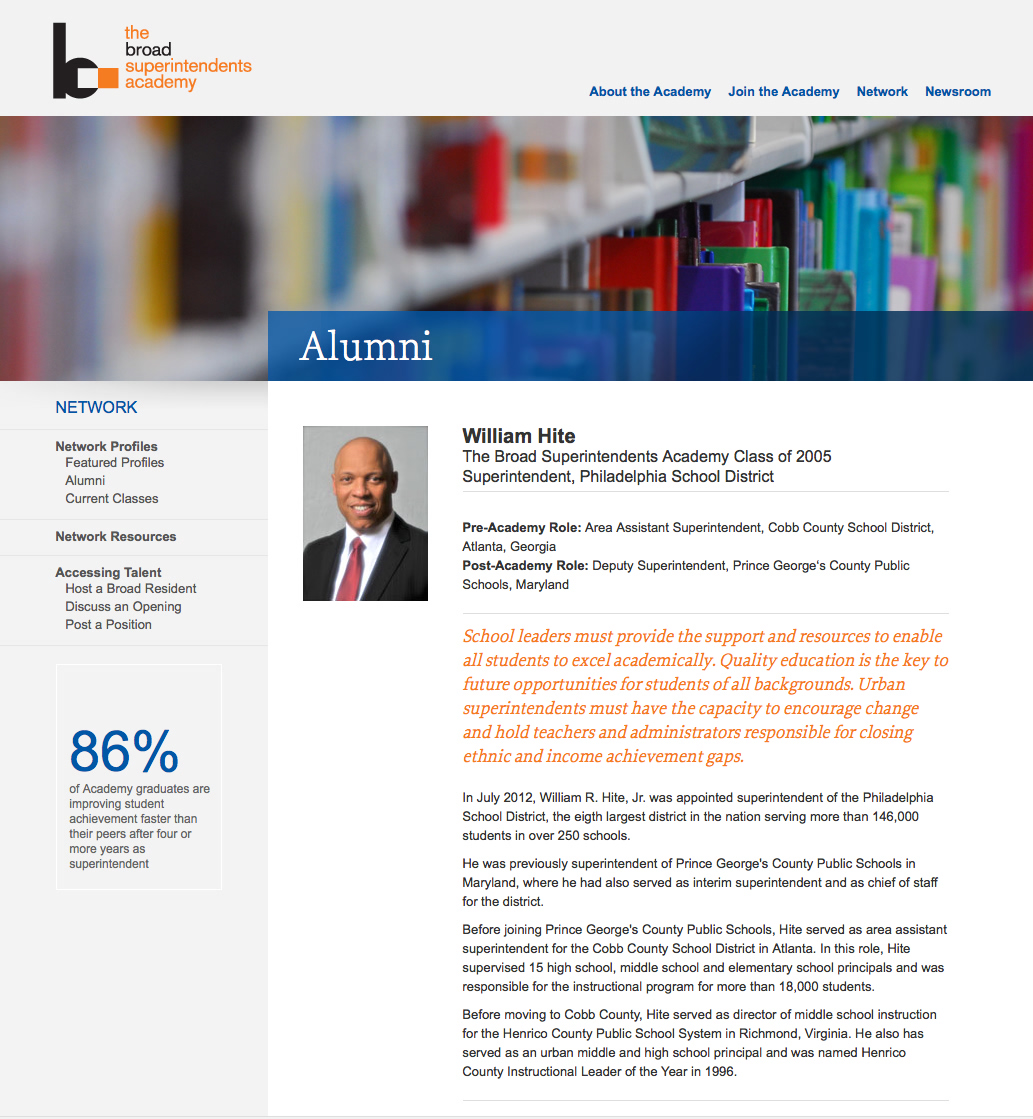
The Battle for Wister has been decided in favor of Mastery Charters over the objections of many parents at the school. (See The Battle for Wister in Part I of this series.)  What makes this turnover different than all preceding turnovers is that Wister, even by Broad graduate Superintendent Hite’s own admission, had been making progress as a public school. The School Reform Commission (SRC) reversed his decision one week after Hite had withdrawn Wister from the turnaround list. No more can the SRC claim that the turnover of a public school to a charter company is based on the pretense that their “data” shows a school is a “failing school”. It is now clear for all to see that the drive for privatization is based on the market interests of corporate education reform, not education.

Also to be turned over to charter companies that have a dubious history, are Jay Cooke Elementary to Great Oaks Charter and Samuel B. Huey Elementary to Global Leadership Academy.

These turnovers went forward despite the SRC’s Charter School Office presenting strong evidence that many charters up for their five-year renewals are performing no better, or worse, than the public schools they replaced. In addition, Philadelphia Newsworks' reporter Kevin McCorry observed, based on Newsworks analysis, “the most consistent thing about school ‘progress’ as captured by the SPR [the District’s School Progress Report] is inconsistency.” He wrote,

There are many reasons to be wary about relying too heavily on the School District of Philadelphia’s main tool for measuring school quality [SPR] – especially when it comes to making high-stakes decisions about closures, staffing shake-ups and charter conversions.

Despite this evidence, along with protests from parents, students, teachers and community members, the SRC is forging ahead with turnovers to charters and disrupting the lives of thousands of students and staff. Like all corporate education reform, it presents its decisions as being based on “failed schools” due to “bad teachers and administrators”. That these turnarounds are happening only in low-income neighborhoods gives the lie to this claim. The educational opportunities of children from low-income families will not change by moving school professionals from one school to another, year after year. What must change are the economic circumstances of these families.

The Latest Spin of the Turnaround Merry-Go-Round in Philadelphia Schools

Thursday, April 14, 2016

Riding the 'Turnaround' Merry-Go-Round in the Continuing Assault on Philadelphia Public Schools - Part III

by Ken Derstine @ Defend Public Education!
April 14, 2016


On April 7, 2016, at a Hillary Clinton campaign rally in Philadelphia, Bill Clinton got into an argument with demonstrators from Black Lives Matter over his legacy. He later said he “almost want[s] to apologize” for his remarks in defending his “welfare reform” and Violent Crime Control and Enforcement Act of 1994. It is these policies that led to a drastic increase in homelessness and explosion of the prison population in the U.S. in the 1990’s and after.

No matter how contrite Bill Clinton may be for the purposes of Hillary Clinton’s campaign, however, nothing he said at the rally was true. The fundamental premise of Bill Clinton’s neoliberal policies was that the working class needed “welfare reform” even as the industrial base of the U.S. economy was eroding because of globalization. This right-wing position was based on free market myth that the workers as individuals are responsible for their deteriorating conditions. At the same time, his deregulation of the corporate and financial sectors led to historically unprecedented accumulation of wealth by the top 1% of the American population and the near collapse of the U.S. economy in 2008. This was only averted by the $700 billion bailout of banks and various financial institutions with taxpayer money. No such relief has ever been contemplated for the workers and the unemployed.

The neoliberal agenda for privatization that became corporate education reform began as part of Clinton’s neoliberal reforms. The Clintons’ relationships with billionaires Eli Broad, the Walton Foundation (Walmart) and the Gates Foundation were to play a fundamental role in its development. The 'no excuses' philosophy would become a fundamental premise of charter schools in the subsequent administrations of George W. Bush and Barack Obama.

The 'No Excuses' Education Philosophy 

The 'no excuses' philosophy of school management was first implemented in 1994 in the original KIPP (Knowledge is Power Program) schools in Houston. Created by Mike Feinberg and David Levin (who is also a co-founder of Relay Graduate School of Education), the philosophy basically says that students from low-income families should be taught to overcome the problems brought on by poverty through a rigid pedagogy that accepts no excuses for failure. Any consideration of social factors in student achievement is considered “low expectations”.
  
In his recently released book, Work Hard, Be Hard: Journeys through “No Excuses” Teaching, Jim Horn, Professor of Educational Leadership at Cambridge College in Cambridge, Massachusetts, says of the 'no excuses' model:

The “no excuses” school model that KIPP charter schools popularized owes significantly to an assumption made two decades ago by paternalistic school reformers (Finn, 1997), who argued that schools and teachers could “reduce inequality in educational achievement if disadvantaged students were held to the same high standards as everybody else” (Cohen, 1996, p. 101).  This belief remains widespread today, and it has contributed to at least four bad outcomes for children, teachers, and public schools:  1) it leads us away from altering the corrosive socioeconomic realities that affect children’s lives outside school, while pushing our attention toward fixing children and their teachers’ belief systems, 2) it requires educators and children to subscribe to an ideology that demands toxic levels of anxiety and stress to attain some modicum of success, even temporarily, 3) it has led to widespread failure to live up to expectations that prove more fanciful than real, which creates self-loathing or self-blame for failing to achieve what students and teachers, alike, are told is achievable, 4) it has contributed to a totalizing compliance regimen for students and teachers that is more penal than pedagogical.

The heart of Horn’s book comes from twenty-five interviews with former KIPP teachers about their experience at KIPP. He summarizes what these teachers say in the interviews in his book (page 141, 142):


Wednesday, April 06, 2016

Riding the ‘Turnaround’ Merry-Go-Round in the Continuing Assault on Philadelphia Public Schools: Part II

by Ken Derstine @ Defend Public Education!
April 6, 2016


Part I of this series detailed how Mastery Charter is using the hostile takeover methods of the corporate world to takeover more Philadelphia Public Schools each year. But education deals with relationships between human beings, not the industrial products and natural resources of the corporate world. Thus, these hostile takeovers aggravate historic class and ethnic tensions (watch the video). Philadelphia schools have struggled for years with underfunding at the state level; now charters bring the added disparity in funding between public schools and charters within Philadelphia. Philadelphia currently has 83 charters. Other charter companies, including KIPP (four schools), ASPIRA (six schools), and Universal (seven schools) are looking to expand their enrollment, but Mastery increasingly dominates the charter sector in Philadelphia. Also, with many independent charters, Philadelphia is ranked third in the nation for the number of students enrolled in charter schools with currently roughly 70,000 of Philadelphia’s approximately 200,000 students being enrolled in charters.

Mastery Charter Schools

Mastery currently manages nine elementary schools, eight middle/high schools in Philadelphia, and six schools (five elementary and one high school) in Camden, New Jersey, in total, serving over 12,000 students. In its five-year budget plan, announced March 24th, at the School Reform Commission (SRC) meeting, the District anticipates an additional enrollment of 10,000 more charter students in the next five years. Adding to the District's problems, on February 16, 2016 the Pennsylvania Supreme Court ruled that the SRC had overstepped its authority in imposing enrollment caps on charters. That will probably result in an increase in charter enrollment in existing charter schools. The SRC also announced on March 24th its intention to add at 10,000 more charter students in the next five years and to close at least three public schools each year beginning in 2018. 

Sunday, March 27, 2016

Riding the ‘turnaround’ merry-go-round in the continuing assault on Philadelphia public schools: Part I

By Ken Derstine @ Defend Public Education!

March 27, 2016

The Philadelphia School Reform Commission


The assault on public schools in Philadelphia has entered a new phase. The roots of the current crisis go back to the 2001 state takeover of the Philadelphia School District, the dissolution of the local school board and the creation of the appointed five-member School Reform Commission.  Over the next decade various attempts were made to privatize Philadelphia's public schools. When these plans did not achieve their goal, long-range five-year plans by Superintendents working with the Broad Foundation Superintendents Academy and the Boston Consulting Group were implemented. These plans included starving the public schools of resources while building up charters schools and using funding from various public and private sources for public relations campaigns designed to make charters appealing to parents. This led to the closing of twenty-four public schools in 2013 due to 'under enrollment'.

The current phase of corporate education reform, for a time, shifted the focus from school closings to ‘turnarounds’ of schools in low-income communities. (Note: Though the term 'turnaround' will be used throughout this article since that is how the SRC terms the changes, these changes are really the turnover of public schools to private interests.) This method of privatization was begun in Philadelphia under Paul Vallas (2002-2006), accelerated under Broad Superintendent Arlene Ackerman (2008-2011), and it has continued under current Broad Superintendent William Hite (2012 - Present).

For a detailed history of what has brought us to the present situation see:

 The Seige of Philadelphia Public Schools

The Siege of Philadelpia Public Schools | Update

The Siege of Philadelphia Public Schools is Now a Full-Scale Assault

At the beginning of the current school year, three schools were targeted for turnaround. Parents and teachers have been given no choice in which charter company will take over their schools. Two years ago, when parents were given a choice, they voted overwhelmingly to remain public at two elementary schools. Steel Elementary rejected a takeover by Mastery Charter Schools;  Munoz-Marin rejected takeover by ASPIRA. Both charter companies had engaged in heavy lobbying with the parents and with district officials. Having learned its lesson that starving the public schools, building up charters was not working with parents, the SRC is giving no choice to parents this year. Three schools are to be assigned to a charter company with the final vote in April:

 • Huey Elementary to Global Leadership Academy, which has a record of low performance, a high percentage of uncertified and inexperience teachers, and several corruption scandals.

• Cooke to Great Oaks Foundation. Great Oaks is experimenting with replacing teachers with groups of uncertified, recent college graduates as low-paid tutors supervised by a teacher. The privatization is being fought by parents of the school.

• Wister Elementary to Mastery Charter, which has nine elementary schools, eight middle and high schools in Philadelphia and six schools in Camden, New Jersey. It is aggressively campaigning to expand its district in both cities.

The Battle for Wister