"A child's learning is the function more of the characteristics of his classmates than those of the teacher." James Coleman, 1972
Showing posts with label Broad Superintendent Academy. Show all posts

Sunday, May 08, 2016

Riding the 'Turnaround' Merry-Go-Round in the Continuing Assault on Philadelphia Public Schools: Part IV

by Ken Derstine
May 8, 2016

The Philadelphia School Reform Commission – April 28, 2016

Crossing the Rubicon
  
The Rubicon has been crossed in the privatization assault on Philadelphia public schools. On Thursday, April 28th, the Philadelphia School Reform Commission voted to turn three more public schools over to charter companies.

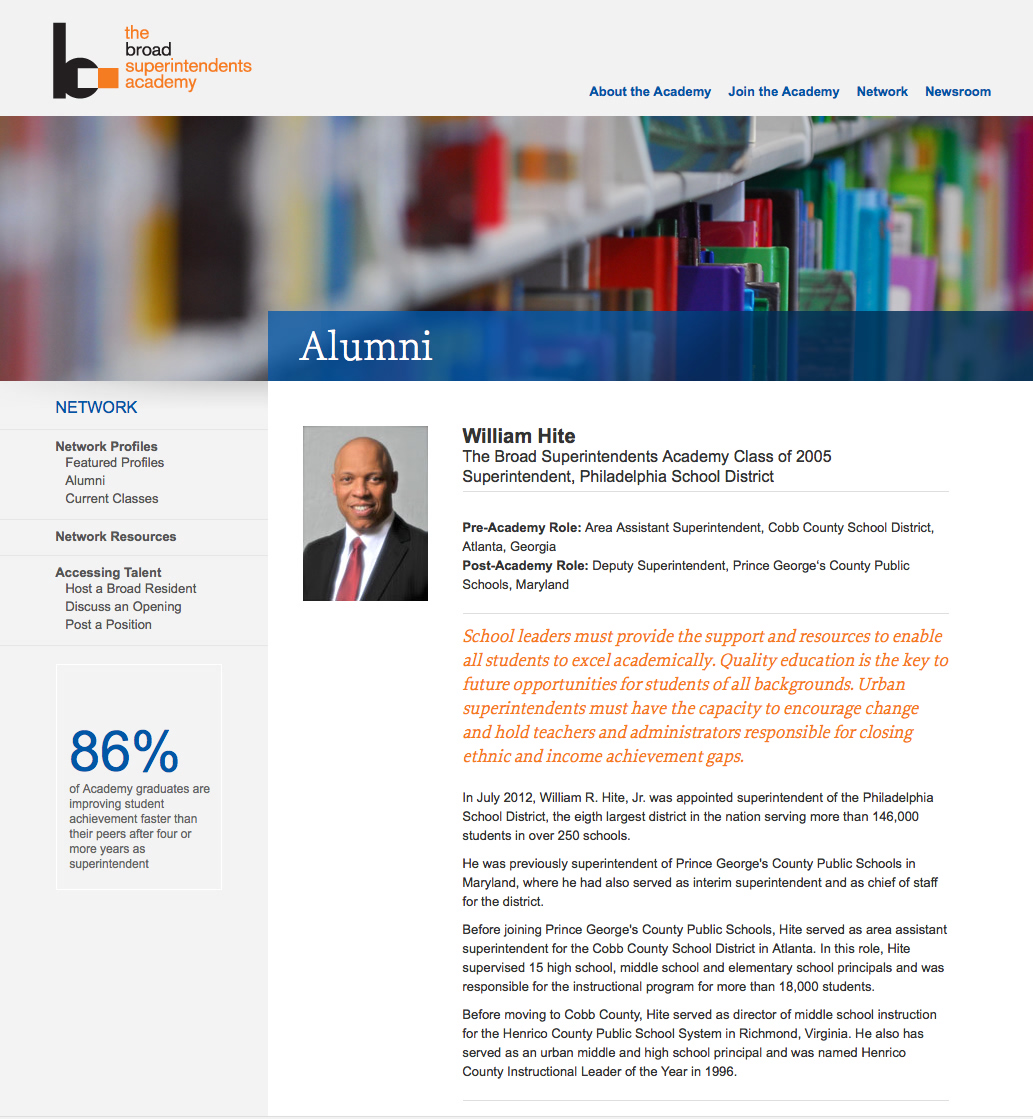
The Battle for Wister has been decided in favor of Mastery Charters over the objections of many parents at the school. (See The Battle for Wister in Part I of this series.)  What makes this turnover different than all preceding turnovers is that Wister, even by Broad graduate Superintendent Hite’s own admission, had been making progress as a public school. The School Reform Commission (SRC) reversed his decision one week after Hite had withdrawn Wister from the turnaround list. No more can the SRC claim that the turnover of a public school to a charter company is based on the pretense that their “data” shows a school is a “failing school”. It is now clear for all to see that the drive for privatization is based on the market interests of corporate education reform, not education.

Also to be turned over to charter companies that have a dubious history, are Jay Cooke Elementary to Great Oaks Charter and Samuel B. Huey Elementary to Global Leadership Academy.

These turnovers went forward despite the SRC’s Charter School Office presenting strong evidence that many charters up for their five-year renewals are performing no better, or worse, than the public schools they replaced. In addition, Philadelphia Newsworks' reporter Kevin McCorry observed, based on Newsworks analysis, “the most consistent thing about school ‘progress’ as captured by the SPR [the District’s School Progress Report] is inconsistency.” He wrote,

There are many reasons to be wary about relying too heavily on the School District of Philadelphia’s main tool for measuring school quality [SPR] – especially when it comes to making high-stakes decisions about closures, staffing shake-ups and charter conversions.

Despite this evidence, along with protests from parents, students, teachers and community members, the SRC is forging ahead with turnovers to charters and disrupting the lives of thousands of students and staff. Like all corporate education reform, it presents its decisions as being based on “failed schools” due to “bad teachers and administrators”. That these turnarounds are happening only in low-income neighborhoods gives the lie to this claim. The educational opportunities of children from low-income families will not change by moving school professionals from one school to another, year after year. What must change are the economic circumstances of these families.

The Latest Spin of the Turnaround Merry-Go-Round in Philadelphia Schools

Tuesday, June 23, 2015

Broadie Supt. Illegally Hires Broad Trainee at Public Expense

Since being hired over more qualified candidates for the position of Knox County superintendent, Jim McIntyre has distinguished himself as a loyal stooge of Eli Broad's corporate efficiency training camp, where he learned undemocratic practices that he has brought to his public responsibilities in East Tennessee. 

Last fall he illegally put the KCS on the hook for almost a hundred thousand dollars to pay a Broad trainee to practice her austerity lessons in Knoxville. 

This week County Commission rejected payment due the Broad clone.  When will Knoxville have enough of McIntyre, another sad example of big business run amok among public institutions!
(WBIR - KNOXVILLE) - At its regular meeting Monday evening, the Knox County Commission retroactively rejected a controversial grant agreement with the Broad Center for the Management of School Systems.

The embattled grant agreement laid out the terms of employment for a Broad Center fellow, Christy Hendler, as she worked for KCS during the 2014-15 school year.

The Broad Center is, essentially, a training program for people with executive leadership experience aspiring to become school district superintendents and other leaders within large education systems.
Knox County Schools Superintendent Jim McIntyre is himself a Broad graduate.

McIntyre accepted the grant agreement for Hendler's employment back in September, without seeking the approval of the KC Board of Education or Knox County Commission.

In April, county Law Director Bud Armstrong informed Board of Education members McIntyre had no authority to do that, since the grant has a matching fund requirement, among other reasons.

RELATED: BOE, law director question superintendent's Broad grant acceptance

In the arrangement, the Broad Center agreed to give KCS a grant totaling up to $29,700, to be put toward Hendler's salary. In exchange, the district would foot the rest of her salary, plus pay benefits.
The baseline salary for a Broad fellow, according to the Broad Academy, is $90,000. The Broad grant would pay for up to $29,700 of that.

With McIntyre's unauthorized acceptance of the grant agreement, Hendler has been working as the district's director of planning and improvement. Her time with the school system as a Broad fellow is set to end at the end of July.

That means KCS - and therefore taxpayers - have been footing the bill this whole time for not only the difference ($90k salary - $29.7k grant = $60,300 taxpayer responsibility), but also for the cost of benefits. The district estimates that at about $27,000, putting taxpayers on the hook for a total of $87,300.

However, because McIntyre accepted the grant agreement back in September, both the Knox County Board of Education and the County Commission had to vote to retroactively approve the grant agreement.

In a 5-4 decision late this spring, the BOE narrowly approved the agreement.

On Monday evening, however, Knox County commissioners returned a surprise vote.

At their work session last Monday, a majority of commissioners indicated they would be in favor of approving the agreement, recommending its approval 7 to 3, with one commissioner opting to pass.
Within a week, six commissioners had changed their mind.

Nine voted against approving the agreement. Commissioner Amy Broyles was not present.

Chairman Brad Anders, who voted "yes" at the work session but then voted "no" Monday night, said "there was more study and questions raised over the week," and agreed it was quite a change.

"The thing that I used as a measure," he said, was that McIntyre's approval "was improperly done and you can't condone that."

Commissioner Sam McKenzie was the lone "yes," though he explained himself prior to the vote.
"The water's over the dam...these funds are pretty much spent," McKenzie told his fellow commissioners, urging fiscal responsibility. "We're basically turning down $30,000...the money's been spent, so we're going to have to take out - at this point - $30,000 out of a potential teacher's assistant or potential, I don't know, across-the-street hire or, you know, toilet paper or something. That money has to come from somewhere to pay this money because it's pretty much been spent."

"This, to me, is just the clean-up," McKenzie continued. "If folks want to make a point, I think there are better places to make a point than us paying $30,000."

Commissioner Charles Busler said he understood McKenzie's point, but said, "the money was spent before it was approved, and that should bother us to no end....I mean, how could we look at the people that voted us in office and say, 'Oh, they went ahead and spent it, so it's spent anyway, so we're not going to do anything about it.'?"

In the pre-vote deliberations, Commissioner Randy Smith asked McIntyre: "Do you feel this is a wise spending of taxpayers' money?"

McIntyre told the commission he does think Hendler's salary has been worth the cost.

"She's been able to work with our operational areas to identify key performance indicators, to ensure that they're as efficient and effective as they can be," he told the commission. "She has been leading and facilitating some of the work around, 'How do we make sure that all the student assessments that we do are either required by the federal government or are valuable to inform instruction for our teachers?' And so, yes, I believe it's been-- it is a good investment of resources, and it's been valuable to our school system to have access to the skills and abilities that she's brought to the table."

Several commissioners mentioned getting several dozen emails from constituents, urging them to reject the grant agreement.

McKenzie, however, cautioned, "We represent 500,000 people. Thirty people sending me an email does not mean we're doing the people's business. That does not mean that. No way does that mean that. ...Listen, but don't say that that's indicative or representative of all the people, because it's not."
Armstrong told commissioners what a "no" vote would mean.

"If it's not approved by this body, then the grant is rejected," Armstrong said. "Then the Board of Education will have to then contact the grantor, and then they'll have to work out something with the grantor and see where it goes from there. There's not a clear-cut answer yes or no."

Bob Thomas, KCS assistant superintendent of administrative services, confirmed to the commission the Broad Center grant has been received and already spent on Hendler's salary.

Asked if the $29,700 will have to be paid back to the Broad Center, Armstrong said those are issues "that I will have to address with the school board and the legalities of where it leaves them."

After the overwhelming, near-majority rejection of the grant agreement, McIntyre said he'll now wait and see what the county law director and BOE decide to do.

"Some of the commissioners indicated one of the possibilities: We might have to send the money back, and I don't know. We'll have to figure that out, and I'll defer to the law director's office and to the school board to sort all that out," he told WBIR. "This is, you know, $30,000. We have a $430 million budget, and so, you know, this is a relatively modest set of resources in the big picture of our overall budget."

McIntyre acknowledged this was a grant agreement approval process with flaws.

"At times there are things that come through the process that don't get handled properly. We try to rectify those and correct those and make sure that they're handled properly in the end, and this was really what this was about," McIntyre said. "It was about, 'How do we address the deficiencies in this process? How do we make sure we get it right?'"

Asked if the district will keep Hendler on as a regular employee after the end of July, McIntyre said, "that's really a separate decision from the grant agreement or from the grant itself, and we'll certainly evaluate that as we do with all employees, moving forward."

Friday, October 03, 2014

LA Times will support John Deasy so long as their customers are corporate advertisers, rather than LAUSD schoolchildren

I was interested in the fact that the scandal over Deasy's PhD hit the headlines at the same time he was hired by Gates. His financial connections with Robert Felner date back to his Santa Monica days — Susan Ohanian

Plutocratic priest of privatization LAUSD Superintendent John DeasyReaching dizzying heights of comedic apologetics for beleaguered Broad Superintendent Academy graduate John Deasy, the Los Angeles Times has penned daily editorials and articles pleading the public to pressure our elected school board into laying down and ignoring Deasy's latest batch of failures. Like any first year law student I've been very busy. Too busy to respond to all of their wrongheaded propaganda, but today's editorial forced me to divert my attentions. I responded thusly:

Another breathtakingly mendacious editorial by the stenographers of plutocracy—also known as the Los Angeles Times. Ignoring the vicious attacks on our elected school board members, and the poisonous vitriol towards our working class teachers this ham-fisted screed metes out, let's look at some of the lies of omission regarding the individual who was ignominiously run out of both Prince George's County and Santa Monica-Malibu Unified School Districts.

Putting aside Deasy's relationship to convicted felon Robert Felner, and the concerns regarding the irregularities of Deasy's academic credentials, here is a "greatest hits" list of Deasy's tenure at LAUSD.

  • Implemented costly and academically discredited DIBELS®, a product of a company called the Dynamic Measurement Group, which is neither State nor Federally mandated.
  • Squandered an additional $18 million on SAP consultants to fix issues that happened under his predecessors, rather than demand contract performance from original deal.
  • Spent countless millions implementing his widely discredited VAM/AGT scam, a pseudoscience that recently saw even the American Statistical Association release a scathing report about.
  • Deasy's callous and improper handling of the Miramonte scandal.
  • The MiSiS disaster, which any competent administrator would have avoided. Even the somewhat conservative AALA severely criticized Deasy's many missteps on this.
  • The unethical, improper, and possibly illegal handling of the Pearson plc and Apple Inc. contracts. The details of which could result in indictments.

Any one of these would have ousted a Superintendent, but because Deasy has Eli Broad immunity, He has been able to avoid termination, and perhaps even criminal prosecution. It's time for this reign of incompetence to end.

Dr. Cynthia Liu, of K12NN fame, had some additional Deasy "hits" that I failed to list. They are reproduced here.

Two things from K12NN if you're writing to the LA Times to urge that Deasy resign:

Examples of gross incompetence by Deasy: 4th largest CA school district Fresno USD conducted an external FCMAT tech review of their district's needs before embarking on any new purchases or upgrades. Second largest CA school district, San Diego USD, did its own year-long tech review and spoke to teachers, parents, students, IT support staff, other school staff, and administrators about the technology strategic plan, then used a specific tech bond to fund the rollout.

The Los Angeles Times keeps insisting their obsequious support for Deasy is based on "his sense of urgency". There's a word for urgency without intelligence, reasonableness, or forethought — that word is recklessness. The last thing our school district needs is an individual whose recklessness remains unabated and unchecked. Deasy needs to resign. Now.

Plutocratic priest of privatization LAUSD Superintendent John Deasy

Friday, October 05, 2012

Deasy the Dauphine of LAUSD returns to his "let them eat ebooks" theme

"These "data-driven" investors are not so much interested in students' scores, as in the opportunities to cut costs by using online technology... The central question, says education entrepreneur John Katzman is "How do we use technology so that we require fewer qualified teachers?"" — Jeff Faux

Plutocratic priest of privatization LAUSD Superintendent John DeasyA "RIFed" (laid off) Los Angeles Unified School District (LAUSD) teacher posted a link to an LA Times piece on my facebook page this morning with the following note: "I'm laid off, but let's buy more equipment."

LAUSD's tablet plan doesn't compute was surprisingly critical of the Broadyte Superintendent given they usually treat him with the reverence that sycophant monarchists afforded that Dauphine of France whose flippant attitudes towards the lower classes were much like Deasy's. In fact it might be the first ever Times editorial mildly critical of Deasy and his corporate reforms.

I posted the following comments:

Tablets like iPads are wonderful, but they're a long way from being a reasonable replacement for school libraries and students having access to books.

According to research cited by Dr. Stephen Krashen "ebooks only account for one-half of one percent of school library collections, and this is predicted to increase to only 7.8% in five years."

In other words, the content isn't there, so bringing in technology is an abject waste of funds. Deasy has been on the wrong side of this from the get go. It makes me wonder if he has stock holdings in firms that provide tablets.

For a background on this topic and links to the research see: John Deasy's Queen Antoinette moment: "let them eat ebooks". This isn't about being anti-technology, it's about budget priorities and understanding the limits of both technology and the availability (or dearth thereof) of academic content in digital format. A hipster corporate reformer recently called me a Luddite, I guess he doesn't know what I do at my day job. Let it suffice that I know a little bit about that whole technology thing.

The point is that purchasing technology for technology's sake isn't just wasteful, it's criminal, especially during the budget crisis our district is suffering. LAUSD needs to restore school libraries, classroom libraries, reduce class sizes, hire back librarians, teachers, and other educators first. Then we can talk about introducing more technology when appropriate and when the content is there.

Wednesday, August 15, 2012

Tami Abdollah and John Deasy gush that 'Size Matters'

"Just continue to follow the money. This Race to the Trough will make the Reading First crooks under Bush look like dopey Boy Scouts." — Professor Jim Horn

Plutocratic priest of privatization, LAUSD Superintendent John DeasyThe neoliberal cabal at Southern California's KPCC can't cheerlead for school privatization loud or frequently enough. Not content with Pat Morrison lobbing softballs to Broad Superintendent Academy graduate and former Gates Foundation employee John Deasy once a week, KPCC's intrepid education beat reporters are always looking for the latest anti-public-school story angle.

Tami Abdollah's latest piece, Size matters in new district-level 'Race to the Top' competition, is a fluffy homage to Deasy and fellow poverty pimp Mayor Antonio Villaraigosa. The light-on-facts article enthusiastically reports the Los Angeles Unified School District (LAUSD) "has worked to institute a lot of the" corporate reforms and privatization requirements that Duncan, Gates, Broad and Coleman want to see for Race to the Top.

I chimed in with the following commentary:

There's a fundamental misunderstanding of Race to the Top (RTTT) in this article. RTTT funds, if granted, are not for things that actually improve education like smaller class sizes or researched backed academic programs including project based learning and the like.

Instead RTTT funds are earmarked for The Gates Foundation and Education Department's pet projects that don't help educational outcomes at all. If anything, they exacerbate problems. RTTT funds are for more profligate data tracking systems. More mind-numbing standardized tests and test preparation for students already averse to school because of a glut of standardized tests. Moreover, RTTT is to be used for highly discredited pseudo-sciences including VAM/AGT.

The district would be better off finding legitimate sources of funding that they can put into classrooms and school libraries. RTTT represents a windfall for testing companies, publishers, and technology firms, but offers nothing for actual improvement to pedagogy. Pearson, Microsoft, and McGraw Hill stand to gain from LAUSD garnering RTTT.

Schoolchildren, educators, and our communities all stand to lose if LAUSD does somehow get tangled up in Duncan's RTTT bribe scheme.

Sunday, April 08, 2012

Highs And Lows? More like a Year of Woe! Deasy has got to go.

I was interested in the fact that the scandal over Deasy's PhD hit the headlines at the same time he was hired by Gates. His financial connections with Robert Felner date back to his Santa Monica days — Susan Ohanian

Plutocratic priest of privatization, LAUSD Superintendent John DeasyLast week the Los Angeles press was effusive with anniversary homages to Eli Broad and Bill Gates' personally selected poverty pimp, Superintendent John Deasy. Short on facts and long on neoliberal cheerleading, the articles paint the man who has shuttered libraries and killed programs depended on by countless desperate poor and immigrant families as some kind of thoughtful hero. The Huffington Post jumped on the bandwagon, paying political tribute to the pirate king. My comments on The Huffington Post's Lucy Blodget's gushing love letter to Deasy are duplicated here:

The debut has been disastrous. Deasy squandered hundreds of millions of dollars on highly discredited programs like VAM/AGT. He spent millions more on costly tests that aren't mandated. Meanwhile, programs critical to impoverished and immigrant communities were cut entirely including: SRLDP, EEC, Elementary Arts, and Adult Education. I document much of Deasy's 1% spending spree in NCL: http://blog.ncladvocacy.org/2012/03/on-adult-educations-critical-role-in-social-justice-2/#notes

Peer reviewed academic studies find only three things improve student performance when poverty is accounted for. Reduced class size, teacher experience, and access to books. My Schools Matter writing colleague Professor Krashen has done expensive research on the latter. Deasy's response to allowing poor children access to books? Close countless school libraries and fire numerous librarians, while telling poor children to buy iPads. I discuss this tragic incident in: http://www.schoolsmatter.info/2011/09/john-deasys-queen-antoinette-moment-let.html

Others mentioned his stealing Title I and III funds to pay for his VAM/AGT white whale, and elimination of the only voice community and parents had in councils. Eliminating parental input, he brings in the vile Maria Casillas, whose long career in service to the lucrative charter-voucher industry belies Deasy's purposes.

On balance Deasy has been everything one would expect the plutocrats Broad and Gates to unleash on the working people of Los Angeles. We need a schoolboard that will eliminate him and get a superintendent that will place pupils above profits.

I also took issue with another Deasy fanfare in the Los Angeles Times, but chose to comment on a single turn of phrase which was incredulous, even by their standards.

One of you penned: "...diverse organizations as the Chamber of Commerce, the United Way, the Urban League and InnerCity Struggle, an Eastside community group."

Since both Urban League and Inner City Struggle are funded by the United Way, just how "diverse" are these groups?

Moreover, outside the plutocrat Billionaire Boys Club that comprises United Way's Tocqueville Society, the vast majority of their donors are the well heeled and quite reactionary members of the Chamber of Commerce.

In other words, diversity would be the last word that one would use to describe an essentially monolithic set of groups with an identical right-wing privatization agenda.

Two recent essays speaking truth to Deasy's power are valuable and enjoyable reads.

LAUSD’s Dark Lord, Dr. John Deasy
by John Mears
LAUSD Superintendent of Schools John Deasy Must Go
by Joseph K.

Of course, if my current endeavors are successful, one of the first things I'll do is push to start a search for a qualified Superintendent for LAUSD, since no such search was conducted when Ramon Cortines stepped down.

The Susan Ohanian piece quoted above says: "Many speculate that the Gates job was just a holding pattern for the Los Angeles appointment, which will give him the opportunity to turn LA in to the Gates model district." The broad base of community members, parents, and educators that I work with on a constant basis don't want a "Gates model district," we want a social justice model district.

Monday, January 30, 2012

Robert D. Skeels: How Administration Tries to Cow Teachers Into Submission

Talk by PESJA/CEJ activist and District 2 LAUSD Trustee Candidate Robert D. Skeels at the Support Cadre Resisting Administrative Maltreatment (SCRAM) Caucus Meeting at CTA State Council of Education on January 29, 2012.

Special thanks to John Cromshow of KPFK and SCRAM for arranging the event.


Robert D. Skeels is a social justice writer, public education advocate, and immigrant rights activist.

Saturday, September 24, 2011

John Deasy's Queen Antoinette moment: "let them eat ebooks"

"Right now, only higher-income readers can afford ebook readers and ebooks." — Dr. Stephen Krashen

Plutocratic priest of privatization LAUSD Superintendent John DeasyOn September 14, 2011 former Gates Foundation executive and Broad Superintendents Academy graduate John Deasy gave a much ballyhooed speech at Occidental College. While I may have time in the future to critique his mendacious stream of business-speak, which amounted to a clever corporate couching of school privatization in the language of "civil rights," it was his aloof response to an attendee's pertinent question on school libraries that deserves an immediate response. Here's a quote from an attendee who endured Deasy's verbal assault on public education:

"[O]ne of Rosemary's questions about his shutting school libraries got through. He said libraries would be irrelevant soon as books will move to electronic format. This was after he lamented about the plight of a homeless student living in a tent. I kid you not. I guess the kid in the tent will have to access books on the $800 I-Pad he can't afford."

A pointed and poignant question indeed to Los Angeles Unified School District's (LAUSD) Superintendent John Deasy, a man who deliberately gutted LAUSD's libraries in defiance of California's Assembly Bill 114, which was supposed to mandate the district spend its copious surplus funds on retaining the very personnel Deasy and company gleefully laid off. Laid off in a most ignominious fashion by the way, as Hector Tobar's The disgraceful interrogation of L.A. school librarians chronicled. Deasy's vapid and vacuous response to the library question sums up everything about corporate education reforms and shows why Deasy was hand selected to implement the neoliberal agenda in Los Angeles.

As disgusting as Deasy's quote about libraries being irrelevant was, it wasn't surprising considering his astonishing wealth and privilege. For wealthy white males like Deasy, poverty is something you see on television and it's easily solved by applying forms of the meritocracy myth via vile "no excuses" rhetoric and corporate privatization policies cloaked as promoting "high expectations." Deasy's own phrasing of the threadbare right-wing no excuses rhetoric reads as follows: "I actually believe that no other issue—circumstances of poverty, one parent, no parent, race, language proficiency, special need—none of that has a greater affect on the achievement gap than our belief about the ability of youth."

More to the point, Deasy's flippant remark that electronic format books would soon replace libraries has no grounding in reality. Such thinking and policies exacerbate the inequality of access to books in a way that is both classist and racist. A brief, but fact packed essay by Schools Matter's own Dr. Stephen Krashen entitled Kindelizaton: Are Books Obsolete? patently disproves everything Superintendent Deasy claims. Let's look at some of the important facts the essay presents.

Data shows that "ebooks appear to be capturing some of the paperback book market, but certainly not all of it, and not the hard cover or tradebook market. Thus far ebooks make up only a tiny percentage of total school library collections." [1] In other words, while ebooks are making inroads in the profitable popular paperbook sector, there hasn't been a great deal of investment in the more costly and lower volume textbook and hardcover sectors. As a consequence "ebooks only account for one-half of one percent of school library collections, and this is predicted to increase to only 7.8% in five years." [2]

It isn't just that ebooks aren't widespread enough to be considered a suitable replacement for school libraries. It's that access to ebooks is strictly class based:

The problem is the expense. Right now, only higher-income readers can afford ebook readers and ebooks. Kindles, for example, cost at least $100 each, and ebooks cost about $10, beyond the budget for those living in poverty. [3]

A table in Krashen's paper shows only four percent of people with household incomes under $30,000 owned ebook-readers, and that percentage remained constant for the nineteen months prior to publication of the paper. Krashen's conclusion is equally revealing:

The cost of ebook readers and ebooks makes them much less available to students from high-poverty families and under-funded school libraries. (Note that it is usually not possible to share ebooks.) Ebooks are allowing the print-rich to get even print-richer. [4]

It isn't surprising that people who get doctoral degrees from Cracker Jack boxes, or worse, purchase them from convicted criminals like Robert Felner in exchange for six figure grants, might be unaware of such research. More cynical readers might be tempted to suspect Deasy's deep ties to monopolistic software moguls like Bill Gates and technobabble charlatans like Tom Vander Ark as possible explanations for his intentional razing of school libraries in favor of profitable, but income exclusive, ebooks. Those things said, one would like to think the head of one of the largest school districts in the country would have a grasp of the basic fundamentals surrounding pedagogical issues and would be immune from pandering to his deep pocketed associates. Given the frightening lack of capacity of California's schools, outlined in UCLA Institute for Democracy, Education, and Access "The Train that is about to Hit," Deasy's notion of "let them eat ebooks" borders on criminal.

Research emphatically puts to lie Deasy's assertion that "libraries would be irrelevant soon as books will move to electronic format." In a state where the ratio of students to librarians is nearly 5,500 to 1 [5], Deasy's outright dismissal of the importance of libraries and books, combined with policies that exacerbate the problem, strongly convict him in his role in neoliberal dismantling of public education. Of course that's Deasy's capacity, he wasn't brought in by the Broad/Gates/Walton Triumvirate to fix LAUSD, he was brought in to destroy it. Collectively we need to reject Deasy's false narrative and demand he spend our funds on libraries and classrooms, not he and his fellow administrators' lavish lifestyles! Collectively we need to fight the privatization of public education!

_____
NOTES

[1] Krashen, Stephen. 2011. Kindelizaton: Are Books Obsolete?. Books and Articles by Stephen D. Krashen. Accessed September 20, 2011. http://www.sdkrashen.com/articles/kindelization.pdf

[2-4] Ibid.

[5] This wonderful infographic from the UCLA IDEA article mentioned above illustrates what the plutocrat class has done to California's education system.
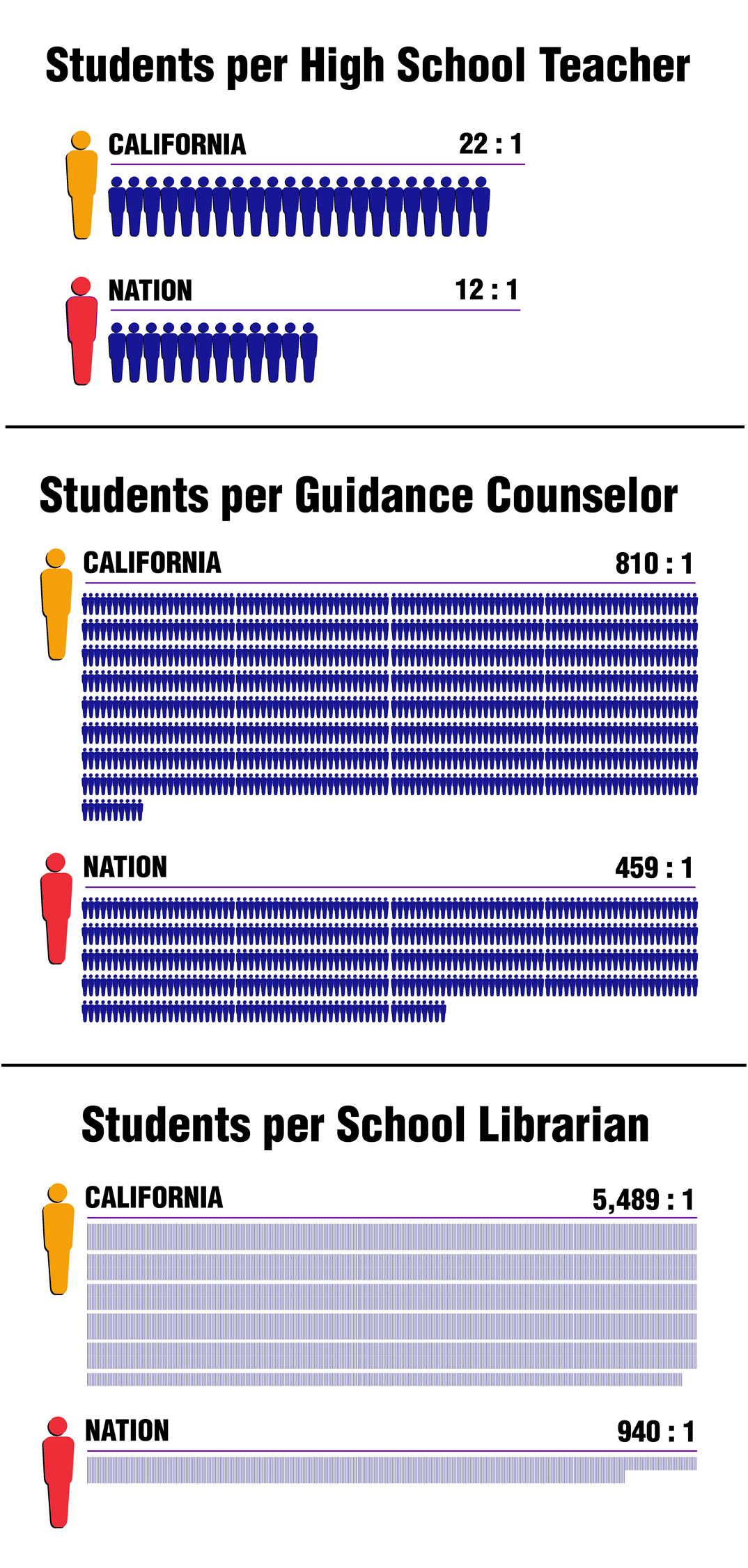
UCLA IDEA "The Train that is about to Hit"

Tuesday, April 19, 2011

Parents and Other Citizens' Guide to the Broadies (rhymes with Toadies)

From Parents Across America.  Please follow the link to Parents Across America because their post has a bunch of links built in.  Great job, guys:

In recent months, three prominent school district superintendents have resigned, after allegations of mismanagement, autocratic leadership styles, and/or the pursuit of unpopular policies. All three were trained by the Broad Superintendents Academy: Maria Goodloe-Johnson (class of 2003) of the Seattle school district, LaVonne Sheffield (class of 2002) of the Rockford, Illinois school district, and Jean-Claude Brizard (class of 2008) of the Rochester New York school district. Brizard resigned to take the job as CEO of Chicago schools, but his superintendency in Rochester had been mired in controversy. Another Broad-trained Superintendent recently announced his resignation: Tom Brady(class of 2004) of Providence, Rhode Island.
Three more Broad-trainees have been recently placed in new positions of authority: John Deasy (class of 2006), as Superintendent of the Los Angeles United School District, John White (class of 2010), Superintendent of the Recovery School District in New Orleans,  and Chris Cerf (class of 2004), New Jersey’s Acting Education Commissioner. Tom Boasberg was appointed Denver’s Superintendent in January 2009, shortly after taking an “Intensive” training at the Broad Academy.   (See map below from the Broad website, showing where until recently their trainees served.)

This summary is designed to help parents and other concerned citizens better understand the Broad Foundation’s role in training new superintendents and other “reform” activities, and how the foundation leverages its wealth to impose a top-down, corporate-style business model on our public schools. It is time for communities to become aware of how this major force works.
What is the Broad Foundation?
The Edythe and Eli Broad Foundation engages in venture philanthropy in four areas: education, medical research, contemporary art, and civic projects in Los Angeles. The foundation was established in 1999 by billionaire Eli Broad (b. 1933) who made his fortune in real estate and the insurance business.
A closer look at the Broad Foundation’s “investment” in education
The Gates Foundation, the Walton Family Foundation, and the Broad Foundation form a powerful triumvirate. The combined net worth of the three families who operate these foundations is $152 billion. By strategically deploying their immense wealth through training school leaders, financing think-tank reports, and supporting “Astro Turf” advocacy groups, these three foundations have been able to steer the direction of education reform over the past decade.
The Broad Foundation is the least wealthy of the three, but has still spent nearly $400 million on its mission of “transforming urban K-12 public education through better governance, management, labor relations and competition.” But what does that actually mean?
The signature effort of the Broad Foundation is its investment in its training programs, operated through the Broad Center for the Management of School Systems and the Broad Institute for School Boards. The Broad Center for the Management of School Systems is the larger of the two and consists of two programs: the Broad Superintendents Academyand the Broad Residency in Urban Education.
The Broad Superintendents Academy runs a training program held during six weekends over ten months, after which graduates are placed in large districts as superintendents. Those accepted into the program (“Broad Fellows”) are not required to have a background in-education; many come instead from careers in the military, business, or government. Tuition and travel expenses for participants are paid for by the Broad Center, which also sometimes covers a share of the graduates’ salaries when they are appointed into district leadership positions. The foundation’s website boasts that 43 percent of all large urban superintendent openings were filled by Broad Academy graduates in 2009.
The Broad Superintendents Academy’s weekend training course provides an “alternative” certification process which has come to supplant or override the typical regulations in many states that require that individuals have years of experience as a teacher and principal before being installed as a school district superintendents.
The Broad Residency in Urban Education is a two-year program, during which individuals with MBAs, JDs, etc. in the early stages of their careers are placed in high-level managerial positions in school districts, charter management organizations, or state and federal departments of education. The Broad Center subsidizes approximately 33 percent of each Resident’s salary.
For financially struggling school districts, the Broad Foundation’s offer of trained personnel or services for a free or reduced cost is extremely appealing, and creates a “pipeline” of individuals with the same ideology who can be installed in central office positions.
The Broad Institute for School Boards provides three training programs for elected school board members and non-Broad-trained superintendents conducted in partnership with theCenter for Reform of School Systems (CRSS). The Institute trains new board members at a one-week summer residential setting. Its Alumni Institute is an advanced course for experienced school board members. The third program, Reform Governance in Action, is by invitation only and provides “a long-term, training/consulting partnership program to selected large, urban districts.” The Broad Foundation underwrites 80 percent of all program costs through a grant to CRSS.
The “Broad Prize for Education” is an annual monetary award which is designated for college scholarships; it is given to the urban school district which the foundation deems as the most “improved” in the country. The selection process is sometimes seen as more political than based on actual results.
The Broad Foundation also supports a broad range of pro-charter school advocacy groups, as well as alternative training programs for non-educators who want to work as teachers and principals (Teach for America, New Leaders for New Schools).
In addition, the foundation offers free diagnostic “audits” to school districts, along with recommendations aligned with its policy preferences.  It produces a number of guides and toolkits for school districts, including a “School Closure Guide,” based on the experiences of Broad-trained administrators involved in closing schools in Boston, Charleston, Chicago, Dallas, Washington, D.C., Miami-Dade County, Oakland, Pittsburgh, St. Louis, and Seattle.
The foundation finances the Education Innovation Laboratory, run by Harvard economist Roland Fryer, which carries out large-scale experiments in schools districts, focused onteacher pay for performance and rewarding students for good test scores and grades. So far, these trials have failed to demonstrate positive results.
The foundation provided start-up funding for Parent Revolution (formerly the Los Angeles Parent Union), the group which developed the “Parent Trigger” legislation, designed to encourage the conversion of public schools to charter schools. Broad has also has given large amounts of money to Education Reform Now, a pro-charter school advocacy organization.
Eli Broad has said he “expects to be a major contributor” to Students First, former D.C. Chancellor Michelle Rhee’s organization that advocates for the expansion of charters, vouchers, and an end to seniority protections for teachers. And journalist Richard Whitmire, author of “The Bee Eater,” an admiring biography of Rhee, expressed his gratitude in the book to Democrats for Education Reform, a pro-charter lobbying organization, for serving as the “pass through” for funds from the Broad Foundation which allowed him to “invest everything in book research.”
The foundation provided start-up funds to New York City’s Leadership Academy, which trains individuals to serve as principals in the city public schools, several of whose graduates have been accused of financial misconduct, as well as  arbitrary and dictatorial treatment of teachersstudents and parents.
The foundation also helps sponsors media events (a PBS series on the “education crisis” hosted by Charlie Rose, the series Education Nation on NBC, etc.). These programs help promote for Eli Broad’s vision of free-market education reform.
In addition to using his foundation to effect change to American public education, Eli Broad has made personal campaign contributions to candidates who are favorably disposed to his preferred policies, even down to the local school board level. In this way, he has helped influence the selection of superintendents who are aligned with him ideologically, even though they may not be Broad Academy graduates.
For instance, Broad contributed to the campaigns of school board candidates who supported former U.S. Assistant Attorney General Alan Bersin’s appointment as superintendent of San Diego’s school district. A 2006 Vanity Fair article by Bob Colacello reported that “Broad believes reform must come “the top down” and that his foundation “plans to virtually take over the Delaware school system in 2007, pending approval from that state’s legislature.”
In 2003, Joseph Wise (class of 2003) was installed as superintendent of Christina School District, Delaware’s largest. In 2006, Wise was succeeded by Lillian Lowery (class of 2004), who served until 2009 when she was appointed as the state’s Secretary of Education. Two Broad Residents work under Lowery at the state level. Another Broad superintendent, Marcia Lyles (class of 2006), replaced Lowery as superintendent of Christina School District.
Along with Bill Gates, Broad contributed millions of dollars to the campaign to extend mayoral control of the public schools in New York City under Michael Bloomberg. Among the leaders he is close to and has personally advised behind the scenes are former NYC Chancellor Joel Klein, former D.C. Chancellor Michelle Rhee, AFT President Randi Weingarten, and US Secretary of Education Arne Duncan.
How the Broad Foundation affects public school families
Broad and his foundation believe that public schools should be run like a business. One of the tenets of his philosophy is to produce system change by “investing in a disruptive force.” Continual reorganizations, firings of staff, and experimentation to create chaos or “churn” is believed to be productive and beneficial, as it weakens the ability of communities to resist change.
As Jack Welch, former CEO of General Electric, a proponent of this philosophy has said,“…we can afford to make lots more mistakes and in fact we have to throw more things at the wall. The big companies that get into trouble are those that try to manage their size instead of experimenting with it.”
A hallmark of the Broad-style leadership is closing existing schools rather than attempting to improve them, increasing class size, opening charter schools, imposing high-stakes test-based accountability systems on teachers and students, and implementing of pay for performance schemes. The brusque and often punitive management style of Broad-trained leaders has frequently alienated parents and teachers and sparked protests.
Several communities have forced their Broad-trained superintendents to resign, includingArnold “Woody” Carter (class or 2002), formerly of the Capistrano Unified School District;Thandiwee Peebles,( class of 2002), formerly of the Minneapolis Public School District; and John Q. Porter (class of 2006), formerly of the Oklahoma City Public School District.
A number of other Broad-trained superintendents have received votes of “no confidence” from the teachers in their districts, including Rochester’s Jean-Claude Brizard (class of 2008), Seattle’s Maria Goodloe-Johnson (class of 2003); Deborah Sims (class of 2005) while Superintendent of the Antioch Unified School District (CA); Matthew Malone (class of 2003) while Superintendent of the Swampscott School District (MA); and most recently,Melinda J. Boone (class of 2004) Superintendent of the Worcester Public Schools (MA).
The Oakland Unified School District (CA) experienced a series of three consecutive Broad-trained, state-appointed administrators over a period of six years. The first, Randolph Ward (class of 2003), aroused huge protests with his plans to close schools and even hired a personal bodyguard for the duration of his tenure. Ward was followed by Kimberly Statham (class of 2003), and Vincent Mathews (class of 2006), all of whom left the district in financial shambles. A civil grand jury found that
“….the district was hampered by continuous staff turnover, particularly in the area of finance, numerous reorganizations and a succession of state administrators…After nearly five years of state management, OUSD’s budget remains unbalanced and the district’s future is unclear.”
Joseph Wise (class of 2003), formerly Superintendent of the Duval County Florida Public Schools, was found to have spent thousands of dollars on personal purchases while a superintendent in Delaware, before being fired by his Duval post in disgrace. While a finalist for the post of Superintendent in Washoe County in Nevada, Kimberly Olson (class of 2005) pled guilty of having engaged in war profiteering when she was a colonel in Iraq.
Chris Cerf (class of 2004), the acting New Jersey Education Commissioner, has been criticized for not identifying his involvement in a consulting firm which developed an secret plan to turn many Newark public schools over to charter operators. The Broad Foundation acknowledged that it put up $500,000 to pay for the plan.  Deborah Gist (class of 2008), Rhode Island Commissioner of Education, has supported the firing of all teachers in Central Falls and more recently in Providence, and is aggressively fighting seniority protections for teachers.
General Anthony Tata (class of 2009), has been embroiled in controversy for dismantling Wake County’s desegregation plan. John Covington (class of 2008), Superintendent of Kansas City Schools, has announced his intention to close half the schools districts in the city. Robert Bobb (class of 2005),  the Emergency Financial Manager of the Detroit Public Schools, recently sent layoff notices to every one of the district’s 5,466 salaried employees, including all its teachers, and said that nearly a third of the district’s schoolswould be closed or turned over to private charter operators. At a recent town hall which Bobb had called so he could go over his plan, angry students, parents, and teachers drove him from the meeting. He was escorted out by his six bodyguards.
Conclusion
Eli Broad is a wealthy individual, accountable to no one but himself, who wields vast power over our public schools. Parents and community members should be aware of the extent to which the he and his foundation influence educational policies in districts throughout the country, through Broad-funded advocacy groups, Broad-sponsored experiments and reports, and the placement of Broad-trained school leaders, administrators and superintendents.
Parents Across America considers Broad’s influence to be inherently undemocratic, as it disenfranchises parents and other stakeholders in an effort to privatize our public schools and imposes corporate-style policies without our consent. We strongly oppose allowing our nation’s education policy to be driven by billionaires who have no education expertise, who do not send their own children to public schools, and whose particular biases and policy preferences are damaging our children’s ability to receive a quality education.
For more information on the Broad Superintendents and Residents
Maps showing where some of the Broad superintendents and residents are currently employed can be found on the Broad Foundation’s website: Broad Superintendents Academy Fellows and Broad Residents, as well as links to more information about them.
The only complete list of Broad Superintendent trainees is here, on The Broad Reportwebsite, which was created by Sharon Higgins, a founding member of Parents Across America.
See also our video: “Parents Across America speak out about corporate interests in education.”
Additional Reading
Barkan, Joanne. “Got Dough? How Billionaires Rule our Schools,” Dissent Winter 2011.http://www.dissentmagazine.org/article/?article=3781
Colacello, Bob. “Eli Broad’s Big Picture,” Vanity Fair 01 December 2006.http://broadartfoundation.org/press/0612_VanityFair_EB039.pdf
Forbes Staff. “The World’s Billionaires.” Forbes Magazine 09 March 2011.http://www.forbes.com/wealth/billionaires
Foundation Center. “Top 100 U.S. Foundation by Asset Size.”http://foundationcenter.org/findfunders/topfunders/top100assets.html
Gammon, Robert. “Eli’s Experiment.” East Bay Express 10 October 2007.http://www.eastbayexpress.com/gyrobase/elis-experiment/Content?oid=1084299&storyPage=1
Higgins, Sharon. “The Broad Report” http://thebroadreport.blogspot.com/
Peters, Sue and Dora Taylor. “Seattle Education 2010” blog.http://seattleducation2010.wordpress.com/
Saltman, Kenneth. “The Rise of Venture Philanthropy and the Ongoing Neoliberal Assault on Public Education: The Eli and Edythe Broad Foundation.” Workplace, 16, 2009http://m1.cust.educ.ubc.ca/journal/index.php/workplace/article/viewFile/65/saltman
Scott, Janelle. “The Politics of Venture Philanthropy in Charter School Policy and Advocacy.” Educational Policy January 2009.http://epx.sagepub.com/content/23/1/106.abstract
Shafer, Jack. “Bully in Search of a Pulpit.” Slate 09 November, 2006;http://www.slate.com/id/2153362/
Tough, Paul (editor). “How Many Billionaires Does It Take to Fix a School System.” New York Times 09 March 2008. http://www.nytimes.com/2008/03/09/magazine/09roundtable-t.html?_r=2
View the Eli and Edythe Broad Foundation grants on the IRS Form 990s at the National Center for Charitable Statistics or GuideStar. The foundation’s Federal Employer ID Number (EIN) is 954686318.