"When teachers are told exactly what and how to teach, when they feel pressured to produce results, they in turn tend to pressure their students. That is exactly what another study found: teachers who felt controlled became more controlling, removing virtually any opportunities for students to direct their own learning." — Alfie Kohn
As always the wonderful Alfie Kohn is right on target. What's left out of his important analysis is that these conditions are exactly what our ruling class—namely, but not limited to the Gates, Broad, and Walton Family Foundations—wants. From their self-serving perspective, self-directed learning is for the scion of the 1%, not for us working class rabble. Completely control both educators and their pupils through fear (Vergara), and deployment the banking model of pedagogy (Common Core State Standards CCSS), and you control access to the one thing that could allow us to overthrow our oppressors.
Works Cited
Freire, Paulo. Pedagogy of the Oppressed. New York: Continuum, 2000. Print.
Kohn, Alfie. The Schools Our Children Deserve: Moving Beyond Traditional Classrooms and "tougher Standards". Boston: Houghton Mifflin Co, 1999. Print.
"Prior research, then, strongly suggests that charter programs have not lived up to their initial promise of transcending the segregating effects of traditional district boundary lines. In fact, these studies indicate charters exacerbate already rampant school segregation, particularly for Black students." — Erica Frankenberg, Genevieve Siegel-Hawley, Jia Wang
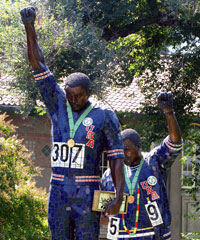
The Smith and Carlos Statue at San José State University
I was reading Dave Zirin's latest piece, Fists of Freedom: An Olympic Story Not Taught in School, this morning and several things stood out and had me thinking in terms of how Common Core State Standards (CCSS) and its related high-stakes testing regimes not only distort curriculum, but how they are intended to distort students' consciousness of their reality.
It was probably Zirin's mention of the testing-industrial-complex conglomerates Pearson and Prentice Hall in his first paragraph that had me thinking of the article from a perspective of the damage Corporate Core Standards are poised to inflict on working class children. Zirin points out that entire history and context that are associated with the iconic image of Tommie Smith and John Carlos raising their fists at the 1968 Olympics in Mexico City is completely lost in the corporate account of the photo and the period. Also absent from the curriculum published by the profitable firm best known for Pineapplegate is an explanation of white supremacist Avery Brundage's kowtowing to Hitler in 1936.
Zirin proceeds to fill in all the details and context missing from Pearson's corporate account in a way that will frighten StudentsFirst's David Coleman since it exposes power inequalities and racism at every level of society. As in the case of Texas textbooks, this is the kind of history that Corporate Core Standards is trying to obscure, distort, and deny at every turn.
The story of Tommie Smith and John Carlos at the 1968 Olympics deserves more than a visual sound bite in a quickie textbook section on "Black Power." As the Zinn Education Project points out in its "If We Knew Our History" series, this is one of many examples of the missing and distorted history in school, which turns the curriculum into a checklist of famous names and dates. When we introduce students to the story of Smith and Carlos' defiant gesture, we can offer a rich context of activism, courage, and solidarity that breathes life into the study of history—and the long struggle for racial equality.
Several very important points here. First Zirin cites "many examples of the missing and distorted history in school," which of course, is by design. Our oppressors not only don't want young people to learn specific ideas and examples of struggle, they especially don't want students to draw the conclusion that they can actually change their reality through struggle. Instead students should become depositories for what Bill Gates, Arne Duncan, and David Coleman feel prepares them "college and career" (read low paying service sector jobs). Never let students begin to engage in critical thinking since that might allow them draw their own conclusions of society, or worse, try to address systemic problems. Confer:
It is not surprising that the banking concept of education regards men as adaptable, manageable beings. The more students work at storing the deposits entrusted to them, the less they develop the critical consciousness which would result from their intervention in the world as transformers of that world. The more completely they accept the passive role imposed on them, the more they tend simply to adapt to the world as it is and to the fragmented view of reality deposited in them. — Paulo Freire (Pedagogy of the Oppressed)
Zirin then mentions that shrinking curriculums, epitomized by CCSS, "turns the curriculum into a checklist of famous names and dates." Putting aside the glaring fact that this again speaks precisely to the banking concept of education aforementioned, CCSS and its attendant testing regime have all but enshrined the "Great Man Theory" of history. This isn't surprising given the extremely high opinion Eli Broad, Bill Gates, Reed Hastings, and all the other corporate education reform billionaires hold of themselves. Much of corporate education reform, including the idea that market concepts like competition will improve education, are a reflection of its proponents' extreme narcissism.
Common Core State Standards, like all the other components of corporate education reform, are an antithesis of social justice. Reducing students to repositories of information deemed important by David Coleman is part and parcel the banking system of education. Instead of teaching students what they need to liberate themselves, Corporate Core Standards were designed to insure passivity and compliance. We must resist the real "status quo" of arbitrary standards and high-stakes standardized tests by every means possible. We must use Smith and Carlos' example of resistance not as something to regurgitate on a Scantron form, but as something we must do ourselves.
"I am heading for a four-year college. The classes that most helped me prepare for this were NOT test prep classes. They were the ones where I got to explore stuff and do projects." — Tiffany Tuggle (CEJ Member and Senior at UCLA Community School)
Jessica Kochick teaches at the Miguel Contreras Learning Complex in the Westlake District of Los Angeles near my home. Jess and I come out of the same political tradition, and over the years we've worked together on several struggles fighting the racist, classist, neoliberal policies of Los Angeles Unified School District (LAUSD). A year or two ago, Jess was discussing standardized testing and Value Added Measures (VAM) — or Average Growth Over Time (AGT) in LAUSD parlance — with several of us and suggested an event demonstrating how the vast majority of real pedagogy can't be measured on standardized tests or quantified in any similar fashion.
Her vision eventually led to Evaluate This!, an education fair showcasing projects at various schools sites throughout LAUSD. With an emphasis on project based learning, the fair featured some absolutely amazing forms of pedagogy. Even though I arrived to catch the very end of the event, it exceeded expectations in every possible way. Even the virulently anti-public education Los Angeles Times ran a blog [1] piece entitled L.A. students and teachers display learning beyond tests.
Evaluate This! was sponsored by Progressive Educators for Action (PEAC), United Teachers Los Angeles (UTLA) North Area, UTLA Raza Education Committee, and Coalition for Educational Justice (CEJ). The same groups also arranged for Professor Linda Darling-Hammond to speak to educators about authentic teacher evaluations at the Historic Coconut Grove Auditorium in the Robert F. Kennedy School Complex a week later.
A notable display included Grand View Boulevard Elementary School's Dual Language Immersion program. A bystander informed me that they heard it had been in place for 21 years. Thinking immersion programs had only been around for about a decade, I wrote my good friend and fellow neighborhood activist Cheryl Ortega, who is also Director of Bilingual Education at UTLA. She confirmed the program has been around that long, and pointed out that it has flourished in an affluent neighborhood, but our task is to convince inner city schools to adopt these programs. Cheryl and I have discussed many times in the past how it is often difficult to convince immigrant parents to enroll their children in dual language immersion programs given the racist nature of U.S. society that both discourages impoverished peoples from retaining their own cultural identities, combined with the pressures on schools from No Child Left Behind (NCLB) to force English proficiency on students.
Cheryl had the following to add in terms of her experience from the education fair:
The entire event was wonderful. I loved the mix of elementary, middle and high school exhibits. I was particularly impressed by the project on violence against women done by 3 high school boys. Well done!
My neighborhood was well represented with a biology project from Logan Street Elementary School headed up by the widely regarded Julie Van Winkle. Many of the CEJ Student Activists that had made the Social Justice Schools Conference so dynamic were also in attendance, and many of them had displays at the fair.
I was able to get two of the participants to submit brief write ups of their projects. The second of the write ups is in relation to a poignant display from an amazing educator who through the sheer budget mismanagement of LAUSD, like many of our newer teachers, receives a reduction in force (RIF) letter on an anual basis. To add insult to injury, many of these RIFs could be averted if the district wasn't squandering hundreds of millions of dollars on discredited and disproven Value Added Measures (VAM).
Esperanza Elementary School first grade garden project at Evaluate This!
Our garden exhibit at Evaluate This! On 5/18/12 at Miguel Contreras Learning Center.
Our display at Evaluate This! documented with photos, student writing, drawings, graphs, crafts and realia how students in four first-grade classes at Esperanza Elementary School have embarked on a quest to learn to grow healthy food in an urban asphalt environment. Students began by planting lettuce, radishes and tomatoes in containers and a small raised bed in a concrete courtyard. They've cared for the plants, documented their growth in writing, graphs and illustrations, started over with new plants when some died, captured green caterpillars who came to dine on the plants and later watched them turn into butterflies, released ladybugs to eat aphids that threatened their plants, and enjoyed eating the lettuce and radishes they grew. (The tomatoes aren't ready yet!) Students have read and discussed books about plants, learned about the needs of all living things, and all have written booklets about their gardening adventures. Some conducted experiments to see if varying the amount of water affects plant growth, and graphed their results. Many have adopted healthier eating habits, snacking at school on carrots, apples, bananas, tangerines and sugar peas still in the pods. Students now want to try growing a wider variety of vegetables, and some have already started growing them in containers in the apartments where they live. School gardening offers a venue for engaging real-life learning about social studies, language arts, math and science that goes far beyond anything measurable on a scantron. Our gardening project is evolving as it proceeds, and we hope to expand it next year to include more classes. The teachers are Angie Low, Alicia Rodriguez, Lynda Ayala and Anne Zerrien-Lee.
How Standardize Tests and Value Added Measures Undermine Learning
My name is Larry Shoham and I teach 8th grade English and 7th grade World History at Westside Global Awareness Magnet.
We are here to challenge the notion that our students are not engaged in meaningful learning experiences. Every day I go to work I am engaged in educational reform. My colleagues and I are constantly reflecting on our practices, trying figure out ways to make our instruction more meaningful and engaging to the students we teach. We know our students and we understand their needs. Innovation isn't achieved through top-down mandates and relentless onslaughts of bubble tests. It's achieved through collaboration, academic freedom, and equitable resources.
Unfortunately, so many rich learning experiences will be lost once we succumb to these new evaluations. There will be incredible pressure on us to teach to the tests and abandon the active, project-based learning that does not directly lead to measurable gains on multiple-choice tests. Instead of speaking, writing, and questioning, our students will be subjected to mindless exercises in an attempt to micromanage testable skills. In fact, it's already happening. Last year, I read two novels with my students. This year, we barely got through one. Why? In an attempt to juke the stats and squeeze our school out of program improvement status, we agreed, as a staff, to commit more time toward test prep--teaching directly to the State's test release questions and reviewing, ad nauseam, the District's periodic assessments. My students were bored out of their minds. I was bored out of my mind. Sadly, this is the game we have been intimidated into playing.
Value-Added Measurement (what LAUSD calls "AGT") is problematic in so many ways. This past fall, LAUSD sent me a confidential AGT report evaluating me as an English teacher. It was a number. It did not tell me anything useful that I could apply in the classroom. The fact that our precious public money is being spent on LAUSD's AGT made me angry. These state tests are meant to assess students on their grade-level mastery of ELA content standards. Having large populations of English Language Learners and students who are far below grade level puts so many of our teachers at an immediate disadvantage. An 8th grade student who is reading at a 5th grade level may improve to a 6th or 7th grade level, but her gains will never be recognized because she is being assessed on her mastery of an 8th grade reading level. This is not right. Yet the LA Times publishes this horrendously flawed data. The public is being fed misinformation about our schools and our teachers.
AGT does nothing to help us improve our instructional practices. We envision something that relates more closely to the NBPTS (National Board of Professional Teaching Standards) certification process. Check out the plan we propose on www.utla.net. Just like the evaluations we give our students, evaluations for our teacher are useless if they are only punitive, if they can't be used as a tool for learning and improvement. I am a National Board Certified teacher. I learned so much by going through the process. We need an evaluation system will provide us with meaningful feedback and promote professional growth among all teachers in our District.
The press release from the organizers listed four framing principles:
Standardized tests are discriminatory to students.
Evaluating teachers based on standardized tests will harm education and harm students with the greatest needs.
Value added measures (VAMs) are inaccurate, unreliable and wasteful.
Academic freedom is necessary if teachers are going to be able to engage students in curriculum that will help them reach both their academic and human potential.
In the wake of Pearson's Pineapplegate and the ominous limiting of learning that will inevitably result from Corporate Core Curriculum, there's never been a more critical time to hold these types of events all around the country throughout the year. It's not that students are clamoring for more testing, and many parents are beginning to catch on to the testing industrial complex. It is my strong belief that events like Evaluate This! make it politically untenable for the privatizers to continue to push their agenda of eliminating critical thinking skills from public schools. If it can be answered on a scantron, it probably isn't worth learning!
_____
NOTES
[1] Naturally they didn't see fit to print anything depicting public education in a positive light in their actual paper.