A RESPONSE TO SRA/McGRAW HILL REMARKS IN REGARD TO THEIR CANCELLATION OF MY PROGRAM AT THE I.R.A. CONFERENCE MAY 2 AND 3, 2006.
I am deeply troubled by the response and position that SRA/McGraw Hill has made public through their two spokespersons, Tom Stanton and John McHale.
Their official position is: “Patricia Polacco did not fulfill her contract to us, therefore her programs were cancelled”…”the company cancelled Polacco’s speaking engagements only after officials learned that she wasn’t willing to keep her remarks limited to the subjects covered in her contract”…”Patricia Polacco CHOSE not to honor her contract”…I CHOSE??? HOW COULD I CHOOSE NOT TO APPEAR WHEN MY CHOICE WAS TAKEN FROM ME BY SRA/McGRAW HILL’S CANCELATION? I WAS NOT GIVEN THE OPPORTUNITY TO FULFILL THE CONTRACT. IT WAS CANCELLED OUT FROM UNDER ME!!!! SRA/McGRAW HILL MADE ALL OF THE CHOICES HERE! THEY EFFECTIVELY REMOVED ANY OF MY CHOICES WHEN THEY ACTED AND CANCELLED THE APPEARANCE. . . .
Tuesday, May 16, 2006
Patricia Polacco Responds

Larry Faulkner, "Shepherd" of the National Math Panel

With one former President of U of Texas already heading up a Spellings Commission, the one to meddle in higher ed, a second former president of UT has been pegged to head up the National Math Panel. Unlike the first one, this one does have an advanced degree, though not in math. But, then, neither does Vice Chair Benbow, but that's an unimportant detail because Dr. Faulkner sees himself not as an expert in this endeavor, but, rather, as the shepherd guiding the sheeple on the Committee to a pre-ordained end that will set back the teaching of math by a hundred years, thus keeping in step fwith other neocon cultural initiatives to roll back the social calendar to the days of Plessy.
If he follows the lead of the other Commission Chair, Charles Miller, he might choose a club rather than a staff to coax his flock. It seems that Miller wants to squelch any alternatives to the marching orders he received when anointed, er, appointed. From Inside Higher Ed, May 12:
Weeks earlier, it turns out, Miller and Richard Stephens, a commission member and senior vice president at Boeing, had huddled in Houston and agreed that Stephens would lead a session at the Indianapolis meeting at which members of the panel would try to “start coalescing,” as Stephens put it, around key themes and goals. Stephens said he had approached Miller about staging such a session because “I had heard that frustration” about the commissioners’ lack of input and believed it was time to “start seeing where we land, and get real feelings on the table.”
When the panel met later that day, Stephens indeed led an exercise in which the commission’s members offered their views on pressing issues the panel should confront, and took an informal tally of the goals the group should focus on. The event seemed to serve its purpose: The commission members who had been most upset felt as if they had asserted their authority and been heard (though Miller says gruffly, “They thought they had prompted it, but guess what — they didn’t"), and the rough consensus that emerged seemed to reinforce the idea that the panel’s diverse members could come together around broad principles, at least, potentially pointing the way for the tough decisions to come.
Monday, May 15, 2006
National Math Panel and Modern Day Eugenics
To support current and new math teachers with the tools they need to succeed, last month the President established a National Math Panel. I'll be announcing the members today, and one of them is with us--Dr. Camilla Benbow, Dean of the Peabody College of Education and Human Development at Vanderbilt University. By January 31st, 2007, she and the rest of the panel will review the best research available and issue a report on what works in teaching math. And to help schools apply those recommendations, President Bush has asked the Congress to fund a new initiative called Math Now.
One member, then, will be Dean Camilla Benbow from Peabody. As someone from a college of education, the current scourge of the neocon educationists, Dr. Benbow must have something special to be chosen for this important project to manipulate math teaching in much the same way that reading has been turned into a joyless code-breaking exercise. Checking out her vita, I found this article she co-authored that would likely cause any neocon to perk up: Tracking Exceptional Human Capital Over Two Decades (in PDF). Here is the brief Discussion section:
Individuals identified solely on the basis of one very high SAT score before the age of 13 achieved occupational success comparable to that of individuals attending world-class mathematics, science, and engineering graduate training programs. Instruments such as the SAT assess much more than book- learning potential; they capture important individual differences in human capital critical for advancing and maintaining society in the information age through a variety of demanding professions, including medicine, finance, and the professoriate. Assessing exceptional cognitive abilities early uncovers a population with remarkable potential for occupational roles requiring complex information processing and creativity.Fascinating! Dr. Benbow is part of the new breed of psychometric psychologists, who are the "scientific" inheritors of the kind of work for which the famous psychologist/eugenicist, Lewis Terman, devoted his life--the use of test scores to engineer an efficient society based on the rule by those with high IQs and the exploitation of those with lesser abilities. Terman, by the way, was also famous for deriving IQ scores for famous dead people, from Copernicus to Lincoln. Science.
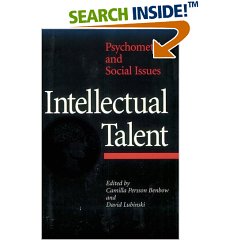 Dr. Benhow has also co-edited and contributed to a heady volume called Intellectual Talent: Psychometric and Social Issues. The introduction has this provocative title, "Politial Correctness and the Zeitgeist: Genetic Antecedents to Human Behavior," and the closing chapter is written by none other than the famous racialist, Arthur Jensen, who began his fame in 1969:
Jensen's most controversial work, published in February 1969 in the Harvard Educational Review, was titled "How Much Can We Boost I.Q. and Scholastic Achievement?" It concluded, among other things, that "head start" programs designed to boost African-American IQ scores had failed, and that this was likely never to be remedied, largely because, in Jensen's estimation, over 70% of the within race IQ variability was due to genetic factors, and the 30% left over was due to non-shared environmental influences (e.g., prenatal drug exposure, placental nutrient competition when there are multiple births).
Small world. Wonder if Dr. Benbow and her National Math Panel Committee will find any credibility in research that shows the advantages of heterogeneous classroom practices? Wonder if the slow learners of math will get the same kind of math as those who show great promise for advancing our human capital? Wonder if you would call this kind of science the " research" that will be used to justify the scientifically-based racism of no expectations? Wonder if this is the future we will choose for ourselves? Wonder if anyone cares?
There is a review of Intellectual Talent: Psychometric and Social Issues on Amazon that you might want to read. It ends with this gush:
Egalitarian educationalists have met their match in applied psychometrician-psychologists. At no cost to dull or mediocre children, brighter children can be helped by programmes of fast track learning. Large-scale experimentation should now commence. Treating children according to their abilities and attainments to date would almost certainly convey wide benefits; and merely allowing parents to choose their children's tracks would quickly end the sorry dumbing-down of state education and the betrayal of intelligent children in the English-speaking world.
Going Haywire
Nearly all states are building high-tech student data systems to collect, categorize and crunch the endless gigabytes of attendance logs, test scores and other information collected in public schools — and the projects in some states seem to have gone haywire.
In North Carolina, a statewide school computer system known as NC WISE is years behind schedule, and estimated costs have risen to $250 million. Teachers have nicknamed it NC Stupid. California has spent $60 million on a system, and officials estimated that the state would spend an additional $60 million in coming years to help school districts connect to it.
And in Idaho, a private foundation spent $21 million on a data system for the public schools but pulled out when estimated completion costs hit $180 million.
"It metastasized way beyond the original concept," said Jason Hancock, an education analyst for the Idaho Legislature. "Costs ballooned, and the funders just pulled the plug."
Based on my own collection of data over the past four months as a student teacher in a suburban New Jersey high school, I would say student test scores are likely to continue going down. Severe budget cuts have eliminated resource room teachers, art, drama, and all non-tenured history and English teachers. The one copy machine for teachers is often breaking down and there aren't nearly enough computers for the 1,500 students or up-to-date technology in classrooms. Perhaps when the Departments of Education across the country finally get their student/teacher tracking systems in place, they can calculate how many students' test scores have gone down because of a redirection of resources into tracking student test scores.
For all those who busy wringing their hands over the "mysterious" drop in SAT scores as if it was a national tragedy, perhaps it's time to funnel some of the billions in resources being used to prop up this failed education policy into what every educator knows really works. There's plenty of good, solid research based on facts and information that might solve this mystery.
Unfortunately, in the metastasizing, cancerous minefield of NCLB, the promise no child will be left behind and the clever distraction of a never-ending discussion about falling and rising test scores, serve as a camouflage for the tyranny of corporate interests like those of Bush's friends at McGraw Hill who bank on things going haywire.
Sunday, May 14, 2006
Texas Republican Speaks Truth on Testing
Cheri Isett (R-Lubbock) Speech

I recognize that I am the most junior members of the House and for me to
speak in this manner, I know,  is highly unusual. However, this may be
the only opportunity I have to address this body on a matter that I feel
is of utmost importance and lies deep within my heart.  In fact, what
I’m about to say to you, I believe, is so important that I’m going to
read it rather than speak freely as I’m accustomed to doing.

HB1 is a good bill. I am wholeheartedly behind reducing and restraining
the growth on the egregious burden of property taxes in Texas.  I was
glad to vote for it.  Carl stayed up way past his bedtime to watch the
passage of HB1 and be a part of this historic legislation which you all
have worked so hard on.

But there is something in this bill which grieves my heart.  Something I
believe we will pay dearly for in generations to come. That is the
education reform measures which, although well meaning, will be to the
detriment of Texas children.  I am eager to see Texas children grow and
increase in knowledge and education. My goodness, I have seven of them.
I earnestly desire for the generation being raised up now to have
greater opportunities than there were for the generation before them.
But I believe we are on a misguided path with increases in standardized
testing and mandated course work.

I know,  we all know, the utter frustration from parents and teachers
and students over increased regiments and standardized testing.  I
believe we would all agree that studying to a test and regurgitating is
not a true education.  We would all agree that the minds of Albert
Einstein, Ben Franklin, Thomas Edison, Samuel Morse, Bill Gates, Steve
Jobs, Michael Dell would never have tolerated such infliction upon
them.  They would never have allowed their creativity and their courage
to step into unknown territories to be held back by the boxes that we
force our school children to conform into.

These children were created by God to be unique individuals with unique
gifts and talents. They are aching to break free from the tyranny of
standardized tests and curriculum “scope and sequence” and express those
gifts and talents.  But we have legislated them out.  We have told the
artist that he has to pull back and cut back on blossoming in his chosen
art because he doesn’t have time.  He has to take another math and
science class.  We have told the very, very bright entrepreneur that his
pursuits are worthless because he is not a good test taker and pulls our
school ratings down.  We have told our teachers that they are not good
teachers and don’t deserve merits for their efforts because the artists
and entrepreneurs in their classes don’t deliver the goods in test
results.

There is a whole world of knowledge and all of history to study.  We
could never impart all of it to every child.  There’s just too much of
it.  So who has the right to determine what body of knowledge has
merit.  Who was it anyway that said “every seventh grader needs to know
all the parts of the cell and their function.”  Why is that more
important than, say, the intricacies of weather systems.  And why are
either of those more important than any other body of knowledge which
delights the heart of a child.  Who gives merit to one body of knowledge
over another.  And yet, through our essential skills and standardized
tests, we praise one type of learner and condemn another.  We tell our
classroom teachers that it doesn’t matter that you want to reach the
heart of a child . We want you to mold his mind to conform to what we
believe is a productive, college-prepped student.

I challenge you, Members, in sessions to come as you discuss these
crucially important matters, to break out of the box.  We can no longer
afford to measure education success in terms of test results and
rigorous curriculum.  In that arena, countries like China clearly have
us beat.  They are disciplined, they are structured, they can produce
multiples of what we can produce cheaper – not better, but more of it
and cheaper.

The one thing other cultures lack which we possess and which we must
fight to hold on to is creativity, imagination, and courage.  These are
the things which we must foster in education if our children and our
nation are to survive.  We need minds that are nurtured in discovery,
not rote memorization. We need individuals who are able to muster the
courage to go where others have never gone.  We need to quit trying to
cookie cutter every child in Texas schools and let the God given, God
led creativity and excellence flow out.  We need to trust teachers to do
what they have been called to do and quit micro-managing them. When it
comes to accountability measures in exchange for state funding, we need
to hold school administrators responsible for their stewardship of those
monies, not place the onerous burden of performance on the shoulders of
those who at this point are victims in this debate, the students and
their teachers. We need to quit telling parents that their child is a
failure because he’s not raising our school’s ratings with his test
results.

What I’m challenging you with will in itself require creativity and
courage to do.  In the sessions to come, I’m challenging you to trust
that children are naturally curious and creative.  Trust that if we as
adults get out of their way, they will discover and grow in their world
every bit as much between the ages of 6 and 18 as they did from birth to
age 5.  We need to give the teachers in their classrooms the support and
discretionary funding to explore and discover with their students. Not
funding for more bureaucracy, but funding to buy state of the art
equipment to learn on, funding to backpack over Guadalupe Peak,  funding
to build a boat from scratch and sail it across a big lake.  We need to
appreciate the value of apprenticeships and accordingly, to loosen child
labor laws enough to provide for them. We need to stop burdening
children with standardized testing which we would all have to honestly
agree is not the measure of a true education.

Members, this is a big challenge.  I’ve seen more intellectual firepower
in this room in the last three weeks than I’ve ever seen in one place
before.  For the sake of our children, for the sake of our nation let’s
use that firepower to find a better, more creative, more productive way
to approach education reform than the road we’ve been on.

Thank you for allowing me to speak from my heart.
Rove Has Two More Days

Saturday, May 13, 2006
Talk Is Cheap
- NCLB is wrong because it does not "fix poverty."
- Schools are doing everything right and the reason that disadvantaged children do less well in school than their more advantaged peers is entirely due to their economic circumstances.
We must make two broad points:
- socioeconomic reform is crucial
- school-based reform is equally crucial
NCLB focuses exclusively on school-based reform, completely ignoring the inextricable link between students and the reality in which they are immersed (their homes and neighborhoods).
Joseph Bottini, a retired teacher who spent 35 years in the classroom, posted recently to the Assessment Reform Network (ARN) list: “If a kid comes to school high, tired, hungry, abused, jaded, or otherwise not ready to focus, the best teacher in the world can't be successful with too many of them. It is not the kids, teachers, school or not even the tests; it's the life they are living. Tests do little more than tell us what we already know and steals time away from teaching/learning.”
NCLB, through initiatives such as Reading First, defines "school-based reform" as an obsessive focus on basic skills like phonemic awareness. Such "reform" comes at the expense of a comprehensive education that all students need to grow and thrive. The recent report from the Center on Education Policy confirms what many of us already knew anecdotally, that such "reform" comes at the expense of non-tested subjects such as history, music, and foreign languages. Most disturbingly, this narrowing of the curriculum occurs most often in schools with high percentages of poor minority students, the very subgroups that NCLB was ostensibly designed to serve.
In order to accomplish substantive school-based reform, we need to focus on the factors that most contribute to the reasons why schools struggle in the first place. Do schools struggle because children are not as phonemically aware as they need to be, or is something more substantive involved? As has been consistently emphasized, one basic yet powerful reform is class size reduction: make classes smaller, especially in urban school districts, and watch what happens.
Of course, making classes smaller means creating a lot more classes. More classes means more buildings. And more buildings means more teachers. More classes, buildings, and teachers means a lot more money. Quite a lot more.
We can also commit as a nation to improving the quality of teacher preparation and dedicate the funds necessary to provide on-going, high-quality professional development to people charged with shaping the future of our country, i.e., teaching our children.
Guess what? This will cost a lot more money, too. Quite a lot more. Richard Rothstein, in his book Class and Schools, estimates it will cost somewhere around $156 billion.
But this is not a money issue. This is a political will issue. Love him or hate him, George W. Bush summoned the political will to invade Iraq and commit more than two billion dollars per week to its care and feeding . . . with no end in sight. On occasion, a voice such as Senator Russ Feingold’s is heard, raising objections to this new adventure in imperialism. But by and large, we do not say, “This costs too much.” The reason? Because it is believed to be vital to our national security. And so we spend whatever it takes to get it done.
But for the cost of a year and a half in Iraq, we can create smaller classes, we can train and support teachers, and we can take substantive actions towards closing the educational achievement gap.
And why would we do this? Because it is vital to our national security to do so.
So the Bush administration can talk all it wants to about its educational priorities, about how much it wants to leave no child behind, and the need to stay competitive in the global marketplace by improving math and science education. But as long as the federal government contributes a paltry 10% to the education of America's children, such talk is cheap.
Boycott NCLB or McGraw-Hill?


There is good reason for SRA/McGraw-Hill to move into damage control over the dis-invitation of Patricia Polacco at the recent IRA Conference in Chicago. The New York Times has picked up the story, and school librarians are mad as hornets about the bare-knuckled arrogance that M-H has exhibited in this most recent assault on freedom of speech, that is, speech that comes up against that big NCLB gold-plated gravy train that SRA/M-H is riding. Not a good move, SRA/M-H--you don't alienate those people who are in charge of selecting the books that go into every children's collection in every library in the world. From the Times:
Even the most non-partisan onlooker would be impressed by the monetary connection between M-H and a federal education policy (NCLB), that same policy that appears now to be off-limits to M-H authors who are critical of the policy. One must wonder if SRA/M-H would have had the same slamming-door reaction if Patricia Polacco had planned to plug NCLB in her speech, or any of the vast catalog of materials that M-H is marketing to all the desperate school systems across America who have shifted their purchasing priorities from children's literature to the scripted reading instruction.Ms. Polacco says the publishing house, McGraw-Hill, a sponsor of the convention, canceled her contract for two appearances because of its dual role as book and test publisher. McGraw-Hill says it only sought to stop an author with an agenda from turning its exhibit at the reading convention into a political platform.
"I see teachers across the country, and they come up to me with tears in their eyes and say we used to be able to do creative things" before the emphasis on testing that came with No Child Left Behind, Ms. Polacco said, explaining why she wanted to talk about the law. She accused McGraw-Hill of trying to benefit from her popularity yet censor her views. "If they want someone to stand up and say how wonderful No Child Left Behind is, then hire someone who feels that way," she said.
Here is part of the message that M-H left in the comments box at Schools Matter yesterday:
Ms. Polacco chose not to honor her commitment to SRA/McGraw-Hill. Shortly before the event, she began insisting that she wanted to use her appearances as a platform for expressing her personal views on public education policy. We respect her right to express her ideas; however, since the SRA educational presentations were focused on writing and children’s books, SRA did not believe that its exhibit booth was an appropriate forum for a public policy speech. Ms. Polacco’s statements about this event are inaccurate and unreasonable.On the face of it, it would seem that there is nothing more relevant to the writing and reading of children's books than to challenge a national policy (NCLB's Reading First) that is intended to replace children's literature with the relentless chain gang de-coding Code embraced by the pseudoscience of Engelmann/Carnine, the marketeers of the DIBELS miracle, and SRA/M-H's own entry to straightjacket learning, Open Court (teachers refer to it as Open Cult for good reason).
SRA’s intention was to have Ms. Polacco deliver four presentations that would inspire the people who have the greatest impact on educating our children – classroom teachers.
Obviously, "inspiring the people who have the greatest impact on educating our children" would require Ms. Polacco to pretend that her own publisher is more interested in literature than it is in supporting the national drive to brainwash children for purposes of economic exploitation.
Did I fail to mention that McGraw-Hill owns Standard & Poors, which owns School Matters (not ever to be confused with this weblog), where you can find out where all the poor people in America live simply by looking up school test scores.
(Updated 12:09 pm)
Friday, May 12, 2006
The Charter School Biz Takes A Hit From the Times
In the article I highly recommend in the February issue of School Administrator, Larry Cuban writes:
Deceit and fraud are harder to cover up when elected school boards are obliged by law to consider, debate and make decisions in public. Of equal importance, school board decisions are subject to media and public scrutiny. Not so in the private sector where corporate leaders are often appointed by self-perpetuating boards of directors who make decisions behind closed doors without public hearings or journalists in attendance.Taken in the context of the growing incidence of corruption in the charter school biz, this statement would appear nothing less than prophetic had such corruption been anything new. Cuban, of course, knows that it is not, but, rather, that corruption has provided the underpinning of the bad education actors for much of the previous century.
What a week for corruption in the charter biz it has been! Take your pick of these stories on what was billed the next great excuse not to fix the public schools:
GARY – Parents are asking state officials to audit a charter school and many kept their children home from classes because of a series of disagreements with administrators.
Nearly one-third of the 220 students who attend 21st Century charter school in Gary were kept home Tuesday after parents complained about the school’s curriculum, a lack of promised technology and problems with faculty.
The first-year school, operated by the GEO Foundation, changed principals and recently suspended teachers for disciplining a student with drumsticks.
. . . . Alyce Butler, president of the school’s board, said the charter school is experiencing first-year growing pains.
Whose pain was that, Ms. Butler?
BRIGHTON, Colo. -- An Adams County charter school official was charged with six felony counts and one misdemeanor Thursday in connection with the theft of more than $72,000.
The Adams County District Attorney's Office announced the charges that came at the conclusion of a three-month investigation involving Katie Squair, 51.She is the founder and former business manager of the Community Leadership Academy and was accused of using checks, wire transfers and debits to embezzle money from the school, which opened in August of 2005. . . .
From Midland, Pennsylvania:
MIDLAND - Allegations of misuse of public money made by a fired consultant for the Pennsylvania Cyber Charter School will be looked at by the Pennsylvania Department of Education, a department spokeswoman said Wednesday.From Annapolis, Maryland:
La-Verna Fountain said the education department has been made aware of allegations against the online school and is going to "review what's taking place or what has been alleged. We're very clear that these are allegations at this point."
In a pending lawsuit in Beaver County Court, Michael Barney claims the contract between the cyberschool and his management company, Rodis LLC, was improperly terminated.
The former consultant to the Midland-based Pennsylvania Cyber Charter School claims that taxpayer money meant to fund the school is being used to pay for building the Lincoln Park Performing Arts Center and to start the National Network of Digital Schools, a nonprofit corporation started by Nick Trombetta, who also is chief administrative officer of the cyber charter school and Midland School District's superintendent.
In a letter to Trombetta in March 2005, Barney claims his company was fired because he brought "several financial, legal and ethical irregularities" to Trombetta's attention, including expense reports that were "in shambles," funneling money into the performing arts center and other entities, and billing discrepancies. . . .
From L.A.:Citing "substantial" evidence of discrimination against disabled students - and even more against American-born teachers - Anne Arundel school officials Monday threatened to close one of the county's two charter schools next year if it doesn't shape up soon.
The Board of Education gave the Chesapeake Science Point Public Charter School 30 days to prove that the unfair treatment has stopped, records are being properly kept and its finances are in order.
"There is evidence that the school leadership attempted to persuade the parents of a student to withdraw from the school based on his status as a student with disabilities," wrote school board President Konrad M. Wayson and interim Superintendent Nancy M. Mann in a letter dated Friday.
The letter - sent to the math-and-science-focused academy in Hanover on Monday - is the second time this year school officials have threatened to shut the doors to its 102 students for good, but some billed it as a final chance for the school's founders to keep it in business.
It follows a series of inquiries into the school, including an investigation into allegations that its former director, Jon Omural, treated teachers unfairly, and an in-depth financial audit. Mr. Omural has since left the school. . . .
The LAUSD board will consider today setting up a better oversight system to monitor charter schools, which could lead to the closing of a number of charters with low test scores and financial problems."When the inspector general looks at the finances of a couple of these schools, it may result in some charters being pulled," said board member Jon Lauritzen, who has pushed for increased scrutiny of the alternative schools that operate independently from the district.
And then comes an editorial from the New York Times on Wednesday focusing on the shortcomings of the new miracle drug intended to eradicate public education. Is Brent Staples on vacation, or what:
. . . . Even states with disastrously low-performing charter systems can point to a handful of outstanding schools. But several studies have shown that on the whole, charter schools perform no better than other public schools. Beyond that, some states have opened so many charter programs so quickly that they can barely count them, let alone monitor student performance. Where charters have clearly failed, the states often lack the political will — or even a process — for closing them down.
The oversight issue has become crucial since the passage of the No Child Left Behind Act, which requires students in charter schools to meet the same standards as students in traditional schools. But getting a handle on the problem is going to be difficult for states like Michigan, which has become a textbook example of how sloppily administered charter programs can harm students and undermine faith in both the chartering process and public education in general.
Michigan quickly opened more than 200 schools under one of most liberal charter laws, and the program has been riddled with problems from the start. A multistate study by the Evaluation Center, a well-known research group at Western Michigan University, describes charter schools in Michigan, Ohio and some other states as actually having a negative impact on student achievement.
The study also finds that states with charter programs dominated by for-profit education companies have poorer results for those schools in terms of performance and accountability.
This spells bad news for Michigan, where three-quarters of the charter schools are run by commercial companies, which have been criticized for turning away disadvantaged and disabled students and for failing to release test data that would allow education officials to check performance. The Legislature, which appears to be losing faith in the whole idea, refused to raise the cap on the number of charters. But it also declined to provide the money that would have allowed the State Education Department to do better monitoring of the charter schools that already exist.
The Michigan and Ohio cases will probably show that it is much more difficult to improve failing charter schools than to put them together properly in the first place. That fact has clearly registered on states like Connecticut and Delaware, which have wisely taken a cautious approach to chartering schools outside the usual public system.
Promising charter systems are few. But those that exist have some things in common: The states issue charters only after a rigorous screening process. They provide technical assistance to the schools, especially on procurement matters. And they provide sophisticated oversight — with regular and systematic data collection — to make sure that the schools are actually working.
So far, the national experience with charter schools shows that they are not a magical solution to the achievement problem. The only way to improve public schooling is to provide well-trained teachers and orderly schools, and to monitor them to make sure that the students are actually learning. To salvage the charter movement, the states will need to abandon the strategy, now discredited, that consists largely of giving public money to what are basically private schools and then looking the other way.
Thank you. As the scales fall away from the eyes of the editorial writers at the Times, perhaps they might go a single step further to suggest it is time to get back to the business of rebuilding the public education system that has sustained an unrelenting bombing campaign since the fundamentalist thugs came to Washington 1980. That is when both God and the Invisible Hand of the Free Market got high-jacked by a bunch of greedy hyprocrites and hucksters who drove the democracy to the precipice we now face. Save the Republic.
Thursday, May 11, 2006
Linda Schrenko Goes to the Pen
Darling of the Georgia Far Right and defender of Christian values, Linda Schrenko, cut a deal with prosecutors yesterday to plead guilty in exchange for eight years in prison for stealing $600,000 in state education money intended for deaf students while State Superintendent of Schools. It was for good reason, though. She got a face lift. Poor Linda. The story:
ATLANTA — A former Georgia state school superintendent accused of embezzling $600,000 and spending it on a face-lift and an unsuccessful campaign for governor pleaded guilty Wednesday and will serve eight years in prison.
Linda Schrenko, 56, struck a plea bargain in the middle of her trial. The trial continues for two alleged accomplices.
Prosecutors said Schrenko stole federal education money to underwrite her 2002 GOP campaign for governor, cosmetic surgery and other extras, including a television, computer and a down payment on a car.
Schrenko pleaded guilty to one count each of money laundering and fraud. She was originally charged with 40 counts, including conspiracy. She and her lawyer had no comment.
But this editorial from the Atlanta Journal-Constitution nails it:
Will Bush have a medal to pin on her for her service to the sacred cause of phonics instruction--before she goes to prison?Former state school Superintendent Linda Schrenko won election twice by promising to infuse a wanton Department of Education with conservative Christian values. To her, apparently, that meant having an affair with her second-in-command, hiring her friends for cushy DOE jobs and stealing a half-million dollars from students to finance her failed 2002 Republican gubernatorial campaign and a face-lift.
For her sins, Schrenko is going to jail. Despite the embarrassing defense that her lover duped her into breaking the law, Schrenko pleaded guilty Wednesday to defrauding the government and money laundering. She accepted eight years in prison and waived her right to appeal.
The cost to Georgians goes far beyond the $600,000 that Schrenko now admits stealing. During her eight years at DOE, the agency squandered at least $50 million on useless technology. A former teacher and principal, Schrenko surrounded herself with cronies whose main qualification was their loyalty to her. Her paranoia and her pettiness drove out education professionals. She slandered the PTA, bickered with Democrats and Republicans alike and fought every effort by the Legislature to reform Georgia schools. . . .