"A child's learning is the function more of the characteristics of his classmates than those of the teacher." James Coleman, 1972
Showing posts with label school curriculum. Show all posts

Tuesday, March 01, 2022

The Hillsdale Curriculum: Adult Mythology as Children's History

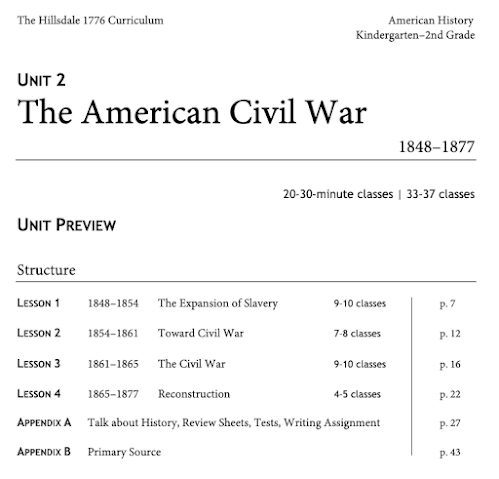
For the antiquarian curriculum crafters at Hillsdale College, it's never too early for children to start absorbing the lies and distortions that have warped American history to conform to the self-imposed ignorance of white Americans who refuse to admit the truth. Therefore, the mythologized glories of our past are to be administered beginning in kindergarten and continuing throughout high school and college. Below is the Introductory page from the K-2 unit on the Civil War era:


Now if all this seems a little ambitious for first graders, you'd be right, of course.  But child development is not a specialty or even a concern for the classical masters who reconstructed this 19th Century historical mythology for the special "benefit" of kindergartners who end up unfortunate enough to be enrolled in schools that utilize the kind of blatant propaganda that Governor Bill Lee would like to feed to Tennessee schoolchildren.  

This curriculum is built on discarded and/or discredited renditions of America's past that seek to sanitize the American history, beginning with the American founders and their Puritan forefathers.  You may see for yourself by downloading the curriculum for free.

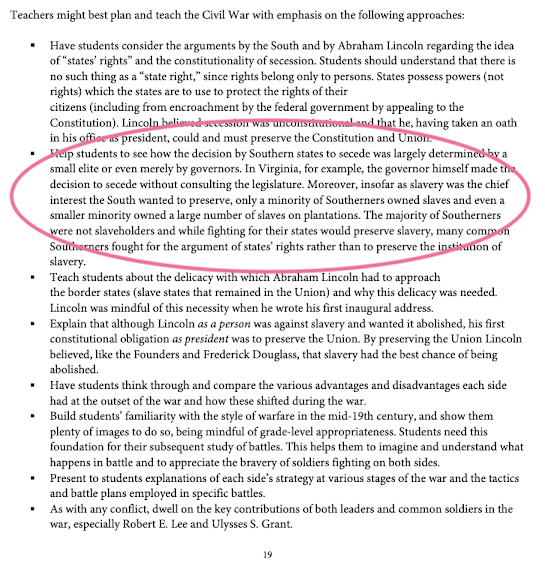
Below is an example of the developmentally inappropriate "approaches" that the curriculum wizards at Hillsdale have put together.  I have circled one of the many examples of discredited and discarded historical distortions that minimize the systemic nature of humans owning other humans and the role that that reality played in slave owners' desire to go to war to preserve the perversity of that economic and social arrangement. 

In this example below, teachers are urged to take the "approach" with K-2 children, no less, that most Southerners were not slaveholders and that they were actually fighting to preserve "states' rights."  I know, you probably thought that rotted chestnut had been discarded. Think again.

This is what Governor Bill Lee wants Tennessee elementary school teachers to provide our students. 

Just for the record, the 1860 U. S. Census shows that 30 percent of Southern families owned other humans.


Thursday, November 05, 2009

Marion Brady on the One Reason Dunc's "Race" will Fail

From Valerie Strauss's blog at the Washington Post:

My guest today is Marion Brady, veteran teacher, administrator, curriculum designer and author. He writes about Education Secretary's Arne Duncan's "Race to the Top" initiative, intended to be the successor to "No Child Left Behind."

By Marion Brady
When "Race to the Top" fails, as it will, the main reason won’t be any of those currently being advanced by the corporate interests and politicians now running the education show.

It won’t fail because of lack of academic rigor, poor teaching, weak administrators, too-short school year, union resistance, differing state standards, insufficient performance incentives, sorry teacher training, or lingering traces of the early-20th Century Progressive movement.

It will fail primarily for a reason not even being mentioned by leaders of today’s reform effort: A curriculum adopted in 1893 that grows more dysfunctional with each passing year. Imagine a car being driven down a winding rural road with all the passengers, including the driver, peering intently out the back window.

The familiar, traditional curriculum is so at odds with the natural desire to learn that laws, threats and other extrinsic motivators are necessary to keep kids in their seats and on task.

It has no built-in mechanisms forcing it to adapt to change. Ignoring solid research about their importance in intellectual development, it treats art, music, dance, and play as "frills."

It isolates educators in specialized fields, discouraging their interest in and professional dialog about the whole of which their specializations are parts. It fails to explore questions essential to ethical and moral development.

It neglects important fields of study, and has no system for determining the relative importance of those fields it doesn’t neglect.

Its failure to reflect the integrated nature of reality and the seamless way the brain perceives it makes it difficult to apply what’s being taught to real-world experience.
And that barely begins a list of the problems.

There’s no easy, quick fix, but one thing is certain.

Doing with greater diligence and determination what brought America’s schools to their present state will simply move forward the day when failure becomes obvious to all. There are, however, some things Congress and the administration could do.

First, they could stop basing education policy on the opinions of business leaders, syndicated columnists, mayors, lawyers, and assorted other education "experts" who haven’t passed the 10,000-hour test-10,000 hours of face-to-face dialog with real students in real classrooms, all the while thinking analytically about what they’re doing, and why.

"Experts" who see more rigor, more tests, more international comparisons, more "data-driven decision-making," more math and science, more school closings, more Washington-initiated, top-down reform policy as the primary cure for education’s ills, are amateurs. And policymakers who can’t see the perversity of simultaneously spending billions on innovation and billions on standardization should consider finding other work.

Second, Congress and the administration could accept the fact that, in formal schooling, the curriculum is where the rubber meets the road.

No matter school type-public, charter, private, parochial, magnet, virtual, home, whatever; no matter the level-elementary, secondary, college, or graduate school; no matter first-rate physical facilities, highly qualified faculty, enlightened administrators, sophisticated technology, generous funding, caring parents, supportive communities, disciplined, motivated students, no matter anything else affecting school performance, if the curriculum is lousy, the education will be lousy.

Third, Congress and the administration could stop for a moment, think, then acknowledge what they surely must know, that the key to humankind’s survival is, at it has always been, human variability.

Trying to standardize kids by forcing them all through the same minimum standards hoops isn’t just child abuse. It’s a sure-fire way to squeeze out what little life is left in America’s public schools after decades of appallingly simplistic, misguided, patchwork policy. Maximum performance, not the minimum standards measured by tests, should be the institution’s aim.

Anything less invites societal catastrophe.

If Congress and the administration are wise, they’ll use their levers of power not to tighten but to loosen the rigor screws and end the innovation-stifling role of Carnegie Units, course distribution requirements, mandated instructional programs, and other curriculum-standardizing measures.

They’ll do what enlightened school boards have always done and say to educators, "We want you to unleash creativity, ingenuity, resourcefulness, imagination, and enthusiasm, and send the young off with a lasting love of learning. Tell us what you need in order to make that happen, and we’ll do our best to provide the necessary support."

Even the suggestion of such a policy will appall many.

We say we’re big on freedom, democracy, individualism, autonomy, choice, and so on, but advocating aligning our schools with our political rhetoric invites being labeled as too radical to be taken seriously.

Such a policy, most are likely to believe, would trigger chaos, pandemonium, anarchy.

Not so. Two things would happen.

In most schools, institutional inertia, entrenched bureaucracy, and pressure from powerful corporate interests, would maintain the status quo.

In most schools, but not all. A few would point the way to a better-than-world-class education by demonstrating what experienced teachers have always known, that the traditional curriculum barely scratches the surface of kids’ intellectual potential.


You can reach Marion Brady at www.MarionBrady.com.
Wednesday, May 14, 2008

"ruining children's futures and leaving them unprepared for the world of work"

From The Independent on a new report of results from the British testocracy, which is a few years ahead of where we are headed:
Tuesday, 13 May 2008

Teaching to national curriculum tests is ruining pupils' futures and leaving them unprepared for the world of work, says a report released today by a group of MPs.

The Labour-dominated Commons Select Committee for Children, Schools and Families warns that the "inappropriate focus" by teachers on test results could rob pupils of a well-balanced education.

"We received substantial evidence that teaching to the test, to an extent which narrows the curriculum and puts sustained learning at risk, is widespread," the MPs state. "The way that many teachers have responded to the Government's approach to accountability has meant that test results are pursued at the expense of a rounded education for children.

"One serious consequence of teaching to the test is that it tends to lead to shallow learning and short-term retention of knowledge." The report adds: "In the worst cases, teachers may resort to dull and boring methods of teaching, using the looming threat of examinations to motivate pupils rather than inspiring them to learn."

The result of this has been a "disproportionate focus" on the core subjects of English, maths and science and "those aspects of these subjects which are likely to be tested in an examination" than all others.

The MPs, however, stop short of calling for an end to national curriculum tests – taken by all pupils at the ages of seven, 11 and 14 – saying that they find the arguments in favour of a system of national testing to be "persuasive". Instead, they say, it is the uses to which the test results are put – such as drawing up league tables of primary schools' test results and the targets set for individual schools' performance – that need a drastic revision.

"The drive to meet government targets has too often become the goal rather than the means to the end of providing the best possible education for all children," they argue.

It calls for further incentives for schools to acknowledge pupils' achievements in other aspects of the curriculum.

On league tables, the report advocates publishing them with a "health warning", telling parents not just to consider the raw results but coupling the publication of the tables with relevant comments from the latest report on the school by Ofsted, the education standards watchdog.

Opposition MPs and teachers' leaders claimed, however, that the report's evidence meant the test regime – shown by the MPs to be the most rigorous in the Western world – should be pruned.

Paul Holmes, Liberal Democrat MP for Chesterfield and a member of the Select Committee, said: "This report is a scathing indictment of the highly negative effects of the Government's high stakes testing regime coupled with league tables. It highlights the destructive effects of teaching to the test in order to hit prescribed Government targets."

The Schools minister, Jim Knight, said that the tests were "evolving" and a national pilot of new testing arrangements for 11-year-olds, whereby they could sit them when their teachers believed they were ready to take them rather than face "sudden death" end-of-year tests, had been launched.

The committee warned that these new "single level" tests would still hamper schools in their attempts to introduce a broader curriculum if they were going to be held accountable for the results.

Monday, February 25, 2008

The Incredible Shrinking Curriculum

Press release from CEP:
WASHINGTON—February 20, 2008—Last summer, a groundbreaking report verified what many in the education and policy communities had long suspected: that a majority of the nation’s school districts were increasing time spent on reading and math in elementary schools since the No Child Left Behind Act became law in 2002, while most of these districts cut back on time spent on other subjects. Today, a follow-up report issued by the Washington, D.C.- based Center on Education Policy provides an unprecedented look at the magnitude of those changes.

In its earlier report, CEP found that a majority of school districts—62 percent— had increased time for English language arts (ELA) and/or math in elementary schools since school year 2001- 02. Meanwhile, 44 percent had increased time for ELA and/or math at the elementary level, while simultaneously cut ting time from one or more area s including science, social studies, art and music, physical education, recess, and lunch. CEP’s new report, Instructional Time in Elementary Schools: A Closer Look at Changes for Specific Subjects, examines the size of the shifts in those districts, in order to determine just how extensive the changes were.

According to the report, districts increasing time for ELA and math had done so by an average of 43 percent , or about three hours each week. To make room for the added time for ELA and math, districts reducing time in other areas averaged cuts of about 32 percent across those subjects, nearly 2.5 hours each week. Some of the districts reduced their time in one subject, while other districts decreased instructional time in several areas.

“We knew that many school districts had made shifts in the time spent teaching different subjects since the No Child Left Behind was enacted, but we had little evidence of the magnitude of these changes within those districts,” said Jack Jennings, president and CEO of CEP. “Digging deeper into the data, we now know that the amount of time spent teaching reading, math and other subjects has changed substantially. In other words, changes in curriculum are not only widespread but also deep.”

Wednesday, August 15, 2007

Flat Worlds, Poison Toys, and Political Thinking

What happens when you depend upon businessmen to make educational decisions, businessmen whose prime motivation in life is the never-ending uptick in corporate quarterly earnings? You end up with a politically-and-artistically- denuded curriculum that's heavy on science, math, and technology--and short on everything else. Welcome to Achieve, Inc. and the Business Roundtable's new vision of the American high school.

When the world got flat, you see, the pedagogical braintrust, not at Teachers College, but the one at the U. S. Chamber of Commerce, made the determination that economics is the only social studies that matters in school anymore, and that if we need to emulate China's totalitarian tunnel vision in order to achieve its level of productivity, then so be it. Cardboard dumplings, poison toys, anti-freeze toothpaste, melamine animal feed, slave labor, environmental disaster, political repression? It's what maximum efficiency and amazing economic engines are built on, according to the Business Roundtable. China's your best example--nobody does it better.

I went in K-Mart the other day, and everything I picked up had an American brand and was made in China. I could not find anything not made in China. I wondered what cost-cutting poison was waiting to be brought home in these pillows and camp stoves, and I wondered how many workers died in forced labor camps in order to have this row of 40 gleaming bicycles, all under a hundred dollars. I finally found a shirt made in Nicaragua. I bought it and left.

Anyway, I found this interesting story today in the NY Times on some pedagogical developments in India that the geniuses at Achieve, Inc. probably haven't heard about, either. There, politics, real politics is being used in Indian high schools to teach and learn critical thinking. And students are eating it up. So, too, are their teachers. Maybe the world is not flat--maybe it never was.

A clip:

NEW DELHI, Aug. 14 — Quietly, a great upheaval is taking place inside Indian high schools.

For the first time, the messy brawl that is modern Indian politics, including some of its ugliest and most controversial episodes, is being taught in political science class. It is part of a broader revision of the school curriculum, with potentially long-lasting implications for how Indian children grasp the workings of their nation and its place in the world.

Using cartoons, newspaper clippings and questions that invite classroom debate on thorny contemporary issues, the new curriculum comes at a time when democracy has firmly rooted itself in Indian soil and is indeed one of the nation’s principal selling points as it tries to assert itself in the world. India marks the 60th anniversary of its independence from Britain on Wednesday.

“Sixty years after independence, it’s a statement of maturity of Indian democracy,” said Yogendra Yadav, one of the two chief advisers to the political science textbook committee. “This couldn’t have been written 30 years after independence. This probably couldn’t have been written 15 years ago.”

Shikha Chhabra, 16, offered an example from her new 12th-grade textbook, “Contemporary World Politics.”

She said she had always been taught that the nonaligned movement, in which India played a leading role during the cold war years and countries carved out at least a rhetorical policy of independence from both the Soviet Union and the United States, was “a wonderful thing.” The new textbook, she noticed, treats it differently. “Now they raise the question — does the nonaligned movement really apply in the world today? Was it just fence-sitting?”

She decided that it no longer applied, joining a contemporary hue and cry among politicians and political observers in this country about the merits of India’s new friendship with the United States. The class had a rich debate about the pros and cons of aligning with the Americans. It came during a chapter called “U.S. Hegemony in World Politics.”

“You do question what India’s strategy should be,” Ms. Chhabra said.

Her teacher, Abha Malik, head of the political science department at the Sanskriti School here, pounded on the textbook, which the National Council of Educational Research and Training, a government agency, rolled out four months ago for both public and private schools. “You can’t have a regular, regular class with this,” she said, beaming. “This book won’t let you sit still.”

In a country where rote learning has prevailed even at the most elite schools, the new emphasis on critical thinking signals a major shift in pedagogy. More striking is the substance of the new curriculum. Before, the emphasis in political science was on political theory. “This is realpolitik,” Ms. Malik said. . . .

Is "hegemony" on the vocabulary list of the Achieve curriculum? Didn't think so.