"A child's learning is the function more of the characteristics of his classmates than those of the teacher." James Coleman, 1972

Tuesday, February 08, 2022

Cash to Poor Families and Early Childhood Brain Activity

In a randomized controlled study, new research finds "causal impact" between decreasing poverty and increased brain activity of young children. 

Significance

This study demonstrates the causal impact of a poverty reduction intervention on early childhood brain activity. Data from the Baby’s First Years study, a randomized control trial, show that a predictable, monthly unconditional cash transfer given to low-income families may have a causal impact on infant brain activity. In the context of greater economic resources, children’s experiences changed, and their brain activity adapted to those experiences. The resultant brain activity patterns have been shown to be associated with the development of subsequent cognitive skills.

Abstract

Early childhood poverty is a risk factor for lower school achievement, reduced earnings, and poorer health, and has been associated with differences in brain structure and function. Whether poverty causes differences in neurodevelopment, or is merely associated with factors that cause such differences, remains unclear. Here, we report estimates of the causal impact of a poverty reduction intervention on brain activity in the first year of life. We draw data from a subsample of the Baby’s First Years study, which recruited 1,000 diverse low-income mother–infant dyads. Shortly after giving birth, mothers were randomized to receive either a large or nominal monthly unconditional cash gift. Infant brain activity was assessed at approximately 1 y of age in the child’s home, using resting electroencephalography (EEG; n = 435). We hypothesized that infants in the high-cash gift group would have greater EEG power in the mid- to high-frequency bands and reduced power in a low-frequency band compared with infants in the low-cash gift group. Indeed, infants in the high-cash gift group showed more power in high-frequency bands. Effect sizes were similar in magnitude to many scalable education interventions, although the significance of estimates varied with the analytic specification. In sum, using a rigorous randomized design, we provide evidence that giving monthly unconditional cash transfers to mothers experiencing poverty in the first year of their children’s lives may change infant brain activity. Such changes reflect neuroplasticity and environmental adaptation and display a pattern that has been associated with the development of subsequent cognitive skills.

This latest finding is consistent with a body of research that shows direct correlations between family wealth, family income, school funding, and child academic achievement levels.  

It is sickening to think that monthly federal tax credit payments to families with children have been discontinued due to white privileged intransigence among anti-democrats.  The cutting of child poverty in half, which the program promised to accomplish in just a few years, could have been the greatest education reform of the past half century--if education reform were actually meant to help the disenfranchised, rather than holding them accountable for the educational problems that the white power establishment created.

Monday, January 24, 2022

How to Learn Nothing from the Failure of VAM-Based Teacher Evaluation

The Annenberg Institute for School Reform is a most exclusive academic club lavishly funded and outfitted at Brown U. for the advancement of corporate education in America. 

The Institute is headed by Susanna Loeb, who has a whole slew of degrees from prestigious universities, none of which has anything to do with the science and art of schooling, teaching, or learning.  

Researchers at the Institute are circulating a working paper that, at first glance, would suggest that school reformers might have learned something about the failure of teacher evaluation based on value-added models applied to student test scores. The abstract:

Starting in 2009, the U.S. public education system undertook a massive effort to institute new high-stakes teacher evaluation systems. We examine the effects of these reforms on student achievement and attainment at a national scale by exploiting the staggered timing of implementation across states. We find precisely estimated null effects, on average, that rule out impacts as small as 1.5 percent of a standard deviation for achievement and 1 percentage point for high school graduation and college enrollment. We also find little evidence of heterogeneous effects across an index measuring system design rigor, specific design features, and district characteristics.

So could this mean that the national failure of VAM applied to teacher evaluation might translate to decreasing the brutalization of teachers and the waste of student learning time that resulted from the implementation of VAM beginning in 2009? No such luck.  
 
The conclusion of the paper, in fact, clearly shows that the Annenbergers have concluded that the failure to raise test scores by corporate accountability means (VAM) resulted from laggard states and districts that did not adhere strictly to the VAM's mad methods.  In short, the corporate-led failure of VAM in education happened as a result of schools not being corporate enough:

Firms in the private sector often fail to implement best management practices and performance evaluation systems because of imperfectly competitive markets and the costs of implementing such policies and practices (Bloom and Van Reenen 2007). These same factors are likely to have influenced the design and implementation of teacher evaluation reforms. Unlike firms in a perfectly competitive market with incentives to implement management and evaluation systems that increase productivity, school districts and states face less competitive pressure to innovate. Similarly, adopting evaluation systems like the one implemented in Washington D.C. requires a significant investment of time, money, and political capital. Many states may have believed that the costs of these investments outweighed the benefits. Consequently, the evaluation systems adopted by many states were not meaningfully different from the status quo and subsequently failed to improve student outcomes.

So the Gates-Duncan RTTT corporate plan for teacher evaluation failed not because it was a corporate model but because it was not corporate enough!  In short, there were way too many small carrots and not enough big sticks.
 

Wednesday, January 19, 2022

British Study Finds Phonics Fanaticism "is uninformed and failing children"

 A new British study reported in The Guardian finds that the imbalance created by dependence on phonics in reading instruction to the exclusion of balanced literacy approaches effectively limits children's comprehension and understanding of what they read, children's desire to read, children's appreciation of books, and their reading achievement scores. 

So what's not to love about concentrated phonics instruction, especially for disenfranchised children?  After all, it is best child neurological training regimen for a life without independent thinking, individual initiative, a broad understanding of how the world works, or the capacity for imaginative problem solving.

The study concludes with a call for national reading curriculum and instruction policy control to be removed from appointed officials whose job it is to pursue an education agenda based on political ideology rather than empirical evidence. How quaint!

From The Guardian:

A landmark study has described the way primary school pupils are taught to read in England as “uninformed and failing children”, calling on the government to drop its narrow focus on phonics.

Researchers at UCL’s Institute of Education say the current emphasis on synthetic phonics, which teaches children to read by helping them to identify and pronounce sounds which they blend together to make words, is “not underpinned by the latest evidence”.

They claim analysis of multiple systematic reviews, experimental trials and data from international assessment tests such as Pisa suggests that teaching reading in England may have been less successful since the adoption of the synthetic phonics approach rather than more.

The UCL researchers are among 250 signatories to a letter which has been sent to education secretary Nadhim Zahawi, calling on the government to allow for a wider range of approaches to teaching reading, which would allow teachers to use their own judgment about which is best for their pupils. . . .


Monday, January 17, 2022

New Sex Crimes Charges Against Another KIPP Teacher

In August 2021, the Southern District of New York announced sex crimes charges against a former Bronx KIPP teacher, Jesus Concepcion, who is now facing 10 years to life on one charge and 15 years to life on another. 

Both federal charges involve sex crimes with KIPP middle school students. From the Justice Department Press Release last August:

CONCEPCION, 48, of Simpsonville, South Carolina, is charged with four counts of enticing a minor to engage in illegal sexual activity and four counts of transporting a minor to engage in illegal sexual activity, each of which carry a mandatory minimum sentence of 10 years in prison and a maximum sentence of life in prison.  CONCEPCION also is charged with inducing a minor to produce child pornography, which carries a mandatory minimum sentence of 15 years in prison and a maximum sentence of life in prison.

Then, in December of 2021, another KIPP teacher, Cesar Sanchez, was charged in Manhattan Criminal Court with sexually molesting students at KIPP Washington Heights, beginning when one girl was in fourth grade. 

Both Sanchez and the principal of KIPP Washington Heights, Danny Swersky, have been fired. Both were suspended temporarily in 2019 for an undisclosed misconduct charge that occurred during a school trip.

Three major news outlets have carried the KIPP sex abuse stories, but not the New York Times, which most often can be counted to remain mum about charter school abusers and predators.

The latest sex crimes charges follow on the firing of KIPP co-founder, Mike Feinberg, in 2018 amid accusations of sex assault against a KIPP middle school student.

Sunday, January 16, 2022

KIPP, Inc. Seeks More Handouts from Public Schools

 Last updated 01/17/22

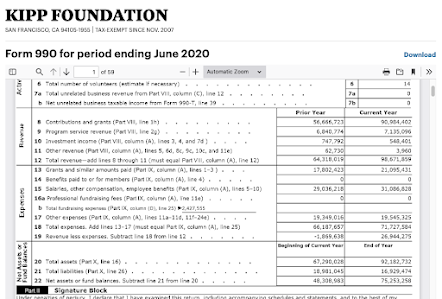
The KIPP Foundation is flush with cash.  Over the past 20 years, KIPP has received dozens of federal grants worth hundreds of millions of dollars.  In 2019, alone, KIPP has handed a whopping $86 million by the U.S. Department of Education.  

And on top of the hundreds of millions of dollars in per pupil funding each year that public school system pay out to the corporate welfare kings of the charter world, the KIPP Foundation took in $90 million in grants and tax exempt donations just in 2020.


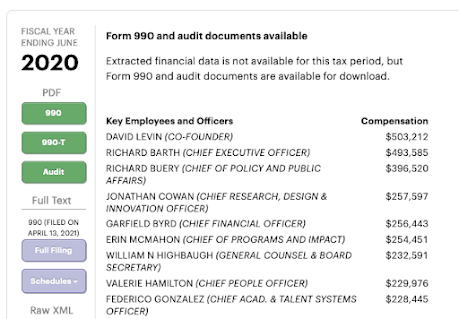
That same year KIPP, Inc. paid its top nine executives over $3 million in salaries, which does not include benefits, bonuses, and travel expenses. David Levin, alone, rakes in more than the President of the United States.
 
 
So it would seem surprising to anyone who doesn't understand KIPP's insatiable greed and dedication to racial sterilization that KIPP would elbow its way past a school board's unanimous decision to reject another KIPP chain gang back in 2020.  Here's the school board's thinking at the time of the vote to reject:

Kaivan Yuen, assistant superintendent for educational services, recommended the board vote to deny the request for a number of reasons, including:

  • There was no indication on how teachers can manage time and structure to hold student conferences while also providing lessons to the other students.
  • Noncredentialed teachers are responsible for a classroom the last Friday of each month.
  • There is insufficient time for students who are learning to speak Spanish.
  • There is no program for gifted students
  • KIPP’s special education program relies entirely on membership in getting approved for a program based in El  Dorado County and its petition does not adequately explain what happens if KIPP doesn’t get in.
  • No details were provided for physical education classes.
  • There is no description of a specific health unit or curriculum.
And what happened to KIPP's plans to open a new school after its successful appeal to a state level commission that the charter industry has packed with charter school supporters?  Well, not much.  Seems KIPP decided to save money by piling in on an existing elementary school in the Montebello School District, where it quickly sought, and achieved, a reduction in the amount of rent charged by the District.
 

Monday, January 10, 2022

The Sunny Side of Corruption by Jay Mathews

American print media's most prominent charter school cheerleader is at it again.  In his most recent Washington Post column, Jay Mathews is preaching the virtues of IDEA Charter Schools, Inc., which recently lost its CEO founder and other senior leaders due to corruption charges involving private jets, NBA sky boxes, and routine use of public funds for "personal benefit:"

A financial investigation “uncovered substantial evidence that … a small number of IDEA senior leaders directed the use of IDEA financial and staff resources for their personal benefit on multiple occasions,” Board Chair Al Lopez wrote in a letter Tuesday. “Furthermore, their actions appeared to be done in a manner to avoid detection by the standard external audit and internal control processes that the Board had in place at the time.”
None of this corruption or efforts to conceal the crimes could ever dampen Jay's enthusiasm, however.  Nor has Mathews departed from his unique brand of dissembling propaganda. Just one example from this latest column:

Charters are independently run public schools that use tax dollars. Most are no better academically than regular public schools. But a 2013 Stanford University report showed that 25 percent of charters were significantly better in reading achievement and 29 percent were significantly better in math achievement than neighboring regular public schools serving the same kinds of students.

When we go to the actual research report that includes Jay's numbers, we find the details that put a whole new light on Jay's sunny summary.  From the Credo Study, 2013, p. 22 Executive Summary:

Figure 8 shows the performance of charter schools relative to the TPS in their market. Based on our analyses, we found 25 percent of schools had significantly stronger growth than their TPS market counterparts in reading, 56 percent were not significantly different and 19 percent of schools had weaker growth. In math, the results show that 29 percent of charter schools had stronger growth than their TPS market counterparts, 40 percent had growth that was not significantly different, and 31 percent had weaker growth. These results were an improvement over those in the 2009 report.


Sunday, January 09, 2022

New Year's Resolution: Eliminate "Rigor" from Education Lexicon

If there is a single word that comes close to capturing the zeitgeist of corporate education austerity policies that have metastasized since the Reagan era (among both Democrats and Republicans), it would be a five-letter signifier that has done more damage to effective and humane schooling than any one word in the English language: "rigor." 

If you can believe the education efficiency zealots of the last two generations, the answer to most questions about schooling have the same answer: more "rigor." Whether we're talking about curriculum, teacher quality, teacher education, leadership, or assessment, what we need is more "rigor."

I went to Webster's online looking for a word that might serve as an adequate replacement.  Here's some of what I found for the word "rigor:"

Synonyms & Antonyms of rigor

2. the quality or state of being demanding or unyielding (as in discipline or criticism)
  • after being coddled by his former coach, the swimmer was shocked by the rigor of the new training program

Synonyms for rigor

Words Related to rigor

Near Antonyms for rigor

Antonyms for rigor

And, yet, there seems to be no end to the use of this code word for segregated "no excuses" KIPP Model schools, "zero tolerance" straight jacket discipline, and racist standardized testing regimes that effectively keep marginalized populations on the margins.

Today I came across an interview with Amanda Ripley, who has become one of the pretty masks placed on the corporate education Frankenstein that continues to wreak havoc with any efforts to transform schools into substantive learning communities aimed at opening and integrating the world for children in challenging and supportive ways.

In the summary provided for her interview, Amanda praises the "rigorous learning" of Korean students.  What does Amanda know about Korean education? Well, she interviewed a student who lived in both Korea and the U. S.:
Kids rise to the level of their peer culture when it comes to how important they think rigorous learning is. Especially adolescents are extremely focused on what their peers are doing. There’s a great example of a girl I met in Korea named Jenny, who had lived half of her life in the U.S. and then moved back to Korea. And what she talked about was how different she was in each place. In Korea, everybody worked really hard and took school really seriously, so she did too. And then in [America], school was much lower on her priority list.

No, Amanda, students in Korea try to rise to the level of the monstrous system created by a steroidal version of American capitalism, which has created a dystopian regime whereby parents sacrifice the health and well-being of their children for the "rigorous" demands of a soul-crushing system of schooling based on memorization and recitation.   

This is from a former teacher in one of Korea's hagwons, or cram schools:

Cram schools like the one I taught in — known as hagwons in Korean — are a mainstay of the South Korean education system and a symbol of parental yearning to see their children succeed at all costs. Hagwons are soulless facilities, with room after room divided by thin walls, lit by long fluorescent bulbs, and stuffed with students memorizing English vocabulary, Korean grammar rules and math formulas. Students typically stay after regular school hours until 10 p.m. or later.

Herded to various educational outlets and programs by parents, the average South Korean student works up to 13 hours a day, while the average high school student sleeps only 5.5 hours a night to ensure there is sufficient time for studying. Hagwons consume more than half of spending on private education.

Any Ripley hit job wouldn't be complete without an attack on teacher education programs in the U. S. While she decries the continued existence of non-rigorous "mediocre teacher training colleges," she has nothing to say about the micro-preparation provided to Teach for America beginner missionaries who are placed into schools with children who need the most experienced and best prepared teachers among us. Nor does she voice any objection to the exploitative non-higher ed alternative certification programs that leave would-be teachers less prepared than accredited university programs. 

Finally, one of Ripley's conjectures remains truly puzzling to me, even considering her thorough lack of understanding of how schools actually work and how teachers experience their jobs:

Anyone who has seen a great teacher or been a great teacher knows that it is not different from being the CEO of a company; there is a lot that is demanded of you and it requires a lot of support.

Yes, Amanda, "rigorous" teaching is sort of like being a CEO, except for the pay, the prestige, the perks, the lifestyle, and the autonomy. Teachers in the U.S. rank 27th in teacher pay among 32 OECD countries.  

I'm still looking for a substitute for "rigor." Until I find it, I guess I'll settle for challenging, supportive, substantive, open, and integrative.

Friday, October 15, 2021

Education Reform Outcomes: Segregation and Child Punishment

One year after the Supreme Court's ruling in Brown v. Board of Education, Milton Friedman published The Role of Government in Education (1955), a screed in which Friedman laid out for the first time a case for school choice and government-funded school vouchers. Amazing timing, right?

That publication marked the beginning of the modern school reform movement, which has produced an impressive array of ideas and strategies whose primary effects have been to maintain segregation and to punish disenfranchised children.

But, you say, what about a good intentions of reformers like Bobby Kennedy, Jimmy Carter, and Barack Obama? And my response will always be, so what? 

How long will we continue to try to assess reformers' intentions, rather than focusing on the outcomes and the effects of reforms?

We know, in fact, what's the road to hell is paved with, and I gave up along time ago trying to determine what is in another person's heart. I am only interested in examining the outcomes of actions and/or inactions of actors whose unconscious motivations remain invisible to themselves and others. 

Meanwhile, here is a clip from the latest example of another upending of a reform idea that sounded good to some people at the time that it was implemented:

Idesha Fraser was proud to hear that a teacher at P.S. 282 in Park Slope had recognized her fourth-grade daughter’s academic potential and transferred her into the school’s Gifted and Talented program. Still, she had misgivings. Fraser’s daughter had been one of many Black students in a diverse classroom, but when she started in the Gifted and Talented program in September, she was one of only a few Black students in a predominantly white classroom.

“They’re drastically different. It’s very visible,” said Fraser. “My daughter hasn’t mentioned it to me — we haven’t talked about skin color — but she’s pretty intuitive. I’m pretty sure she notices it.”

Which is why Fraser cheered Mayor Bill de Blasio’s announcement last week that New York City would be ending its Gifted and Talented programs, acknowledging that they had exacerbated racial segregation in the city’s school system. The numbers are stark: While Black and Latino students make up nearly 60 percent of the city’s 65,000 kindergarteners, they fill just 14 percent of the 2,500 Gifted and Talented seats. About 75 percent of the seats go to Asian American and white students, who represent only 25 percent of the citywide population.

If you can think of an education reform from the past 65 years that is not 1) segregative, or 2) harmful to children, please let me know about it. 

Friday, September 17, 2021

Teaching the Facts and Historical Contexts on Constitution Day

 Visit the Zinn Education Project for more, including lesson plans and resource links:

#TeachTruth 
About Constitution Day

For example, in Texas, House Bill 3979, which went into effect Sept. 1, requires that teachers tell students that slavery and racism represented “betrayals of, failures to live up to, the authentic founding principles of the United States, which include liberty and equality…” The state of Texas — and many others — now require teachers to lie to students.

In fact, Black lives did not matter to the rich white men who met in 1787 to write the U.S. Constitution. About 40 percent of them were enslavers — including George Washington and James Madison, the so-called father of the Constitution. Although this document never mentions “slaves” or “slavery” — or race — the men assembled in Philadelphia made sure to hammer slavery into the foundation of the country they were building.

The kidnapping and forced transport of enslaved human beings from abroad would be continued until at least 1808. (And even then, the internal slave trade would continue to be legal.) Anyone fleeing slavery and subsequently apprehended “shall be delivered upon claim of the party to whom such service or labor may be due.”
At a Georgia #TeachTruth teach-in, Decatur High School graduation coach Jennifer Young invited people to write on the sidewalk. Young said, “What we would love for you to do is cover the sidewalk with whatever you learned today, because that’s not being taught in your school and it can be taught in the Square. The reason we are using chalk today is because this is just like history. If we’re not careful, it can all get washed away.” Photo by Dean Hesse.
No. The U.S. Constitution was a document of oppression for enslaved people. But in more and more states, it is against the law for students to learn this from the curriculum.

On this Constitution Day, let’s commit ourselves to teach the truth. Let’s look deeply and critically at how this document may have offered a republican form of government for some, but denied humanity to others, and contributed to the system of white supremacy we still need to dismantle.

Monday, September 06, 2021

Teacher Writes about Hellish Conditions at Knoxville School

 A Knoxville kindergarten teacher wrote this disturbing letter on conditions at her school.  She shared it with the Board of Education and state legislators from her area. 

I know we have met before, but I am ——————, and I teach kindergarten at —————-. I have taught here for 7 years, and I love everything about this community. But right now I am literally wishing someone had a reason to fire me or I had a reason to quit. It is not the mask issue, it is not contact tracing, it is the fact that there are literally massive attendance problems - and I am talking teachers because there are no subs in KCS.

At the board meeting, many were saying the absences aren't that bad and teachers can handle it. I can assure you - this is not true. I currently have a class of 20 five year olds, where 17 of them speak a different language at home, and 6 of those speak zero English at all. I say this because staff absences that are not covered by subs make a difference to these kids. They NEED their ESL hour. Before today, for two days one of our ESL teachers was out sick with no sub. We also have our kindergarten TA out sick with no sub. Our ONLY principal (no vice principal) is out the whole week as one of her family members is dying - no sub there either. Both of our custodians are out sick - we have one sub, who bless him, is trying but cannot do it alone understandably. A day ago, even worse, on top of that we had a first grade teacher and special areas teacher out with no sub. With so many out and no coverage the result is this... -I have cried everyday on my way to work and back home because I am in so much distress. -I missed half of plan time covering and figuring out a plan for special areas class for a TA to implement. -For 3 days, I had a 10-15 minute lunch because there was not enough staff to cover lunch duty. -Yesterday, I bled through my clothes because I was unable to get someone in my room to cover a bathroom break on time. -Our ELA coach and pre-k coach that are shared with other schools are now here (after I called one begging and crying to her to ask permission to help us) trying to be the principal and fill all positions with no subs. -My classroom has not been vacuumed or swept or mopped in 3 days. The floors today were covered with food from previous days (and we already have mice and roaches here), moldy milk/rust black goo liquid stuff all over the floor from trashcans that aren't able to be taken out. Milk bucket filled with 2 day old smelly milk sitting in the hall still. - VERY unhealthy and nasty conditions -During instruction today, I had to get the custodial mop and mop my floors and hope kids didn't slip because they were that disgusting. Other teachers borrowed the vacuum to clean their floors. The ONE sub custodian did everything he could, but it is not reasonable to give one man that expectation. -I wore a LITERAL adult diaper to school today in case I couldn't get coverage in time for the bathroom because I didn't want to bleed through clothes again. -Our angel of a school secretary is doing everything she can to fill needs, aka mop up spills in classrooms, change kids who had accidents, help with behavior students, find staff to help when no one responds on the walkie. -Dismissal at the end of the day started late because we did not have enough staff to hold and open car doors for kids while also watching them in the school. -Having NO time to learn and teach the new Benchmark series (which btw is making us teach parts of speech to 5 year olds and wants us to read articles instead of actual picture books), assess all of my kids on aimsweb (which btw is making 20 five year olds with no english take a whole group 15 question multiple choice test - took an hour), complete my 3 page required TIGER reflection/learn the new evaluation system, video every child's letters and sounds for the annual required and new kindergarten portfolio, make a canvas page (which apparently we need and have time to make), make a seating chart for my room and cafeteria, write a DCS report and call for a child in my class, contact every parent to get them to return their chromebook agreement, oh and just actually teach my kids and love them. So all in all, I know this sounds like me venting and being annoying. But, to be honest, this is me sticking up for my kids. Because me being a custodian, a lunch monitor during my lunch, a specials teacher, and everything else, means my kids don't get a teacher that can be there for them and actually teach. It is not right. I don't care why they say they choose to do it, but KCS needs to take a week off and either find subs, let people get better, or make a plan because THIS, no teachers or subs (let alone students), is NOT OKAY. Or at the very least, they can send board members to help fill these positions, provide teacher bathroom breaks, and help at dismissal. I hope you get this email - I know you are probably flooded with them. And I know there is nothing you personally can do on your own - but just knowing there is SOMEONE on the board who cares and is willing to listen and not DENY what is happening in schools helps me feel a little better. Because the last email I sent to the superintendent (which was short, sweet, and kind - asking if there was a plan because teachers can't be successful right now) was replied to by A higher up with a generated response and a call out for me to talk to my principal who she then CC'd on the email (I am assuming to make me feel like I would get in trouble, and that my principal should keep me in line - none of which is true and my principal is out with her dying loved one). Anyways, thank you for caring. And you were right - I was literally teacher of the year at my school last year, and even I can't/don't want to do this anymore. Something needs to happen or change FAST. And not that you would - but please do not CC my principal, she is busy with her family emergency and deserves that time. And please, keep my name anonymous if you share this email/my frustrations with anyone. I don't want to get in trouble, and I don't want anyone else to get in trouble because of me.”