"A child's learning is the function more of the characteristics of his classmates than those of the teacher." James Coleman, 1972

Thursday, November 16, 2006

Science and Urban Children

No doubt national testocrats will use the following piece as some kind of twisted justification to argue for national standards (science and otherwise) and national testing. Would those same educational standardistas argue for policy measures to end poverty in urban America, rather than some half-measure to exacerbate the stupidification of America's children? I think not, since those standardistas who aren't whores for the testing industry are so enamored by the myth that schools can end the achievement gap, they would never even consider the fact that there is little that schools can do alone to change the reality that poor kids are behind other kids in science and every other subject. (It will be be interesting to see how Austin, TX has managed to be different--I wonder if it has anything to do with a policy of economic integration.) Anybody know what's going on there?

At least half of eighth graders tested in science failed to demonstrate even a basic understanding of the subject in 9 of 10 major cities, and fourth graders, the only other group tested, fared little better, according to results released here Wednesday.

The outcome of those tests, part of the National Assessment of Educational Progress, often called the nation’s report card, showed that student performance in urban public schools was not only poor but also far short of science scores in the nation as a whole.

Half or a little more of the eighth-grade students in Charlotte, San Diego and Boston lacked a basic grasp of science.

In six of the other cities — New York, Houston, Chicago, Cleveland, Los Angeles and Atlanta — the share of eighth graders without that knowledge was even higher, ranging from about three-fifths in New York to about four-fifths in Atlanta. By comparison, the corresponding share for the nation as a whole was 43 percent.

Among the 10 cities, only in Austin were the eighth graders who lacked a basic understanding in the minority, and just barely there.

“It’s a national disgrace,” said Rodger W. Bybee, director of the Biological Sciences Curriculum Study, which develops and evaluates science curriculums and promotes the teaching of science. “We as a nation should be able to do better than that.” . . .


Educators Must Get Political

Most teachers want to teach but in the current environment, teachers and educators are going to have to start thinking more and more about the connection between politics and education and in fact, take a more prominent role in politics if they want to preserve what they cherish and value the most -- education and the interests of the children they teach.

In honor of American Education Week, here's a column from one teacher, Jan Abelove in Pennsylvania, who would prefer to spend more time working on creative and valuable lesson plans but finds herself becoming a political activist as well.
-----------------------------------------
This is American Education Week. Historically, it is a time to recognize and celebrate the successes of local public schools. But it is also a time to reflect on the state of public schools, locally and nationally.

As a veteran educator, I have watched the cycle of public education revolve for more than 30 years. New education reforms come and go, and there is continued discussion about adequately funding our classrooms.

However, the one constant in public education is the influence of politics. This year's theme for American Education Week is "Great Public Schools: A Basic Right and Our Responsibility." The theme is aimed at raising awareness in our communities about the critical need to provide every child with a quality public education.

The only way we can truly achieve this goal is through the political process. On Election Day, public-education supporters went to the polls and made their voices heard by electing many pro-education candidates.

During the campaign, Pennsylvania State Education Association members supported pro-education candidates by putting signs in their yards and talking to friends and neighbors about the issues and the candidates.Education employees got involved because we know that every decision in education is a political decision.

Consider the passage of the new property tax reform law, Act 1. The landscape for public education is changing because of Act 1. School districts will now have tighter time lines and less flexibility for school budgets.

The most worrisome part of Act 1 is the potential for referendums for tax increases above a certain index. This means public-education supporters will have to expend time and energy waging public campaigns to persuade voters to raise their taxes for school programs. In other states with the referendum provision, a failure at the polls has resulted in the elimination of nonmandated programs such as art and music.

For educators and students, this can be devastating.

Along with Act 1, public educators are dealing with the demands from the No Child Left Behind law and the increasing focus on test scores.

There is no question that public education is inherently political. In all the debate and rhetoric, however, it seems that we have lost sight of what really matters: doing what is best for the children.

American Education Week is an appropriate time to reflect on the political nature of our public schools.

Educators do not choose their profession with any desire to be involved in politics. It is, however, a reality, and none of us can escape it.

For many public-education supporters, being politically active is uncomfortable and time-consuming, but it is necessary.

If we truly care about children, everyone who cares about the state of public education needs to get politically
involved.


This means recruiting pro-education candidates for school boards, campaigning for pro-education state and federal candidates, writing letters to legislators and speaking out about necessary reforms.

I think great public schools represent a basic right for every child, and it is my responsibility as a teacher, community member and taxpayer to use my political power to achieve this goal.

Ed Reporter Startled by 5-Year Old Facts

This from the Hickory Daily Record:

NEWTON - Only a handful of parents to elementary school-aged children attended a meeting Tuesday night that could have significantly improved their children’s testing scores.

The meeting at Balls Creek Elementary School was designed to educate all parents about the testing children undergo in school, particularly third-, fourth- and fifth-grade students.

One startling fact that surfaced during the meeting is that all students are expected to be at 100 percent proficiency in reading and math by 2014.

Another surprising statistic: there can be multiple subgroups, and children can be put into more than one. If one student doesn’t meet proficiency, and is in more than one subgroup, then every subgroup the student is in fails.

If you really want to get a parent turnout, scribble some posters and stick them up around the supermarkets:
COME TO PARENT MEETING TO END SCHOOL TESTING MADNESS!

Wednesday, November 15, 2006

Reading First Crooks Beware

A salute to Cindy Kupp in the New York Times, which now after the election feels that it is safe to do a story on the unprecedented corruption at ED's Reading First. It was Cindy whose sleuthing helped to get the ball rolling on nailing the crooks at Reading First, some of whom are still employed at ED, and none of which has been indicted yet:

. . . .When the federal government enacted Reading First in 2002, Dr. Cupp thought her company would surely get a slice of the pie. After all, 90 percent of students in the schools that use her kits had learned to read by the end of first grade.

The federal program emphasized phonics — mastering the sounds of letters and letter blends — as opposed to what officials considered the mushiness of whole-language teaching, which emphasizes grasping meaning through good children’s literature. Dr. Cupp’s materials also emphasized phonics — in 60 stories centered on two caped turtles named Jack and Jilly.

That emphasis was on display one day recently in Marie Durrence’s kindergarten at the East Broad Street Elementary School here.

“Jack can see the man play,” Terrica Williams read, pride glinting through her bashful smile.

“Jack can see the man go, go, go,” Kiara Plummer chimed in.

Still, schools that used her materials found themselves frozen out of federal money. Dr. Cupp sought an explanation from a friend at the Georgia Department of Education, where Dr. Cupp was director of reading from 1996 to 1999, and was told, she said, that any school listing her reading program “would not be funded.”

After the federal department repeatedly rejected their grant applications, Georgia officials concluded that “this money is available if you follow the rulebook,” said Dana Tofig, communications director for the Georgia Education Department. Dr. Cupp’s reading program “did not meet the benchmarks it had to meet,” he said, adding that the officials who could explain why no longer worked in the department.

Dr. Cupp points out that Georgia chose big textbook publishers, like Scott Foresman and Macmillan/McGraw-Hill, spurning what she called home-cooked turkey dinners like her reading program. She ended up losing contracts at about a half-dozen schools. Then, she said, by demanding files under Georgia’s open records law, she discovered that a national evaluator had never even looked at her program.

Dr. Cupp’s dealings with the Georgia Education Department are being examined by the federal inspector general. Mary Mitchelson, counsel for that office, said, “We don’t talk about our pending work.” But Dr. Cupp is hoping to get some answers.

Others might have given up when they lost their contract, but Dr. Cupp said she has a strong inclination to resist injustice, rooted in a childhood shadowed by an alcoholic mother. She did not sheepishly accept her fate because she thought she deserved a place.

“We’re not all going to be Wal-Marts and K-Marts,” she said. “I go to the hardware store down the street because I can walk in and say, ‘Help me with this,’ because I know the guy.” So she filed a complaint.

According to Robert E. Slavin, chairman of Success for All, a nonprofit publisher whose phonics-based program is used in 1,200 American schools and who also complained when 200 schools dropped his program in order to get federal money, Dr. Cupp got the ball rolling against Reading First. She “gave us an example and gave us some courage,” Mr. Slavin said.

Last December, federal inspectors came to Savannah, a city graced by sleepy squares and shaded by oak trees dripping with Spanish moss.

Dr. Cupp showed the investigators hundreds of documents she collected over three years that showed links between contractors hired by the federal government to evaluate school reading programs, and the writers of those programs. She also diagrammed these links. Her findings and those of others, including reporters for Education Week, found that consultants hired to help school districts apply for and run Reading First grants sometimes received hefty royalties from the very materials that schools were encouraged to buy.

For example, Dr. Cupp learned that a writer of a Scott Foresman reading textbook selected by schools in Georgia and other states was Edward Kame’enui, a professor on leave from the University of Oregon. Dr. Kame’enui headed a Reading First technical center in Oregon, one of three under contract that help state officials run Reading First programs. Dr. Slavin unearthed financial disclosure forms Dr. Kame’enui filed for 2005 and 2006 showing that he earned between $100,000 and $250,000 a year from Scott Foresman’s parent company, Pearson.

Dr. Kame’enui is now commissioner of the National Center for Special Education Research, an arm of the federal Education Department.

CHAD COLBY, a spokesman at the department, said Dr. Kame’enui’s “role at the department has nothing to do with Reading First anymore, so he’s not giving interviews.”

Dr. Henry L. Johnson, assistant secretary for elementary and secondary education, contends that the universe of science-based reading research is small and would include some textbook writers, but Dr. Cupp argues that it is not so small that blatant conflicts were inevitable.

“It’s like saying there are only six heart surgeons in the United States,” she said. Watchdogs like the Center for Education Policy think Reading First money has generally improved reading. Yet the center has also has found ethical problems with the way the program was run.

Dr. Cupp, a Republican by habit, sees an irony in the fact that an administration supposedly skeptical of Washington bureaucracies that dictate to local governments ended up creating one that did precisely that. She thinks the Reading First scandal “will go down as the greatest flimflam in the history of education.” But she said what drove her was the sheer injustice of evaluators rejecting reading kits that she knew succeeded. Her life has been teaching children to read, and “they were attacking my life.”. . .

Ed and Doug and Reid and Roland and Chris and Susan and Ruth--it's never too late to get fitted with that new orange jumpsuit. So just be patient until the new Congress gets sworn in, the one you thought would never happen until after the scam was completed.

Crude and Thoughtless

In this UPI story, Spellings claims she just doesn't understand all the commotion over her plan to introduce the same crude and thoughtless policies into higher education that now inflict K-12.

Unfortunately for American students, you go to college with the education secretary you have, not the education secretary you wish you had.

What the American taxpayers don't need is more information on colleges but rather more information and transparency on the cronyism and scandals going on over at the Department of Education while Maggie and friends run around the country stirring up "a false sense of crisis."


Spellings said she does not understand objections to her plan, which she says would give families, taxpayers and policymakers more information about the schools they plan to attend or fund, USA Today reported Tuesday.

"If you want to buy a new car, you go online and compare a full range of models, makes and pricing options," she says. "The same transparency and ease should be the case when students and families shop for colleges, especially when one year of college can cost more than a car."

However, David Ward, president of the American Council on Education and a member of the commission that authored the report that Spellings' plan is based on, has accused the education secretary of creating a "false sense of crisis." He said he refused to sign the commission's final report.

Douglas Bennett, president of the Quaker-founded Earlham College in Richmond, Ind., expressed concern that the recommendations, which include tracking individual student progress, could open the door to standardized testing "in a crude, thoughtless way."

Tuesday, November 14, 2006

Arizona Voucher Program Sued

From PFAW:

November 14, 2006 at 202-467-4999 / media@pfaw.org

Lawsuit Filed Against Unconstitutional Arizona Voucher Program

People For the American Way, along with a coalition of allied groups and parents of Arizona students, today filed a lawsuit challenging the constitutionality of Arizona’s publicly funded school voucher programs. The lawsuit challenges two laws which appropriate public money to pay for tuition to private and religious schools.

“This voucher scheme thumbs its nose at the separation of church and state,” said People For the American Way Legal Director Elliot Mincberg. “The Arizona Constitution is very clear that taxpayer money shouldn’t fund religious instruction or private schools. We expect the court to abide by this straightforward constitutional principle.”

The voucher laws in question violate the Arizona constitution by allocating public money to private schools, and by funding religious instruction at taxpayer expense. The Constitution also limits the Legislature to providing for a “uniform system” of public education and prohibits public funding of private or otherwise competing schools or school systems.

“The government shouldn’t be in the position of writing checks to private schools or religious institutions. It’s bad for our government, it’s bad for our students, and it’s bad for religious freedom,” Mincberg said.

Noting that Arizona Superintendent of Public Instruction, Tom Horne, a named defendant in the suit, has publicly acknowledged that the state constitution forbids vouchers, Mincberg added, “We are asking the Court to acknowledge the obvious: the Legislature clearly overstepped its authority.”

The Arizona taxpayers named as individual plaintiffs in the suit are Scott Holcomb, a parent and member of the Governing Board of Madison Elementary School District No. 3, Virgel Cain, a parent of a child with disabilities and a former foster parent and Sandy Bahr. The challenge is supported by the ACLU of Arizona, Arizona Association of School Business Officials, Arizona Education Association, Arizona Federation of Teachers, Arizona PTA, Arizona Rural Schools Association, Arizona School Administrators Association, Arizona School Boards Association and others.

"NCLB is a movement predicated on lies."

Go to Download Video from NDSG.

The Poverty Gap is the Achievement Gap

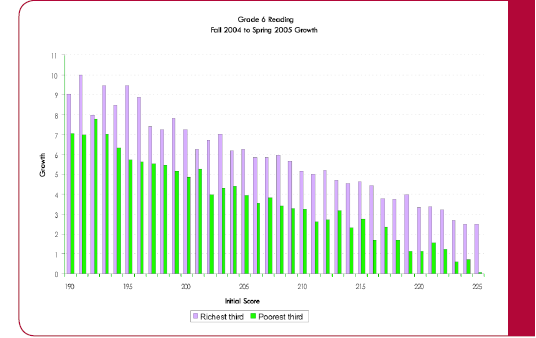
A new study from the Northwest Evaluation Association may help finally bring an end to the lies about using testing and "accountability" to close the ahievement gap. Once again the evidence shows, this time using test scores from over a half-million kids, that the current educational genocide is doing nothing for the poor except leaving them further behind academically, while turning their schools into chain-gang camps that snuff out any remaining pride and hope through repeated failures. Will the reform-by-wishful-thinking crowd at Ed Trust finally get the message? No achievement gap will be closed without addressing the poverty gap because these gaps are one and the same.

Below is the press release, links, and a couple of charts from the study. The first graph (above) shows that "when growth is broken out by initial skill, it is evident that students in minority groups and those in high-poverty schools are not making as much progress during the school year as their peers. The graph . . . is typical of observed growth" (click graph to enlarge). The second graph (below) shows that "during the summer months African-American and Hispanic students and students in poorer schools do not fare as well academically as their peers. The chart illustrates the pattern that is repeated at each grade level in both reading and mathematics for all of the groups studied."
PORTLAND, Ore.--(BUSINESS WIRE)--Northwest Evaluation Association (NWEA) researchers released today a new study on the achievement gap, the difference between the academic performance of students in poor and wealthy schools and between minority and non-minority students. The study revealed that for every group at every grade students from poor schools grew less than students from wealthy schools and minority students exhibited less growth than their non-minority peers.

This study was designed to provide information about the achievement gap from the viewpoints of status (one point in time) and growth (academic improvement following a group over time). When individual student performance is followed across time, it is possible to see the effects of instruction more clearly giving educators better tools for identifying best practices.

The study found that no rate of change/growth in any minority group was sufficiently strong enough to close or reduce the observed achievement gap between groups of students in any substantive way before the end of their K-12 career. While the study shows no evidence that the achievement gap is closing, the intent of the study was not to identify causal factors.

In general, students enrolled in high-poverty schools, African-American students and Hispanic students begin school with lower skills, grow less academically during the school year and lose more skill over the summer than their wealthier and European-American peers. In the case of the African-American students in these samples, the concern carries added emphasis. Their rate of change over the two-year projection was the lowest of all groups, suggesting that the achievement gap between student segments remains a significant problem.

“This study should be a wake-up call for educators, as it reveals real differences in student achievement based on socio-economic status,” said Allan Olson, president of NWEA. “The use of growth data provides a clear picture of individual student growth and helps inform educators on specific areas where students need focused instruction.”

The overall study contains three component studies. The first study looks at group differences between average scores taken at one point in time and between average student growth over the course of one school year. The second study uses a more complex model to evaluate aggregate growth over two years. In the third study both status and growth are examined in more detail with results displayed for each score point. This reveals patterns obscured in aggregate data and shows that growth differences for African-American, Hispanic and students in high-poverty schools are more severe than summary data suggests.

The number of students used for this study was 569,564 for reading and 542,057 for mathematics in 24 states. The first and third studies use data from a set of students in grades 3 through 8 who took Northwest Evaluation Association tests in fall of 2004 and spring of 2005. The second study used student test records from the beginning of grades 4 and 7 for both reading and mathematics for students beginning in the fall, 2003 and continuing through spring, 2005. In addition each student’s ethnic group membership and their school’s percentage of free and reduced-price lunch (FRL) were considered. The FRL percentages were obtained from the National Center for Education Statistics (NCES) Common Core of Data for 2002-2003.

“This study shows that minority and non-minority students who start at the same place are growing at different rates, so the achievement gap between them actually widens over time,” said NWEA’s Chief Research and Development Officer, G. Gage Kingsbury, Ph.D. “Accelerating the growth for high-performing low-income and minority students as well as for students below standard is recommended to close the gap in the short run.”

Study data were supplied through NWEA’s Growth Research Database (GRD), one of the most expansive repositories of longitudinal data on student growth in the country. The database comprises data of interest to education researchers, including assessment data gathered from NWEA member districts. These data provide a detailed look at academic growth and aggregated proficiency levels. In addition, the tests from which the data are derived are more sensitive for low- and high-performing students, giving a more accurate picture of achievement.

In addition to its focus on research to improve assessment and the use of assessment data, NWEA also develops testing systems, including a growth measure called Measures of Academic Progress (MAP), in use at more than 2,400 school districts across the nation. The GRD includes data from the MAP.

The NWEA study builds on findings that this independent national education research group released in April 2005, April 2004 and November 2003. The 2005 study showed student achievement has improved since the No Child Left Behind (NCLB) legislation was passed but student growth has declined slightly. In 2004 the study indicated that Adequate Yearly Progress (AYP) measures are not a complete picture for judging school effectiveness. The 2003 study demonstrated that state standards of proficiency differ substantially from state to state, grade to grade, and subject to subject. These studies can be found at: http://www.nwea.org/research/national.asp.

The new report is available at http://www.nwea.org/research/gap.asp.

Monday, November 13, 2006

Parents for NCLB Reform Respond

A response to Judy's post earlier today:

Parents for NCLB Reform: Focus on the Kids, not the Tests
www.stormpages.com/notest

As a parent, I began investigating the motivation behind the excessive emphasis in our schools on preparing for standardized tests. The No Child Left Behind Act was a bipartisan education reform effort and holds support on both sides of the aisle. Its purpose seems sincere and it’s understandable that most, including our elected officials, would unequivocally support its premise. However, NCLB’s objectives are being seriously undermined by its implementation. My main concern is the reliance on the “one size fits all” testing used to measure the performance of schools and students. When standardized test scores are the only barometer of success or failure it causes serious problems for administrators, teachers and most importantly, the students.

There is overwhelming documented research on the ramifications of schools being evaluated and punished based on test scores. Teachers and administrators are under tremendous pressure to perform well or face NCLB sanctions. To quote our school principal,"When you establish an evaluation process in which the final step is to disband the school and fire the staff when the 100% standard is not reached, it does tend to focus the instructional efforts." As parents, we are seeing a greater focus on basic math and literacy skills, but at what cost? All over the country, administrators are cutting back on the arts, science, history, social studies and literature, to create more time in the classroom for test preparation on these two areas of study. This year, our school eliminated plays. Again, quoting our School Principal,“We all will miss the traditional plays but the testing sets the agenda. More changes will be coming in the future.”

When other parts of the curriculum are systematically removed, what will be left to motivate our children’s desire to attend school? Take into account what children do when they are bored and their creativity is not challenged. One of the major objectives of NCLB is to provide teachers with better training and resources to help them become better educators. However, I increasingly hear stories and read articles about their frustration and concerns that they are being prevented from using their talents in providing an enriched curriculum. Teachers are faced with such great pressure to improve scores that they are left with no choice but to shift their focus away from the individual student to “teaching the test.” While literacy, math and limited areas of science (the areas currently tested under NCLB), are essential components of a child’s education, drilling the basic skills and coaching them to pass a proficiency test does not provide our students with the tools they need to become well rounded self motivated thinkers.

While our politicians will argue that statewide testing is the only means of giving parents an independent assessment and of how well a child is doing in school, I have found little or no evidence to support the argument that standardized test scores are an accurate measure of real learning or better teaching. Consider also how high stakes testing affects our children’s physical and emotional health. We must examine how a learning environment that emphasizes excessive test preparation and pressures students to perform proficiently or face grade retention significantly adds to the normal worries that children face. The NCLB testing requirement promotes a learning environment that diminishes critical thinking, creativity and the social and communication skills that are necessary for the long term learning process. We must concentrate on the children, not the tests. Please visit my website, www.stormpages.com/notest , for information on how we as parents can challenge this political decision.

Testing Poison Sickens Soccer Moms

Since its inception, No Child Left Behind and its emphasis on measuring, testing and standardization has been wreaking havoc on the nation's poorest and most vulnerable school districts but the poison being spewed by a $2.8 billion testing industry and this bad legislation is now infecting wealthy suburban districts.

The question is how long will soccer moms and white collar dads put up with this intellectual and emotional genocide that is destoying the fabric of our democracy by turning students into mindless robots and sucking the joy out of learning and school for most of Americas children? .

For a glimpse into this phenomenon, see today's story in the New York Times on the disappointing experiences of a few families who have fled the cities for the lure of high-scoring wealthy suburban public schools. How much longer will it take for the American public to connect the dots and stand up and say "NO" to reauthorization of NCLB and the testing companies that are profiting from this poison?

Here's a few clips from the story:
------------------------------------------------------------
Only the suburban bargain the Ophirs thought they were getting turned out to be no bargain at all. They chose the Yorktown school system, a relatively well-off district whose students consistently outscore their peers on state tests. But the Ophirs came to view the schools as uninspiring and unresponsive, and now they pay $51,000 a year for their children, 11-year-old Dylan and 9-year-old Sabrina, to attend the private Hackley School here — on top of $23,000 annually in property taxes.

Many parents said they were stunned at how poorly even some well-regarded public schools compared with private schools. They complained about what they considered rigid curriculums, excessive standardized testing and tight budgets that allow for few elective classes and limited foreign language choices. And they said the public schools, powerless to choose who fills the desks, often had less motivated students.

Other parents found the teaching in their public schools unimaginative. Susan Drews, 49, who lives in Yorktown Heights, in Westchester, said that art in the first grade at her son’s public school, for instance, involved “half-baked projects” like gold-sprayed macaroni glued to paper plates. “People went through the motions, they could claim there was an art program, but I didn’t feel it was very rich,” she said.

In contrast, Mrs. Drews said that her son, Sam, now 12, had become a passionate learner at Rippowam Cisqua, where teachers have encouraged his curiosity through projects like building an arch and studying rocks and bones found nearby.
-----------------------------------------------------------------------
Where is the passion to end this madness?