Happy Anniversary!!An increasing number of schools fear stiff penalties in part because NCLB is woefully underfunded. The law has never been funded at the authorized levels, and schools face a cumulative 6-year shortfall likely to exceed $56 billion.
After a reasonable increase in funding in the first year, and smaller increases in the succeeding three years, funding was cut by over $1 billion dollars last year. To add insult to injury, there are more mandates this year that schools must comply with, yet they are receiving less money than they were three years ago.
About 80 percent of school districts said they have costs associated with NCLB not covered by federal funding. Indeed, in this current school year 62 percent of all school districts had their Title I funds cut.
According to the Education Department, 27 percent of schools failed to meet "adequate yearly progress" under the law for 2004- 2005, a one percentage point increase from 2003-2004. NEA's positive agenda calls on lawmakers to provide adequate tools and resources to comply with the law.
Educators, parents and the general public all want positive changes to the law that will help students succeed. According to a recent survey, about 70 percent of NEA members said they disapprove of NCLB and 57 percent said they want major reforms. Most people share their concerns. Nearly six in 10 Americans believe NCLB has had no effect on schools, or has had a negative effect, according to a Phi Delta Kappa/Gallup poll.
NEA has been collecting eyewitness accounts of educators' experiences with the law and compiled them into "ESEA/NCLB: It's Time for a Change! Voices from America's Classrooms," a publication that will be released next week. The stories are from every state, from all size school districts, and from all types of educators, but they raise strikingly similar concerns.
Karol Nyberg, a high school teacher in Grand Forks, ND, said: "It's a professional slap in the face, someone telling you, after you've been working so hard at your craft for 30 years, that all of a sudden you are not qualified to do it.
"But the piece that did surprise me was the number of young teachers who told me they were getting out because they said that 'if they do this to us now, what else are they going to decide to pull when we get further into our careers and don't have any options?'
"They felt that now they have the option to go and do something else, to be treated with more respect, and to make more money at the same time."
Not only do NEA and educators throughout the country have serious concerns about this law, but so do a wide variety of other organizations and policymakers. A coalition of 99 national organizations representing education, civil rights, religious, children, disability rights and other interests have joined together and called for changes to NCLB. The National Conference of State Legislatures last year issued a report criticizing the law and calling for specific changes. And in the previous Congress, 41 bills supported by NEA to amend NCLB were introduced, including several sponsored by Republicans.
Will Potter is a member of the NEA's media relations team.
• Myth No. 1 - No Child Left Behind is working.
Reality: While the Bush administration claims that the No Child Left Behind Act is "99.9 percent pure" and working, in fact, it is leaving children behind and failing to close the gaps in student achievement. Moreover, the law labels students as failing and unfairly punishes schools.
The Civil Rights Project at Harvard University, in a June 2006 report, said, "NCLB did not have a significant impact on improving reading and math achievement across the nation and states É [and it] has not helped the nation and states significantly narrow the achievement gap."
• Myth No. 2 - Schools and educators are spending more time helping students learn and less time filling out forms.
Reality: The Bush administration claimed, when it signed the law, that educators and schools would spend more time teaching and less time doing paperwork. In fact, the opposite is true. Educators and school personnel are spending millions of additional hours and dollars doing paperwork as a result of NCLB. This means less time preparing students and drawing up lesson plans. It means more time drafting compliance plans to submit to Washington bureaucrats.
(According to the U.S. Department of Education, states and schools are expected to spend 6,457,586 burden hours and $135.9 million to comply with the paperwork requirements of NCLB.)
• Myth No. 3 -Congress is providing record levels of funding to schools.
Reality: When Congress enacted the law, it promised to provide the resources necessary to meet the law's many mandates. Unfortunately, it is failing to provide the tools and resources that educators and students need to succeed in an increasingly interconnected 21st century global community.
Congress has been shortchanging states, schools and parents to the tune of $40 billion since the law's enactment. In FY 06 (funding for the 2006Ð07 school year), Congress cut NCLB by over $1 billion, bringing the level of resources available to schools below what was provided three years ago. Both the pending House and Senate FY 07 legislation would cut funding by an additional $400-$500 million. And because of federal funding shortfalls, states such as Connecticut and Ohio are using their own money to close the funding gap.
(In 2005Ð2006, two-thirds of all school districts received less Title I money than they had the previous year. In 2006Ð2007, an additional 62 percent of school districts have had their Title I funding cut because Congress reduced overall Title I funding.)
• Myth No.4 - NCLB is on track to eliminate the achievement gap by 2014.
Reality: With news headlines such as "Schools slow in closing gaps between races," and "What it will really take to close the education gap," the gaps in student achievement remain persistent. According to UCLA's National Center for Research on Evaluation, Standards and Student Testing (CRESST), the "most serious problem is that the NCLB expectations for student achievement have been set unrealistically high, requiring that by the year 2014, 100 percent of students must reach the proficient level or above in math and reading.
"Based on current improvement levels and without major changes in the definition of adequate yearly progress (AYP), almost all schools will fail to meet NCLB requirements within the next few years."
According to a study by the Civil Rights Project at Harvard University released June 2006: Only 24 to 34 percent of students will meet the proficiency target in reading and 29 to 64 percent will meet the math proficiency target by 2014. If the current trend continues, the proficiency gap between advantaged white and disadvantaged minority students will hardly close by 2014. The study predicts that, by 2014, less than 25 percent of poor and black students will achieve NAEP proficiency in reading and less than 50 percent will achieve proficiency in math.
• Myth No. 5 - Educators oppose NCLB, testing, and accountability.
Reality: Educators have supported the Elementary and Secondary Education Act since its inception in 1965, when President Lyndon B. Johnson signed it as part of the War on Poverty. They strongly support the stated goals of NCLB - to improve student achievement and help close the achievement gaps.
However, the rigid accountability system under NCLB focuses excessively on labeling and punishing. Educators are insisting on meaningful accountability, one that's more flexible and comprehensive than the existing one-size-fits-all.
Educators understand that all children can learn but not all children learn in the same way and at the same rate. Meaningful accountability should acknowledge and differentiate between a truly failing school and one that is short on only one of 37 federally mandated criteria.
• Myth No. 6 - Support for NCLB is strong and growing.
Reality: The more Americans know about NCLB, the more they dislike what the law is doing to teaching and learning in our public schools and classrooms. A recent independent poll found 7 out of 10 Americans who are knowledgeable about the law believe it is either making no difference or hurting local schools.
An NEA member poll also found similar results. Nearly half of members polled said that NCLB is hurting the teaching conditions in the schools in which they work, and educators are not alone. One hundred national organizations have signed a joint organizational statement on NCLB that calls for significant changes to the law during reauthorization. In addition, members of Congress from both sides of the aisle have proposed legislation to improve NCLB.
• Myth No. 7- NCLB is improving teaching and learning in America's classrooms.
Reality: Teaching to the test and narrowing the curriculum are only two of the unintended consequences of the fundamentally flawed law. School districts are spending more time on reading and math - the two subjects on which tests are based under NCLB - sometimes at the expense of other subjects not tested.
(According to the Center on Education Policy, 71 percent of districts are reducing time spent on other subjects in elementary schools, and 60 percent of districts require a specific amount of time for reading in elementary school.)
The Partnership for 21st Century Skills said, "The No Child Left Behind Act risks losing relevance if an innovative approach to reauthorization is not pursuedÉ" One of its recommendations is that "NCLB's assessment and accountability system should be based on multiple measures of students' abilities that include 21st century skills."
According to the Thomas B. Fordham Institute, "is anybody prepared to tackle one of that law's most damaging unintended consequences? We refer, of course, to 'the big squeeze'- the compression of the curriculum to little but reading, math and sometimes science. Doubling the time that schools devote to math and reading in response to state and federal testing requirements won't truly prepare young Americans for life in the 21st century. It probably won't even boost reading and math scores in the long term, concluded a conference of policymakers, business leaders, and educators."
Sunday, January 07, 2007
Who Is Accountable for Five Years of NCLB's Failed Policy?

State-Sanctioned Child Abuse in New York
Saturday, Jan 6, 2007
You've heard of the schoolyard bully, the one who picks on the most vulnerable children on the playground?
The big bully today is none other than the U.S. Department of Education, and among the victims are some of Utica's most vulnerable children — those with learning disabilities and those who are new to this country and do not yet have command of the English language.
In a policy shift that reverses long-standing testing practice, the bureaucrats in Washington, D.C., next week will require New York's 60,000 newly arrived English language learners and thousands of moderately disabled students in special education classes to take the same grade-level tests as the general student population.
Requiring children to take inappropriate tests far beyond their current ability will likely have disastrous consequences for Utica schools. With 1,200 students labeled as having limited proficiency in English — 13.4 percent of the enrollment — Utica will be hit particularly hard by this unwarranted, ill-considered policy shift.The likelihood is great that many of these foreign-born students — some living in the Mohawk Valley for just 12 months — will fail the ELA tests. And, because of the unbending accountability requirements in the No Child Left Behind Act, too many failures will mean that Utica city schools will be falsely labeled as "in need of improvement" and penalized by the federal government.
Amazing, isn't it? Despite the efforts of Utica's teachers to help the city's large immigrant population learn English and succeed academically, many of these newly arrived students will fail merely because they are being forced to take an unfair test of their skills. And, as a result, Utica public schools will be labeled as failures.
The real, measurable progress that Utica's schools has been making with these student and others toward closing the performance gap will be obscured. Negative publicity will be devastating for teachers, parents and the city.
What's most frustrating is that policymakers in Washington, D.C., and Albany ignored several alternatives that were educationally sound and endorsed by classroom teachers, including nearly 3,500 who wrote the Regents asking them to stand up to the bureaucrats in Washington.
Teachers fiercely lobbied the Regents and state Education Department to allow English language learners to continue to take an appropriate assessment that would fairly measure their progress in learning to read and write English. This test, which had been used successfully since 2003 and had been recently revised to be better aligned with New York's learning standards, was not even reviewed by the federal government.
Teachers also argued that certain special education students should be required to take tests appropriate to their instruction — not the grade of their non-disabled peers.
Sadly, the Regents chose to let the federal ruling stand.Make no mistake, teachers — and their union, New York State United Teachers — strongly support accountability measures. Teachers support well-designed tests that are aligned with the curriculum, and which fairly measure students' academic progress.
States and school districts should also be held accountable for the performance of all students, including special education students and recently arrived English language learners.
Yet, requiring new immigrant students who are not proficient in English — and students with moderate disabilities -- to take tests they are obviously not able to pass makes a mockery of both the testing and accountability provisions of NCLB.
Expecting a 14-year-old eighth-grader, living in this country for a year, to read and write English as well as a native-born teenager is cruel. Requiring disabled students in special education to be assessed on material several academic years beyond their ability is totally unreasonable. Taken together, it amounts to a concerted effort by the federal government to set vulnerable children and school districts up for failure -- and then penalizing them when they do.
Teachers and parents are natural allies on many issues. In Utica, there must be a strong voice against unfair, unsound and unreasonable testing policies that pick on the weakest. It's time to stand up to the bully.
There is only one option left: Just Say No to Child Abuse!
Jaywalking Historians in Atlanta Beware
On Friday the Tufts historian Felipe Fernandez-Armesto was arrested by Atlanta police as he crossed the middle of the street between the Hilton and Hyatt hotels. After being thrown on the ground and handcuffed, the former Oxford don was formally arrested, his hands cuffed behind his back. Several policemen pressed hard on his neck and chest, leaving the mild-mannered scholar, who's never gotten so much as a parking ticket, bruised and in pain. He was then taken down to the detention center along with other accused felons and thrown into a filthy jail cell filled with prisoners. He remained incarcerated for eight hours. Officials demanded bail of over a thousand dollars. To come up up with the money Fernandez-Armesto, the author of nineteen books, had to make an arrangement with a bail bondsman. In court even the prosecutors seemed embarrassed by the arrest and asked Fernandez-Armesto to plead nolo contendere. He refused, concerned that the stain on his record might put his green card status in jeopardy. Officials finally agreed to drop all charges. The judge expressed his approval. The professor says he has no plans to sue. But the AHA council is considering lodging a complaint with the city.
Saturday, January 06, 2007
Professor Schrag, Congressman Miller, NCLB, and the Nurturing of Despair
Like many federal laws, the No Child Left Behind Act operates mostly on states and local agencies. Few ordinary citizens notice it in their private lives.
But NCLB, the centerpiece of President Bush's compassionate conservatism, has had a deeper impact on the nation's schools and thus on students than any other piece of federal legislation.
"It's changed the conversation in the schools," as Alan Bersin, Gov. Arnold Schwarzenegger's outgoing secretary of education, said the other day, by forcing serious attention on school accountability and achievement, particularly the lagging achievement of poor and minority kids.
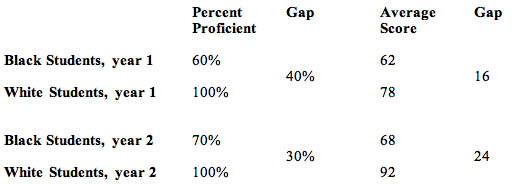 Serious attention, or disingenous political rhetoric? Check out (click to enlarge) this chart by Jerry Bracey:
But it's also generated fundamental controversies and thorny problems that go to the heart of the nation's ambivalence about educational policy and the treatment of kids. One of its two core provisions requires all schools to achieve 100 percent proficiency in major academic fields by 2014. Schools receiving federal funds for disadvantaged students that don't make progress toward that goal face an increasingly tough set of sanctions.
Some critics have called the very notion of 100 percent proficiency an oxymoron -- something that, if proficiency is to have any meaning, can't be achieved. And since the states themselves define proficiency and set their own standards, some, such as Wisconsin, have lowered their standards to make the targets. California, which has among the highest standards in the nation, is not one of them, despite some legislative efforts to water them down.
Professor Schrag does not go so far here as to agree with the critics, even though he doubtless knows they are correct. Studies in MA, WI, MI, IL, for instance, show a 60-90% failure rate by 2014, even with the state standards that Schrag claims have been watered down. If we abandoned state standards for, let’s say, NAEP standards, there would truly be no public school left standing even before 2014 (see Bob Linn’s projections based on NAEP scores (pdf). Of course, no public school left standing (NPSLS) is exactly the result that the education privatizers have been working toward even before the NCLB was craftily crafted, a fact that has been shrouded beneath the threadbare mantle and the cynical mantra of "closing the achievement gap" between rich and poor.
But as seemed evident from the start, the federal mandate on schools to get students in all ethnic, economic and educational subgroups to full proficiency is a near impossibility, especially for learning disabled students and immigrants who have been in U.S. schools for three years -- or perhaps five years -- or less.
Rep. George Miller of Martinez, a Democrat who's the incoming chairman of the House Education Committee, and, with Sen. Ted Kennedy, one of the co-authors of NCLB, agrees that the law needs fixes especially in weighing the achievement of English learners and handicapped students.
He's also willing to consider proposals from California and other states that school progress be measured by year-to-year growth rather than movement toward that 100 percent proficiency goal. But he's leery about abandoning a drop-dead date. "We can't give away the integrity of the act," he said. If the schools think that mere "growth," no matter how little, is enough for students to be competitive in the global economy, the country is likely to be back on the slippery path to mediocrity.
So it is no longer the job of the American free market to make us competitive in the global economy—it has come down to making children in school accountable for whether or not American capitalism maintains its world dominance. And the slippery path to mediocrity? If we were not being constantly reminded by ED, we could certainly wonder where the mediocrity left off or where it became most pronounced.
In terms of the "integrity of the Act," consider the reasoning that anchors the current stupidity:
- NCLB requires 100% proficiency of all children by 2014.
- The disadvantages of English language learners and handicapped students make it impossible for these children to achieve the 100% proficiency target by 2014.
- Therefore, the goal of 100% proficiency by 2014 must be kept in place to preserve “the integrity of the Act.”
Family Income Verbal/Math Scores
Less than $10,000/year-----417/442
$10,000 - $20,000/year-----435/453
$20,000 - $30,000/year-----461/470
$30,000 - $40,000/year-----480/485
$40,000 - $50,000/year-----496/501
$50,000 - $60,000/year-----505/509
$60,000 - $70,000/year-----511/516
$70,000 - $80,000/year-----517/524
$80,000 - $100,000/year----530/538
More than $100,000/year---555/568
So if we know, without a doubt, that most poor children, immigrant children, and disabled children are going to score, let’s say, 18-20% lower than middle class native-speaking ableist children, why should we treat their disadvantage of income differently than, let’s say, autism, especially when the same disparities in performance result? Why do we acknowledge a psychological disability, a biological disability, or a language disability at the same time we ignore the socioeconomic disability? Does the refusal to acknowledge poverty as a disability allow us to continue our unethical and inhumane testing practices that we could not allow ourselves otherwise?
The bipartisan deal that led to the passage of NCLB in 2001 was based on a combination of rigorous school accountability measures and increased federal funding that would supposedly pay for the increased demands on schools.
Inevitably there's been erosion at both ends of the bargain. States have continually fudged on the law's demand that there be a "highly qualified teacher" in every classroom -- a laudable target but a near impossibility -- and on the proficiency standards. The Bush administration, while increasing funding, has fallen many billions short of its fiscal commitments when the law was passed.
Not surprisingly, there's been push-back from a variety of sources -- from bipartisan legislative committees, from the National Education Association, from some civil rights groups and from educators who believe that the law's pressure on states has led schools to overemphasize drill for tests and the subjects, particularly math and English, that are tested, and to neglect other subjects.
There's also debate about the extent to which federal accountability programs have raised achievement and closed the gaps between different groups of students. And as low-standards states continue to report high levels of success, the gaps between state and national test scores have increased pressure for a system of national standards, even among educational conservatives who generally oppose meddling with what used to be a strict state-local prerogative.
What's certain is that until the federal and state accountability are "harmonized" -- Bersin's term -- there'll be continuing public confusion about what different scores and proficiency reports mean. In California, as elsewhere, hundreds of schools that are doing well according to the state's "growth" model are underperforming in moving toward the federal proficiency target.
Although NCLB is up for renewal this coming year, and while it's already the subject of hearings, the chances of major revisions before the 2008 presidential election -- or even on anything more than a temporary extension -- are low. Given the controversies, neither the administration nor Congress is eager to touch the subject any sooner than necessary.
And yet it's also true that, as Miller says, "When you have poor kids, poor schools and poor teachers, how can you expect a good result?" To change that requires a major -- and well targeted -- investment, including serious reforms in the nation's tired schools of education, another item on Miller's agenda. And it will require a continuing national push.
So will changing the schools of education bring an end to the family income chasm, which is the source of the achievement gap? Who will be blamed after it is demonstrated that schools of education are not creating the gap?
"If NCLB is gone," as he says, "America's poor kids will again be forgotten."
Does Rep. Miller really believe that poor kids have been helped by dumping them into the cruel testing crucible of assured failure? Does he not see that these children are being dumped on the streets the same way they have been dumped ever since slavery—but this time with a new realization that the mantra of “work hard, be nice” means even less than it meant when Booker T. Washington learned it from the white philanthropic liberals of his generation? Will this current generation of assured losers be as acquiescent when they find out they have once again been told a lie that is intended to assure their own complicity in their own subjugation as second-class citizens in a global economic order that doesn’t give a damn about their loss beyond what it might mean to the grand revenue stream that, by the way, continues to carve the canyon between the haves and the have nots.
If Representative Miller’s and Senator Kennedy’s efforts to continue the educational genocide of constant and unrelenting testing in chain-gang schools can be construed as "not forgetting" poor children, then let us assuredly end our memory of them in hopes that our neglect may offer at least an outside chance that these children might survive without the benefit of our obliterating mindfulness.
Friday, January 05, 2007
Stanley Milgram and the NEA
The Experiment
In 1961, social psychologist Stanley Milgram asked those same questions. That was the year Nazi Adolf Eichmann, on trial for his war crimes, denied responsibility for his actions by saying he was simply doing what his superiors told him to do.
Contemplating this rationalization, Milgram came up with a famous and controversial experiment to examine what happens when ordinary people are faced with morally questionable orders. What he learned shocked not only him but the entire world.
In the experiment, conducted at Yale University over a period of months in 1961, an authority figure — "the experimenter" — dressed in a white lab coat and instructed participants to administer what they believed were increasingly painful electric shocks to another person.
Although no one was actually receiving shocks, the participants heard a man screaming in pain and protest, eventually pleading to be released from the experiment. When the subjects questioned the experimenter about what was happening, they were told they must continue.
And continue they did: Two-thirds of Milgram's participants delivered shocks as they heard cries of pain, signs of heart trouble, and then finally — and most frightening — nothing at all.
Now one of the participants who faithfully continued the "shocks" at the urging of the experimenter was a 7th grade teacher. During the debriefing session with this teacher, she acknowledged that at first she had concern about the other participant receiving the shocks, but when the experimenter assured her that the experimenter assumed all responsibility for any ill effects, the teacher then felt relieved and emboldened to continue. This situation, she volunteered, was analogous to the NCLB testing that she administered to her 7th graders, which she knew was causing harm, but which she continued to do because it was not her responsibility. Of course, this point did not even register a hmmm on the ABC reporter's relevance meter.
This 7th grade teacher can hardly be accountable alone for her unethical actions, especially when we see that the professional organization that has offered her a Code of Ethics turn its back on that very same Code. Where is the NEA on this issue of educational genocide against the children of America? How many intellectual and emotional cores of children must be melted down before the NEA bigwigs acknowledge that this policy is destroying children, schools, and the health of our democratic future.
Thursday, January 04, 2007
Hand-Wringing at Middle School
This clip captures the irony of ironies for the mess in the middle:
Middle schools, sometimes called intermediate schools, were created starting in the 1960s, after educators determined that seventh-through-ninth-grade junior high schools were excessively rigid and unattuned to adolescents’ personal development. But now, a battery of standardized tests, some required under the No Child Left Behind law, are starkly illustrating that many of these sixth-through-eighth-grade schools are failing, also.
How do we know that middle schools are "excessively rigid and unattuned to adolescents' personal development?" We administer a battery of excessively rigid and unattuned instruments, silly--like the ones that have destroyed the natural intellectual curiosity that once accompanied childhood.
Wednesday, January 03, 2007
Earth to Professor Fuller
 Bruce Fuller is a smart guy--and one I respect. He does a good job in this commentary deconstructing the do-gooder talk by the elites of non-elitism like Nancy Pelosi, who is offering an education assistance plan to make it easier for Caitlin and Seth to go to Cal Tech at taxpayer expense--while neglecting to do anything significant to help those who need the most help.
Fuller, however, goes over the deep end with this gem:
The nation's literacy rate is now in decline, dragged down by youths who acquire few skills in mediocre high schools, who come to feel little stake in civil society. So, American firms move overseas, ironically spurring upward mobility for graduates in Bangkok and Bangalore, rather than in Daly City and Des Moines.
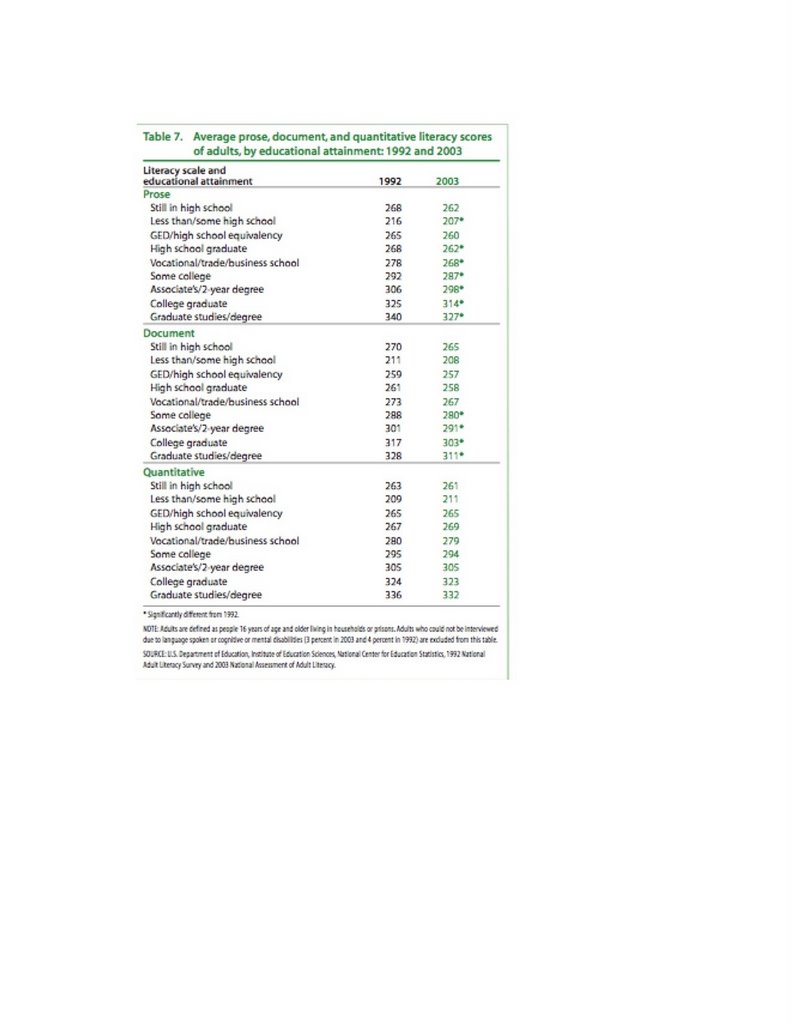
Can Fuller, a real researcher, believe this simplistic crap? First, does he not know that literacy rates (click to enlarge) have been in decline since 1992 for all segments of the population--high school grads, MIT grads, or middle school dropouts? Most importantly, though, does Professor Fuller really believe that corporations have been exporting jobs for the past 15 years because American high schools are bad, or because there is a shortage of talented and trained workers here? Has he been drinking the Kool-Aid offered him by the Business Roundtable?
Tuesday, January 02, 2007
It's the Family Income, Stupid!
And it is appealing to some African American professionals. The private Henson Valley Montessori School in Temple Hills has grown 50 percent over the past decade and plans to move to larger quarters in Upper Marlboro in the fall.
On a recent day at Henson Valley, children were putting together map puzzles, blowing seeds in the air to demonstrate plant dispersion and planning the construction of a space station. "They are learning how to learn," said Stephanie Carr, a federal government manager who has three children at the school. Despite the free-form nature of lessons, "they get very good test scores," Carr said. "My children are testing above grade level."
Pamela Hayes, an accountant in Fort Washington, has three children at the school. "There was a feeling that we were part of a family," she said. The school serves 260 students from preschool through eighth grade; tuition is $9,190 through sixth grade and $12,160 for seventh and eighth.
Monday, January 01, 2007
KIPP and the Stepford Children
Sorry for lurking and posting, but I can rarely let a KIPP reference pass without making some kind of comment. I am a former public school teacher and journalist who volunteered at the original KIPP Academy, warmed by the personality and charm of Mike Feinberg and his publicity. It's been a while since I've made my passionate arguments against KIPP -- and I hardly have the educational background of an advanced degree-- but I would make some broad statements about Early KIPP:
KIPP's original success was personality driven, no different than the success of Thaddeus Lott and his "miraculous" elementary schools in Houston ISD. There was no tremendously superior curriculum, no amazing secret axiom, no incredible structure. (These were guys who sometimes forgot to order the school buses!) If you walked past the classrooms, the textbooks and discussion were the same as they were in any other HISD schools. I was not in every classroom, but the skills of the teachers were, from what I could see, the same as they were in any other school. The textbooks were the same. The writing curriculum was New Jersey Writing Project. Some teachers were hired for their skills; others were simply hired because they were Ivy League friends of Levin and Feinberg. It was, from all appearances, just like any other school, except for the tremendous discipline, which I would compare to a rigidly disciplined private school.
The secret of KIPP, of course, was the buy-in from the kids and parents. They signed contracts. They agreed to extra hours. They felt honored they were picked for the school. And after the media picked up on KIPP, families were even grateful to be at the campus. They did not question authority. They were Chosen. If only that could be transferred to the public school system!
I was on a KIPP campus recently in Austin, and I have to tell you it was odd to me. It appears the drill-and-skill fast-paced parrot-the-teacher sort of activity is now a high art form on KIPP campuses. Margaret Spellings, who was with us, called it inspiring. (One kid came up to here and told her he had been accepted at an exclusive Eastern seaboard prep school, and I am sure that was inspiring to the child and his family.) Most of it, however, is what I would call creepy as hell. You wouldn't call this a place where children were encouraged to think. it was classroom after classroom of creepy Stepford children.
I'm a high school journalism teacher who values children who know how to think. That is not what is valued at KIPP. Conformity is what is valued at all cost. I think rigid controlled instruction is fine at the 4th grade, but if you're still controlling children that way at the 8th grade, you have problems. (I think that is why KIPPsters have such a problem going on to high school and why Feinberg has a problem pulling the KIPP experience into the high school grades.) This is a school that instills the discipline that most children could and should learn at 8 or 10. They just like to hammer it home at 10, 12 and even 14.
My own thought? At some point in the middle school years, kids need to move into their own, think on their own, learn how to be creative. I'm sure others would argue with me, but that just didn't happen at KIPP, in my mind. KIPP and I parted ways after I wanted to take the kids to a junior high journalism conference in San Antonio, and Feinberg wouldn't agree because the kids hadn't "earned" the trip. It occurred to me -- and I probably am not as artful I could be when I say this -- that when a rigid discipline code trumps valuable student learning, then the ones who lose are the kids. Period.
To me, that was profound. No system of discipline, no method of teaching, should ever get in the way of learning.
You'll hear a lot about the Myth of KIPP. The fact is that KIPP is a fine charter school, but it is no better or worse than many other charter schools. It will work for some kids and not for others. (I would have been miserable at KIPP!) I don't care how selfless it may be -- the great noble story of two Teach for America grads pioneering a new way for education -- but the whole "Harriet Ball was our inspiration" (blah blah blah) is, I suspect, some part truth and then
just a whole lot of spin. I imagine KIPP has evolved -- they have learned to order the buses, take the grant money, hire better teachers, whatever -- but I never saw any incredible magic at KIPP that couldn't be replicated at a public school with a good principal and concerned parents.
And all these interviews about how selfless these guys are... I mean, what Kool Aid did Jay Mathews drink? When I was there, everything at KIPP was about Feinberg and his ego. His approval meant everything to the kids. I won't go into his particular temper tantrums, but they would never be acceptable at a public school. His point system for
rewarding the kids was above everything else. And don't think every teacher agreed with his methods. I think Feinberg likes to paint teachers who disagreed with him as simply not being "with the program" or unwilling to do the work. But there were plenty of teachers on the campus who simply got there and just didn't agree with the way that Feinberg ran his school. A number of us wondered aloud whether this brave experiment could be replicated anywhere at all.
When I actually criticized KIPP at an Education Writers Association meeting, Feinberg had a class of eighth-grade students write me letters about how wonderful KIPP was. Co-opting kids to do your PR campaign? I just was repulsed on so many levels, and it just reminded me why I was so opposed to KIPP in the first place.
So... my fair assessment... I don't know what makes me madder... Feinberg so self-satisfied with his great KIPP experiment or the media that is so willing to make KIPP a great school simply because it's a great story to tell.