"A child's learning is the function more of the characteristics of his classmates than those of the teacher." James Coleman, 1972

Friday, December 25, 2009

Merry Learning to All, Together, Really

Day before yesterday, North Carolina's governor threw her unequivocal support behind the diversity policies in her state that have brought about improved learning for all and increases in student achievement scores:

As Wake County and other school districts across North Carolina shift away from busing students to achieve socio-economic diversity, Gov. Beverly Perdue and other officials fear the districts will become racially segregated.

"It's the most troublesome thing I think that's happened," Perdue said of the push toward neighborhood schools from Goldsboro to Charlotte.

. . . .

Perdue said neighborhood schools that are almost all-black or all-white won't provide all students with a quality education, saying schools in low-income areas will be at a significant disadvantage.

"Whether it's racially done or economically done, there has to be some kind of momentum to continue to have diversity in our schools," she said. . . .


Thursday, December 24, 2009

Oregon's Race to the Top, DIBELS Knockoff, Corporate Taxation, and Philanthropic Stupidity

The educational landscape in my home state of Oregon is likely to be greatly impacted by two issues: the Race to the Bottom and a pair of important ballot measures that will be voted on in January of 2010. To my fellow Oregonians out there (or anyone concerned about public education), there are some fine print details about how these issues will impact the lives of our children (and teachers). Predictably, local philanthropists are involved in these issues, and their activity is, well, quite concerning. Let's begin with the ballot measures, but be sure to read all the way down to the discussion about a program called "Easy CBM," a reading program put together by the fools down at the University of Oregon (hint: it's DIBELS, but attached to longitudinal data systems - scary, eh?).

Oregon voters will vote on two ballot measures, 66 & 67, in a January election. The two measures will 1) raise taxes on families earning over $250,000 (2.5% of families) and 2) raise the corporate minimum tax, which currently is set at an astonishing $10 (set in 1931 and unchanged since). Yes, that's ten dollars, which is the likely tax bill for large corporations like Nike, Intel, and the other corporations doing business in our state. The right-wingers and libertarians have, not surprisingly, come out against these measures, which would help the state raise over $700 million, half of which would go towards public education and much of the rest to essential social services.

Here's where local philanthropies come into play. For the sake of this posting, I'll stick to the agenda of the Chalkboard Project, an education advocacy group that bills itself as "Uniting Oregonians to make our public schools among the nation's best." One might think that advocating for the passage of these ballot measures would be a top priority for any education advocacy organization, but the Chalkboard Project has remained entirely silent about these essential funding sources. I asked why, and their communications manager put it this way:
Chalkboard has taken a position on very few ballot measures in the past and the Board of Directors has not taken a position on Measures 66 and 67. [E-mail correspondence, 12/21/09]
Their board of directors includes representatives of Oregon's six biggest philanthropic organizations, and each group is represented by high-wealth individuals (listed here). It should not be surprising to see the Gates Foundation is another funder of this group, and you can tack on a bank and other large corporations to their list bankrollers. Do you honestly believe any of these people would advocate for higher taxes? Not a chance - they're all about a public education system where they don't have to pay their fair share of taxes.

While sitting quietly on the sidelines about the important tax measures, the Chalkboard Project is a prime cheerleader for Oregon's Race to the Bottom application. Also from their communications director:
Superintendent Castillo has said that preparing a Race to the Top proposal is not just about winning the money, it is about creating a plan to improve education in our state. The money would allow us to move faster, but without it the state still plans to pursue reforms that would support effective teachers, turnaround low performing schools, etc. As you've seen in the news, states are making changes already before any federal money has been given out. [E-mail correspondence, 12/21/09]
Oregon MIGHT win a one-time donation of a few hundred bucks per kid (a paltry sum, and hardly enough to make any kind of real changes), but just the temptation of this Race to Stupidity is enough to entice a competition to see who can draw up the most awful reform package. Oregon isn't pushing a Louisiana-like agenda, nor are we explicit about expanding charter schools (although it's implied in the application), but we have pretty much everyone beat when it comes to the most awful reading programs. Get a puke-bag ready, you'll need it.

You remember DIBELS, right? Meet Easy CBM, yet another "reading" program cooked up by the idiots at the University of Oregon. The current RttB draft for my state involves using this program with our longitudinal data system, a perfect way to track how many words kids can spit out in 30 or 60 seconds. This is considered formative assessment, but, of course, it's little more than mindless test prep, complete with multiple choice questions and timed reading quizzes, all feeding into Oregon's data-driven insanity. Easy CBM is programmed to use these kinds of assessments for all Oregon students in grades K through 8. Good luck finding the words "book" or "library" in Oregon's application - those are relics of the past, evidently.

One of the major "researchers" for this program is none other than Dr. Gerald Tindal, who sat on the Secretary's Reading Leadership Academy Assessment Committee with Dr. Edward Kame'enui, Deborah Simmons, and Roland Good, three other notorious U of O edu-idiots. The other main researcher, Julie Alonzo, is a 2007 U of O grad, which means she probably had the chance to study under the aforementioned reading terrorists cooking up assessments down in Eugene. What'd she do before going to U of O? Worked as a high school teacher, but now she's helping decide how Oregon's K-8 kids should learn how to read. Brilliant, just brilliant.

In the future, maybe Oregon kids will ask, "Teacher, what's a book? What's a library? I saw this word the other day, l-i-b-r-a-r-i-a-n. What does that mean?" And Oregon teachers, if they're able to smuggle in some legitimate reading material into their classroom, might be able to dust off a real book and show kids, "This is a book, kiddos. It tells you a story, it can make you lose track of time and the things going on around you...and you can learn from them." The confused children, used to the endless test-prep and 60 second reading quizzes, might be lucky enough to get their hands on one or two of these relics of the Gutenberg press. That is, if we even have a school system to speak of, lest it be privatized or dismantled at the altar of low corporate taxes and trickle-down economics.

It shouldn't be surprising, of course, that the Chalkboard folks, including their executive director, had never heard of the Broader, Bolder Approach when I was quizzed by them at a meeting earlier this year. They're shills for the EEP fools, the more-testing-less-literacy crowd, and small-government fanatics, not to mention some of the wealthiest foundations in our state (which, of course, are tax-free havens full of stock in some of the most offensive companies, including healthcare giants and multinational corporations).

So, just to summarize, one of Oregon's most influential education advocacy groups, which is an arm of the state's six major philanthropic organizations and takes their marching orders from the Gates Foundation/Duncan's DOE, will remain entirely silent on important ballot measures, but they'll push an education reform package that pushes a DIBELS-on-steroids program for our K-8 students.

Good luck, Oregon kids and teachers. You can thank Race to the Top, philanthropic stupidity, the federal DOE, and the U of O idiots for the shoddy education you'll be offered, particularly if you grow up in one of the less affluent parts of the state. Schools matter - and so do our funding streams, fair taxation, and literacy based on books and libraries. Our kids deserve so much better.

Wednesday, December 23, 2009

What President Obama Did Not Campaign On

If the President, as he unconvincingly claims, did not campaign on a public option, then he certainly did not campaign on forcing 30 million new customers into the clutches of the insurance corporations to charge whatever they like, with us, the taxpayers, picking up the tab for all the citizens who can't afford it. But that's what he is vigorously supporting. You decide:

Beating Back the Propagandists

From EPIC:

December 23, 2009

TEMPE, Ariz. and BOULDER, Colo. (December 23, 2009) -– This past week, two new reviews of think tank reports were published online: by Teacher Magazine and by Teachers College Record. Neither of these reviews was published as part of the Think Tank Review Project, but both further the project's goal of advancing discussions by providing the public, policy makers, and the press with timely reviews of think-tank publications.

Innovation "Report Card" - On December 16th, Teacher Magazine published a review by Alaska 2009 Teacher of the Year Bob Williams, who examined the goals and methods underlying a report that had assigned each state an "innovation" letter grade. The report, called "Leaders and Laggards," was a follow-up to a 2007 report from the same group that had been published in November by the U.S. Chamber of Commerce along with the Center for American Progress and the American Enterprise Institute's Rick Hess.

Williams focuses his review on aspects of the report concerning alternative teacher certification and teacher tenure. He notes that the report's authors begin with the premise that "improving education requires weakening teacher tenure and union influence while supporting alternative certification and national programs to place inexperienced people ... into teaching positions with minimal training." Williams explains how the report distorts the data in order to create state-by-state ratings that fit the authors' pre-determined agenda. The 'innovation' ratings are really little more than a façade for the authors' advocacy for privatization and marketization of public education.

The Williams review can be accessed through the website of Teacher Magazine, which requires (free) registration, or on the Epicpolicy.org website, where it was republished with permission of the author.

Fordham Detracking Report - On December 14th, the journal Teachers College Record published a commentary by University of Colorado at Boulder Professor Kevin
Welner, who co-directs the Think Tank Review Project. Welner provides a brief review of a new report authored by Brookings' Dr. Tom Loveless and published by the Fordham Institute. Loveless' key conclusion is that each additional track in eighth-grade mathematics in Massachusetts is associated (in a regression model he presents) with a 3 percentage-point rise in students scoring at the advanced level on the state exam, after holding constant the school-level percentage of students receiving free- or reduced-price lunch, which he calls "socioeconomic status."

Welner's review describes how the Loveless report combines weak data with questionable analyses to manufacture an argument against detracking. For instance, even using just the limited control of free- or reduced-price lunch rates, the purported benefit to high-achieving students disappears when one compares the option of a school with two math tracks versus an untracked school. Overall, better treatment of these same data would likely show that high-achieving Massachusetts middle school students in heterogeneous, untracked schools do as well or better than those in two-tracked schools -- certainly in language arts (English) and maybe even in mathematics. Welner concludes that the report misleads in an attempt to convince policymakers to maintain tracking policies.

The Welner review is available here. It can also be accessed through the website of Teachers College Record (subscription required).

About the Think Tank Review Project

The Think Tank Review Project (http://thinktankreview.org), a collaborative project of the University of Colorado at Boulder Education and the Public Interest Center (EPIC) and the ASU Education Policy Research Unit (EPRU), provides the public, policy makers, and the press with timely, academically sound reviews of selected think tank publications. The project is made possible by funding from the Great Lakes Center
for Education Research and Practice.

Kevin Welner, the project co-director, explains that the project is needed because, "despite their garnering of media attention and their influence with many policy makers, reports released by private think tanks vary tremendously in their quality. Many think tank reports are little more than ideological argumentation dressed up as research. Many others include flaws that would likely have been identified and addressed through the peer review process. We believe that the media, policy makers, and the public will greatly benefit from having qualified social scientists provide reviews of these documents in a timely fashion." He adds, "we don't consider our reviews to be the final word, nor is our goal to stop think tanks' contributions to a public dialogue. That dialogue is, in fact, what we value the most. The best ideas come about through rigorous critique and debate."

CONTACT:

Kevin Welner, Professor and Director
Education and the Public Interest Center
University of Colorado at Boulder
(303) 492-8370
kevin.welner@gmail.com

Senate Offers 23 Million Lumps of Coal

Click here to find out more!

From Huffington Post by Jason Linkins:

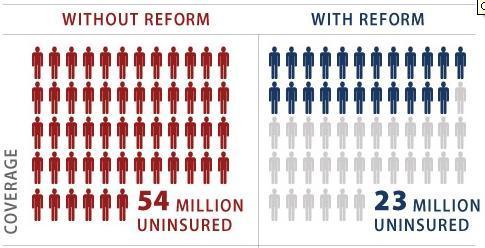
. . . .And the fact is, if the Senate language survives to be signed into law, America will still be in the throes of a massive health care crisis that will need to be reformed with all immediate haste. This is evident in this portion of a graphic created by Igor Volsky, promoting the virtues of the Senate bill:

[The word "reform" sort of belongs in scare-quotes, frankly.]

As you can see, by treading right up to the line set by Joe Lieberman, the Senate leaves 23 million Americans without insurance. No one is hallucinating this! And unless Volsky is saying that the 23 million who will remain uninsured represent an acceptable number of needless deaths, I'm sure he'd agree that this means that America will still be in dire need of health care reform on the very next day after "health care reform" is signed into law.

But the problem is, after the health care bill is signed, all of the momentum to reform the system is going to drain away. Legislators will have come through what will be regarded as a grueling fight that they won't be too keen on taking up again. The president is likely to celebrate the event as a momentous historical accomplishment instead of doing the right thing -- offering the correct and sober assessment that his efforts led to a bill that is sorely lacking.

And the media, embodied by simps like John Harwood, will declare the matter settled and get on with the process of writing the stories they are good at writing -- who won and who lost politically in the health care fight. The historical achievement of politicians will outweigh the matter of how that supposed achievement falls on those 23 million uninsured.

If you want to know who is really drug-addled, it's anyone who seriously believes that the John Harwoods, Chris Matthewses, Jon Meachams and Fred Hiatts of the world give a tinned shit about how this legislation actually affects real Americans. If you don't stand to gain or lose political capital, you just don't show up in their reporting.

And so, all the "bill-killers" hope to achieve here is the maintenance of the very real urgent needs of their fellow citizens, before everyone rushes to drown themselves in the waters of Lethe.

Reading more but test scores stagnant? Reply to Willington

A response to Daniel Willington, who asks "Why doesn’t reading more make us better readers?" Why are we reading more but NAEP scores are not improving?

Controlled studies consistently show that more reading leads to better reading, and there are a lot of them (see Krashen, S. 2004, The Power of Reading, second edition, published by Libraries Unlimited and Heinemann Press). These scientific studies are more telling than crude correlations with large populations.

Nevertheless:
1. Quantity of reported voluntary reading has correlated with NAEP scores over and over. See the many reports for individual NAEP tests in past years.

2. Overall, there is more reading going on. But there is also more child poverty, now at 25% (the largest of all industrialized countries, compare to Denmark at 2%). Children of poverty have very little access to books at home, school or in their communities, and thus have lower NAEP scores. The low scoring high poverty group lowers the overall score to a greater extent every time the NAEP is given. This is more likely the reason more reading has not resulted in higher NAEP scores over the years, not the suggestion that we are doing more "lighter" reading.

But Willington raises a good question: Are children and adults reading more "lightweight" reading than before? This is an empirical question that should be investigated scientifically.

Why high-tech high has low enrollment

Why Phoenix high-tech high has low enrollments

Sent to the Arizona Republic, Dec 22, 2009:
I suspect that the reason that Phoenix's new "high-tech school (is) off to (a) slow start," (Dec 20) is that prospective students know something that school administrators don't: There is no shortage of experts in science and technology in the US. A number of recent studies, in fact, conclude that there is a surplus. Students are not interested in preparing for jobs that don't exist.
Stephen Krashen

Some sources:
Bracey, G. 2009. Education Hell: Rhetoric Vs. Reality. Alexandra, VA: Educational Research Service.

Teitelbaum, M. 2007. Testimony before the Subcommittee on Technology and Innovation. Committee on Science and Technology, U.S. House of Representatives, Washington, DC, November 6, 2007

Toppo, G. and Vergano, D. 2009. Scientist shortage? Maybe not. USA Today, August 9, 2009

High-tech school off to slow start
CREST in northeast Phoenix still aims to enroll 150 for its 2010 freshman class
by Eugene Scott - Dec. 20, 2009
The Arizona Republic
A new high school expected to boost the number of Arizona's science and technology professionals has attracted interest from only about half of the number of students it plans to enroll in the fall.

The Center for Research in Engineering, Science and Technology hopes to enroll as many as 150 students in its freshman class when it opens in northeast Phoenix in fall 2010, but so far slightly more than 60 students have submitted applications for the "small, specialty" school.

CREST will be part of the Paradise Valley Unified School District but will be open to students who live outside the district's boundaries. School officials have visited every district eighth-grade science class to talk about the school.

"We're working with some marketing people that are helping us understand the best way to go forward with sharing this with students outside of our district right now," said Kathy Lahlum, an adviser to the school.
The school, on the campus of Paradise Valley High School at 40th Street and Bell Road, will focus on science, technology, engineering and math (STEM).

Phoenix proposed a grant two years ago to encourage Phoenix high schools
to offer programs that could increase the number of high-school graduates planning to pursue STEM-related careers and post-secondary education. Having a limited number of students graduating from Arizona colleges entering STEM-related fields is a major threat to Arizona's economy, said Phoenix Mayor Phil Gordon at the school's groundbreaking.

"This has been about job creation, too," he said. "Now we get to put lots of people to work."
School officials hope to partner with professionals in the Valley's technology- and engineering-related industries to provide instruction, internships and community service activities.

"I retired recently after 47 years working for some of the electrical-equipment manufacturers in the area, so I'd be interested in helping in whatever way I can," said Peter Kienast, a former electrical engineer who has worked with Arizona Public Service and Salt River Project. "I feel like what they are trying to do is a very good thing."

The school will have a hands-on curriculum allowing students to research and develop biotechnology projects while spending a lot of time in laboratories, possibly at local colleges and universities. Officials have met with individuals in the state's university communities to ensure that CREST students will transition seamlessly into the schools' STEM programs.

"I've heard nothing from the sustainability and biotechnology sectors," Lahlum said. "I'm pushing really hard in that direction, with plans to do that right after the beginning of the year."

Raising test scores without learning

Sent to the Harold-Tribune, Dec 23, 2009:
Test-Prep: Higher test scores without increased learning
FCAT test preparation will begin earlier at several schools ("This year's FCAT lesson: Plan ahead," Dec. 20). This may raise test scores but it won't help children. All too often, "test preparation" refers to methods of increasing students' test scores without increasing learning (e.g. when to guess, when not; answer easy questions first or questions with higher point values, on true/false tests choose "true" if you are not sure, because most true/false tests have more true answers than false answers, etc).

Raising test scores through test preparation is like claiming you have raised the temperature of the room when all you have done is light a match under the thermometer.
Stephen Krashen

"This year's FCAT lesson: Plan ahead," (Dec 19)
Herald Tribune, Sarasota, FL
By Tiffany Lankes
Published: Sunday, December 20, 2009

Teachers at Sarasota's Brentwood Elementary used to save their FCAT preparations for after the winter holidays.

But lagging reading scores on last year's Florida Comprehensive Assessment Test prompted the school to start getting ready much sooner this year. They began identifying and offering extra help to struggling students shortly after class started in August.

"We didn't want it to come down to January and we're scrambling," said Principal Michelle Henderson. "This year we just hit the ground running."

Like Brentwood, schools all over the region are already deep in their FCAT preparations, starting remedial classes, intense practice camps and motivational activities earlier in the school year.

The change comes with increasing state and federal pressure to do better on the standardized tests, which determines extra funding, a school's reputation and whether some students get promoted. This year's budget cuts have also forced schools to try to figure out how to get better results with fewer resources.

For many schools, the solution was to begin working with students sooner. Students take the writing FCAT in February. The reading, math and science sections are in March.

Third-graders at risk for failing at Englewood Elementary received letters about two months into the school year that they would no longer attend science and social studies classes. One Manatee County middle school started its weekend FCAT boot camp last month.

"It's never too early," said Omar Edwards, principal of Manatee's Johnson Middle School.

These efforts, however, raise concerns among parents, testing critics and even lawmakers who last year passed a law intended to cut back on how much time schools spend preparing for the FCAT.

"It does seem to fly in the face of what we were at least claiming we were trying to do with that legislation," said Rep. Keith Fitzgerald, D-Sarasota.

Some thought the law, which banned schools from stopping instruction to prep kids for the test, would keep schools from holding activities like pep rallies, drill sessions and boot camps. But that has not been the case. The law allowed exceptions for schools to target students who are behind, give practice tests and even hold motivational activities.

"It didn't change any of the incentives for schools to get ready," said Fitzgerald, adding that the law is nearly impossible to enforce.

"You're saying don't put pressure on the kids, but on the other hand the schools, the students and the teachers are all evaluated by this measure."

Educators also defend their preparations by saying they are not drilling students for the test, just making sure they have the skills they need to succeed academically. The FCAT helps measure that, and preparing students eases the stress level when they sit down to take it.

That is part of the reason Johnson Middle started its voluntary Saturday morning FCAT boot camp last month for students who want some extra practice for the February test.

Students who attend the camp get individual attention from teachers in the areas they most need it.
"We just make them aware of the areas where they need extra help and we work with them on it," said Edwards, the principal.

Last month, parents of Englewood Elementary third-graders at risk for failing the test received letters from Principal Pam Buchanan letting them know their children will receive extra help -- in place of science and social studies.

"Though we believe social studies and science is of great importance, we recognize that reading and math instruction must take priority," Buchanan wrote in the letter.

Buchanan notes that students receiving the extra help will still participate in science labs and that teachers weave science and social studies lessons into their reading instruction.

"Every principal has been charged with making sure every single one of our students is on grade level," Buchanan said. "With all of the state and federal mandates, we have to use every minute wisely."

Tuesday, December 22, 2009

Wake County Board Chair Chooses Jesse Helms Loyalist as Board Lawyer

(Photo by Ted Richardson of NewsObserver.com) With the new segregationists now holding a 5-4 majority on the Wake County School Board, Wake's long-standing and exemplary economic integration policy could be on the chopping block at tonight's Board meeting. Offering legal advice to the new majority will be GOP insider, Thomas Farr, who learned about civil rights at the knee of world-famous segregationist, Senator Jesse Helms. From NewsObserver.com:

The Wake County school board's choice of a prominent Republican lawyer to take a hard look at the school system's legal contracts and fees has ignited a wrangle about whether the move amounts to overt partisanship or just sound government practice.

The selection of Raleigh attorney Thomas Farr, a former nominee for a federal judgeship with strong GOP ties dating to the Jesse Helms organization, is just one matter of dispute between the board's ruling coalition and members who previously held sway. The new five-member majority, which received strong backing from the county Republican Party, favors killing the current policy of mandated socio-economic diversity in each school, as well as mandated year-round schools.

Board member Kevin Hill, ousted as chairman during a tumultuous Dec. 1 meeting, said naming Farr signals an excessive role for partisan politics on the officially nonpartisan school board. In addition, Hill said, the board should not have named Farr to the job without establishing his fee for the work.

"I do believe it doesn't look good for the board," Hill said. "He is closely identified with the Republican Party at the state level. His law firm has a minimum amount of experience with school law."

Board Chairman Ron Margiotta said Friday that he has not started negotiating money with Farr. The measure is up for renewed discussion at Tuesday's board meeting, which will also likely include a showdown between advocacy groups. State members of Americans for Prosperity say they'll rally support for the new board majority, while BiggerPicture4Wake and at least one other group have promised to show up in support of the existing diversity policy. . . .

And today the News & Observer published another story detailing Farr's involvement in a black voter intimidation scheme in 1990:

. . . .A 1992 U.S. Justice Department complaint said the Helms campaign sent postcards designed to intimidate tens of thousands of registered voters in heavily black districts during the 1990 U.S. Senate election. The complaint described Farr as a participant in meetings about the mailing and said he had been involved in earlier "ballot security" efforts.


However, Farr said on Monday that he had limited contact with campaign officials before the 1990 mailing and advised them not to send the postcards. His chief involvement was representing the defendants in negotiating a settlement with the Justice Department under which the defendants agreed to take no further actions to intimidate black voters, he said. . . .

The News & Oberver story also links Teabagger organizer and right wing hack, Art Pope, to the GOP strategy to win a majority of Wake County Board seats. Since when does a local school board election merit national attention by GOP wingnuts? Think about it:

. . . .Pope was credited by a local GOP party official with crafting strategies in an October election that earned school board seats for three Republican-backed candidates and landed an allied candidate, John Tedesco, in a runoff that he ultimately won. In an Oct. 7 e-mail from Wake County Republican Party finance chair Marc Scruggs to incumbent board member Ron Margiotta, Scruggs said the GOP had implemented Pope's plan and that it "worked very well."

The election resulted in the new members' and Margiotta's gaining a majority on the nine-member board, with the ability to advance their agenda, including ending the system's diversity policy and mandated year-round schools. Margiotta is now chairman of the school board. . . .


Monday, December 21, 2009

ROTT: Arne Duncan's "Moon Shot" Turns into a Scud Attack

The education deformers' lapdog, Arne Duncan, has sent Newt and Rev Sharpton home for the holidays, and all is quiet around Washington except for the continued quiet counting of health industry dollars in the back rooms of the Senate Building. Even so, Duncan's inspiring rhetoric regarding his Race Over the Top (ROTT) still rings out in the messages from political prostitutes like Governor Phil Bredesen, who has called for a special one week session of the Tennessee Legislature in early January to change state law to force teacher pay and tenure to be decided by a test score.

If Tennessee lawmakers bow to the Governor's brass-knuckled tactics, it will constitute an act that defies the best scientific evidence and advice regarding the Oligarchs' unproven and reckless strategy that has almost no backing among most everyone who knows anything about schooling. Today's Ed Week piece announces, yet, another smackdown for the irresponsible, unethical, and grossly underfunded moon shot that looks every day more like a reckless Scud attack:

A Washington research group is raising questions about the wisdom of the U.S. Department of Education’s favored strategies for turning around the lowest-performing schools with stimulus funding, saying that its research shows that similar federal approaches to school restructuring have not been effective.

The questions raised by the new study were on the agenda last week as the Center on Education Policy , which issued the report, hosted a forum on its findings that included a top Education Department official. . . .
Bredesen, like many other governors hungry for cash, pushes on. From the CityPaper:
. . . .Last week, Bredesen called a surprise seven-day special session of the legislature beginning Jan. 12 to adopt this sweeping change. If lawmakers refuse to go along, the governor warns, the state will blow its opportunity to cash in on up to $400 million in federal economic stimulus money in the Race to the Top competition.

U.S. Education Secretary Arne Duncan calls it “education reform’s moon shot.” Across America, state governments are scrambling to make reforms to qualify for shares of the $4 billion available. The deadline for entries from the states is Jan. 19, the last day of the special session.
Yes, the moon shot--Arne's $4.3 billion moon shot. The real moon shot cost $25 billion in 1969 dollars, which means that in 2005 dollars, it would cost $135 billion--which is $565 billion less than the Wall Street Shot that was launched in 2008. Looks more like a mooning than a moon shot, Arne.

Obama’s initiative, Bredesen said, “has made the stars line up to create some opportunities that no one has really expected. I have a little sign on my desk. It says ‘carpe diem’ — seize the day — and that’s what I’m trying to do here with education. … There is a lot at stake here.”

Pulled in two directions

Bredesen’s high-pressure gambit — giving lawmakers one week to act, with hundreds of millions of dollars on the line — puts the statewide teachers’ union, the Tennessee Education Association, in a nearly impossible position. Either the TEA caves and accepts legislation that’s anathema to much of its membership, or the union could look like the villain in the loss of federal aid.

Teachers are complaining about strong-arm tactics from the White House all the way down to the governor’s office. On its Web site, the TEA is asking its members to complain to their state legislators. Lawmakers are themselves grousing over the speed of the special session.

The crux of the controversy is how much weight should be given to student test scores in evaluating the performance of teachers.

. . . .

The governor insists, therefore, that tests should be made the largest factor in tenure decisions and teacher evaluations. The TEA says that’s unfair and would force teachers to “teach to the test” — that is, restrict instruction to the subject matter that’s going to be tested, at the expense of all the other things students need to know. The Obama administration’s guidelines for the stimulus money are vague, asking only that tests play a significant role.

Governor plays tough

“I’d be less than honest if I didn’t say it’s heavy-handed,” TEA lobbyist Jerry Winters said of Bredesen’s call for expedited new legislation. “It’s really a lot of pressure. … Our position is we can’t sell our souls in this process. If there are some changes that we can make that will make the state eligible for $400 million, we don’t want to be viewed as the obstructionist in that process. But on the other hand, we can’t throw our members under the bus. I firmly believe that’s it’s totally unfair to take one test score, one snapshot, and base a teacher’s future on that one particular day.” . . . .