Showing posts with label Detroit Schools. Show all posts
Showing posts with label Detroit Schools. Show all posts
Tuesday, February 02, 2016

Monday, January 11, 2016
Detroit Citizens Take Action to End Deplorable School Conditions
From the Detroit News:
. . . .Teachers are upset by large class sizes, pay and benefit concessions, and a state plan to create a new, debt-free Detroit school district. DPS, which has been run by a series of state-appointed emergency managers since March 2009, has $515 million in past debts and unpaid vendor and pension bills.
At a lunchtime rally outside DPS’s Fisher Building headquarters, teachers said the district’s students are being jeopardized by poor building conditions and a shortage of educational materials.
Students lack textbooks and other supplies and come to learn in buildings where roofs are leaking and they breathe mold every day, said Kimberly Jackson, a seventh-grade teacher at Paul Robeson Malcom X Academy. Even some bathrooms don’t even have toilet paper, she said.
“We are set up for failure,” Jackson said to a crowd that cheered and chanted that they’d had enough.
“No other district ... would allow their children to be inside a school building under those conditions,” she said. “Many of our (classes) are way oversized — some with as many as 50 children inside one classroom. It’s time out for that. It’s time out for biz as usual, it’s time out for working in deplorable schools.”
Teachers, joined by parents and children, took turns talking about their frustration over conditions in the schools. Holding signs and chanting, the group of about 200 people marched around the building.
The rally was organized by DPS Teachers Fight Back – a grassroots group formed a week ago by teachers, parents and community members who want the best education for the students, Jackson said.
They outlined demands that include improving working conditions, decreasing classroom sizes and restoring staff positions, pay and benefits. They also called for local control to be restored at DPS.
“Our goal is not to shut the schools down,” said Jackson. “Our goal is to have a quality education for our children. ... We’ve been trying to make do with what we have. Our children deserve better.”
Joann Jackson attended the rally with her two grandchildren, 6-year-old Larry Price and 10-year-old Alayah Price, both students at Robeson.
“I am sick and tired of what is happening in Detroit Public School system,” Joanna Jackson said. “We are $4.5 billion in deficit. Every time I turn around, I am asking where’s the money? No one seems to know.” . . . .
Saturday, July 09, 2011
Will Duncan Lose Sleep for Detroit Charter School Basement Scores ?
Just a couple of years ago Duncan was losing sleep, he said, about Detroit's public school test scores. His boss's solution was to turn the schools over to apartheid corporate welfare charter schools that have dictatorial control, no public oversight, and no record of being any better than than the public schools.
From the Detroit News:
Test scores for schools often trail DPS students' average
Mike Wilkinson/ The Detroit News
Once touted as a solution to Detroit's public school woes, charter high schools are often doing just about as poorly — and in many cases worse — at educating students and getting them ready for college, a Detroit News analysis of recent test data shows.
Of 25 charters in Detroit or nearby, only six had higher math or science proficiency scores than Detroit Public Schools' average on the most recent Michigan Merit Exam, with most of the others doing worse than the district.
More charters did poorer in reading and writing as well; only in social studies did more charters surpass rather than trail DPS.
The results raise questions about the district's plans to authorize additional charters in its search for improvement and could also renew the debate over whether charters are the answer to the riddle of urban education, where multiple strategies are often producing the same poor results.
"If charters do not outperform the host district, they ought not to have a charter," said Margaret Trimer-Hartley, superintendent of the University Prep Science and Math Middle School in Detroit, a charter school.
One of the largest nationwide charter-schools studies found that nearly half of charter schools do as well as the local public school; more than a third did worse, and just 17 percent did better.
"(The results are) a call to focus on the quality of charter schools," said Dev Davis, research manager of the Center for Research on Education Outcomes at Stanford University, which published the study in 2009. "It's not a panacea. There are no magic bullets in education.". . . .
Tuesday, June 21, 2011
Duncan Supports Snyder's Privatization Plan for Michigan Schools
Dreamed up by the lawyers to the Billionaire Boys' Club, Gov. Rick Snyder's infamous Public Act 4 grants the Governor or his appointed "emergency" managers "power to fire local officials, cancel contracts, privatize municipal services, and even dissolve whole towns."
Yesterday Snyder applied his new powers to take over, charterize, and further segregate Detroit's poorest schools, and Arne Duncan was on the satellite hookup offering his full support for Snyder's bold action, which is being imposed through the Governor's latest emergency lackey, Roy Roberts, former GM exec trained by the same stooges at Harvard who provide instruction at Eli Broad's corporate training camp for urban superintendents just down the street.
From an excellent piece at HuffPo by Joy Resmovits:
Broad's Detroit's previous emergency manager, Robert "Bonus" Bobb, the DPS debt swelled from by $127 million. Things are obviously bad enough now to declare a crisis and an emergency corporate solution (see The Shock Doctrine).
Here's more on the plan, which is not even mentioning the toxic, segregative, and brutalizing corporate charters that are being planned for Michigan's poorest children:
Segregation, cultural sterilization, behavioral neutering, and cognitive decapitation: welcome to the New Eugenics, the Oligarchs' version.
I started to post this piece below separately, but it makes for good reading here to see the level of debased hypocrisy and deception coming out of the Obama Department of Education. By Nathan Bomey for AnnArbor.com:
Yesterday Snyder applied his new powers to take over, charterize, and further segregate Detroit's poorest schools, and Arne Duncan was on the satellite hookup offering his full support for Snyder's bold action, which is being imposed through the Governor's latest emergency lackey, Roy Roberts, former GM exec trained by the same stooges at Harvard who provide instruction at Eli Broad's corporate training camp for urban superintendents just down the street.
From an excellent piece at HuffPo by Joy Resmovits:
The plan mirrors similar efforts in New Orleans and Tennessee that target the lowest-performing schools. But how Michigan's EAS [Education Achievement System] will live up to its promise to improve Detroit's schools -- and address the district's crippling debt -- has yet to be revealed.Why the incubation for this Alien takeover? Michigan voters are likely to vote down Public Act 4 in a referendum next year, which could leave the privatization plan high and dry. The specifics of the plans are were not elaborated yesterday, but it does includes firing all teachers in "failing" schools, giving school CEOs latitude to set up their own fiefdoms without oversight, and control by the unelected anti-democrats who own the Governor's Office:
What Roberts did say is that the state will run the EAS in partnership with EMU beginning in the 2012-2013 school year. The coming 2011-2012 school year will be an "incubation" period for the development of the system. In addition enveloping schools from DPS, the system is slated to expand to include low-performing schools throughout Michigan.
Schools deemed low-performing based on standardized test scores and student grade point averages will enter the EAS. After five years in the system, an evaluation will determine whether the school can choose to go back to local control.Under
A parent advisory council will be created at each school, and each parent will be required to sign a contract certifying involvement in his or her child's education.
The new authority will function with an 11-member board. Two members will be appointed by DPS, two appointed by the university [Eastern Michigan] and seven by the governor. Five of those board members will make up the system's executive committee, chaired by Roberts.
Here's more on the plan, which is not even mentioning the toxic, segregative, and brutalizing corporate charters that are being planned for Michigan's poorest children:
The plan was developed to mirror earlier efforts by former DPS emergency manager Robert Bobb, as revealed in documents subpoenaed by a lawsuit, said Donna Stern, national representative of BAMN, an activist coalition in Detroit. Bobb's plan called for an aggressive conversion of failing DPS schools into charter schools, but had been since tempered by Roberts.
When asked whether EAS would focus on creating charter schools, Wilbanks pointed to the eight charter schools EMU runs across Michigan. "That's one mechanism we might use to improve performance," he said.
The FAQ on EAS says the system will include input from "top quality charter authorizers" in developing its "objective criteria for identifying high quality schools."
"Performance against these criteria will be the basis for all decisions made within the EAS," the fact sheet reads.
Anthony Adams, president of Detroit's school board, said he had heard bits and pieces of the plan over the last week.
Before Monday's announcement, the school board -- which has been stripped by the emergency manager of its powers -- met with Roberts to learn about the plan's details. That meeting resulted in a heated exchange, Adams said, when one member asked for details on eliminating the district's debt.
"One of our board members wanted more detail regarding the deficit elimination portion of the plan," Adams told The Huffington Post. "The emergency manager didn’t necessarily like the questions. People here are very aggressive."
Requests for comment from Roberts following the news conference were not returned.Response from teachers, students, and parents was immediate and strong:
Some teachers were curious to hear about the changes to their schools, but they were turned away at the door, so they started picketing, forming a crowd of about 20.Unless Michigan citizens act to shut down this plan, it will spread from Detroit to other poor areas of Michigan. With Duncan's stamp of approval to turn around the bottom 5 percent of schools, there will always be a bottom 5 percent as long as schools are measured based on their standardized tests, which is, in fact, a measure of the level of poverty.
Joined by several students, they chanted: "No layoffs, no cuts, Detroit won't get to the back of the bus."
Among the student protesters was Leroy Lewis, a 16-year-old rising senior at Southeastern High School.
"They were holding a press conference to destroy public education, so I wanted to see it," he told HuffPost. "My school is on the list of failing schools. I'm prepared to fight around it and gather up support."
"They took our teachers away, cut our fine arts program. It's very difficult to learn here," he added.
Some critics said the move to create a separate district run by an appointed board invites further privatization of Detroit's schools.
"This is the next level in the attack on public education," said Nicole Conaway, a science teacher at Catherine Ferguson Academy. "They're trying to implement a New Orleans plant model that will have severe brutality and be segregated."
"Classrooms will be overcrowded. Supplies will be shorter. It is like the new Jim Crow in creating a second-class tier of schools," she added.
Segregation, cultural sterilization, behavioral neutering, and cognitive decapitation: welcome to the New Eugenics, the Oligarchs' version.
I started to post this piece below separately, but it makes for good reading here to see the level of debased hypocrisy and deception coming out of the Obama Department of Education. By Nathan Bomey for AnnArbor.com:
In the aftermath of Gov. Rick Snyder's decision to give emergency managers more power to address crises in Michigan's distressed public school districts and municipalities, Snyder faced a barrage of criticism.
Activists ranging from the Michigan Education Association to the Michigan Democratic Party to liberal MSNBC commentator Rachel Maddow slammed Snyder and Michigan Republicans, saying the emergency manager legislation dismissed democracy in favor of dictatorial politics.
But it's becoming increasingly clear that Snyder's emergency managers — whose existence has inspired an effort to place the issue on the ballot in 2012 to allow voters to repeal the legislation — have more political support than previously thought.
Exhibit A: Washtenaw County Board of Commissioners Chairman Conan Smith, a Democrat.
Exhibit B: Flint Mayor Dayne Walling, another Democrat.
Exhibit C: President Barack Obama?
Silly, you say? There's no way that Obama would back Snyder's decision to allow emergency managers to sever union contracts, wrest power away from elected officials and unilaterally reshape budgets and curriculum in the name of fiscal sanity. Right?
Perhaps. But then I ask you this: Why did U.S. Secretary of Education Arne Duncan, an Obama appointee, participate in Snyder's press conference today by satellite, praising Detroit Public Schools emergency manager Roy Roberts' leadership and lauding Snyder's efforts to uproot the "status quo."
Duncan — the third speaker at the press conference, behind Snyder and Roberts — praised the initiative to establish a statewide system to revitalize Michigan's worst public schools by transferring them to a new autonomous authority, requiring teachers to reapply for their jobs and giving principals more authority to make their own decisions.
The new initiative starts with Detroit's approximately 100 failing schools in 2012-13 but it will extend to the other 100 failing schools in Michigan in 2013-14.
"This city has no viable future if the status quo is allowed to stand," Duncan said. "Detroit has the potential to be a model not just for the state, but for the entire country."
Fair enough.
Bad news, though: Without the strengthened emergency manager law, Roberts would find it much harder to make all the changes he wants to make — and that Snyder is supporting.
"I want to be a good partner to folks in Detroit who want to take that school system to a whole new level," Duncan told reporters this morning.
I believe him. Because if he actually opposed the emergency manager powers, he'd basically be opposing Roberts' right to take control of the district, which makes much of these reforms possible.
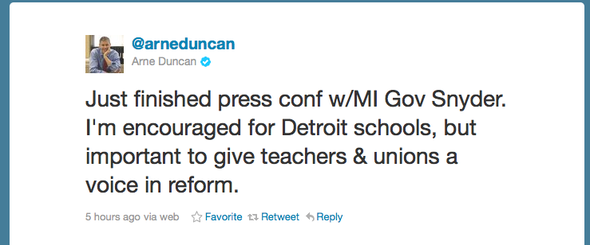
That's why it was startling to see Duncan post this to his Twitter account after the press conference:
Emphasizing that it's "important to give teachers and unions a voice in reform" is a puzzling caveat to add, considering that under Snyder's new Education Achievement System, teachers at Michigan's 200 failing schools will be fired and forced to reapply for their jobs.
It's always fascinating to watch back-tracking occur in real time through the modern lens of social media.
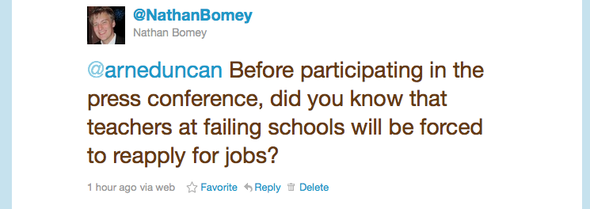
So I directed my questions to Duncan through the same medium he chose to add his caveat:
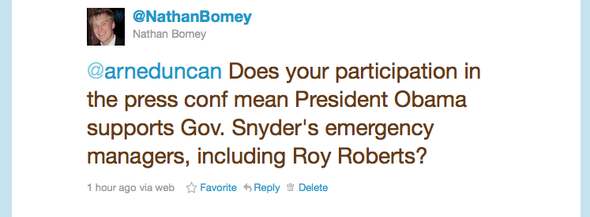
Seems like a fair question, right? No answer. So I pressed further:
Still no answer.
So I decided to go the traditional route. I called his communications office in Washington.
I asked Daren Briscoe, deputy press secretary for the U.S. Department of Education, whether Duncan's participation in the press conference means he supports Snyder's emergency managers.
"The way to understand what the secretary was saying was, more so than endorsing that as a specific blueprint, he was expressing his support of thematically what they’re doing in Michigan, which is taking urgent action, to remedy a situation that is not serving the students there well," Briscoe said.
Duncan participated in the press conference to endorse "the kind of collaboration that you have to have in a situation like that in order to come to the kind of agreement that they’ve come to, which involves administrators, parents and teachers," Briscoe said.
Briscoe added: "That’s what he was endorsing and praising, was the broader-stroke urgency, collaboration and that sort of thing, rather than line by line" approval of Snyder's reform policies.
That's strange: So, you're publicly supporting a theme of change but the details make you uncomfortable?
I asked Briscoe whether Duncan — which, by extension, means the president of the United States — supports forcing teachers in failing public schools to reapply for their jobs as part of a broader reform initiative.
In situations where schools are "persistently failing," the Department of Education sometimes supports "all of the teachers being fired and principals being fired."
"That's not a blanket description for each school, but that is among the options that the department endorses, given a certain set of circumstances," Briscoe said. "Where you have dramatically underperforming schools, persistently underperforming schools, yeah the department does endorse actions that are both dramatic and urgently needed."
Here's my takeaway: President Obama supports firing teachers when schools are failing — and, if he had a big problem with Snyder's emergency managers, he wouldn't have allowed his education secretary to lend his political clout to an event trumpeting one of the biggest education reform initiatives to sweep through Michigan in decades.
What about you?
If Obama despised Snyder's emergency managers and firing bad teachers, why would he allow a key member of his cabinet to sing the praises of a reform initiative that is partly possible because of Snyder's policies?
Contact AnnArbor.com's Nathan Bomey at (734) 623-2587 or nathanbomey@annarbor.com. You can also follow him on Twitter or subscribe to AnnArbor.com's newsletters.
Tuesday, March 15, 2011
Detroit Schools Emergency Mismanager Bobb Continues to Do a Heckuva Job
Eli Broad's corrupt stooge in charge of Detroit Schools, Robert Bobb, continues his dismantling of Detroit's public schools per oligarch instructions, with a strategy that could not be clearer: provide a breathtaking level of planned incompetence and draconian policies that 1) destroys confidence in the public governance of schools, 2) scares away all students from the system whose parents have resources to make another choice, 3) blows up the debt through accelerated loss of students to unsustainable proportions, which is then used to justify all sorts of curriculum and teacher/admin/aide cutting, salary and benefit reductions, and union smashing.
Once that process is completed, the remaining pockets of impoverished children will be turned over to the hedge funders' corporate charter CEOs to manage with behavioral and psychological sterilization plans borrowed from the KIPP and Uncommon Schools chains. This is modern day eugenics plain and simple.
Below is part of the story told by Michael Winerip of the Times as only Michael can capture it:
Once that process is completed, the remaining pockets of impoverished children will be turned over to the hedge funders' corporate charter CEOs to manage with behavioral and psychological sterilization plans borrowed from the KIPP and Uncommon Schools chains. This is modern day eugenics plain and simple.
Below is part of the story told by Michael Winerip of the Times as only Michael can capture it:
. . . Since Mr. Bobb arrived, the $200 million deficit has risen to $327 million. While he has made substantial cuts to save money — including $16 million by firing hundreds of administrators — any gains have been overshadowed by the exodus of the 8,000 students a year. For each student who departs, $7,300 in state money gets subtracted from the Detroit budget — an annual loss of $58.4 million.
Nor have charters been the answer. Charter school students score about the same on state tests as Detroit district students, even though charters have fewer special education students (8 percent versus 17 percent in the district) and fewer poor children (65 percent get subsidized lunches versus 82 percent at district schools). It’s hard to know whether children are better off under these “reforms” or they’re just being moved around more.
Steve Wasko, public relations director for Mr. Bobb and the Detroit schools, did not respond to a dozen voice mails and e-mails seeking comment. Those who know Mr. Wasko say he cares about Detroit and is sick of the national media portraying the city as hopeless.
Is it?
Maybe the best way to say it is: Things are not hopeless, but they are not hopeful, either. Last week, union officials took me to a few schools to see some of the good.
In September the district opened a new public school, Palmer Park Preparatory Academy, that is run by teachers instead of a principal. Sherry Andrews, a 25-year veteran, teaches sixth grade there. Her credentials are impressive: she attended Cass Technical, one of Detroit’s elite high schools; graduated from the University of Michigan; and returned. “These are my kids,” she said. “This is my community.”
Every week Ms. Andrews holds a spelling bee. At the most recent bee, the last one standing was Keimon Gordon. “My best method for figuring out words,” Keimon said, “is standing still, closing my eyes and drawing everything out in my mind.”
It takes practice. “I tell my mother I need everybody to be quiet, I need to study the dictionary,” he said.
Keimon’s mother, Charity Williams, a mail clerk, sent her older son to high school in Ferndale, a nearby suburb, because she didn’t trust Mumford High, the Detroit school he was assigned to. “What do I think of the Detroit schools?” she said. “They need a lot of improvement.”
But not Keimon’s teacher, Ms. Andrews. “A wonderful teacher,” Ms. Williams said. “At the start of the year, when Keimon first got in her classroom, he was smart and picked on. She showed him he didn’t have to follow them. She told Keimon, ‘Just be the person you are.’ ”
Down the hallway, in third grade, Emily Wize, who has been teaching 12 years, has every student’s reading scores saved on her laptop. She knows that on Oct. 14 her best student, Danielle Rogers, read 150 words a minute on a test of her fluency. On Nov. 10, she read 184 words; and on Jan. 13, 203 words.
Detroit teachers learn to be ready for anything. In wintertime, local TV newscasts in Northern states stream the list of school closings because of snow. In Detroit, they stream the list of school closings because of the fiscal crisis.
Last spring, Mr. Bobb had planned to close 50 schools with dwindling enrollment. But his list was reduced to 30 after several public meetings at which parents and staff members pleaded their school’s case before the all-powerful Mr. Bobb.
In June, Mr. Bobb held a news conference at Carstens Elementary — one of the schools spared — to announce the 30 closings.
One reason Carstens survived was an article in The Detroit Free Press last March headlined “Carstens Elementary on DPS closing list is a beacon of hope.”
The school, surrounded by vacant lots and abandoned houses, serves some of the city’s poorest children. Thieves who broke into the school last year escaped by disappearing into what the police call “the woods” — the blocks and blocks of vacant houses.
Yet Carstens students perform well on state tests, repeatedly meeting the federal standard for adequate yearly progress.
“We try to fill in the holes in our children’s lives,” said Rebecca Kelly-Gavrilovich, a Carstens teacher with 25 years’ experience. Students get free breakfast, lunch and — if they attend the after-school program — dinner.
To have more money for instruction, teachers sit with students at lunch, saving the school from having to hire lunchroom aides. Teachers hold jacket and shoe drives for children who have no winter coats and come to school in slippers. At Thanksgiving every child goes home with a frozen turkey donated by a local businessman. Twice a year a bus carrying a portable dentist’s office arrives, and a clinic is set up at the school so children can get their teeth checked.
Despite all this, teachers worry that Carstens’s appearance on Mr. Bobb’s closing list — even though it was brief — means the end is near. Anticipating the worst, several parents have taken their children out of Carstens, enrolling them elsewhere, including at charters and suburban schools.
Carstens’s enrollment is half of what it was a few years ago. Every hallway has empty classrooms, giving the school a desolate feeling.
Mr. Bobb has set off a vicious cycle undermining even good schools. The more schools he closes to save money, the more parents grow discouraged and pull their children out. The fewer the children, the less the state aid, so Mr. Bobb closes more schools.
Carstens has also been harmed by poor personnel decisions made by the district. Last year, 1,200 teachers took the retirement buyout, and Mr. Bobb laid off 2,000 others in the spring. Then in the fall, he realized he needed to hire the 2,000 back, and chaos ensued.
At Carstens, a kindergarten class of 30 had no teacher until October; teachers at the school took turns supervising the class. “How do you think parents feel when there’s a different teacher every day?” said Mike Fesik, the current teacher.
It’s hard to understand why any teacher who could leave Detroit stays, but they do. Kim Kyff, with 22 years’ experience, is one of the lead teachers at Palmer Park, the elementary and middle school that opened last fall. In 2007 she was the Michigan teacher of the year. She has had offers from suburban schools, but stays because she believes that in Detroit, she has a better shot at being a beacon of hope.
Last summer, she went door to door in the neighborhood to explain to parents the plans for the new school, including classes not seen in most Detroit elementary and middle schools: French and Spanish, art and music. “Most were skeptical,” she said. Even so, Ms. Kyff thanked them and then tried the house next door.
Friday, July 30, 2010
In Detroit Schools News It's Democracy 1, Oligarchs 0
How refreshing it is to see publicly elected officials responding to demands by the public. From the Detroit News:
DARREN A. NICHOLS
The Detroit News
Detroit --The City Council voted 6-3 this afternoon against asking voters in November if they want to authorize mayoral control of the Detroit Public Schools.
Dozens in the audience erupted in applause and shouts of "it's all over."
The council rejected a proposal fine-tuned this afternoon from Council President Pro Tem Gary Brown that would have asked voters Nov. 2 if they support the elected board or want the mayor to supervise schools. The plan called for the mayor to appoint the superintendent and the current board to be replaced with an advisory board of two parents, two teachers and three other stakeholders. The City Council would also play a role in school finances.
Brown supported the measure along with Council President Charles Pugh and Saunteel Jenkins. Members Kenneth Cockrel Jr., Andre Spivey, Kwame Kenyatta, JoAnn Watson, Brenda Jones and James Tate opposed it.
They killed the plan despite heavy lobbying by Mayor Dave Bing, Gov. Jennifer Granholm and U.S. Education Secretary Arne Duncan to let residents weigh in before DPS Emergency Financial Manager Robert Bobb's term ends in March.
. . . .
During a highly charged debate that spread out over three weeks, activists likened the proposal to slavery and claimed it subverts democracy because it could have abolished the 11-member board. Even if voters had approved the advisory referendum, the Legislature still would have had to approve changes to the district's governance.
And many activists worried that Lansing would not adhere to the wishes of the city's residents.
"This is our school system, not yours," said Mildred Madison from the League of Women Voters, who also pushed a successful advisory referendum last November calling for City Council members to be elected from wards rather than the city as a whole.
"This is a state issue and it never should have come to you. We have an elected school board. Let them do (their) job."
Activist Malik Shabazz warned council members would invite "war" if they approved the measure.
"I ask you to do the right thing," Shabazz said. "Why don't you all do the job you are elected to do? The council and mayor can do something about homelessness, (and) the loss of residency, which is destroying the tax infrastructure of this city. If you pass this, it means outright war. We're going to recall y'all and march on your houses." . . . .
Sunday, June 13, 2010
Eli Broad's Bonus Boob, Robert Bobb, Gets Grilled in Court about Ties to Billionaire Boys Club

The story from Michigan Public Radio:
DETROIT, MI (Michigan Radio) - Lawyers for the school board say Emergency Financial Manager Robert Bobb overstepped his authority when he waded into decisions about things like which textbooks to purchase, and which tests to administer.
School board attorney George Washington says Bobb cooperated with private foundations and charter school backers to draft a plan that calls for a mayoral takeover, and for replacing traditional schools with charter schools.
"Somebody who comes in as an emergency financial manager should not be scheming behind the back of the people to overturn a referendum that the people spoke on only two years ago," said Washington.
That referendum put an elected school board back in charge of Detroit Public Schools following a state takeover.
Bobb says the accusation and the lawsuit are diversions from the fact that he's working to turn around the troubled school district.
"I mean we have some tremendous challenges in front of us," Bobb said. "So every hour that we spend here, we're making it up by extending our day, or on the weekends."
Bobb says decisions about the district's finances and academics cannot be separated.
Hearings are scheduled to continue next week.
Saturday, May 22, 2010
Eli Broad's Robert Bobb Pleads in Court to Hold On to Bonuses

In Detroit, the puppet in charge is Robert Bobb (Broad Class of '09), who continues defending his case in court to hold on to the $145,000 in sweetener that he collects from Broad and the infamous Kellogg Foundation, whose eugenicist namesake, John Harvey Kellogg, was co-founder of the Race Betterment Foundation and an early proponent of clitoral mutilation using carbolic acid. One other oligarch providing Bobb's
Surely Bobb was not to be influenced to follow the wishes of his patrons when he came up with Detroit's segregation/containment/cognitive sterilization school plan to increase class sizes in Detroit by shutting down 55 schools and to shoving out all the experienced teachers and cutting the pay and benefits of those remaining. Nah, no judge would make that connection. From the Detroit News:
TOM GREENWOOD
The Detroit News Detroit -- Wayne Circuit Court Judge Susan Borman indicated today Detroit Public Schools Emergency Financial Manager Robert Bobb is entitled to receive part of his pay from private foundations.
The issue -- challenged by the district's school board, a civil rights group and a coalition of teachers who oppose charter schools -- was whether Bobb was in conflict of interest for accepting $89,000 of his salary from a foundation that supports private and charter schools. Bobb receives $280,000 in salary and $145,000 in supplemental income from foundations for fixing the school district's finances.
"There's no evidence Mr. Bobb has any interest in these foundations," Borman said.
Arguing on behalf of the Board of Education was attorney George Washington, who said the constitution trumps the statute allowing Bobb to collect pay from foundations.
"The precedent would be the same as if you had the British Petroleum Foundation paying one-third the salary of oil inspectors," Washington said. "One-third of that salary is being paid by people who want to deconstruct the schools. They believe charter schools and private schools can do better. It's OK to believe that, but it's not OK to pay Bobb's salary.
"This has never been done before in Michigan. Because we don't sell public officials," Washington added. "As far as I'm concerned, this is one step removed from accepting money in a paper bag."
Under his one-year contract extension approved in March by Gov. Jennifer Granholm, Bobb receives $56,000 from the Los Angeles-based Broad Foundation. The Broad Foundation paid Bobb $28,000 last year. The sources of the remaining $89,000 in this year's contract were not identified. But the W.K. Kellogg Foundation said this week it's chipping in $39,000 to retain Bobb in Detroit, compared to $56,000 it gave him last year. It is unclear who else is paying the remaining $50,000. The governor's office has yet to release the names of the other donors.
Borman is expected to issue a ruling next week.
tgreenwood@detnews.com">tgreenwood@detnews.com (313) 222-2023 Detroit News Staff Writer Marisa Schultz contributed
Tuesday, March 09, 2010
Bonus Bobb (Broad Alum) Sued by Detroit School Board for Illegal Payments From Broad Foundation
 If the brainwashing during Broad training academy doesn't work, maybe an extra hundred grand a year will keep Mr. Bobb focused on the privatization task at hand. From the Detroit News:
MARISA SCHULTZ
The Detroit NewsThe Detroit Public School Board unanimously voted Monday night to file a second lawsuit against Emergency Financial Manager Robert Bobb, saying $145,000 in private foundation support he receives under his new contract is unlawful.
"It's a conflict of interest," said DPS board member LaMar Lemmons.
Bobb's supplemental income from private foundations increased from $84,000 last year to $145,000 this year, under a one-year contract extension signed by the governor and state superintendent this month. The only philanthropic donor publicly identified is the Broad Foundation, whose support of charter schools has stirred controversy among some members of the DPS community.
"This is more than putting the fox in charge of the hen house, it's serving up the hens to be eaten by this guy," said George Washington, an attorney representing the teachers and community activist groups who have spearheaded the lawsuit and who urged the board Monday to join them.
The contract, Washington says, violates state ethics laws that prohibit public officials from accepting gifts that could influence the way they perform their duties.
The board filed suit against Bobb in the summer, alleging he overstepped his authority by making academic decisions for the district's 86,000 students. That case is ongoing.
Gov. Jennifer Granholm supports the efforts of private philanthropic foundations to keep Bobb in Detroit. Other foundation donors will be identified once their agreements are finalized, her office has said.
The Broad Foundation believes Bobb, a 2005 graduate of its superintendents training program, is the greatest hope for Detroit in transforming education, and the foundation wanted to invest in him to stay here. Any decisions about DPS are up to him, the community and the governor, a spokeswoman there said.
"Robert Bobb and his team is 1,000 percent focused, working day and night and weekends, devoted to things to improve the district, such as our academic plan and facilities plan," said DPS spokeswoman Jennifer Mrozowski. "That's what our attention is on."
Monday, December 14, 2009
Detroit Parent Group's CEO Calls for Jailing Teachers
Detroit's official unemployment rate is at 17 percent, and the poverty rate in 2007 before the 2008 Wall Street heist was 33 percent. No telling what it is now. And ever since the conservatives prevailed in a 5-4 decision in the Milliken v. Bradley case in 1974, the apartheid future of Detroit schools has been sealed. Today Detroit schools have a 219 million dollar deficit.
None of this, however, seems to matter to outfits like The Skillman Foundation, a corporate non-profit tax dodge in Michigan with a 50 year history of accumlating tax credits for friends of the Ford family, all the while pushing public policies that are corporate friendly. The Foundation is a founding funder of the the Detroit Parent Network, and it was this weekend that the Network's CEO (yes, Virginia, parent groups now have CEOs) of that illustrious group, Sharlonda Buckman, called for jailing Detroit teachers, who must be to blame for the latest NAEP math scores for Detroit, which show that children in the City without Hope don't give a neighborhood rat's ass anymore about how they do on, yet, another meaningless test.
While Sharlonda doesn't seem to care about is that the corporations who pay her for her services, or the State of Michigan, or the U. S. Department of Education don't seem to have any plan to help alleviate the $219 million dollar hole in the Schools' budget or to help improve learning in the Schools. Never mind that that Skillman Foundation has almost a half billion in corporate assets (non-profit assets, of course) that they are not interested sharing to pay down the Schools' debt. What Sharlonda and her handlers are supporting is the plan to take $500 per month from each teacher's salary to bring down the budget deficit--with a promise to pay back at retirement time. Hah!:
None of this, however, seems to matter to outfits like The Skillman Foundation, a corporate non-profit tax dodge in Michigan with a 50 year history of accumlating tax credits for friends of the Ford family, all the while pushing public policies that are corporate friendly. The Foundation is a founding funder of the the Detroit Parent Network, and it was this weekend that the Network's CEO (yes, Virginia, parent groups now have CEOs) of that illustrious group, Sharlonda Buckman, called for jailing Detroit teachers, who must be to blame for the latest NAEP math scores for Detroit, which show that children in the City without Hope don't give a neighborhood rat's ass anymore about how they do on, yet, another meaningless test.
While Sharlonda doesn't seem to care about is that the corporations who pay her for her services, or the State of Michigan, or the U. S. Department of Education don't seem to have any plan to help alleviate the $219 million dollar hole in the Schools' budget or to help improve learning in the Schools. Never mind that that Skillman Foundation has almost a half billion in corporate assets (non-profit assets, of course) that they are not interested sharing to pay down the Schools' debt. What Sharlonda and her handlers are supporting is the plan to take $500 per month from each teacher's salary to bring down the budget deficit--with a promise to pay back at retirement time. Hah!:
Buckman also had harsh words for a group of teachers who are in favor of striking instead of approving a new contract that forces them to give up $500 per month or $250 per paycheck as an investment. The money will be given to the district to help plug a $219 million deficit, and it will be returned when they retire.So let's join Sharlonda in urging that all Detroit teachers be jailed. With the teachers out the way, maybe we can begin to focus on the real criminals here.
Thursday, May 14, 2009
Will Authoritarian Control of Detroit Schools Let Duncan Sleep Better?
 (Photo: Clarence Tabb Jr. / The Detroit News)
In terms of one-man rule, Detroit has been there, done that. In 2004 voters overwhelmingly rejected mayoral control and put an elected school board back in charge. Unfortunately, that did not stop the blowing up of the system as NCLB's impossible explosive devices (IEDs) continued to wreak havoc in the schools. The current $300 million dollar deficit is the result of parents fleeing the effects of the onslaught.
Now Dunc and the vulture philanthropists have moved in, advocating for dictatorial control of the schools in order to make sure the school buses run on time and the corporate charter franchises are given free rein.
Too bad Wayne County Commissioner, Keith Williams, did not get to meet Dunc yesterday:
While Duncan met with state and local leaders this morning, other local representatives and parents met with Peter Cunningham, assistant secretary for communications and outreach for the federal education department.A little history of the Detroit situation from the Detroit Free Press:
Wayne County Commissioner Keith Williams said poverty is a big concern in Detroit. Others raised the problems of gangs in schools, and text messaging in classrooms.
"If you can solve the poverty issue, you will solve the education issue," he said.
Cunningham said the secretary and his team generally see education as the way out of poverty.
Cunningham also raised the issue of whether mayoral control was a consideration here in Detroit. Williams said mayoral control isn't the answer.
"We don't need a takeover," he said. "We need cooperation."
. . . .DPS has been under mayoral control before. In 1999, a state law gave the mayor power to appoint six of Detroit's seven school board members. The other was the state superintendent or his designee. The board had no financial powers, solely existing to hire, evaluate and fire the chief executive officer who ran the district.
In 2004, Detroit voters became the nation's first to repeal a school takeover, giving power back to an 11-member elected board. Those against mayoral control resented Lansing legislators for passing the law, calling it a racist power grab for control of the district's $1.5-billion construction bond.
Freman Hendrix, adviser to Bing, a former mayoral candidate and the first president of the reform school board appointed by then-Mayor Dennis Archer in 1999, said frustration and apathy favor mayoral control. "I think the mood is different now, the city is beat down now," he said.
After 3 1/2 years under an elected board, DPS has an estimated $305-million deficit, and the governor, in March, took financial control from the school board for the next year. DPS has lost 45% of its students in the past 10 years, fueling the financial problems.
Wednesday's meeting with Duncan came one day after Bobb announced that 29 of DPS's 200 schools will close for good this summer -- bringing the five-year total to 100 closed buildings. An additional 40 schools will be restructured; some may be placed under control of private companies.
Duncan, a supporter of mayoral control, is the former chief executive officer of Chicago Public Schools. In that city, Mayor Richard Daley appoints the CEO and school board. . . .
Subscribe to:
Posts (Atom)