"A child's learning is the function more of the characteristics of his classmates than those of the teacher." James Coleman, 1972

Friday, January 12, 2007

Failure at Any Cost

From WaPo:

As Congress prepares to debate renewal of the five-year-old federal law, controversy has emerged over how to measure the progress of children learning English. The federal government objected last year to the way Virginia and 17 other states test limited-English students. Often, federal officials indicated, the state tests for such students were not demanding enough. They said that all students in a given state must be held to the same standards.
"It's important students enrolled in our schools are properly assessed, and that includes limited-English-proficient students," Chad Colby, an Education Department spokesman, said yesterday. "With testing, we have more data. So policymakers and educators at every level will have more information to make sure students who need more help get it."
The transparency of this plan for manufactured failure and the bankruptcy of Colby's argument would be laughable if it were not for the fact that children, schools, parents, and teachers are suffering as a result. Does Colby really believe the American people are so stupid as to think that "more data" does anything to change the fact that poor children who recently arrived from another country are being commanded to perform at the same level as middle-class children who have lived here all their lives? Can "more data" allow us to see how inhumane this practice is? Did we ever need "more data" to know what any sane person would know without "more data?" Does "more data" bring these children any closer to becoming literate in the language they are being tested in that they cannot speak? Are there any additional resources for these children, besides what has been guaranteed to the unaccountable tutoring corporations who don't even have to hire teachers, highly-qualified or otherwise?

Thursday, January 11, 2007

LeFevre's "Report Card on Education" Earns an F

HT to Peter Farruggio:
****NEWS RELEASE--FOR IMMEDIATE RELEASE****

‘REPORT CARD ON EDUCATION’ GETS BAD GRADES ON RESEARCH, ANALYSIS

Contact: Gene V Glass (480) 965-2692 (email) glass@asu.edu
Kevin Welner (303) 492-8370 (email) kevin.welner@gmail.com

TEMPE, Ariz and BOULDER, Colo. (January 8, 2007) -- The widely-touted Report Card on Education, 1983-1984 to 2004-2005 falls far short of valid or useful research, a new review finds. The reviewer concluded that the report’s “ineptness and naiveté in measurement and data analysis have thwarted any attempt to draw legitimate conclusions.”

The Report Card, which promotes a policy agenda that includes charter schools and vouchers, was written by Andrew T. LeFevre and published by The American Legislative Exchange Council (ALEC).

The ALEC document was reviewed for the Think Tank Review Project by Gene V Glass, Regents' Professor at Arizona State University. Glass is past-president of the American Educational Research Association as well as the 2005 recipient of the organization’s award for “distinguished contributions to research in education.” He is also a member of the National Academy of Education.

The key policy claim of ALEC’s Report Card is its assertion that student achievement has not been improved by increased spending on education, smaller class sizes, or improved teacher salaries. It further asserts that “strong accountability measures” will help focus educational resources and that parental choice policies will lead to improved achievement. As Glass explains in his review, however, the policy agenda promoted by the Report Card lacks support.

“LeFevre presents a great deal of data, but the vast majority of these data are not analyzed,” Glass writes. Further, the Report Card “ignores, intentionally or unintentionally, the many studies that flatly contradict its findings and conclusions.” In fact, the Report Card fails to cite any research studies at all. “Particularly for a report with such sweeping, far-reaching recommendations, this oversight is indefensible,” Glass writes.

Examples of the report’s shortcomings include:
  • While citing data intended to support of the claim that per-pupil expenditures have increased without improvement in academic achievement, LeFevre makes “no attempt…to track whether those increasing dollars actually are spent on regular instruction of students.” Other research has found that the bulk of additional spending on education in the last two decades has been for items such as special education, dropout prevention, transportation, health insurance, school lunch programs, and security – leaving only modest gains for regular classroom instruction.
  • The report’s measure of educational success is a mish-mash of valid and invalid measures, with the result having very limited usefulness. In fact, if the author had used only the valid measure, he would have found substantial evidence that increased per-pupil expenditures correlate with improvements in 8th Grade Math state averages.
Glass concludes: “In spite of being clad with myriad numbers and statistics, the Report Card on American Education is rhetoric, not research. Legislators may find value in looking up education statistics for their own state and comparing them with other states. But they will find neither credible findings nor any firmly established facts on which to base policy decisions.”


Find Gene Glass’ review on the web at:
http://epsl.asu.edu/epru/ttreviews/EPSL-0701-224-EPRU.pdf


About the Think Tank Review Project

The Think Tank Review Project (http://thinktankreview.org), a collaborative project of the ASU Education Policy Research Unit (EPRU) and the CU-Boulder Education and the Public Interest Center (EPIC) provides the public, policy makers, and the press with timely, academically sound reviews of selected think tank publications. The project is made possible by funding from the Great Lakes Center for Education Research and Practice.

Kevin Welner, the project co-director, explains that the project is needed because, “despite their garnering of media attention and their influence with many policy makers, reports released by private think tanks can be of very poor quality. Too many think tank reports are little more than ideological argumentation dressed up as research. We believe that the media, policy makers, and the public will greatly benefit from having qualified social scientists provide reviews of these documents in a timely fashion.”


CONTACT:
Gene V Glass, Regents' Professor
Arizona State University
(480) 965-2692
glass@asu.edu

Kevin Welner, Professor and Director
Education and the Public Interest Center
University of Colorado at Boulder
(303) 492-8370
kevin.welner@gmail.com

Using NCLB to "Incentivize" "Voluntary" National Standards Based on NAEP

(Photo shows Sen. Dodd and former-Gov. Engler (R) (President, National Association of Manufacturers) being cozy at Monday's announcement.)

There are more details today on Senator Dudd's "post-partisan" participation in the New America Foundation's plans for national, or is that international, education standards. (By the way, Petrilli sits on the Board of this august "think tank.") I say "international" because there is nothing in the rationale for these standards that would link them particularly to what historically has been American goals or American purposes for education.

Coming from the New America Foundation, which is a self-proclaimed “post-partisan” non-profit think tank, we can assume, in fact, that the purpose and aims of education under this new plan are to be “post-partisan” as well. As we can see below, these are standards that may be just as applicable in Springfield, Illinois as they are Pyongyang, North Korea or Beijing, China. Gone are the messy, controversial, and time-consuming rationales of preserving and expanding our democratic way of life, or civic commitments or equality among peoples, or human rights and social equity. Well, we know that time is money, and economic competitiveness is what these national standards are all about. If we are going to gut punch the rest of the world during this foundational stage of the new century, then we need citizen-workers with that goal in mind.

So here is the rationale for the un-American education standards set forth in The Standards to Provide Educational Achievement for All Kids (SPEAK) Act (pdf):
WHY AMERICAN EDUCATION STANDARDS?
  • To ensure that all American students are given the same opportunity to learn to a high standard no matter where they reside.
  • To allow for meaningful comparisons of student academic achievement across states.
  • To ensure American students are academically qualified to enter college, or training for the civilian or military workforce.
  • To ensure that students are better prepared for the global marketplace and, consequently, maintain America's competitive edge.
I guess this is what “the world is flat” really means.

And here is what the "post-partisan" Bill does, or what it wants to do:
  • Tasks the National Assessment Governing Board (NAGB), in consultation with relevant constituencies and upon review of existing standards, with creating rigorous and voluntary core American education content standards in math and science for grades K-12.
  • Ensures that such standards are internationally competitive and comparable to the best standards in the world.
  • Requires the standards to be anchored in the National Assessment of Educational Progress (NAEP) math and science frameworks and achievement levels.
  • Ensures that special education students and English Language Learners are considered in development of the standards.
  • Establishes the American Standards Incentive Fund as a means to incentivize states to adopt the standards.
  • Provides an additional bonus grant to states that successfully meet the requirements of the incentive fund to enhance statewide student-level longitudinal data systems.
  • Allows the Secretary to extend the NCLB timeline for participating states.
So let’s see—these national standards will be adopted only voluntarily by the states, right? For instance, you, Utah or Virginia, you don’t have to join up here. You can go your own way and stick with your own standards, thus foregoing all the millions in “incentivizing” bonuses that would have come your with your “voluntary” adoption, just as you may forego the extension for meeting Maggie’s impossible 2014 deadline that is looming—you know, the deadline you don’t have chance in hell of meeting without the extension that you just turned down. So have fun, South Dakota and Virginia--see you around. Voluntary? Just as voluntary as all kids in urban and rural poverty who voluntarily join the Army as their only route to a college education.
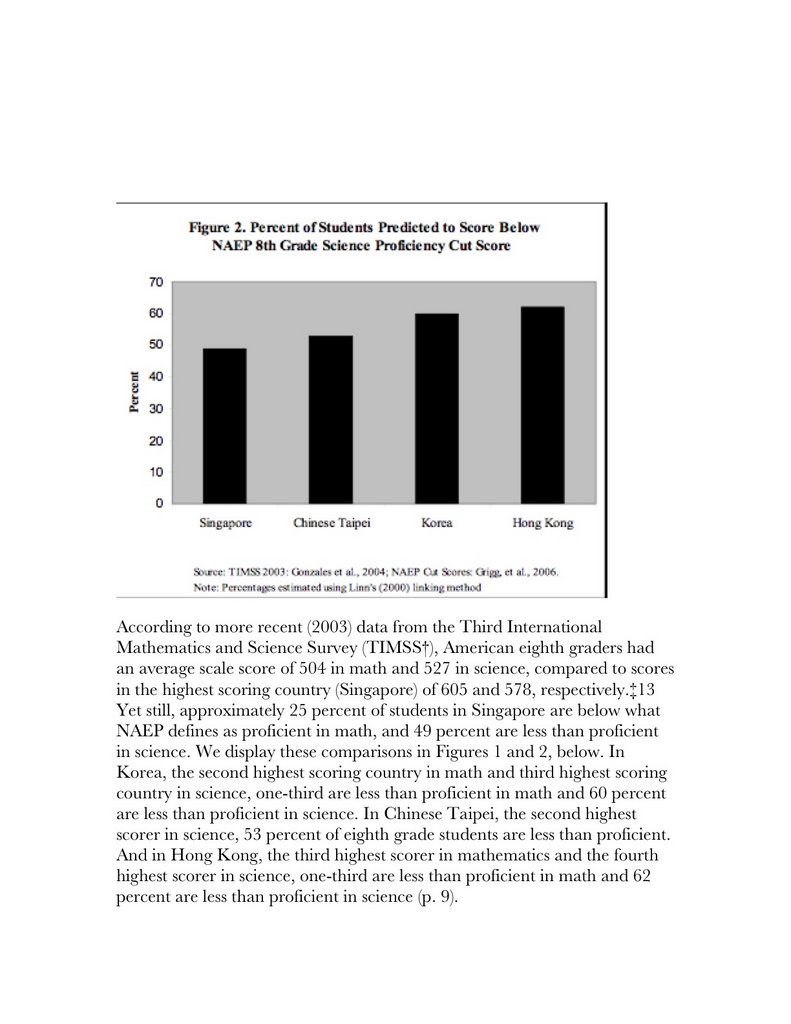
The NAEP business--we all saw this one coming as a way to continue the accountability intimidation indefinitely. It would appear, in fact, that if the rest of the world adopted NAEP as a standard, then everyone could be held hostage to accountability pressures that no one could meet. Just one example is provided in the chart and text at left (click to enlarge) from a paper by Richard Rothstein, Rebecca Jacobsen, and Tamara Wilder that was delivered at Columbia University November 16. The impossible cut scores, which have long been considered a bad joke by the psychometric folks, would make it impossible for even the most repressive educational regimes (the ones we want to emulate) to meet.

Finally, here is the soothing conclusion to Presidential "Contender" Dodd's speech at Monday's at the announcement of the new educational "way forward":

With core standards, America can begin the work of regaining its competitive edge in the global economy. And in the life of every student, equality will be made a little more real, as the skills and knowledge we expect of them are no longer made contingent on the accident of birth or residence.

High standards—American standards—have the potential to accomplish all of that. Their power can be enormous—as John Cole, the president of the Texas Federation of Teachers, once illustrated with a little story.

Apparently he had read that his favorite running back, Emmitt Smith, was asking for a $13 million contract from the Dallas Cowboys. So Cole immediately wrote a letter: “Dear Dallas Cowboys: I would gladly serve as your running back for just one hundredth of Emmitt Smith’s salary. Please let me know.”

Amazingly, he never heard back; and he asked himself why the Cowboys would pay $13 million for a running back when they could have had someone play the same position for just $100,000. “The answer,” he decided, “has to do with keeping score. If you don’t keep score, quality really doesn’t matter.” Unfortunately for John Cole, football teams keep score.

And unfortunately for our students, American education doesn’t—not in any consistent, comparable, competitive way. With your hard work, that’s going to change very soon.

Start keeping score—start holding America’s children to the same high standards—and we might be amazed at the excellence that follows, for our economy, for our security, for our parents, and for our children.

So if the new educational "way forward" looks amazingly the same as "staying the course," well, chalk it up the Collective Political Unconscious--or should that be the Collective Political Un-Conscience. You decide--it might be one of your last.

Wednesday, January 10, 2007

America's Homeless and the Decider's War

Today in a new report, we find out that almost 3/4 of a million Americans are homeless. 744,000 to be more specific. Tonight while the Decider was holding Americans spellbound with his "new way forward" in Iraq, I did a little quick arithmetic to see what it would take to solve the homeless problem.

I figure we could put each of the 750,000 homeless people in a new $200,000 house and pay each of them 50,000 dollars a year for 4 years while they get some schooling or job training. Oh yes, we could give them 20,000 each per year for four years of tuition at his or her favorite school.

When I carry my zeros and put in the commas, it comes to right at $360 billion, almost exactly the amount we have thus far blown up, burned, and handed over to war profiteers in Iraq.

Dodd on Arrival

Carrying water for the school privatizers is not the way to earn presidential points among those who still support public schools. And the last time I checked, that group constituted an impressive majority. From WaPo.

Petrilli, Finn and the Sludge Tanks' Revival of Federalism, or Why Does My Carrot Feel Like a Stick?

Now that the Dems have taken charge of the Congress once more, there is at least a small chance that the ascendancy of the new fascism (corporate socialism) may be temporarilly put on hold. And now with The Decider deciding to make more war just as the people are demanding much less of it, it looks like 2008 might even bring the neo-liberals back into the White House as well. With Power in real flux, then, it is no surprise to see the sludge tank reps like Petrilli and Hess, Finn and Rotherham start to backpeddle on their recent wild enthusiams for federal powers to shape education policy. We are witnessing nothing less than the beginning of a great awakening among backslid states rights federalists in Washington. Imagine that. See Petrilli's murky blather in NRO, "Leaving My Lapel Pin Behind: Is No Child Left Behind’s birthday worth celebrating?"

Now, in fact, that there appear to be votes to end some of the more egregious abuses of power and abuses of children in the NCLB Act, such as the idiotic pretenses and impossible test performance targets that NCLB is built around, No Child Left Behind no longer seems like the great idea it once did to the sharks in the ed policy tanks whose job it has been to figure out how to crush public education.

Now that there could be a movement away from the test-teach-test corporate model that is stupidifying America, and toward something ever-so-slightly more humane, maybe NCLB is not such a great idea after all. Now that there are signs of a commitment to get some of the $56 billion to the public schools that were promised to them five years ago when the Texas Miracle became America's Nitemare, maybe NCLB is not such a great idea. Now that there are clear indicators that some technical assistance to teachers and some help for the poor could truly be on the way, Petrelli and Co. have begun to conclude that a federal role will never suffice to reach the "lofty ideals" of reformers like himself who once embraced NCLB. Surely he must be referring to the lofty ideal of privatizing schools and turning teachers into Walmart employees.

With a real possibility on the horizon that the Department of Education under a new President might cast out its cast of edu-business crooks and privatizers come '08 (can you imagine ED without a Paige or a Spellings?), the Petrillis of the world are about to re-dedicate themselves to the old-time religion of states rights federalism that had been cast aside in favor of a federal treasury feeding frenzy that their sludge tankers have lapped up for the past five years. But, alas, all good things must come to an end.

Now as Petrilli and the other policy prostitutes for the Business Roundtable start to envision at least 4 blue Christmases in Washinton, they are in the process of doing a complete 180, which in prior times was known as a flip-flop. Where under the right-wingers, ED functioned as the the big stick, Petrilli and Finn are now imaging an ED that only carries a big carrot. They are asking the Feds to create national tests that will be "optional" to the states who want to use them. If the states "choose" to use the new national tests and create the data systems to make the data public, then there will be big financial rewards. The Feds at ED will become the scorekeepers in the National Test Score Derby. Will Vegas carry the line on Montana vs. New Jersey?

Where once there was enthusiasm for Federal power to force states into a particular educational mold, now with Democratic control looming, there is only a call for incentivizing by ED. Instead of using federal accountability demands, federal Title 1 purse strings, and paid thugs to force states to enact the the crackpot reading pseudo-science of Bush cronies, Lyon, Carnine, and Good, now there is a desire for each state to control its educational destiny. Instead of using federal sanctions to destroy the public schools, now there should only be big federal checks available for states to do it themselves, as they develop the Tucker Model of statewide corporate welfare charters. Instead of crafting federal timetables so cramped that states are forced to buy educational "solutions" from the testing corporations that have bankrolled the right wing takeover of educational policy, now there should be free-rein for states to choose privatization on their own time schedules and to be rewarded for it.

And guess what? The Business Roundtable has already found the nuch-needed neo-liberals to help make it all possible in a way that the cheap suits for the NEA will accept. Check out the "bipartisan" Dodd-Ehlers Bill to get the ball rolling for just what Petrilli is calling for. In short, Plan B is already underway before Plan A can be knocked down. Note that the BRT has allowed liberal relic, Ted Kennedy, to throw the usual bone to the progressives, one that will be quickly snatched away as the Congress gets down to real Business. From Ed Week:

As Congress moves to reauthorize the No Child Left Behind Act as early as this year, at least one topic will be high on the list: increasing the rigor of state standards and tests by linking them to those set at the national level.

Sen. Edward M. Kennedy, D-Mass., the new chairman of the Senate education committee, introduced a bill late last week that would encourage states to benchmark their own standards and tests to the National Assessment of Educational Progress, often known as the "nation's report card," but would stop short of calling for the development of national standards.

And on Monday, Connecticut Sen. Christopher J. Dodd, the committee's second-ranking Democrat and a potential presidential contender, introduced a bipartisan bill with Rep. Vernon J. Ehlers, R-Mich., that would go a step further by providing incentives for states to adopt voluntary "American education content standards" in mathematics and science, to be developed by the governing board for NAEP.

About 40 organizations have endorsed the Dodd-Ehlers bill, including such Washington-based groups as the National Education Association, the Thomas B. Fordham Foundation, the Alliance for Excellent Education, and the Council of the Great City Schools. The sponsors have just begun circulating the bill on Capitol Hill in an attempt to gain additional congressional sponsors.

Tuesday, January 09, 2007

Accelerated Charter School Puts Brakes on Repayment of $10 Million Loan From L.A.Taxpayers


The edu-business world is making a killing from corporate welfare payments and easy-pay or no-pay loans from city and state officials across the country who are bilking taxpayers as a part of the charter school revolution. Here's a great example of one sweetheart deal that has come to light in California. Some clips:

A nationally recognized charter school in South Los Angeles has defaulted on a $9.9 million loan extended by the Los Angeles Unified School District using voter-approved bond funds, documents and interviews show.

The Accelerated School, an elaborate, high-tech campus where Mayor Antonio Villaraigosa delivered his State of the City address last spring, made a $200,000 payment about two weeks ago - but only after district officials received a memo alerting them the campus was in default. The school previously had made two payments totaling about $1 million, the last in October 2005.

. . . .

"We took out a $10 million line of credit with the district in order to finish construction of our school (and) we were hopeful and ambitious of our fund-raising."

Although the school has close ties to the Mayor's Office, there is no indication that Villaraigosa has been involved in the loan or in the renegotiation discussions.

Williams said the original terms of the loan required repayment of the loan within five years. The payments included interest, which Meghrouni said was calculated based on the district's bond rates.

. . . .

Williams and Kevin Sved, like Williams a former teacher, opened the school in 1994 with 50 students in grades K 4, renting space from a Catholic church where every Friday the founders and parents packed up and stored the school equipment so the space could be used for church services.

Its expansion a decade later was made possible by $28.1 million from the LAUSD and a credit line with the district of $11.3 million, of which the school used $9.9 million to complete its growth, according to district documents.

According to Tokofsky, the loan was necessary because the school founders' vision for their construction - "more detailed, more elaborate, more spectacular" than anything the LAUSD has built - exceeded the budget allotted by the district and the state.

Monday, January 08, 2007

NCLB and Right Wing Privatization

From Workday Minnesota:
WASHINGTON - The nation’s largest union, the 3.2-million-member National Education Association, plus two other big unions and a coalition of more than 80 allies, are launching a fight to rewrite the "No Child Left Behind" Act. But Bush Education Secretary Margaret Spellings says the law needs tweaking, but not a major rewrite.

Teachers, school boards and their allies, members of the Forum on Education Accountability, sharply disagree with her. Besides NEA, the coalition includes AFSCME, the Service Employees and a third union, the School Administrators. It also includes civil rights groups such as the NAACP and the Urban League, and the national PTA.

All the groups say the law places too much emphasis on test scores and is too punitive, as it trashes even those schools that make progress in educating their students.

Indeed, one suburban Philadelphia school superintendent last month told the Joint Center for Political and Economic Studies--a think tank that concentrates on issues of interest to minorities--that NCLB sets up inner-city public schools to fail. When schools “fail” under NCLB, their federal funds can get yanked and diverted to a favorite Right Wing cause: Taxpayer-paid vouchers for parents of private school students. . .

Tell me it's not so! The rest here.

NCLB and The Hounds of Hell

"It really has brought the Hounds of Hell down on the schools of Prince William County," says Betsie Fobes, a recently retired eighth-grade algebra and pre-algebra teacher at Parkside Middle School in Manassas, Va. "This AYP business is just killing us — absolutely killing us."

Parkside, which has seen a large Latino influx, didn't meet its goals two years in a row — so now teachers must attend twice-weekly meetings, often focused on testing. They've built in a tutorial period, and even secretaries do their share of tutoring.

Here is another big chunk of the USA Today story on how NCLB has changed schools:

It's driving teachers crazy

Here's a pretty safe rule of thumb: Start in the classroom and travel up the educational food chain. The further you travel, the more you'll find that people like the law. Mention it to most teachers and they'll just roll their eyes. Many principals tolerate it. Ask a local superintendent, a state superintendent or a governor and the assessment gets rosier as their suit gets more expensive.

Carmen Meléndez quit her job as a bilingual language arts teacher at an elementary school last spring in Orange County, Fla., after the law prompted her principal to institute 90-minute reading blocks and a scripted curriculum — in the process making individualized instruction impossible. Meléndez also found that she couldn't teach poetry anymore.

"It was insane," she says. "The kids were all jaded. They were tired — they hated school."

Most of the frustration, teachers will tell you, comes from the stress of mandated math and reading tests. The law requires that virtually all children be tested each year starting in third grade — and it doles out growing penalties if schools don't raise scores each year. Naturally, test day in most schools is fraught with tension.

"They're 8 years old, and they're so worried about a passing score," Meléndez says. "I think that's inhumane."

Dianne Campbell, director of testing and accountability in Rockingham County, N.C., told the American School Board Journal in 2003 that administrators discard as many as 20 test booklets on exam days because children vomit on them.

Also, many state rating systems (which often predated No Child Left Behind) now end up celebrating the same schools the federal law slams.

Longstreet Elementary School in Daytona Beach, Fla., has scored high on the state ratings for five years, but Longstreet is one of 21 Volusia County schools due for "corrective action" this year under the law.

"Our parents are thrilled at what happens at our school — and a lot of what happens at our school has nothing to do with No Child Left Behind," says counselor Bill Archer.

Jack Jennings of the Center on Education Policy, a Washington education research group, says some of the testing actually helps drive better instructional strategies and, in that respect, is helpful. But he says teachers tell him they're overwhelmed by the sheer volume of testing, which can last six weeks in some schools.

"I don't think you can go into a teacher meeting in the country without somebody bringing up No Child Left Behind," he says.

After five years, the law has even spawned an online petition that, as of Sunday, had about 22,500 signatures of people urging Congress to repeal it.

Along with his signature, teacher Mark Quig-Hartman of Vallejo, Calif., said: "I am well on my way to becoming an embittered and mediocre teacher who heretofore considered teaching to be a profession, not a job. I once loved what I did. I do not now, nor do my students; school has become a rather grim and joyless place for all."

Teachers' unions have often been the law's loudest critics. One top National Education Association official even entertained the NEA's 2004 conference in Washington by appearing onstage with an acoustic guitar and singing a protest song with this unforgettable hook: "If we have to test their butts off, there'll be no child's behind left."

And if you think it's just teachers who complain, think again: 2006 saw even the law's most ardent supporters complaining, but for a very different reason: They say states and school districts game the system by lowering their standards.

Because the law allows each state to set its own pass/fail bar on skills tests, "proficient" means something different depending on which state you live in. The percentage of Missouri fourth-graders at or above "proficient" in English is only 35%, but 89% of Mississippi fourth-graders meet that state's standards. In math, only 39% of Maine fourth-graders are proficient or better; in North Carolina, 92% are.

Philadelphia Public Schools CEO Paul Vallas jokes that to really improve scores in his city, he could make classes smaller and modernize buildings. "Or we can give everyone the Illinois test," he says.

It's narrowing what many schools teach

If nothing else, the law's first five years have proved the maxim "What gets tested gets taught."

The law's annual testing requirements in math and reading have led many schools to pump up the amount of time they spend teaching these two staples — often at the expense of other subjects, such as history, art or science.

Jennings found that 71% of districts are reducing time on other subjects in elementary school.

"What we're getting under (the law) is a very strong emphasis on building skills at the expense of history and literature and science," says researcher Thomas Toch of the Education Sector, a Washington think tank.

Other critics say the law has created a "complexity gap." Children in lower grades have made improvements — some impressive — in basic skills, but the improvements vanish in middle school and beyond, when kids are tested on more complex conceptual thinking.

Brown University researcher Martin West this fall compared federal data from 2000 and 2004, and found that since No Child Left Behind, elementary schools have spent, on average, 23 fewer minutes a week on science and 17 fewer minutes on history. He also found that in states that test history and science each spring, teachers spend about half an hour more a week on each subject.

. . . .

It's making the school day longer

If a restaurant takes 12 eggs and makes a lousy omelette, will adding another two eggs make it better?

If a school can't teach a child to read in seven hours, will eight do the trick?

Under No Child Left Behind, the answer is: Probably yes.

The law requires schools that don't make adequate yearly progress to offer free transfers to a better-performing public school.

If results don't improve the next year, the school must begin offering free after-school tutoring — in many cases with classes taught by the school's own teachers with whom the kids were failing during the school day.

William Bennett, Ronald Reagan's education secretary, invoked the egg metaphor, and as it turns out, a lot of families — and teachers — are willing to try the omelette. In the 2004-05 school year, 1.4 million students were eligible for the tutoring, and about 17% took advantage of it.

Spellings says the tutoring is often provided by different teachers from the ones a kid sees during the regular day. Perhaps more important, she says, the law is forcing large districts such as Los Angeles to figure out how to keep kids from needing tutoring in the first place.

"They're … sitting there thinking, 'What the heck? How can we have so many kids who can't get to grade level in the course of the school day? What needs to happen in the school day different?' "

It's changing how reading is taught

Forget everything else No Child Left Behind stands for. If it does nothing else, advocates say, it will have improved poor kids' reading in unprecedented ways. A few say it already has.

The law gives schools $1 billion a year to spend on reading and focuses it, laser-like, on 5,600 schools that serve the nation's poorest 1.8 million kids. It starts with kids as soon as they enter school and, so far, has trained 103,000 teachers on "scientifically based" reading strategies heavy in phonics, step-by-step lessons and practice, practice, practice.

And because many schools build their reading programs around what primary grades do, it could affect millions more students' reading skills.

How could it fail? Easily, say critics such as Susan Ohanian. She points to overly scripted reading curricula and a curious little reading test called DIBELS, which makes it easy to rate children's reading skills, in part by asking them to look at nonsense words; it then rates them on their ability to read the words aloud — very quickly.

"I have never seen anything like this," says Ohanian, a former New York teacher who blogs about education in general and No Child Left Behind in particular. She bemoans the loss of teacher autonomy and says DIBELS is one of its worst symptoms.

"I don't dispute that it's quick and easy and it's a tool — and if you just used it that way, I probably wouldn't have a problem with it," she says. But she adds: "They're using DIBELS to hold kids back in kindergarten. And that's where it becomes really evil. Some kids are just not ready for that skills stuff."


Saving the Wars on Iraq and on Public Education

(Chart at left from The Christian Science Monitor)

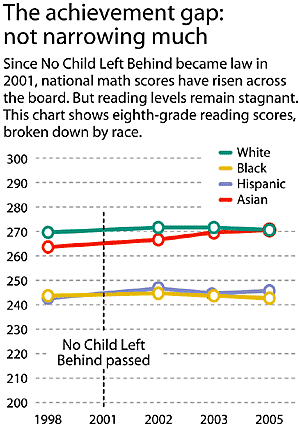
It's going to be another big week for the Decider. Not only will he be going before a hostile public to advocate for an escalation of his War, but he will meet with Miller and Kennedy this morning to charm his way toward a new surge in the continued war on the poor and on the public education system in our country. It comes just in time to mark the five-year anniversary of the most reckless, destructive and utterly failed education policy ever. Let's take a little accounting of how NCLB is accomplishing its goals as set out in 2002:

Performance Goal 1: By 2013-2014, all students will reach high standards, at a minimum attaining proficiency or better in reading/language arts and mathematics.

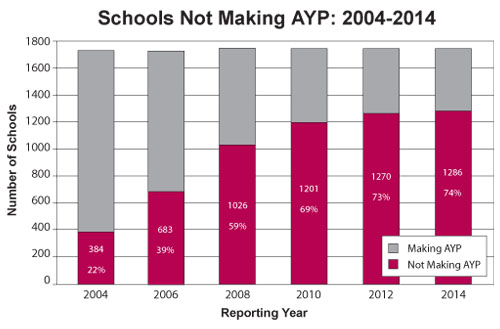
Reality 1: The most significant form of educational growth is the alarming increases in the number of schools not making AYP (adequate yearly progress) toward the impossible goal of 100% proficiency. In Massachusetts and Connecticut, for instance, where public schools are the strongest, the NCLB-mandated failure in reaching beyond the impoverished urban schools and into suburban enclaves.

Here is a chart from a study commissioned in Massachusetts (click to enlarge) that shows 74% of their schools failing to make AYP by 2014. If ED has its way, of course, these schools will have been turned in corporate welfare charter schools by then.

Performance Goal 2: All limited English proficient students will become proficient in English and reach high academic standards, at a minimum attaining proficiency or better in reading/language arts and mathematics.

Reality 2: If most people know that 100% proficiency is impossible for native speakers, 100% of people know that English-language learners and special ed. students are not going to become 100% proficient. The insanity of this goal clearly demonstrates the built-in failure that will not, cannot, be overcome, regardless of all the wishful thinking by the likes of Kati Haycock and Amy Wilkins at Ed Trust.

Performance Goal 3: By 2005-2006, all students will be taught by highly qualified teachers.

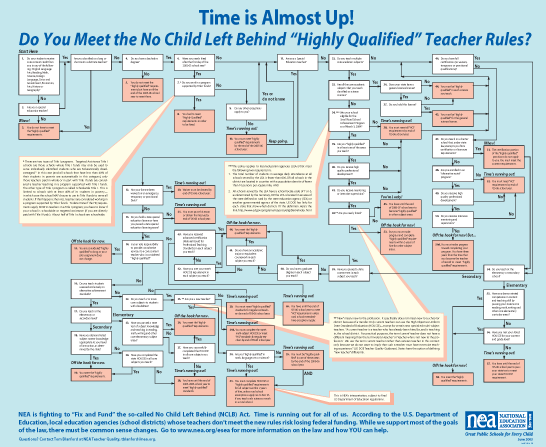
The attempted implementation of this goal has caused more grief and confusion and resignations than most could have imagined in 2001. On the one hand, higher standards would seem to guarantee more qualified teachers. This could have been the case if not for the overriding ideological commitment to bypass schools of education in creating a teacher corps is "highly-qualified."

ED prefers teachers who have passed subject matter tests to teachers who have completed professional certification programs. In the meantime, states like New Jersey now have a 52-page document explaining what it means to be "highly-qualified." Or check out the NEA's guide to highly-qualified (Download this chart as a PDF document here).

Performance Goal 4: All students will be educated in learning environments that are safe, drug-free, and conducive to learning.

Reality 4: 14 percent of eighth graders, 28 percent of 10th graders, and 36 percent of 12th graders used an illicit substance during the past year.

In terms of safety, here are the key findings from the latest (2004) School Safety Survey conducted by the National Association of School Resource Officers (NASRO):

More than 55% of the school officers stated that teachers, administrators, and support staff (secretaries, custodians, etc.) do not receive ongoing professional development training on school security and emergency preparedness issues.

Over 65% of the SROs stated that school bus drivers and other school transportation personnel have not received training during the past three years on issues related to security measures, emergency planning and response, terrorism, and associated topics.
Nearly 86% of respondents indicated that the number of crimes that occur on school campuses nationwide are underreported to law enforcement.

The majority of SROs (over 54%) stated that the federal “No Child Left Behind” law requiring states to create definitions of “persistently dangerous” schools decreases school crime reporting. Only 17% believed the law would improve school crime reporting.

The majority of school-based police officers (67%) believe that a federal law mandating the reporting of serious/violent school crimes to law enforcement would enhance law enforcement efforts to reduce school crime. Over 20% were uncertain as to whether such a law would improve school crime reporting.

Over 70% of the surveyed school officers indicated that funding for school safety in their districts is either decreasing or remaining the same.

Only 15% of respondents reported an increase in safe schools funding.

Over 70% of the survey respondents reported that school safety funding either decreased or remained the same in their district. Over 25% of that figure said that school safety funding was decreasing in their district, while over 44% said that funding was remaining the same. Only slightly more than 15% reported an increase in school safety funding in their districts.

More than 80% of the SROs believe that, considering the amount of federal funding being provided to improve homeland security for non-school entities, the amount of funding being made available specifically for K-12 school security and emergency preparedness planning is not enough.

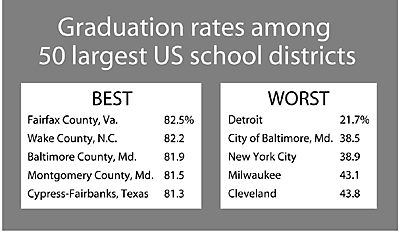
Performance Goal 5: All students will graduate from high school.

In June 2006 the Christian Science Monitor reported on a new study funded by the Gates Foundation that showed a dropout epidemic in American high schools. The Administration's solution: increased testing in high school.

In the meantime, high schools have survived repeated attempts by the Administration to eviscerate vocational education, proposing in 2006 to simply eliminate all vocational education programs. The Administration is pushing, too, for more testing in high schools under the perverse rationale that testing will improve high schools and improve dropout rates, when the evidence points to the contrary. The 10 states, in fact, with the lowest graduation rates all have high school exit exams, and 9 of them have had exit exams for more than 10 years:

Georgia (1994)
Nevada (1981)
Florida (1979)
Arizona (2006)
Tennessee (1986)
S. Carolina (1990)
Mississippi (1989)
Alabama (1985)
North Carolina (1982)
New Mexico (1990)