"A child's learning is the function more of the characteristics of his classmates than those of the teacher." James Coleman, 1972

Saturday, October 17, 2015

Child Labor to Build Charter Real Estate Empires

The real estate part of charter scam has always been the germinating monstrosity underneath the self-serving do-gooderism of the billionaire tax-sheltering paternalists whose aim has been and remains to convert the children of the poor into productive robots in the multi-billion dollar testing sweat shops that have replaced schools across urban America. 

It is a movement that occupies the moral bottom of a cavernous culture of greed and cynicism that would make the most jaded and inhumane 19th Century baron blush, and the movement is manned by privileged fascist camp guards who falsely claim to be educators.  No educator would quietly submit to the degradation and inhumanity that is at the heart of the "no excuses" charter movement that routinely dehumanizes children for the sake of creating brand names based on test score production and robotic behavior.

There a special circle of hell reserved for these monstrous capitalists, pious pretenders, charlatans, and crass abusers of the public trust, who are intent upon building profitable empires with public dollars on the backs of the most vulnerable children of America. 

From the Wall Street Journal:
Real-estate investors are showing an increasing interest in charter school development as the demand grows for classroom seats and some state and local governments become more willing to help finance charter-school projects.

Almost all charter schools are operated by nonprofit organizations. But these groups often rent and buy their buildings from private real-estate developers, and that is creating a new niche asset for some investors.

One of the latest entrants to the charter real-estate business is Northstar Commercial Partners, a Denver-based private-equity firm that is raising a $100 million fund. It will focus on converting charter schools out of vacant office, industrial and retail properties that can be purchased for less than half of what they would cost to build, according to Northstar Chief Executive Brian Watson.

Meanwhile, investment manager Bobby Turner, who founded Turner Impact Capital LLC in 2013, is raising his second fund with tennis legend Andre Agassi for building new charter schools, this one with a goal of $400 million.

And established players in the business are seeing volume increases on charter school developments. For example, a venture of HighMark School Development and EPR Properties, a real-estate investment trust, spent more than $118 million in 2014 on acquisition, renovation and construction, compared with $34 million in 2011.

“There’s no shortage of cash,” said Patrick Beausoleil, a HighMark vice president.

The rise in investment activity partly reflects the growth of the charter school movement, which has been overcoming political opposition in many states. During the 2014-2015 school year, 500 new public charter schools opened nationwide, for a total of more than 6,700 enrolling about 2.9 million students, according to the National Alliance for Public Charter Schools.

Some states are beginning to make financing tools available to charter schools that had been limited to traditional public schools. For example, the states of Texas, Colorado and Utah now backstop tax exempt bond issues for some charter schools, reducing their capital costs when acquiring facilities, according to Scott Rolfs, managing director of B.C. Ziegler & Co., a niche investment-banking firm that has underwritten more than $600 million in charter school bonds.

But the growing role of for-profit real-estate developers has added a new dimension to the debate over charters, which are taxpayer funded and independently operated schools that are largely free of union rules. Critics say charter schools are in danger of cutting costly deals with developers who are more concerned with investment return than educating children. The result can lead to failed schools.

Even people in the business warn that the charter school owners need to beware when agreeing to lease and buy buildings from private players. Charter schools often are launched in church basements or donated space by well-intentioned people who lack the financial sophistication to take their operations to the next level.

“There is a ton of capital coming into the industry,” Mr. Rolfs said. “The question is: Does it know what it’s doing? I don’t know yet.”

People involved in the charter school movement say for-profit participation is critical for the industry’s growth. The capital sources available from foundations and other nonprofit sources aren’t sufficient to keep up with demand, they say.

“The challenge is too large for the nonprofit sector to solve,” said Reena Abraham, a vice president with Local Initiatives Support Corp., a nonprofit that has helped about 189 charter schools obtain some $276 million in grants, loans and tax credits.

Some of the newer entrants to the business say investors in charter schools can do well by doing good. For example, Northstar tries to structure its deals with school operators so that no more than 12% of their revenue goes to facilities.

At the same time, Northstar believes it can give its fund investors more than a 10% return on their money. Part of its formula is buying buildings for a fraction of their cost and cutting deals with operators with a proven track record. . . .

Friday, October 16, 2015

TFA's Exploitative Paternalists Try New Zealand

With patience and support for TFA's racist and classist corporate missionary work drying up in the U. S, Wendy Kopp and her British clone are in New Zealand trying to expand their privileged prison guard teaching model into the Maori schools.

Apparently, news of TFA's real agenda has reached around the world:
. . . . Critics have labelled it a "crash course", and this week primary teacher union the NZEI said it believed disadvantaged students deserved experienced and qualified teachers, and should not be treated like guinea pigs.

President Louise Green said the money behind the organisation - which in New Zealand comes from philanthropies such as The Aotearoa Foundation as well as the Government - also hinted at an additional agenda: privatisation.

"In the past few years, New Zealand has started drifting down the path of neoliberal education reform," she said. "We only need to look to America to see how far it can go - and they have by no means finished their privatisation of public education." . . . .

Monday, October 12, 2015

The Siege of Philadelphia Public Schools | Update


By Ken Derstine @ Defend Public Education!
October 11, 2015

The most recent link update at the end of this post was posted October 16, 2015.

This post is an update to the post:
The Siege of Philadelphia Public Schools | Defend Public Education!
August 29, 2015


Philadelphia public school Superintendent William Hite with some of his management team.

On September 15, 2015 the Philadelphia Public School Notebook published an interview with Philadelphia School Superintendent William Hite. In the interview, the interviewer stated, “Some people seem convinced that you are here to privatize and that has been your task.” Hite replied,

“That’s kind of silly, actually. If my goal was to privatize we would be privatizing a lot more than what has been privatized here. A lot of what has been privatized was done long before I got here.”

On September 24 Hite announced the next phase of the privatization of Philadelphia public schools. The changes will create great churn for 5000 students affecting twelve schools. The changes include closing schools, opening new charters, and charter and in-district conversions.

Anyone following the adage “watch what they do, not what they say” was not surprised. Early in July 2015 Hite had signaled that the School Reform Commission is on course in following the Boston Consulting Group plan for privatization of Philadelphia Public Schools by appointing ten new highly paid administrators. The majority come from the charter and corporate education reform world.

This follows a pattern where, at its public meetings, the SRC devotes a majority of time to resolutions supporting and organizing charter schools. There is a continual pattern of neglect of the public schools. The percentage of the PSD budget for District schools is 45% and for non-District schools 24%. Yet the SRC is solely focused on charters. It should also be noted that 9% of the School District budget is debt service to the financial community. Currently, Philadelphia has 84 charters. Hite’s plan is to continue the expansion of the charter sector.

In his September 24 announcement, Hite announced the resumption of school closures. After 24 schools were closed at the end of the school year in 2013, Hite assured the traumatized school community that this was the end of closings. Two schools will now be added to the list of closed school buildings left vacant, turned over to charters, or sold to real estate interests at bargain basement prices.

Hite announced the expansion of “learning networks” from eight to thirteen. This would include resumption of turning schools into Renaissance charters that was begun under Superintendent Arlene Ackerman. Despite claims by the District that Renaissance schools perform far above the public schools based on standardized test scores, the latest PSSA test scores do not confirm the hype. (See the comments in PSSA scores for District, charter schools: Philly students struggled in math.)

The plan is to turn three schools over to Renaissance charters. The underhanded and undemocratic method being used can be seen with the manipulation of parent meetings about the turnover at the schools. One year ago, using their much touted issue of “school choice”, the SRC gave the parents at Steel and Munoz schools a choice of their school remaining a public school or being turned over to a charter company. Parents in both schools voted to keep their schools public. Having learned its lesson, the SRC will give the parents at the three new charter conversions only a choice of which charter company gets ownership of their school. 

But the undemocratic methods didn’t stop there. Two schools report that the meetings were highly manipulated. At Wister, parents reported that information about the meeting was hard to find. Those that showed up for the poorly publicized meeting were told the meeting had been moved to another location away from their school. Once the meeting began, the parents learned they were not there to be listened to by the SRC representatives, but they would get a sales pitch. Introduced to the parents was a parent from Mastery Cleveland Charter School who invited the parents for a tour of the school. The Wister principal informed the representatives from the SRC that her daughter had attended Cleveland and the school was great for her child before it was turned over to Mastery. She also informed the meeting that Wister had made AYP in 2008-2011 until schools were further starved for funds by the state budget under the Corbett administration. SRC spokeswoman Evelyn Sample-Oates told the angry parents, “The recommendation is from the superintendent for what should happen to this school.”

The day before Hite’s announcement, bids were put out for major repairs to the Wister schools infrastructure totaling over $2 million. This has been standard practice since the state takeover in 2001, neglect maintenance and upkeep of the public schools and then contract out upgrades when they are to be converted to charters or sold.

The same methods to frustrate parents were used at Jay Cooke school. Parents were not told the location of the meeting until the last minute and then it was difficult to sign up. (Teachers were not invited to the meeting.) The unpublicized meeting was held at the nearby church. District officials openly stated they withheld the location information “to ensure a small gathering of parents.” A few parents (the way they will be selected has not been disclosed) will join a review committee that will be able to give advice to Hite before he decides which charter to impose on their children. The SRC will vote on the conversions on January 21, 2016.

At the Cooke meeting, parents pointed out that a nearby school that had been a Renaissance school since 2011, Birney Academy, had been taken from the national for-profit charter operator Mosaica in July, and transferred to American Paradigm without an SRC vote. Mosaica had been placed in fiscal receivership in October, 2014, by a federal judge. This follows a pattern where failing charter schools, such as Young Scholars Frederick Douglass charter school, are turned over to Mastery.

The Mastery Charter school network, which now has fifteen schools in Philadelphia, is favored for the turnover schools. Each of the three elementary schools that are being turned around as Renaissance charters are within one mile of the Simon Gratz Mastery Charter High School. 

The first cohort of seven Renaissance schools came up for their five-year renewal this year. Four were renewed. One charter operator surrendered its school to Mastery. The SRC is having non-renewal hearings for two of the original Renaissance schools. The clear pattern is to close independent charters and turn them over to charter management companies like Mastery and KIPP. Mastery and KIPP are also planning to expand their charter management companies in Camden, New Jersey where they are promoting the privatization of all public schools.

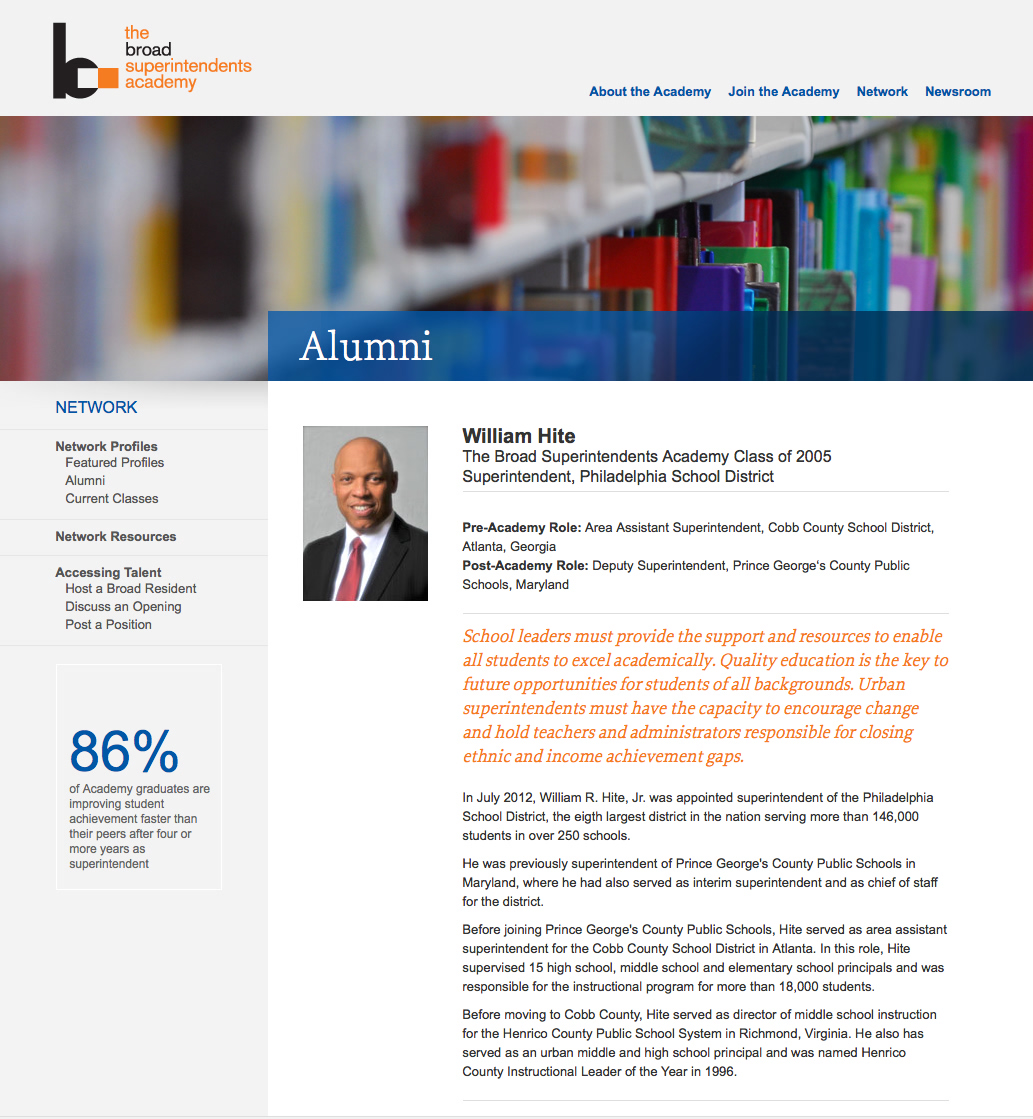
On May 15, 2015 The Broad Superintendents Academy announced that Scott Gordon, CEO of Mastery Charter Schools, had joined its latest cohort of trainees. The press release stated that the latest cohort is made up of ten trainees who are “passionate, proven leaders to transform America’s urban school systems so every student receives a world-class education.” Also joining the trainees is Paul Kihn, former Deputy Superintendent of the School District of Philadelphia, who resigned in July from the SDP in Hite’s latest administrative shuffle. Kihn returned to the Washington D.C.-based McKinsey and Company, “a global management consulting firm.” In 2011 around the time he was hired by Hite, Kihn co-authored Deliverology 101: A Field Guide for Education Leaders, with Sir Michael Barber, chief education advisor for the British testing company Pearson. They join alumnus William Hite who is a graduate of the Broad Superintendents Academy Class of 2005.

The new school openings include a new Science Leadership Academy. The principal of the first Science Leadership Academy, Chris Lehmann (to the right of Hite in the picture above) has been brought into top management as Assistant Superintendent to begin creating a network of his SLAs. SLA had been sharing a school with Beeber Middle School that will be closed and become a second SLA. A third SLA is planned in the new school building being built by Drexel University located where University City High School was recently demolished after its closing in 2013. 

The SLA school at Drexel will be teamed with the nonprofit Big Picture, a national charter chain. A second new school owned by Big Picture is planned for North Philadelphia. Last spring Big Picture High School in Los Angeles was threatened with closure since it only had 90 students for the planned 572, but its closure was delayed.

Unstated in the reports about the new charter schools is that they will all be non-union.

Members of the Philadelphia Federation of Teachers have been staging a work-to-rule action to protest the conditions in the public schools. Though they started planning before Hite announced the latest assault on public schools, Hite’s privatization plan has become part of the protest. School District employees have been working under a contract frozen in place since September 1, 2013. Salaries are frozen in place including no step increases. Violations of seniority for job placements are routine. The SRC refuses to negotiate its demands for changes in health benefits and draconian work rule changes. On October 21, 2014, the SRC revoked the teachers’ contract. The legality of the revocation of the contract is before the Pennsylvania Supreme Court. A decision is expected after the mayoral election at the beginning of November.

Though the SRC has not disclosed the figures, there are reports of many unfilled teacher positions in many schools. The SRC’s attempt to privatize substitute teaching has been an ongoing disaster requiring teachers and principals to cover classes with their preparation time.

On October 8, 2015 hundreds of Philadelphia public school students, organizing through social media, staged a student strike to protest the lack of funding for Philadelphia public schools. The Pennsylvania state legislature has been at an impasse for more than one hundred days. ALEC legislators are refusing to acknowledge the education-funding crisis in Pennsylvania and are using the crisis to advance a privatization agenda. 

Also see:

Curmudgucation – October 11, 2015

Philadelphia Inquirer – October 12, 2015

Jan Resseger – October 12, 2015

Company that finds Philly sub teachers misses another deadline
Philadelphia Inquirer – October 12, 2015

Le Bok Fin: What Do We Value? What Are We Forgetting?
PFT Caucus of Working Educators - October 12, 2015


Advocacy group to Gov. Wolf: Get rid of SRC member
Philadelphia Daily News - October 14, 2014


Mastery gets $9.6 million federal grant to expand
Philadelphia Public School Notebook - October 14, 2015

In addition to Philadelphia, this grant will be for Mastery charter management company to expand in PA, NJ, DE and DC.
This grant is part of a $157 million grant that Arne Duncan announced three days before he announced his resignation. It will go to 12 charter management organizations and eight state agencies across the country. 

See this article in Chicago's Substance News for details:
Arne Duncan's corrupt legacy in promoting charter schools...'...the massive promotion of charter schools took place during Duncan's watch...Even more perplexing is that the largest grant of $71 million ($32.5 million the first year is going to Ohio...' Substance News - October 13, 2015. 


Mastery's CEO talks about expansion plan and Renaissance turnarounds
Philadelphia Public School Notebook - October 15, 2015
Read the comments.

SRC to hear from parents about charter conversion plans
Philadelphia Public School Notebook - October 15, 2015


SRC's Jimenez the one who really cares
Philadelphia Daily News - October 16, 2015
A Philadelphia Daily News columnist compares the Alliance for Philadelphia Schools to the Taliban.


Philly SRC meeting dominated by charter conversion critics
Philadelphia Public School Notebook - October 16, 2015


Protestors at SRC meeting angrily call for dramatic changes
Philadelphia Inquirer - October 15, 2015


 APPS testimony at the Philadelphia School Reform Commission - October 15, 2015
Alliance for Philadelphia Public Schools - October 16, 2015 


Thousands of Philly students still without permanent teachers
Philadelphia Inquirer - October 19, 2015


Sunday, October 11, 2015

Has California really abolished the high school exit exam? Not quite.

Sent to my state government representatives:


 According to news reports, Gov. Brown has "abolished" the high school exam.  Not quite.  The bill Gov. Brown signed (AB 172) does not abolish the exit exam forever.  In fact, it requires that a panel be set up to "provide recommendations" for a new high school exit exam. 

I hope the panel reads the research on high school exit exams.  Several studies have been done showing that high school exit exams do not lead to more college attendance, do not result in increased student learning and do not result in higher employment. In fact, researchers have yet to discover any benefits of having a high school exit exam.

I will be happy to provide the details of the research.

Thursday, October 08, 2015

TeacherTown Ranked 93rd Out of 95 for Child Well-Being

Until recently the non-profit corporate parasites feeding off Gates cash, along with the education industry profiteers feeding off the taxpayers, were waging a public relations campaign to have Memphis known nationwide as Teacher Town.  What sadness, particularly when thousands of real teachers have been replaced by the clueless temps from Teach for America and the fundamentalist missionaries from the Memphis Teacher Residency.

But despite all the ads, blogs, tweets, TFA propaganda, and endless FB posts crafted to appeal to unemployed millennials looking for the meanest kind of occupational self-flagellation and the coolest mini-brewery, the ed biz in Memphis is on a rocky road.

Because of persistent resistance from UMemphis faculty and other citizens, Relay has pulled the plug on setting up operations on campus, and a number of out-of-state high rolling charter companies have cancelled plans to open concentrated testing camps in Memphis.  And as the TeacherTown website has become an empty shell, the big PR push to "Choose901" (901 is the Memphis area code) has scaled back so that naive millennials can no longer buy those awesome Choose901 t-shirts.  Sorry, store closed.

Recently CorpEd's local blogger and charter disciple, Jon Alfuth, pulled the plug on his Bluff City Education blog, declaring that ground zero for charter privatization had shifted to Nashville.  Hah!  Obviously, Alfuth knows less about Nashville than he does Memphis.

All this comes as news arrives that, in a state that ranks 36th in child well-being, Memphis/Shelby County ranks 93rd out of 95 counties.  And while poverty, racism, and segregation continue to be ignored, Memphis offers yet another prime example of failure by the corporate education losers.  How long can we afford to allow these self-serving fools to divert attention away from the real problems facing urban America?

New Orleans Charter Caste System

When the profiteers and venture paternalists moved into New Orleans to patch together their corporate system of schooling in the wake of Katrina, they had an opportunity to break the mold and create a socioeconomically-integrated and diverse system, or to design a corporate welfare system that mirrors the long held hierarchy based on unearned privilege, economic exploitation, and racial oppression. 

A new report from Stanford outlines clearly which road the corporate reform schoolers chose, and it was not the one less traveled by the predatory pedagogical pretenders.  See charts below.


Not only have the corrupt and arrogant CorpEd losers created a rigid caste system of schooling, but they have imported Wall Street methods of accountability, as shown in this clip from the report provided by Jan Resseger:
“A constantly changing set of metrics in terms of how student scores are reported (with recent changes in cut scores and content) and how school ratings are reported (with several sets of changes to the school ranking system) have contributed to competing narratives about the effectiveness of reforms in the years since Katrina.  So has the fact that the state allows schools that are brand new, have been closed, or have accepted students from a closing school to be exempted from the accountability ratings for a period of time.  Thus, in 2013, when 9 schools opened and 9 closed, and another set of schools accepted students from those being shut down, more than one-third of New Orleans RSD schools, disproportionately lower-performing, were exempted from the ratings.  In that year the district’s improved ranking (from an ‘F’ to a ‘C’) occurred substantially because of these exemptions… When looked at separately from OPSB, which was not the subject of state takeover and did not include a system-wide conversion to charter schools, New Orleans RSD schools demonstrate very low outcomes.”

Some Historical Ironies Regarding Elite Support for Charter Schools in New York City

by Mark Naison
 
Some Historical Ironies Regarding Elite Support for Charter Schools in  New York City

   One of the main reasons why many parents in low and moderate income communities send their children to charter schools- in spite of the scripting, intimidation, and rigid discipline many feature - is that most of these schools keep children from 7 AM to 7 PM. This is a huge boon to working parents, especially those who work more than one job to make ends meet. Neighborhood public schools who do not have fully funded after school programs cannot compete. Parents in the city's poorer communities need schools to be child care centers as well as centers of instruction. In New York City, charter schools provide this more effectively than public schools. And they are able to do this because they force teachers to work far longer hours than public school teachers for the same pay.

    What is ironic about this situation, given the enthusiastic Hedge Fund and Celebrity support for charter schools, is that ALL New York City public schools once provided excellent after school programs for the city's children. From the late 1940's through the Fiscal Crisis of the late 1970's, every New York City public school was open 3-5 and 7-9 for supervised activity.  These after school centers and night centers were beacons of hope and activity for New York City children as well as places to escape the gangs and violent streets you had in some neighborhoods. They featured sports programs, arts and crafts, music and talent shows. World famous athletes and musicians, some of them living in the city's poorest neighborhoods, were products of these programs

      What happened?. In 1976, when New York City was put into receivership to avoid bankruptcy, with fiscal decisions make by a banker controlled Emergency Financial Control Board, huge cuts were mandated in the city's educatio budget  Within a year, ALL of the great after school centers and night centers in the New York City public schools were shut down, along with the great music programs you had in the city's middle schools and high schools. They were deemed too expensive for the taxpayers of New York to afford. These programs were NEVER restored!  New York City public schools only have a fraction of the after schools programs and music programs that they had in the 50's and 60;s and those often have to come from outside grants.

     Now, through the medium of charter schools, bankers are restoring SOME of what they took away from the city;s children in the 1970's. But they are not doing it for all the city's schools and all the citys children. They are only doing it schools where teachers lack union protection and work 12 hour days, and where school administrators have the power to summarily fire teachers and remove children who don't test well or conform to rigid discipline.

     In short, elites are restoring much needed services to children and families only if they can be done far more cheaply than they were in the past, and if they reinforce the kind of intimidation they are trying to foster in the workplaces they own and control.

     As a result, parents in poor communities are caught between a rock and a hard place. If they want to keep their children safe and supervised during 12 hour work days, charter schools may be their most viable choice. Even though the teachers in those schools are browbeaten and intimidated and transfer that intimidation to their children.

      If you think this is a sad commentary on the cholces you provide to children of the poor, you would not be the only one.

Tuesday, October 06, 2015

Where Teacher Recruitment, Education Programs and the Economic Achievement Gap Meet

I often say how lucky I was to have gone to Fordham University’s Undergraduate School of Education in New York City during the late 1960s. We were the 60’s “Boomer” generation, raised during the quietly prosperous 1950s that became the idealist generation looking to save the world from itself. Many joined the Peace Corps to work with the poor across the globe, but many more joined what no one thought of as an American peace corps…the teaching profession. What better way to help those in need than to help them learn how to learn so they could build their lives?
Yes I, as well as most of my classmates, complained about what we knew were practically useless courses. But, we also knew how well we were introduced to the culture of NYC and our primarily minority future students. We took courses where we learned about how skin color affected relationships among Puerto Ricans (the largest Spanish speaking group in NYC at the time). Our 95% white classes read Piri Thomas’s “Down These Mean Streets” and the "Autobiography of Malcolm X." We did a semester of field work in the communities where we were to get jobs, and of course we student taught for a full semester in those communities. We also had courses in child psychology, and were instructed in methodology specifically for our subject and/or grade levels. Of course, not all of our professors were great, but after all it was college. We all know that college is often not the best place to find the best teachers, regardless of the subject or major.

How things have changed for today’s twenty-somethings thinking of becoming teachers! Economic conditions have worsened. Idealism has been replaced more and more by materialism. The public policy of high stakes standardized testing to evaluate students and teachers has poisoned the teaching profession. Common Core State Standards have stifled creativity. 

Read more....

http://www.edcircuit.com/where-teacher-recruitment-education-programs-and-the-economic-achievement-gap-meet/

The Year's Most Inaccurate Headline

By suggesting that Hillary Clinton has done anything to impede the demise of public education or the de-professionalization of teaching, the Inaccurate Headline Award goes to Huffington Post:

Hillary Clinton Earns Backing Of Nation's Largest Union

Monday, October 05, 2015

NEA and AFT Misleaders Go with Broad-Gates Pick for President

Hil and Lil
by Jim Horn
During the final months of Bill Clinton's presidency, both Bill and Hillary worked hard to secure legislation to benefit their friends' and supporters' newly-formed foundations, as well as the one planned for themselves.  The Clinton-friendly Broads and Dells got into the foundation business in 1999, and the Bill and Melinda Gates Foundation got rolling in 2000.

In the fall of 1999 as Hillary was beating the bushes for pledges to support the building of the Clinton Library and the Clinton Foundation,  Bill and Hill developed a list of "philanthropy heroes" who would be honored at a special Washington gala:
A September 1999 White House list proposing possible "philanthropy heroes" to highlight at the conference included wealthy donors of "large recent gifts," among them Microsoft's Bill Gates and his wife, Dell computer founder Michael Dell and investors George Soros and Eli Broad.

They all later donated to the Clinton Foundation through their companies or private foundations. There are no indications that White House officials discussed future Clinton Foundation gifts with any nonprofit. But the White House attention lavished on their concerns, Jacobs said, showed that "the president and the first lady were making tax reform for a specialized, wealthy part of American life one of their top priorities."

In January 2000, the Clintons were preparing policy strategies to provide tax breaks to their friends' new corporate foundations and other billionaire donors.  At the State of the Union address that year, Clinton bragged about his final budget initiative to offer the middle class a tax reduction, but he said nothing about the really big plans to provide generous tax benefits to venture philanthropists and corporate foundations.

All of the "philanthropy heroes" gave to the Clinton Library, as did the Walton Family Foundation, even if the specific Clinton tax reforms died in legislative committee in 2000.

Something that did not die, however, was the New Markets Tax Credit, which allows the rich to collect 39 cents in tax savings on every dollar given to corporate welfare charter schools or to fund palatial developments placed in poor city areas:
The New Markets Tax Credit, introduced during the Clinton administration, was intended to spur the development of projects that would create jobs in low-income communities. However, recent reports by Bloomberg Markets Magazine and CBS News have cast a harsh light on how banks and investors have managed to manipulate the qualifications for the tax credit to allow projects to be built in areas that would seem to hardly fit the definition of a low-income community.

Among the projects is the luxurious Blackstone Hotel in downtown Chicago, which was the beneficiary of $15.6 million in tax credits, much of which went to Prudential Financial and its partner in the project, JPMorgan Chase. Prudential also profited by building another luxury hotel, the Nines, in Portland, Ore., which was built with $27.3 million in New Markets Tax Credits.
Today Clinton's efforts continue to generate billions for the charter industry, hedge funders, and philanthrocapitalists.  For them to choose anyone but Hillary for President would be sacrilege.

It is now clear that the same is true for the NEA and AFT chiefs, whose support for privatization cannot be disputed.  It is time, way past time, for educators to organize locally and regionally and to withdraw from any support of AFT and NEA.