"A child's learning is the function more of the characteristics of his classmates than those of the teacher." James Coleman, 1972
Showing posts with label Pennsylvania charter schools. Show all posts

Monday, January 14, 2019

Pennsylvania's Cyber Charter Bonanza

The taxpayers of Pennsylvania send $525,000,000 dollars every year (35,000 students @ $15,000) to 15 cyber charter schools, 10 of which have been operating on expired charters since 2012.

Even the charter industry, itself, is taken aback by the total capitulation by the state's failed oversight function:  
“When you have charters that are operating on expired contracts, the question becomes: Are they being held accountable for meeting the needs of students?" Brooks-Uy said.
In terms of the state and federal government assessments of how public schools are "meeting the needs of students," the picture for cyber charters is crystal clear:
In 2017, all but one cyber charter ranked in the bottom quarter of schools statewide on Pennsylvania’s School Performance Profile, which graded schools on standardized test scores, as well as attendance and graduation rates. The one school, 21st Century Cyber, was just above the bottom quarter. Ten cyber charter schools were in the bottom 10 percent.
Will anyone make state politicians accountable for this ongoing scandal?  Anyone, anyone?

Tuesday, March 14, 2017

Riding the 'turnaround' merry-go-round in the continuing assault on Philadelphia public schools: Part VI - Who is Afton Partners?


 by Ken Derstine
@ Defend Public Education
March 14, 2016


The previous article in this series was posted June 2, 2016. This series has detailed the assault on Philadelphia public schools by corporate education reform business and financial interests. At the last posting, the Philadelphia School Reform Commission had not acted on the non-renewal recommendation of its charter office for Aspira, Universal, and Mastery charters. 

Pennsylvania law mandates that a charter term is five years and must undergo a renewal process after that.  There is a stipulation in the law that the renewal process can be extended for one year, if there are mitigating circumstances.  That one-year extension can only be used one time. They have been postponing the renewals month after month since April 2016. Aspira’s was postponed without the SRC even taking a vote in 2015.

Now, as can be seen in Part VI in this series, the privatization merry-go-round is spinning ever faster in the assault on Philadelphia public schools.

*****

In a recently released report by Afton Partners, the cost of students leaving Philadelphia public schools to transfer to charters was examined. The study had been commissioned in February, 2015 by the School Reform Commission, which functions as a school board and makes all final decisions for Philadelphia schools.


In “is the glass half full or half empty” coverage, the Philadelphia Inquirer published Report: Philly schools still face costs when students go to charters vs. the Philadelphia Public School Notebook’s Students leaving Philly schools for charters less costly than once thought.

According to The Notebook article, the resolution calling for the contract with Afton said the analysis would take place between February 20, 2015 and May 1, 2015. SRC officials claim the report “got lost in the shuffle as old administrators left and new administrators replaced them.” The District’s Chief Financial Officer Uri Monson, appointed February, 2016, said he first got word of the report last summer and has been working with Afton “to make sure the report addressed all questions.”

Why is the report being released now? Could it have something to do with a bill in the Pennsylvania House introduced by Speaker Mike Turzai on March 6th which would require the Philadelphia School District to add 3,000 charter seats per year? This bill would undercut the charter oversight authority of the Philadelphia School Reform Commission (SRC). The establishment of the SRC in 2001, as part of the state takeover of the School District, abolished local control of public schools, along with any hope of any type of democratic process.  A 2014 bill passed by the legislature imposed a $2/pack cigarette tax for school funding; it included a last-minute provision that the SRC consider applications for new charters each fall.  Rejected applicants would be able to appeal to the state Charter Appeal Board.

Now, invoking the states rights' provisions of the Every Student Succeeds Act (ESSA), Turzai wants to completely take even this oversight from any local influence. He has been agressively intervening in the SRC's charter approval process lobbying for approval of charters that the SRC has rejected. The SRC's Uri Monson said the bill is unessessary because in the SRC's five year financial plan presented last year there is an already projected annual growth of charter enrollement of between 2,700 and 3,000 seats.


Sunday, February 19, 2017

Decaying Buildings and the Rise of Digital Education

by Wrench in the Gears


“DeVos doesn’t think we should be funding school buildings as much as students.” The line caught my eye as I scrolled through social media this weekend. How could it not? I’ve been working hard over the past year to try and convince other education activists that the true endgame of the reform movement is to make school buildings obsolete. So I listened to the video of DeVos speaking to attendees of the Magnet Schools of America National Policy Training Conference in Washington, and there it was at timestamp 11:40: “I don’t think we should be as focused necessarily on funding school buildings, as much as we should be having a conversation around funding students.”
DeVos, being from Michigan, surely knows the deplorable conditions students in Detroit face daily trying to access a free and appropriate public education. And Detroit is not alone. Parsons completed a Facility Condition Assessment for the School District of Philadelphia last month identifying $4.5 billion in deferred maintenance. Over $1 billion of that total involves life safety, code compliance, health hazards, accessibility, and security issues. Think about that. We are asking vulnerable children and school staff to enter buildings that are not safe five days a week, while at the same time the Secretary of the US Department of Education is proclaiming we should not be funding school buildings.

This week I also came across a legislative forecast for Educational Savings Accounts (vouchers) prepared by Jeb Bush’s group Excellence in Education. The info-graphic accompanying the report indicated that my home state of Pennsylvania was one of 13 states identified as having a 75+% chance of implementing ESA legislation in the coming year. Our schools are already in an incredibly precarious financial position after years of austerity budgets and onerous debt service. The combination of intentionally unsafe buildings and ESAs will likely end up pushing more families out of the public school system with devastating consequences for those who remain.

Following on the “don’t invest in buildings” comment was another doozy from Jonathan Swan’s conversation with DeVos featured in Axios “I expect there will be more public charter schools. I expect there will be more private schools. I expect there will be more virtual schools. I expect there will be more schools of any kind that haven’t even been invented yet.” And while some chuckle over that last line, I’m pretty sure she’s talking about “Learning Ecosystems” which exist in concept right now, if not execution. The decentralized cyber-based education model with community drop-in centers would be consistent with her support of market-driven choice and tech-based educational content delivery, as well as her disdain for neighborhood schools being anchors in their communities. In a 2013 interview with Philanthropy Roundtable DeVos noted, “One long-term trend that’s working in our favor is technology. It seems to me that, in the Internet age, the tendency to equate “education” with “specific school buildings” is going to be greatly diminished.”


Sunday, December 13, 2015

The Siege of Philadelphia Public Schools is Now a Full-Scale Assault


By Ken Derstine

December 13, 2015


The Pennsylvania Legislature

Introduction

The bipartisan celebrations in Washington D.C. over the enactment of the Every Student Succeeds Act were barely over when the Pennsylvania Senate passed a bill which goes to the heart of the states’ rights dangers opened up by the new law.  In a bipartisan 42-9 vote on December 10th, the Senators approved a school code bill that would require the state to turnover to private interests five “persistently low performing “ schools each year. The only school district in the state affected would be Philadelphia.

As detailed by Kevin McCorry in Newsworks, the Pennsylvania Department of Education would have five intervention options:
  • Turn over operations of the school to an outside education management organization
  • Convert the school into a neighborhood-based charter
  • Close the school and facilitate transferring students to higher performing schools
  • Authorize a new charter and guarantee admission preference to students who reside in the area around the low performing school
  • Replace the principal and at least half of the school's staff

The action is in line with the charter mandate in the Every Child Succeeds Act. As detailed by Jim Horn of Schools Matter in his article Massive Charter Giveaways in ESEA Re-Write, Part 1,

With a continuing federal mandate to fix the bottom five percent of schools, the ESEA rewrite will provide at least a billion dollars each year to fund charter school expansion, thus further weakening public education.  The new grant programs will be fashioned to provide minimal oversight and maximum autonomy to charter companies and their corporate support organizations, and for the first time, private non-profit corporations will be classified as “state entities,” thus eligible to apply directly for federal grant programs.

The Historical Background of the Bill

Sunday, January 27, 2013

Bubble Bursts for Pennsylvania Charter School Scores

Ron Tomalis is Secretary of Education for Pennsylvania.  He holds a Bachelors Degree in Political Science, which makes him at least as qualified as Margaret Spellings was for her job as former Secretary of Education for the U. S under Bush II.  Before Margaret Spellings, there was Rod Paige, whose leadership during fraudulent Houston Miracle era earned him a spot as W's first Secretary of Ed.

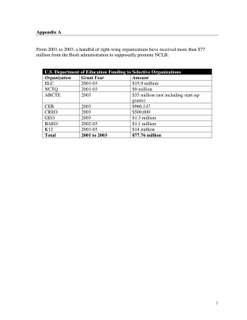
Paige had a Deputy Secretary from Pennslyvania by the name of Eugene Hickok, who was put in charge of passing out $75,000,000 dollars in federal discretionary grants to Bush Administration cronies.  This is where Bill Bennett's K-12, Inc. was born and other education industry kingpens got their nest eggs laid, including Lisa Keegan and Andy Rotherham, both with the Education Leaders Council that produced nothing to show for the $16 million in federal tax dollars they received.  Since then, Rotherham has emerged as an education "thought leader" who spend s lot of time in Sun Valley skiing and leading thoughts, I suppose.

Below is a chart done by PFAW that shows where much of the federal money went that Hickok handed out (click chart to enlarge).

Eugene Hickok left ED when Paige departed, and soon thereafter he was forced to pay a $50,000 fine to avoid criminal charges for conflict of interest accusations.

Ron Tomalis was Hickok's assistant at ED, and when Hickok left for Dutko Worldwide to share his expertise with other bottom feeders, Tomalis went with him.

After PA elected to Republican, Tom Corbett, as Governor, Corbett chose Tomalis as the next best thing to Hickok for privatizing Pennsylvania's schools.  Below is a news story from last week that offers a clear picture of how these operate, which hinges on the kind of ham-handed crookedness that we have come to expect from the corporate reform schoolers.  The story from The Morning Call:
_________________________________
The number of charter schools hitting testing benchmarks plummeted after the federal government said the state Education Department graded them too leniently.

At first, nearly half of the state's 156 charter schools whose students took the 2012 PSSA math and reading tests made so-called Adequate Yearly Progress under a new grading system Education Secretary Ron Tomalis implemented last summer.

The new system, which Tomalis initiated without federal approval and at the behest of a charter school lobbying group, made it easier for charter schools to reach federal standards than traditional public schools. It classified charters, no matter their size, as school districts, which are measured on a broader scale than individual schools.

The U.S. Department of Education, however, shot down that change in November. It ordered Pennsylvania to recalculate the charters' AYP status on the school level and publicize the results by January. So under the federal order, charters must have the school-level and district-level grades.

Under Tomalis' system, 77 charter schools — or 49 percent — made AYP when they were measured as school districts. But when tabulated as individual schools, only 43 — or 28 percent — made AYP, according to a Morning Call analysis of state data.

By comparison, 49 percent of the state's public schools made AYP and about 61 percent of the state's 499 school districts that administered the PSSAs did, too.

Of the seven charter schools in Lehigh and Northampton counties, only the Lehigh Valley Academy Charter School was affected by the change. It made AYP as a district, but dropped to warning status as a school.

Roberto Clemente in Allentown and Seven Generations in Emmaus made AYP on both grading scales.
Lincoln Leadership in Allentown, and The Lehigh Valley Performing Arts High School, Vitalistic Therapeutic and Dual Language, all in Bethlehem, missed it on both levels. (Vitalistic will close Friday for financial reasons.)

That equates to about 29 percent AYP success rate on a school-level basis and a 43 percent success rate on the district level for Valley charters, The Morning Call's analysis shows.

Pennsylvania had long graded charter schools, which are funded with tax dollars, as individual schools. Under such a system, a school achieves AYP if a percentage of its students in each tested grade scores proficient or advanced through straight or curved scores. Student scores are further broken down by student demographics. If at least one demographic group in any grade level fails, the whole school fails.

A school district is measured on a broader scale that uses grade spans: 3-5 for elementary schools; 6-8 for middle schools and 9-12 for high schools (though only 11th-graders are tested). Only one of the three grade spans needs to hit the testing targets for a district to make AYP.

Tomalis did not announce he had switched over to a district-based system for charter schools when he released 2012 PSSA results in September. But he did blame the drop in statewide PSSA scores on tighter testing rules he instituted in response to what he said were episodes of cheating.

Tim Eller, Department of Education spokesman, declined to answer questions about the disparity The Morning Call's analysis showed between the two types of charter school results.. . .