"A child's learning is the function more of the characteristics of his classmates than those of the teacher." James Coleman, 1972
Showing posts with label Race to the Top. Show all posts

Friday, June 13, 2014

Toxic Culture of Education


Orlando Sentinel

Frustrated Orange teacher decries 'toxic culture of education'

By Leslie Postal, Orlando Sentinel
6:26 PM EDT, June 12, 2014

Fed up and fired up, algebra teacher Josh Katz this spring took to the stage for a 17-minute denouncement of what he called the "toxic culture of education" in Florida's public schools.
Since then, nearly 30,000 people on YouTube have viewed the University High School teacher's impassioned attack on high-stakes testing, Common Core academic standards, private education companies and the false "narrative" that "public schools are teeming with horrible teachers."
His talk, delivered at a conference in Ohio, earned a mention from a Washington Post columnist, praise from education historian and activist Diane Ravitch and emails from colleagues saying "thanks for speaking up."
Katz posted a video of his talk on YouTube in May and linked to it on Facebook. He also put it on his teacher website next to a reminder about the "drop dead date" for turning in any missing work.
In his speech, Katz said state policies have failed struggling students, who he said lack the skills and home life to thrive in a school environment that stresses college preparation for all.
"Because we have a toxic culture of education … we take the blame for the student who can't focus in class because she hasn't eaten since yesterday's lunch," he said.
A University of Central Florida graduate, Katz, 39, has spent seven years teaching at the east Orange school. He's a father of three young children and came to teaching as a second career.
He ended his fast-paced speech by saying, "I believe in the potential greatness of a public-education system done right, and so do my colleagues."
But in an interview, Katz said that in recent years he's grown frustrated that so much of public education is tied to standardized tests, which Florida uses to judge students, teachers and schools' success.
The question, "What does this do for the kids?" doesn't seem to play into the education equation anymore, he said.
The principal of University High, Anne Carcara, would not comment on Katz's speech, but district spokesman Kathy Marsh said the talk wasn't viewed as an attack on his school or even the Orange County school district.
"There may be some points that raise the ire of some folks or even stir thoughts," she wrote in an email, but it was nothing that would prompt any district concerns.
Katz, however, said he wasn't sure how much longer he would remain teaching, giving that he is "fed up with everything" about state school policy.
State educators say their policies, including measuring student success on standardized tests and holding schools accountable for the results, have led to decade-long improvements. Florida now has more students graduating from high school and more succeeding on national exams, they note.
But Katz said those policies don't focus on what some students really need.
"How can we help them be better students, better people? How can we help them with these noncognitive factors like work ethic and character? How can we make sure that they're getting enough sleep, that they're getting enough to eat, that they're showing up for class?"
Standardized tests, Katz said, have been used to prove that these students and their schools are "failing," a message pushed by "our super villain: private education companies."
The firms that make standardized tests want to "perpetuate a picture of failure," he said, because "companies cannot make money on long-term student success."
The new Common Core standards in language arts and math that Florida adopted "will do even more damage," in his view, because they are tied to more high-stakes testing and to lessons that aren't appropriate for everyone.
Katz first gave a shorter version of his speech last year at a conference held by the Delta Upsilon fraternity, which he joined at UCF. At a second fraternity conference, Katz met someone from the University of Akron who'd heard about his first speech and invited Katz to talk at a TEDx conference at his school.
TED hosts events where the "world's most interesting thinkers" give short speeches on a variety of topics. A TEDx event is similar but independently organized.
Before teaching, Katz worked as an adviser to UCF student organizations and then as executive director for Central Florida Hillel, a Jewish campus organization.
Public education would work better, he said, if principals could run their schools with input from their teachers, not based on "rigged" education rules dictated by Tallahassee.
"No one does it better than a public-school teacher," he said.
lpostal@tribune.com or 407-420-5273

Tuesday, December 17, 2013

High Stakes Standardized Tests Help Fuel Drug Company Profits

Don't you just love how the entire education industrial complex is intertwined with  corporations like pharmaceutical companies?  Just think of all the stress, physical ailments and behavioral problems that will result from the continuous test and punish, value added, and merit pay for high test scores education deform can yield. Even the rich kids of the 1% find drugs can help them compete and perform better in high pressure environments.
In a society that values competition over collaboration, privilege over justice and test scores over children's health and well being, what do you expect?
A class in Tae-Kwon-Do or music, or art, or dance, or drama would probably help these kids improve their learning abilities and overall health and emotional well being. However, what would happen to the pharmaceutical company's profits if all those ADHD kids were suddenly actually doing well and didn't need drugs to get through life in the U.S.A.'s version of education reform in 2013?
Until Citizens United is overturned and our elected representatives begin to focus on the best interests of the children, our nation's future will be bleak. These stories about corporate abuse will proliferate, but not on the corporate owned evening news stations on television but online where journalists are still free to report. 
As 2014 begins, watch out for the upcoming battle over net neutrality as the crescendo of voices speaking truth to power is scrutinized more closely by the powers that be and the monied interests.  The only thing that counts these days in this for profit education universe, at the expense of the 99 percent, is how much money Governors like Chris Christie can funnel to his friend's pockets. In fact, Governor Chris Christie's high school buddy caused a major traffic jam on the first day of school as retribution for the Mayor of Fort Lee's refusal to back Christie in the gubernatorial election.  Let's see. How many value added points should we deduct from those schools where the children lost the first day of school as they sat on school buses in traffic for two to three hours?
Luckily, we still have freedom of speech and access to the Internet where most of us educated and curious people get our information. So, sit back and enjoy some real journalism, from real reporters in real media about ADHD drugs and their overuse and abuse for boys and girls who just don't know how to sit for 7 or 8 hours in school at desks filling in bubbles or staring at a computer screen.
As Bill Gates and David Coleman altruistically prepare this generation for sitting at the computer 10-12 hours a day to collect all that data on how their peers, teachers and schools are doing, overprescribing ADHD drugs is a good education strategy for raising test scores.

Merry Christmas. 
But a new report in The New York Times questions whether these staggering figures reflect a medical reality, or an over-medicated craze that has earned billions in profits for the pharmaceutical companies involved. Sales for ADHD drugs like Adderall and Concerta topped $9 billion in the United States last year, a more than 500 percent jump from a decade before. The radical spike in diagnoses has coincided with a 20-year marketing effort to promote stimulant prescriptions for children struggling in school, as well as for adults seeking to take control of their lives. The marketing effort has relied on studies and testimonials from a select group of doctors who have received massive speaking fees and funding grants from major pharmaceutical companies.
Democracy Now! is joined by four guests: Alan Schwarz, an award-winning reporter who wrote the New York Times piece, "The Selling of Attention Deficit Disorder"; Jamison Monroe, a former teenage Adderall addict who now runs Newport Academy, a treatment center for teens suffering from substance abuse and mental health issues; Dr. Gabor Maté, a physician and bestselling author of four books, includingScattered: How Attention Deficit Disorder Originates and What You Can Do About It; and John Edwards, the father of a college student who committed suicide after he was prescribed Adderall and antidepressant medications at the Harvard University Health Services clinic.

Saturday, March 30, 2013

New Jersey Educators' WORST FEARS Come True


Tested to Despair in New Jersey


Proposed Regulations for Tenure Evaluations Confirm

 NJEA's Worst Fears


Did you really think No Child Left Behind was to improve 
education? Well, that's what happens when you don't read the fine print or pretend it just isn't there.

Friday, February 22, 2013

Common Core State Standards Primer

Disclaimer: The publishers of this document, Truth in American Education, have some very disconcerting right-wing membership and advisors. I mean really right wing, like Heritage, Koret, the Teabaggers, and other assorted birthers and Birchers. However, this Common Core State Standards Primer document appears on the Hoosiers Against Common Core site that Professor Ravitch mentions in her recent Two Determined Moms in Indiana Take On Common Core post. Like the old adage: "even a broken clock is right twice a day," this flyer provides factual information on the Corporate, er... I mean Common Core State Standards. While I have major ideological differences with their organization, I find their assessment of CCSS to be pretty much spot on.

Common Core State Standards Primer by Shane Vander Hart

Saturday, December 29, 2012

Continuing skirmishes with CCSS cheerleaders on Diane Ravitch's blog

"There is no evidence that standards and tests improve school achievement. The money budgeted for standards and tests to enforce the standards should be used to protect children from the effects of poverty." — Professor Stephen Krashen

Common Core State Standards (CCSS) means profits for corporations and reduced critical thinking skills for working class peopleThe following is my edited commentary in response to comments by a CCSS supporter on the Professor Ravitch post: A Teacher of Latin Writes In Defense of Fiction.

Kaye Thompson Peters, I've grown weary of the trite "apple and oranges" device that you employ everywhere in your stalwart defense of Corporate Core. You even used it in a gushing apology for Common Core State Standards (CCSS) on Hoover's fringe-right EdNext. While you might not be uncomfortable that Pearson Education, Inc. has been promoting your writings on CCSS, it does cause some of us consternation. When discussing CCSS in relation to NCLB and RTTT, we're not conflating apples and oranges, we're discussing a bushel of rotten apples foisted on us by a bunch of billionaires suffering from the Shoe Button Complex.

To be sure, the revenue minded corporate overlords who coined Corporate Core have never considered high-stakes standardized testing a separate issue from their imposition of CCSS. They are one in the same and they serve the same set of goals in the neoliberal project of privatizing public schools. The Gates Foundation and the Duncan led Department of Education (my apologies for that redundancy) have been quite effective in convincing surrogates (some even in the AFT and NEA, sadly) to crow that they aren't inextricably linked. Such propaganda is so transparent that astute people see right through it. Ms. Peters, CCSS isn't a solution to, but instead it is a deliberate doubling down of, the vile policies of NCLB and RTTT.

Privatizer Dr. Catherine Thome's explanation for the impetus of Corporate Core tells us all we need to know about who stands to gain from CCSS:

"All students must be prepared to compete with not only their American peers in the next state, but with students around the world."

David Coleman's contempt for literature in English classes (at least for working class children) reflects both his corporate pedigree and that of his plutocrat handlers. It is no "red herring" to point out this glaring fault of CCSS, but I do agree with Mr. Heller that there are other fundamental flaws to this nationally imposed corporate curriculum. We need far more "Grapes of Wrath" and far less "FedViews" in this society. Sandra Stotsky does an excellent job taking on Coleman's corporate aims in her piece reproduced on the Parents Across America site.

Ultimately we must resist CCSS. Susan Ohanian, Professor Stephen Krashen, and the Schools Matter camp are leading the way on this. My recent short on Schools Matter has some great resource links for fighting CCSS.

Tuesday, December 25, 2012

Debunking Common Core Curriculum's so-called Four C's

"When you go to doctors, they don’t take all your blood, they only take a sample." — Professor Stephen Krashen

Common Core State Standards (CCSS) means profits for corporations and reduced critical thinking skills for working class peopleProfessor Diane Ravitch had a brief comment entitled The True Goals of Education? this morning where a reader suggested a sort of whole child approach based on virtues as opposed to tedious test preparation. That in itself wouldn't merit much attention, but oddly one of the readers posted a comment suggesting that those self-same virtues were the stated intent of Common Core State Standards. The following was my response to that assertion:

For the plutocrat sponsors* of Common Core State Standards (CCSS) to suggest that it has any goals beyond imbuing corporate servitude, compliance, petty jingoism, and acceptance of austerity is nothing short of pernicious propaganda.

Certainly David Coleman and Co. coined their "four C's" well after the fact, and clearly this was in response to to cogent criticisms by actual educators including Susan Ohanian, Professor Stephen Krashen, and others.

Everything in Corporate Core Curriculum is designed to discourage critical thinking skills, and this is why CCSS won't be required outside of public schools (eg. charters, parochial, and private schools). There definitely won't be any canned corporate curricula sponsored by the Gates Foundation inflicted on the children of privilege at schools like Sidwell Friends.

Like its fellow malignant projects "No Child Left Behind" and "Race to the Top," CCSS has goals directly aligned to neoliberalism:

  • Cause the appearance that the public school school system is broken, and that market solutions (charters/vouchers) would fare better.
  • Control the curriculum and combat any chance that "dangerous" curricula that might cause people to resist neoliberalism or question corporate dominance is taught.
  • Further sort students by race and class, and further subject them to endless mind numbing test preparation. Ultimately discouraging any critical thinking skills in any class outside those running society.
  • Serve as the perfect excuse for union busting and the total deprofessionalization of teaching. Ultimately leading to low cost, but highly profitable delivery of necessary information (informational texts anyone?) to those not deemed as needing critical thinking. Real teaching will continue to exist in the hallowed halls of elite private schools for scion of the ruling class.
  • Obscene profits for charlatans like Pearson, Microsoft, Goldman Sachs, Gideon Stein, and everyone else associated with the diverse markets connected to school privatization, real estate, and the standardized-testing-industrial-complex.

We must resist Corporate Core by every means posible. Paris 1968 is a good model for us to follow. If we don't, we may as well begin writing our eulogies for public education today.

_____
* I'm not saying Mr. Mindlin is working for one of them. He did, after all, say the so-called "four C's" were "allegedly" at the heart of CCSS.

Saturday, December 01, 2012

Money, Test Prep, Money,Exams,Money


Guest Post: 
Robert Rendo
Nationally Board Certified Teacher,
New York 

Public education has long become a billion dollar industry, according to a report put out way back in 2007 by Thomas Meldon, professor in the Benerd School of Education at the University of the Pacific in California, and editor of Teacher Education Quarterly, and Bruce A. Jones, professor and director of the David C. Anchin Center at the University of South Florida.

In their fact finding, they state that companies that produce educational materials and supplies were (then) over the billion dollar threshold, with product lines rapidly expanding.

Fast forward almost 6 years later and in the perfect storm of NCLB and Race to the Top, profits are at a record high while teacher's pedagogical autonomy and basic job rights remain at an all time low.

Ultimately, children absorb this "system" as they're being jam packed into assembly line style teaching with frequent and numerous tests. The extent of testing narrows the curriculum by paying far less attention to the arts, foreign languages, athletics, and civics.

The high stakes testing culture created by the ruling power elite, most of whom are not educators or cognitive scientists, stands only to de-prioritize any discipline not measured by a standardized test. And it stands to reason that among the cruelest ironies of all is that standardized tests, which are empirically full of flaws and distortions, can never capture the truest, most accurate picture of a child's abilities. Yet, they dominate the landscape of a student's and teacher's worthiness. For now, the testing companies conjure up the imagery of a crass monster, a hideously writhing, wounded dragon that refuses to expire, thrashing its psychometric tail in a frenzy of might and will.

Upton Sinclair's "The Concrete Jungle" described the horrible working conditions inside Chicago's Meat packing industry, but the educational testing complex is fast producing the same tone of darkness, productivity, and obedience inside public schools. The love of learning is left to fester in the thick and grimy heat generated by the sweatshop of test-to-death academics. Such vapid curriculums will only dumb down future generations, marginalize labor rights, and fatten the pockets of upper end executive of these so called "education products and service" industries.

For fiscal year 2011, Pearson alone pulled in over one and a half billion dollars in income from its testing and publishing services. Add Pearson to other educational service companies, and one can realize an industrial complex that costs taxpayers several billion dollars annually while compromising the quality of education for the masses.

Public education is supposed to promote democracy, but as it becomes adulterated by pecuniary interests, it is undoing democracy. Ultimately, it will be alliances between parents and teachers only, and not government or the anemic education unions, that will, to some degree of hopeful probability, reverse the trends in education policy. While there is hope for real change and an expansion of equality, there is also the inevitability of a long, drawn out fight.

And as with any battle, one is not immune to the consequences of excellent teachers being faultily measured and characterized by a hastily thrown together and overly polticized system. Equally bad are the consequences of a poorly educated society. Catalyzing those unthinkable consequences are many corporations and "think tanks" that have jumped on the "reform" bandwagon to fulfill agendas that have little or nothing to do with equalizing educational opporutnity. The very factions that purport to defend the poor and vulnerable, like the Walton family and Eil Broad to name a few, are the same ones who advance class stratification. 
Is this class warfare? You decide.

In the meantime, 
we natives - who pay taxes, send our children to public schools, and educate - are getting very, very restless. . .

Robert Rendo can be reached at: artwork88@aol.com


Tuesday, October 16, 2012

Dear President Obama,


Monday, October 8, 2012


Letter to Obama

Diane Ravitch is encouraging everyone with an interest in education to write a letter to President Obama and send it to him on October 17th.  Here is my letter: 

Dear President Obama,

I am writing to you today as one voice in a chorus of millions of educators, students, parents, and concerned citizens.  I ask that you take a moment to hear our stories.

Mr. President, I worked as a special education teacher at a small elementary school just two blocks from your Chicago home.  Perhaps you and your family have walked by it, Reavis Elementary at 50th and Drexel?  Did you ever wonder what happened inside that small, crumbling, yellow-brick schoolhouse which sits just outside your affluent Hyde Park neighborhood?

I doubt you let your girls spend much time in the park in front of Reavis, what with the frequent drive-bys and police chases.  But that is where our students played before and after school.  As you may know, our students' families are what's left of the population remaining after the demolition of the Robert Taylor Homes. Nearly all the students come from low-income homes, and every single one was African-American.  Many were homeless, gangs infested the neighborhood, drugs touched far too many lives, and the violence was an ever-present threat.  But everyday, those little babies walked to our school.  And we worked hard for them, spending sixteen hours days and giving up our weekends and money to try and fill the gaps of not having a library, textbooks, support staff, a full-time nurse, supplies or music in our building. We gave our all.

And Mr. Obama, do you remember the friend you wrote about in your book, Dreams From My Father? You called her "Mary".  Did you know that she dedicated more than twenty years of her life to the children of Reavis?  I had the privilege of working with her during my first year of teaching.  She was the most inspirational, kind-hearted, good, hard-working teacher I had ever seen.  She had a way of making the children light up with joy.  She worked endlessly, often losing sleep.  You know her history, you wrote about it, she has not had an easy life.

I'm sorry to report her life has been made worse thanks to you, Mr. President.  The pressure of test after test was all-consuming.  Our administration was cruel, and our principal looked for reasons to belittle us, berate us, and to fire us.  Instead of letting us, as professionals, be free to create relevant, engaging curriculum we were told we must write lessons a certain way, we must configure our board a specific way, we must put up the children's test data on the walls of the classrooms, and above all else, we must obey unquestioningly.  We watched as the principal targeted the older teachers, or anyone who disagreed with him.  No one was safe.  More than one teacher from our small school community ended up at a psychiatric facility.  Marriages failed, tensions were high, and many tears were shed.

I wish I could say that school culture of fear was unique to Reavis.  But it is not.  For too many schools, this is the new normal in education under oppressive top-down mandates.

But "Mary" and I found small pockets of joy with our students.  We secretly planned engaging lessons on all sorts of topics squeezed into the cracks between the mandated tests and while our principal was out of the building.  We co-taught fun lessons that were filled with laughter, creativity, and lively questions.  We had to tell the children not to get too loud in their excitement, in case someone from administration came down the hall and saw that we were not following the boring scripts and mandated paperwork.  I remember one day, in the heart of an active lesson, one of our reluctant readers getting up and reading a whole paragraph which she had written herself in front of the class.  We all danced and hugged and shed tears of joy, all while nervously glancing over our shoulders for fear of being discovered by the bosses.  Mr. President, we shouldn't have to hide those moments.  But you see, that small success won't even matter since that special education student will likely never pass the standardized test.  In the eyes of the Department of Education, she is a "failure".  And thus, so are we, her teachers.

Poor "Mary". She knew as a veteran teacher that no school would ever hire someone her age. So she was stuck in that abusive school.  She reminisced how things had always been hard teaching in an inner-city school, but they had been better years ago.  The past few years had become unbearable, she told me.  The year after I worked there, she was finally forced into early retirement.  She will have to live on a reduced pension for the rest of her life.  According to your administration, her years of dedication, loyalty, and practiced expertise mean nothing.  In fact, I'm sure the Department of Education would be happy to bring in a poorly-trained, inexperienced novice like Teach for America provides.  So Mr. President, your friend "Mary" is now just another selfless soul thrown away in this barrage of teacher-bashing, deprofessionalization, and budget-cutting.

This is the world of Race to the Top.  Of cold competition, deceptive data, test scores, merit pay, unfair teacher evaluations, and a constant fear of school closures or massive layoffs.  I remember trembling as the list of school closures came out, knowing this time it could be our school, our fragile children displaced.  Meanwhile, we would watch as the Chicago Public Schools unfairly gave new money, facilities, marketing, and praise to charter schools and turnarounds, while our neighborhood school was crushed under growing accountability with shrinking resources.

Read the rest here.

Wednesday, August 15, 2012

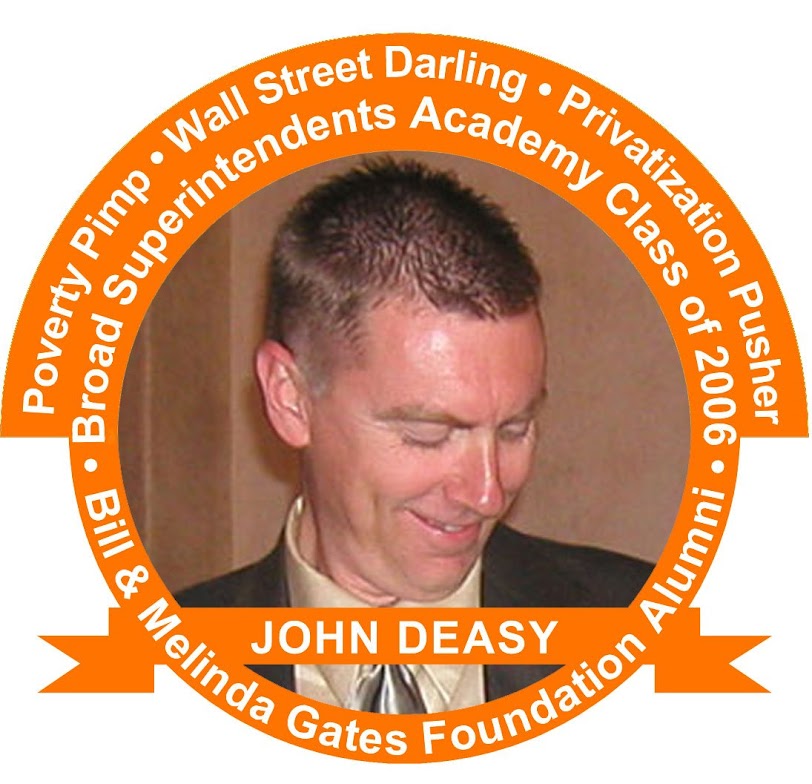
Tami Abdollah and John Deasy gush that 'Size Matters'

"Just continue to follow the money. This Race to the Trough will make the Reading First crooks under Bush look like dopey Boy Scouts." — Professor Jim Horn

Plutocratic priest of privatization, LAUSD Superintendent John DeasyThe neoliberal cabal at Southern California's KPCC can't cheerlead for school privatization loud or frequently enough. Not content with Pat Morrison lobbing softballs to Broad Superintendent Academy graduate and former Gates Foundation employee John Deasy once a week, KPCC's intrepid education beat reporters are always looking for the latest anti-public-school story angle.

Tami Abdollah's latest piece, Size matters in new district-level 'Race to the Top' competition, is a fluffy homage to Deasy and fellow poverty pimp Mayor Antonio Villaraigosa. The light-on-facts article enthusiastically reports the Los Angeles Unified School District (LAUSD) "has worked to institute a lot of the" corporate reforms and privatization requirements that Duncan, Gates, Broad and Coleman want to see for Race to the Top.

I chimed in with the following commentary:

There's a fundamental misunderstanding of Race to the Top (RTTT) in this article. RTTT funds, if granted, are not for things that actually improve education like smaller class sizes or researched backed academic programs including project based learning and the like.

Instead RTTT funds are earmarked for The Gates Foundation and Education Department's pet projects that don't help educational outcomes at all. If anything, they exacerbate problems. RTTT funds are for more profligate data tracking systems. More mind-numbing standardized tests and test preparation for students already averse to school because of a glut of standardized tests. Moreover, RTTT is to be used for highly discredited pseudo-sciences including VAM/AGT.

The district would be better off finding legitimate sources of funding that they can put into classrooms and school libraries. RTTT represents a windfall for testing companies, publishers, and technology firms, but offers nothing for actual improvement to pedagogy. Pearson, Microsoft, and McGraw Hill stand to gain from LAUSD garnering RTTT.

Schoolchildren, educators, and our communities all stand to lose if LAUSD does somehow get tangled up in Duncan's RTTT bribe scheme.

Friday, August 10, 2012

Students Want a Voice in Ed Policy

Students stand up against high stakes testing, corporate education reform.

Blogger Nikhil Goyal Common Core and Race to the Top are destructive.

Day 33: SOS Convention and Featured in Newsday


Today, I had a fabulous time at the Save Our Schools Convention in Washington D.C.
I left my house at 7 AM sharp, hopped on a 8:45 flight from J.F.K., and arrived in D.C. a little more than a hour later.
I spent the morning on a Student Voice panel chatting about how students are crusading for a stake in education policy, the specifications of my book, and specific alternatives to destructive policies, like the Common Core Standards and Race to the Top. At times, the conversation became heated, but they’re often absolutely necessary.
Later, Barry Lane, internationally known author and speaker from Vermont, filmed myself and a few other students for his upcoming documentary on the state of education. Later, he took us all out for lunch, which was very kind of him.
At the conference, many of my Facebook and Twitter friends came to life. It was great to finally meet Deborah Meier, Michael Klonsky, Becky Smith, Susan DuFresne, Ceresta Smith, Stephanie Rivera, Marvin Matthew, Arnold Dodge, Anthony Cody, Bob Schaeffer, Kenneth Bernstein, and Jo Napolitano.
I was also featured in a piece by Jo Napolitano of Newsday: “In D.C., Save Our Schools eyes education policy”
Nikhil Goyal, 17, who will be a senior at Syosset High School when school starts Sept. 4, will serve on a student panel that meets Saturday. He said he favors project-based learning, an end to high-stakes testing and the molding of an individual’s education around his or her passions.
” ‘Accountability’ is a code for punishment,” he said.

Tuesday, April 24, 2012

National Resolution on High Stakes Testing


This Resolution calls on federal and state policymakers to reduce standardized test mandates and, instead, base school accountability on multiple forms of measurement.

To end the abuse and misuse of high stakes testing Sign on to this Resolution:

WHEREAS, our nation's future well-being relies on a high-quality public education system that prepares all students for college, careers, citizenship and lifelong learning, and strengthens the nation's social and economic well-being; and

WHEREAS, our nation's school systems have been spending growing amounts of time, money and energy on high-stakes standardized testing, in which student performance on standardized tests is used to make major decisions affecting individual students, educators and schools; and

WHEREAS, the over-reliance on high-stakes standardized testing in state and federal accountability systems is undermining educational quality and equity in U.S. public schools by hampering educators' efforts to focus on the broad range of learning experiences that promote the innovation, creativity, problem solving, collaboration, communication, critical thinking and deep subject-matter knowledge that will allow students to thrive in a democracy and an increasingly global society and economy; and

WHEREAS, it is widely recognized that standardized testing is an inadequate and often unreliable measure of both student learning and educator effectiveness; and

WHEREAS, the over-emphasis on standardized testing has caused considerable collateral damage in too many schools, including narrowing the curriculum, teaching to the test, reducing love of learning, pushing students out of school, driving excellent teachers out of the profession, and undermining school climate; and

WHEREAS, high-stakes standardized testing has negative effects for students from all backgrounds, and especially for low-income students, English language learners, children of color, and those with disabilities; and

WHEREAS, the culture and structure of the systems in which students learn must change in order to foster engaging school experiences that promote joy in learning, depth of thought and breadth of knowledge for students; therefore be it
RESOLVED, that [your organization name] calls on the governor, state legislature and state education boards and administrators to reexamine public school accountability systems in this state, and to develop a system based on multiple forms of assessment which does not require extensive standardized testing, more accurately reflects the broad range of student learning, and is used to support students and improve schools; and
RESOLVED, that [your organization name] calls on the U.S. Congress and Administration to overhaul the Elementary and Secondary Education Act, currently known as the "No Child Left Behind Act," reduce the testing mandates, promote multiple forms of evidence of student learning and school quality in accountability, and not mandate any fixed role for the use of student test scores in evaluating educators.

Monday, April 23, 2012

Is President Obama Listening?


April 17, 2012
Dear President Obama:
The night of your election, in Grant Park, you said, “I will listen to you especially when we disagree.” We are all committed to the best educational future for the children of America. Yet, as the nation prepares for the reauthorization of the Elementary and Secondary Education Act (ESEA), school board members and top educational thinkers overwhelming urge abandoning the current “command-and-control” federal educational oversight. America’s treasure lies in unleashing the creativity of our youth. Though well-intentioned, the current federal direction is ignoring and working against much of what we know about student motivation and achievement. Instead, the federal government should support local efforts to ignite curiosity, creative potential, and a drive for excellence among students and staff.
Throughout my presidency of the National School Boards Association, I have travelled to many states and written for our national journal and asked for input to this letter. School board members and educators across the country have contributed their thinking here. We share your sense of urgency: We must give every child, no matter their circumstances, the opportunity to excel. We must ensure high quality experiences so each child develops fully. Our major disagreement comes from how we go about this task.
We want for each American child the same things that you and Michelle want for Sasha and Malia—inspiration, aspiration, creativity. I know you don’t want an overemphasis on testing. I have heard you say it.  Experience in schools and communities, supported by research, tells us that relentlessly focusing on standardized tests erodes our national competitiveness and deadens curiosity and drive. Clearly, we need some testing to gauge student learning, and we have no problem with appropriate accountability. But we have swung to a far extreme that is significantly hurting children. “Students are numbing over testing for testing’s sake…. We can’t test this country into excellence.” (Sonny Savoie, LA)
Other countries that traditionally focus on testing recognize the shortcomings of their systems and come to our shores to learn how we inspire a spirit of innovation. And decades of work by motivation theorists, such as Daniel Pink, help us understand why a focus on testing and standards may not cultivate the learners we want. Others have found that such narrow focus restricts our views of what is possible, and even causes unethical behavior, such as the rash of testing scandals here and abroad.
By contrast, Finnish schools are now “exemplars of many of the success indicators we … want to see in American schools. Achievement is consistently high. Students are self-motivated and engaged in their learning. Schools have wide latitude to decide on their own programs, and there are no intrusive sanctions.” (Jill Wynns, CA)
The focus on strict quantitative accountability has never worked for any organization, and it has not worked with No Child Left Behind and Race to the Top. Teachers are trying to meet the mandates of those programs and consequently “our children suffer and are not getting educated to their individual potential.” (Carolyne Brooks, IL) Teachers’ focus on tests is undermining their potential and initiative, making it more difficult to share a love of learning with their students.
Our students will never be first in the world on standardized tests. We never have come close. Nor is that something toward which we should aspire! We simply are not a compliant people willing to absorb facts without challenge. But we have had the most innovative workforce in the world (and now vie with Finland for that top position). Though intended to encourage equity, our current policy is, in fact, driving us toward mediocrity. Our students may be becoming better regurgitators, but what we need is excellent thinkers.
We have significant challenges in many of our communities, especially those that are underserved, yet we continue to boast some of the best schools in the world. We have models of excellence from which we should all be learning. Our vision should be to empower excellence—to draw out the best in each and every individual in our schools. We should recognize that our children’s brains are our most important resource. We should aspire to having children take responsibility for their own learning. We can have a common curriculum as a guide, but leave it to our local “civic labs,” as Thomas Jefferson envisioned them, to find optimal ways to inspire learning.
That said, we won’t achieve any vision without significant teamwork.  Finland’s process may offer a model: They spent years developing national consensus about the essentials for successful education and, hence, the nation. Collaboration can promote independent thinking and action.
As a nation, rather than inspiring people toward a vision of excellence, we have been blaming some for blocking student achievement. It is time to inspire all toward a pursuit of excellence for each of our children.
The work world our children inherit will be significantly different from the one we have known. Jobs in the 20th century were mostly algorithmic or routine. According to McKinsey & Co., most such jobs have already evaporated because of automation and outsourcing. Future work will be more complex, so we had better prepare students differently than through standardized tests.
As the nature of work changes, so too must motivators. Carrots and sticks, which worked with routine jobs, actually impede efforts when the work is more complex, Daniel Pink says. Instead, the rewards of learning and challenges of the work itself must now be the primary motivators.  Adults learn best, experts say, if they feel competent, autonomous, and a sense of belonging.
Much in our current school systems works against these, and our new national focus on teacher evaluation will continue that trend. As a result of ignoring innate needs, our schools too often are not innovative hubs. Yet to meet the challenges of our future, we must cultivate a spirit of innovation and inspiration. We will only succeed in preparing for our future if we empower all in our schools to think through complex problems and processes and generate solutions.  Rather than laboring over bureaucratic compliance problems, let’s engage students and teachers (even board members!) in solving problems of teaching and learning.
Our schools will never become great through threat or intimidation. Schools must be safe places to take risks, where staff members and students feel valued for their ideas and talents and empowered to fail so that they can grow. Students will learn what they see, experience, and enjoy.
We have the knowledge and experience to do this at the national, state, and local levels. However, the present narrow focus on accountability and trend of demonizing those in public education, arrogantly focusing on “failing schools,” is diametrically opposed to fostering excellence.
Again, we can learn from Finland: It holds teachers in high regard (appealing to competence). Teacher training includes a strong feedback loop; professional development is embedded in the work, through coaching and ongoing support (appealing to belonging). People are willing to try new approaches and ideas (appealing to autonomy).
Innovation requires investment. Retired school superintendent Jack Reynolds noted that under the original ESEA we had a national system for identifying, supporting, and sharing excellent, vetted educational ideas. We should return to such a system of research, development, and diffusion, using technology to share teaching and learning approaches. Further, Ohio school board member Charlie Wilson suggested we encourage and fund our universities to conduct empirical research on the considerable experimentation that does occur in our schools.
Some board members suggested that we benefit from broad, guiding curriculum principles. Wyoming’s David Fall encouraged you to continue your work with the National Governors’ Association to refine core standards. However, our children would be best served if the standards were guides, but decision-making remained local.
Across the nation, I have heard growing support for an emphasis on the early years. To close achievement gaps, we need to provide rich early learning environments for children born with the least. We need to teach their parents how to encourage their learning. Please continue to support states’ early childhood efforts.
Mr. President, public education in the U.S. is on the wrong track. As we have moved decision-making farther from teachers and children, we have jeopardized our competitive edge and keys to our national success: our ingenuity, our openness to innovation, and our creativity.
I urge you to convene a national dialogue, not made up of politicians, but including the breadth of educational opinion, to reconsider our educational direction. I would love to help you do this. Let’s ensure that each child has the tools to be successful. Let’s marshal the nation’s brain power and tap into the research, proven practice, and demonstrated evidence of excellence.
Please bring your parent hat to determining our new direction for public education. Your daughters, like all of our children and all of our teachers, don’t need more tests designed to identify weaknesses. They need excited, motivated, passionate teachers who feel challenged, supported, and encouraged to try new approaches, who share with their students a learning environment that is limitless. If we work collaboratively on a shared vision of excellence, if we foster team development, encourage innovation, and care for the growth of our teachers, our children will lead us into the future with confidence. And public education will remain the cornerstone of our vibrant democracy.
Thank you, Mr. President.
Sincerely,
/s/
Mary Broderick
National School Boards Association President