"A child's learning is the function more of the characteristics of his classmates than those of the teacher." James Coleman, 1972
Showing posts sorted by relevance for query "reading recovery. Sort by date Show all posts

Tuesday, November 07, 2006

Reading Recovery and Big Gains

One of the reading programs that Carnine, Lyon and the other Reading First thugs have marginalized is Reading Recovery, an intensive program that does not meet the criteria for the chain-gang behavioral approach and the 19th Century phonics favored by the cons.

Now the BBC reports on a British study that shows exceptional gains as a result of Reading Recovery:
Struggling young readers make dramatic improvements when they are given tailored one-to-one coaching by expert teachers, research suggests.

A study of around 500 six-year-olds suggested those on the Reading Recovery scheme caught up with their peers in 20 weeks - four times faster than normal.

The government-backed scheme also saw improvements in writing and motivation, the Institute of Education study found.

About 6% of primary school leavers do not reach the expected reading levels.

Reading Recovery, which is part of the government's Every Child a Reader programme, works by giving the poorest readers individual support from specially trained teachers for 30 minutes a day over 12 to 20 weeks.


Many reading programmes are off the peg. This is completely pupil-centred
Jean Gross
Director, Every Child a Reader

An evaluation of the £10 million project, which is funded by the government and several charitable trusts, also found that those who did not get the extra help fell further behind their peers.

Researchers at London's Institute of Education followed 234 of the lowest achieving children in 42 schools in London.

They compared the progress in reading of 87 children who were taught through the Reading Recovery programme with 147 children with similar reading difficulties who had not.

Although the two groups started at very similar levels, after four or five months of specialist tuition, the Reading Recovery group gained 20 months of reading ability.

But those without the specialist help improved by only seven months and had fallen further behind their peers.

'High costs'

Similar results were recorded amongst some 373 children getting help through Reading Recovery programmes in 61 schools in Birmingham, Bristol, Liverpool, Middlesbrough, Sheffield as well as London.

The children had moved from an average reading age of four years 10 months to a reading age of six years seven months.

And there was also evidence that benefits were seen across the school.

Leader of the research team, Dr Sue Burroughs-Lange, said the progress made by those on Reading Recovery programmes was "startling".

Jean Gross, Director of Every Child A Reader programme, said more than 75% of pupils who had been behind were now achieving average literacy levels or above thanks to the programme.

She said: "Our research shows that it is not the type of reading scheme that is important so much as teaching that is exactly matched to what each child knows and needs to know."

'Repercussions'

She added: "Many reading programmes are off-the-peg. This is completely pupil-centred. It is a very good example of personalised learning par excellence."

However, the high costs of the scheme at £2,500 per pupil - about the same amount primary schools have for one child's education a year - have made it unaffordable for schools without extra financial support.

Mrs Gross said: "The cost of doing it may be high but the cost of not doing it is also very high.

"The repercussions for truancy, exclusion and crime are very big. It's a case of spend now to save later."

Schools minister Lord Adonis said the results were "great news for children and parents".

He added: "They show that with the right teaching and support virtually every child can become a successful reader after starting primary school."

You can expect the Oregon Mafia to be out in force in the coming days to try to knock down this study. And you can expect the same from others who favor quick and dirty reform for those urban kids that no one cares about.

Friday, September 22, 2006

More Reading First Revelations: Doherty, Lyon, and Carnine, Oh My

Chris Doherty, the soon-to-be ex-Director of Reading First, was described by a Washington researcher I heard from today as an "absolute imbecile." In other words, perfect for a job that required a lot of "bold" and "extra-legal" actions to make sure that, 1) the Bush Co. phonics and chain gang ideology got enforced, and 2) that Bush cronies got the majority of the billions pumping out of ED for Reading First during the past five years. Here is a verbatim clip from the Inspector General's Report that suggests my Washington acquaintance was right--Doherty is very bold, very arrogant, very much blinded by power, and in the end, very stupid:
The Department Took Action With Respect to the Expert Review Panel Process That Was Contrary to the Balanced Panel Composition Envisioned by Congress
Congress, through Title 1, Part B, Section 1203(c)(2)(A) of the ESEA, envisioned an expert review panel with equal representation from the Department, NIFL, NAS, and NICHD. As we reported in Finding 1A, the Department nominated a majority of the individuals serving on the expert review panel. Additionally, 15 of the 16 subpanels had a majority of Department- nominated panelists and none had the balanced composition envisioned by Congress.

The Reading First Director took direct action to ensure that a particular approach to reading instruction was represented on the expert review panel. Direct Instruction (DI) is a model for teaching that requires the use of Reading Mastery, a program published by SRA/McGraw-Hill, to teach reading. The Reading First Director formerly served as the Executive Director of the Baltimore Curriculum Project, which has implemented DI in Baltimore City schools since 1996.

The Reading First Director personally nominated three individuals who had significant professional connections to DI to serve on the expert review panel. The Reading First Directorselected these three individuals to serve on a total of seven of the 16 subpanels and one of these individuals to serve as the panel chair on five subpanels. These three individuals were collectively involved in reviewing a total of 23 States’ applications.

A Baltimore City Public Schools official contacted a Department official to express concern that two panelists were involved with or employed by DI and questioned whether those two panelists indicated their connections to DI on the conflict of interest form. In May 2002, the Department official forwarded this information to the Reading First Director who passed the concerns on to one of the panelists in question as a “Confidential FYI.” This panelist replied:

I suspect that [the Baltimore City Public Schools official’s] assumption is that USDE must be warned that there may be DI infiltrators and that somehow USDE knows how dangerous that can be. You may remember that [the Baltimore City Public Schools official] is a whole language (now called Balanced Literacy) proponent.

The subsequent e-mail response from the Reading First Director suggests his intention to ensure a DI presence on the expert review panel: “Funny that [the Baltimore City Public Schools official] calls *me* to inform that there may be some pro-DI folks on *my* panel!!! Too rich!” The panelist then asked, “Does he know who you are? Past and present?” The Reading First Director replied, “That’s the funniest part – yes! You know the line from Casablanca, ‘I am SHOCKED that there is gambling going on in this establishment!’ Well, ‘I am SHOCKED that there are pro-DI people on this panel!’”

Shortly before this exchange, a Department employee reported to the Reading First Director that the Department had received a question from a member of the media about the panel composition. The response by the Reading First Director suggests that he may indeed have intended to “stack” the expert review panel. The employee stated: “The question is...are we going to ‘stack the panel’ so programs like Reading Recovery don’t get a fair shake[?]” The Reading First Director responded, “‘Stack the panel?’...I have never *heard* of such a thing....[.]”

A few days before the Department publicly announced the panelists it had chosen to serve, one of the Department-nominated panelists contacted the Reading First Director and shared his strong bias against Reading Recovery and his strategy for responding to any State that planned to include Reading Recovery in its application. The Reading First Director responded: “I really like the way you’re viewing/approaching this, and not just because it matches my own approach :-), I swear!” This individual later served as the panel chair for the subpanel that reviewed Wisconsin’s State application and in response to the State’s plans to use Reading Recovery, he included an 11-page negative review of Reading Recovery in his official comments on the application.

Around the same time, Reid Lyon, the former Chief of the Child Development & Behavior Branch at the NICHD, advised the Reading First Director, the Assistant Secretary for OESE, and the Senior Advisor to the Secretary at the time that one of the panelists had been “actively working to undermine the NRP [National Reading Panel] Report and the RF initiatives.” Lyon further stated, “Chances are that other reviewers can trump any bias on her part.” In a written response to all of the people involved, the former Senior Advisor to the Secretary stated, “We can’t un-invite her. Just make sure she is on a panel with one of our barracuda types.”

The statute envisioned that the expert review panel would be balanced with representatives from the Department and three other named organizations. In fact, virtually all of the subpanels had a majority of Department-nominated panelists. Against this backdrop, the actions of the Director and the former Senior Advisor to the Secretary become particularly problematic.

Additionally, the first element identified in GAO’s Standards for Internal Control in the Federal Government as affecting the control environment is “the integrity and ethical values maintained and demonstrated by management and staff.” The apparent intent of the Reading First Director to include and to give a significant role to panelists who reflected his personal preference in reading programs; his specific encouragement to a panelist who held views similar to his on Reading Recovery; and the intention of the former Senior Advisor to the Secretary to control another panelist raise significant questions about the control environment in which the program was being managed. (pp. 17-19)
More clips and more Panel members to be identified soon. Carnine's Oregon cabal is so busted.

Saturday, September 30, 2006

Reid, Chris, and the Barracudas: More from Reading First Finding #4

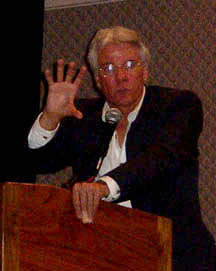
(Photo: Reid Lyon, Bush's Former Crackpot Reading Czar)
This OIG Report is only the first in a series that is planned for Reading First before the end of this year, but don't expect OIG to name names. That will only come with a criminal investigation or from a filing for OIG documents under the Freedom of Information Act. Or from a reporter with the resources and the gumption to get the facts. Any formal investigation aimed at getting the facts will have to be launched from outside ED, unless Spellings intends to surrender and resign.

There is so much rich and readable detail in this section on how Doherty, Lyon, unnamed panelists, and senior advisors stacked the deck to make sure that Direct Instruction beat out all comers that I have posted this section in its entirety from the OIG Report:
The Department Took Action With Respect to the Expert Review Panel Process That Was Contrary to the Balanced Panel Composition Envisioned by Congress

Congress, through Title 1, Part B, Section 1203(c)(2)(A) of the ESEA, envisioned an expert review panel with equal representation from the Department, NIFL, NAS, and NICHD. As we reported in Finding 1A, the Department nominated a majority of the individuals serving on the expert review panel. Additionally, 15 of the 16 subpanels had a majority of Department-nominated panelists and none had the balanced composition envisioned by Congress.

The Reading First Director took direct action to ensure that a particular approach to reading instruction was represented on the expert review panel. Direct Instruction (DI) is a model for teaching that requires the use of Reading Mastery, a program published by SRA/McGraw-Hill, to teach reading.
The Reading First Director formerly served as the Executive Director of the Baltimore Curriculum Project, which has implemented DI in Baltimore City schools since 1996.

The Reading First Director personally nominated three individuals who had significant professional connections to DI to serve on the expert review panel.
The Reading First Director selected these three individuals to serve on a total of seven of the 16 subpanels and one of these individuals to serve as the panel chair on five subpanels. These three individuals were collectively involved in reviewing a total of 23 States’ applications.

A Baltimore City Public Schools official contacted a Department official to express concern that
two panelists were involved with or employed by DI and questioned whether those two panelists indicated their connections to DI on the conflict of interest form. In May 2002, the Department official forwarded this information to the Reading First Director who passed the concerns on to one of the panelists in question as a “Confidential FYI.” This panelist replied:
I suspect that [the Baltimore City Public Schools official’s] assumption is that USDE must be warned that there may be DI infiltrators and that somehow USDE knows how dangerous that can be. You may remember that [the Baltimore City Public Schools official] is a whole language (now called Balanced Literacy) proponent.

The subsequent e-mail response from the Reading First Director suggests his intention to ensure a DI presence on the expert review panel: “Funny that [the Baltimore City Public Schools official] calls *me* to inform that there may be some pro-DI folks on *my* panel!!! Too rich!” The panelist then asked, “Does he know who you are? Past and present?” The Reading First Director replied, “That’s the funniest part – yes! You know the line from Casablanca, ‘I am SHOCKED that there is gambling going on in this establishment!’ Well, ‘I am SHOCKED that there are pro-DI people on this panel!’”


Shortly before this exchange, a Department employee reported to the Reading First Director that the Department had received a question from a member of the media about the panel composition. The response by the Reading First Director suggests that he may indeed have intended to “stack” the expert review panel. The employee stated: “The question is...are we going to ‘stack the panel’ so programs like Reading Recovery don’t get a fair shake[?]”
The Reading First Director responded, “‘Stack the panel?’...I have never *heard* of such a thing....[.]”

A few days before the Department publicly announced the panelists it had chosen to serve,
one of the Department-nominated panelists contacted the Reading First Director and shared his strong bias against Reading Recovery and his strategy for responding to any State that planned to include Reading Recovery in its application. The Reading First Director responded: “I really like the way you’re viewing/approaching this, and not just because it matches my own approach :-), I swear!” This individual later served as the panel chair for the subpanel that reviewed Wisconsin’s State application and in response to the State’s plans to use Reading Recovery, he included an 11-page negative review of Reading Recovery in his official comments on the application.

Around the same time, Reid Lyon, the former Chief of the Child Development & Behavior Branch at the NICHD, advised the Reading First Director, the Assistant Secretary for OESE, and the Senior Advisor to the Secretary at the time that one of the panelists had been “actively working to undermine the NRP [National Reading Panel] Report and the RF initiatives.” Lyon further stated, “Chances are that other reviewers can trump any bias on her part.” In a written response to all of the people involved, the former Senior Advisor to the Secretary stated, “We can’t un-invite her. Just make sure she is on a panel with one of our barracuda types.”


The statute envisioned that the expert review panel would be balanced with representatives from the Department and three other named organizations. In fact, virtually all of the subpanels had a majority of Department-nominated panelists. Against this backdrop, the actions of the Director and
the former Senior Advisor to the Secretary become particularly problematic.

Additionally, the first element identified in GAO’s Standards for Internal Control in the Federal Government as affecting the control environment is “the integrity and ethical values maintained and demonstrated by management and staff.” The apparent intent of the Reading First Director to include and to give a significant role to panelists who reflected his personal preference in reading programs; his specific encouragement to a panelist who held views similar to his on Reading Recovery; and the intention of the former Senior Advisor to the Secretary to control another panelist raise significant questions about the control environment was being managed.

Sunday, January 02, 2011

Succs For All: From One Form of Scripted Bullshit to Another

During the heyday of the Paige/Spellings federal disaster-in-motion-at-ED, Reid Lyon, Doug Carnine, Roland Good, and other disciples of Engelmann's Direct Instruction held sway, with Robert Slavin's brand of parrot reading shut out of the Reading First dollar bonanza. 

It is predictable to see Slavin re-emerging to claim his millions in delayed expertise, with another version of the same teacher-proofed crap passed off as reading instruction.  The only literacy approach that ever passed in all four categories of reading literacy was Reading Recovery, which is too expensive to encourage when you have billions to give away to the Oligarchs' sidekicks in the charter biz and the testing industry.  From an old post:
Six years ago when Margaret LaMontagne (Spellings), Reid Lyon, and Doug Carnine loaded the Reading First review panels with their direct instruction stooges and cronies, they set back reading instruction by decades, who knows how many. As ED's own Inspector General's reports have shown, states that applied for Reading First grants were manhandled into choosing reading programs aligned with the Lyon and Carnine back-to-brutality phonics orthodoxy. And if grantees ended up off the direct instruction reservation, Reid Lyon's Reading First Director, Chris Doherty, could simply pull the plug, as he did in Rockford, Illinois:
Mr. Doherty then directed the state to freeze the district’s funding, and ultimately to withdraw the grant. Those actions prompted another e-mail from Mr. Lyon: “wow – Talk about a guy with smarts, integrity AND balls,” he wrote. “I am talking about you Chris.”
The Lyon and Carnine Cabal's most hated reading program was the balanced literacy methodology of Reading Recovery, a holistic and humane literacy approach grounded by empirical research. It is suitably ironic, then, that Ed Week reports that Reading Recovery has emerged in the latest federal research from Spellings's own shop as the only program "found to have positive effects or potentially positive effects across all four of the domains in the review—alphabetics, fluency, comprehension, and general reading achievement:"
. . . .That program, Reading Recovery, an intensive, one-on-one tutoring program, has drawn criticism over the past few years from prominent researchers and federal officials who claimed it was not scientifically based.
Federal officials and contractors tried to discourage states and districts from using Reading Recovery in schools participating in the federal Reading First program, citing a lack of evidence that it helps struggling readers. . . .
How sweet it is!! It's just too bad that so many states are now stuck with the McGraw-Hill Open Court parrot reading system that they were force fed by hacks and crooks in order to get Reading First grants.

Thursday, August 16, 2007

Reading Recovery Receives Top Marks in Federal Research

Six years ago when Margaret LaMontagne (Spellings), Reid Lyon, and Doug Carnine loaded the Reading First review panels with their direct instruction stooges and cronies, they set back reading instruction by decades, who knows how many. As ED's own Inspector General's reports have shown, states that applied for Reading First grants were manhandled into choosing reading programs aligned with the Lyon and Carnine back-to-brutality phonics orthodoxy. And if grantees ended up off the direct instruction reservation, Reid Lyon's Reading First Director, Chris Doherty, could simply pull the plug, as he did in Rockford, Illinois:
Mr. Doherty then directed the state to freeze the district’s funding, and ultimately to withdraw the grant. Those actions prompted another e-mail from Mr. Lyon: “wow – Talk about a guy with smarts, integrity AND balls,” he wrote. “I am talking about you Chris.”
The Lyon and Carnine Cabal's most hated reading program was the balanced literacy methodology of Reading Recovery, a holistic and humane literacy approach grounded by empirical research. It is suitably ironic, then, that Ed Week reports that Reading Recovery has emerged in the latest federal research from Spellings's own shop as the only program "found to have positive effects or potentially positive effects across all four of the domains in the review—alphabetics, fluency, comprehension, and general reading achievement:"

. . . .That program, Reading Recovery, an intensive, one-on-one tutoring program, has drawn criticism over the past few years from prominent researchers and federal officials who claimed it was not scientifically based.

Federal officials and contractors tried to discourage states and districts from using Reading Recovery in schools participating in the federal Reading First program, citing a lack of evidence that it helps struggling readers. . . .

How sweet it is!! It's just too bad that so many states are now stuck with the McGraw-Hill Open Court parrot reading system that they were force fed by hacks and crooks in order to get Reading First grants.

Monday, March 31, 2008

The Struggle to Keep the Reading First Gravy Train on Track

Soon after the Supreme Court settled the Presidential election for us in late 2000, the phonics zealots of Governor Bush’s reading czar, Reid Lyon, along with the scripted direct instruction (DI) lieutenants of Sig Engelmann disciple, Doug Carnine, took an ideologically-corrupted National Reading Panel report to devise a federal program for early reading instruction and intervention, aimed at molding and controlling the neurological development and behaviors of the children of the poor. (See examples here and ask yourself if middle class parents would ever allow their children to attend one of these incarceration centers called Title I schools).

This program would become Reading First, the centerpiece of the new Title I under what we now fondly refer to as NCLB. And with the same conservative cronies who drafted the program in charge of selecting recipients of the $1,000,000,000 a year in federal reading grants to the states, it didn’t take long for word to get out on which literacy approaches that the Paige/Spellings shop would fund and which they would not. The full extent of the corruption remains unknown, but Congressional testimony and ED’s own Inspector General uncovered enough to show why DI, DIBELS, and phonics now rule in schools with large numbers of poor children. It also offers enough details to see how corporate and academic and bureaucratic insiders got fabulously wealthy in the process.

Last year Congress acted to slash funding of the Cronies, er, Reading First program. So now while we wait to see if the Inspector General’s referral to the Justice Department will lead to a criminal investigation and/or indictments, Margaret Spellings is making the rounds advising cash-starved state departments of education on how to re-direct federal funds to make sure that the gravy train doesn’t get derailed and to make sure that the “cognitive decapitation” (Kozol’s term) of poor, minority children continues unabated.

In the meantime, many states are stuck with the parrot reading programs approved by the Lyon-Carnine Cabal, such as McGraw-Hill’s Open Court (or as reading teachers refer to it, Open Cult). And what about the balanced, humane, and marginalized programs like Reading Recovery, which was systematically excluded by the goon squad of Reading First Director, Chris Doherty? In the Fed’s own research last year, reported by Education Week, Reading Recovery was the only program "found to have positive effects or potentially positive effects across all four of the domains in the review—alphabetics, fluency, comprehension, and general reading achievement:"
. . . .That program, Reading Recovery, an intensive, one-on-one tutoring program, has drawn criticism over the past few years from prominent researchers and federal officials who claimed it was not scientifically based.

Federal officials and contractors tried to discourage states and districts from using Reading Recovery in schools participating in the federal Reading First program, citing a lack of evidence that it helps struggling readers. . . .
Is Margaret Spellings advocating for a reconsideration of all Reading First grant funding decisions in light of these new findings? Any guesses?

Wednesday, August 10, 2005

More Investigations at US DOE

The Reading Recovery Council of North America (RRCNA), which offers a truly balanced reading alternative to the drill and kill phonics approach favored by the current regime in Washington, has requested a federal investigation into the implementation practices of Reading First. Reading First is part of the NCLB reading improvement initiative that shovels out a billion dollars a year to raise reading scores, most of it going to test prep and scripted teaching programs developed by McGraw-Hill (click here for an interesting article on the Bush/McGraw Hill connection), Harcourt, and other friends and large contributors.

Cited in RRCNA's letter to the Inspector General are these points:
1. State and local control. The implementation of Reading First has restricted state and local control in the selection of scientifically based reading programs.

2. One-to-one instruction. The Department has excluded one-to-one instruction in the Reading First program, contradicting the authorizing statute, congressional intent, and scientific research findings of effectiveness for the lowest-achieving children.

3. Selective application of scientifically based research criteria. In the implementation of Reading First, the Department has systematically favored some programs while excluding other programs with a scientific research base.

4. Misinformation about Reading Recovery. The Department has supported a quiet yet pervasive misinformation campaign against Reading Recovery despite a large body of research demonstrating Reading Recovery’s effectiveness and long-term results.
Complaint #4 focuses on an administration that has perfected the art of sliming its opponents, and the hacks running the show at US DOE are no different. The sham of "scientifically-based research" has been made clear by Gerald Coles (reviewed here) and others who have examined the propaganda piece, the National Reading Panel Report, that provides the foundation for all this fanatical phonics phenomenon that dismisses any study that does not echo the party line--and eventually disregards excellent well-documented strategies that improve literacy and thinking.

Sunday, October 09, 2005

Silencing by the Wolves

Though no Web search seems to turn up anything on this story, this report from Ed Week is moving quickly among online discussion groups and listservs.

It seems that filing a complaint against the the Reading First wingnut ideologues in Washington has earned no political brownie points for Connie Briggs, who appears to be the the first victim in a bare-knuckled effort to squelch resistance to the backward-thinking crony politics that guides federal reading and research policies and the granting of almost a billion dollars a year in Reading First cash.

Speaking out and open challenge are the remedies for this kind of raw intimidation.

Published: October 5, 2005
Teaching & Learning Update

Kan. Fires President of Reading Recovery After Complaint Filed
After a decade of working with the Kansas education department and schools throughout the state, Connie Briggs was taken aback when she received word that she was no longer needed to work with one of the state’s Reading First schools.

Even more troubling, Ms. Briggs said, was that her tenure on the state’s advisory committee for the federal reading program had also been terminated, and that state officials told her they could not work with her on a federal grant proposal for special education, despite previous arrangements to do so.

For Ms. Briggs, who is also the president of the Reading Recovery Council of North America, those decisions seemed like retaliation for her role in a complaint the council filed in August against federal officials in charge of the Reading First program. The complaint to the U.S. Department of Education’s inspector general accused the officials of “systematically
undermining” Reading Recovery, a popular one-on-one tutoring system, and ignoring research showing its effectiveness in helping struggling readers.

“This series of events that have occurred since [the council] sent the letter to the inspector general is just a little bit more than coincidental,” the Emporia State University professor contended in a recent interview. “I never thought about [the federal complaint] harming my work within the state, although I knew we had been warned that there could be retributions.”

Kansas officials, however, say the decision was not about Ms. Briggs. “The decision was to take the program in a different direction, and her services no longer fit in with that direction,” said Alexa Posny, the state’s deputy commissioner for learning services.

Both the Columbus, Ohio-based Reading Recovery Council and the Baltimore-based Success for All Foundation have filed formal complaints with the inspector general, charging federal officials involved with the $1 billion-a-year program with favoritism. But few others have complained, despite privately expressing similar concerns, for fear of losing out on Reading First
money and other federal grant programs. ("Group Seeks Federal Probe of Reading First," Aug. 5, 2005.)

Ms. Briggs said she asked Kansas officials for an explanation and was told only that she had served the state very well in her consulting role and that her services were no longer needed.
— Kathleen Kennedy Manzo

Wednesday, July 10, 2019

Gerald Coles Documents the Re-emergence of the Phonics Zombies

…it is the sign of a competent “crap detector” that he is not completely captivated by the arbitrary abstractions of the community in which he happened to grow up. Teaching as a Subversive Activity, p. 17
Midway through the first decade of this century's widespread reading instruction malpractice that was enforced by No Child Left Behind and funded by the corrupt Reading First program, the U. S. Department of Education released a long-awaited study that identified the most effective reading programs used in American schools.  

The direct instruction and phonics zealots, who had seized control of the federal Reading First billions in 2002, could not have been more unhappy with the results.

The study, released by the What Works Clearinghouse, found that the balanced program known as Reading Recovery, which Bush II's chief reading ideologues had singled out as dangerously "non-scientific," was the only program in the study "found to have positive effects or potentially positive effects across all four of the domains in the review—alphabetics, fluency, comprehension, and general reading achievement:"
. . . .That program, Reading Recovery, an intensive, one-on-one tutoring program, has drawn criticism over the past few years from prominent researchers and federal officials who claimed it was not scientifically based. 

Federal officials and contractors tried to discourage states and districts from using Reading Recovery in schools participating in the federal Reading First program, citing a lack of evidence that it helps struggling readers. . . .
That was then, this is now, and just as the phonics zombies have been re-animated repeatedly over the past century by the spirit of corrupt and oppressive fanaticism, the phonics zombies have once more been turned loose to restore a fearful order and intellectual rigor mortis among poor black and brown children everywhere.

Fortunately, Gerald Coles has once more activated his dedicated crap detection unit, which Coles has grown over the past 30 years for just such occasions. Coles has penned an astute synopsis of the current state of affairs in the latest not-so-great awakening of the phonics zombies, and it is a must read for everyone, whether or not you have read his very important book from 2003 on the hegemonic ideology of reading "scientists." Here's a clip from Cryonics Phonics: Inequality’s Little Helper:
. . . . As I noted at the beginning of this article, the new insistence that phonics-heavy reading instruction can provide the pathway to academic success, regardless of the poverty afflicting students, spotlights the beginning-reading program in Bethlehem, Pennsylvania. Reporting on the instruction in Bethlehem, journalist Emily Hanford insists that hundreds of scientific studies have “shown over and over that virtually all kids can learn to read,” if they are taught to read with a method in which “explicit, systematic phonics instruction” is central.

The 60-plus years of the resurrection and failure of phonics to overcome the impact of poverty on educational achievement leaves the question of the “science” purportedly supporting phonics. Can it be that phonics instruction does indeed have substantial scientific evidence favoring it, but it has not been deployed properly in the classroom?

It’s not apparent what “science” Hanford has in mind, but having written about the research on reading, learning disabilities, and dyslexia since the late 1980s, beginning with my first book, The Learning Mystique (1987), what’s clear about this so-called “science” is that much of it is contrived evidence to “prove” pre-existing conclusions. For example, Hanford is much taken with the research on dyslexia, which has searched for neurological dysfunction in beginning readers. However, she fails to consider the decades-long confusion in this research of correlation and causation. That is, the brain functioning of poor readers (“dyslexics”) is different from that of competent readers, but that is largely because of a difference in competence. Similarly, for example, readers able to read Czech will show brain functioning different from those who cannot, but that is not reason to brand the latter as “czechlexic.” (See my essay on the deficiencies of this research in “Brain Activity, Genetics, and Learning to Read” in Handbook of Early Childhood Literacy, Joanne Larson and Jackie Marsh, eds., 2012).

Hanford frequently references the “science” on the side of heavy-phonics-and-skills-instruction-for-reading-success, but offers nothing about the evidence on the other side of the dispute. Neither does she explore the purported “scientific evidence” the George W. Bush educators used to push through the mandated skills-based instruction, purportedly based on “the findings of years of scientific research on reading,” that subsequently failed children who were victims of it. (For a thorough review of this bogus “evidence” see my Reading the Naked Truth).


Monday, February 01, 2021

Part 2: Red State Governors Pick Up Where DeVos Left Off

More than 15 years before the Trumpers arrived in DC to initiate the latest "back to basic stupidity" era in all things social, cultural, economic, and intellectual, there was another Republican, George W. Bush, who had his own particular backwards fixation, which found its way into education policy in general and K-3 reading instruction in particular. 

Following his appointment to the Presidency by the Supreme Court in December 2000, Bush's first big initiative was No Child Left Behind, and reading instruction was the centerpiece of that legislation. 

In shaping NCLB reading policy, Bush leaned heavily on NIH neuropsychologist and self-declared reading guru, Reid Lyon, who viewed learning to read "the right way" as important for neural wiring as it was for academic success.  In a 2002 speech, Lyon told a group of Maryland teachers that "[w]e have to realize that education has to take on the same importance as medicine. . . . Teachers are the best brain surgeons around, the best at developing the nervous system." 

Lyon's enthusiasm for regimented phonics instruction as the best way to hard-wire receptive, convergent learners was matched by his animosity toward professional teacher preparation and research-based methods for teaching reading that go beyond . Just two months after Lyon spoke to Maryland teachers about the importance of their craft, he said this at a national policy forum:  "If there was any piece of legislation that I could pass it would be to blow up colleges of education."

Five years later, however, Lyon was helping to launch a for-profit college of education focused on preparing reading teachers the way God and Reid Lyon intended (my bolds): 

What I learned at NIH and what guides our course development at American College of Education is that children's brains can literally be molded, changed, by the teaching they receive. Our goal now is to close the gap between our science tells us about learning and what our teachers apply in the classroom. A graduate degree from American College of Education means that teachers know the science behind how children learn.

Despite five years and over $5 billion spent on Reading First federal discretionary grants that were used to cajole, pressure, and bribe school systems to adopt and implement direct phonics instruction methods, DOE's own research, in both the interim and final reports, showed that Reading First was a big flop. From the NCEE Final Report Summary

The findings presented in this report are generally consistent with findings presented in the study's Interim Report, which found statistically significant impacts on instructional time spent on the five essential components of reading instruction promoted by the program (phonemic awareness, phonics, vocabulary, fluency, and comprehension) in grades one and two, and which found no statistically significant impact on reading comprehension as measured by the SAT 10. 

To add insult to Lyon's injury, a 2007 study by the federal "What Works Clearinghouse" found that the only reading program to pass muster in all reading domains was one that Reid Lyon and the Reading First goons had excluded for its lack of fidelity to the reductionist catechism preferred by right-wing code breakers. From Education Week:

Just one program was found to have positive effects or potentially positive effects across all four of the domains in the review—alphabetics, fluency, comprehension, and general reading achievement. That program, Reading Recovery, an intensive, one-on-one tutoring program, has drawn criticism over the past few years from prominent researchers and federal officials who claimed it was not scientifically based.

Federal officials and contractors tried to discourage states and districts from using Reading Recovery in schools participating in the federal Reading First program, citing a lack of evidence that it helps struggling readers.

The bankruptcy of current education reform initiatives is evident in ongoing attempts to resuscitate explicit, phonics-based methods that seeks to convert learners into compliant code breakers and rule followers, thus using neurological and behavioral patterning to influence children's brain functions. Phonics fanatics believe this can be done "during the reading initiation phase." 

Part 3 will examine the latest efforts to impose the antiquarian science of reading in South Carolina and Tennessee.

Friday, September 29, 2006

Reading First Finding #4: Breaking Federal Law (again)

If there was any doubt that federal laws were broken by the Reading First mafia, there will be none after looking at the following examples. The heft of the OIG Report can be found in Finding 4, which is broken out into the following categories with evidence supplied to illustrate how each violation of federal law was accomplished:
In the course of answering our objectives for the inspection, we found that the Department, acting through the former Assistant Secretary for OESE, the Reading First Director, and others [Carnine and Lyon]:

  • Developed an application package that obscured the requirements of the statute;
  • Took action with respect to the expert review panel process that was contrary to the balanced panel composition envisioned by Congress;
  • Intervened to release an assessment review document without the permission of the entity that contracted for its development;
  • Intervened to influence a State’s selection of reading programs; and
  • Intervened to influence reading programs being used by LEAs after the applicationprocess was completed.
Developed an application package that obscured the requirements of the statute. This section details how Susan Neuman, then an Assistant Secretary, aided Doherty in adding some language that was not included in the Law and deleting other language that was in the law. Why? To make sure that non-Oregon mafia (Ore-Mafia) programs like Reading Recovery were cut out of the action:
The Assistant Secretary for OESE planned for the Reading First Guidance to include language that was not in the statute and exclude language that was in the statute. After reviewing a revision to the Department’s draft of the Reading First Guidance, the Assistant Secretary for OESE wrote to the Reading First Director, “under reading first plan. i’d like not to say ‘this must include early intervention and reading remediation materials’ which i think could be read as reading recovery’ [a reading program]. even if it says this in the law, i’d like it taken out.” The subject phrase appears in the law twice (p. 15).
Doherty, under the direction of his handlers, came up with a solution that moved some of the language required by law from the Reading First Criteria into the Reading Guidance section, thus effectively changing the criteria that Congress intended when the Law was enacted:
The approach outlined by the Reading First Director was eventually reflected in the application package that was available to every State on April 2, 2002. As discussed in Finding 3, the Department ultimately included the “bold” language that distorted the requirements of the statute in the Reading First Criteria.

In the Pre-reading notes document, the Reading First Director wrote:
OGC [Office of General Counsel] could likely have concerns with the overall, near-unrelenting aggressiveness of this application...the law does not really require what we are quite literally requiring in our (aggressive) application. Such examples are manifold and OGC may catch some, many or all of them. We have not highlighted them to OGC, of course, and we don’t know how many they’ll focus on. On some issues, we may be able to dodge a little by moving some ‘Meets Standards’ points to the ‘Exemplary,’ but if we do that too much, the result is a less bold application and decreased chances of overall success. We’ll need your muscle [Neuman's?] with OGC on these points across the board (p. 16).

Our next post will examine the the other remaining points under Finding 4.

Tuesday, May 01, 2007

Wood on Reading First

Part of George Wood' strong post yesterday:
. . . . The corruption and pseudo-science surrounding Reading First is bad enough. But the real problem with Reading First and similar programs is the assumption as to where decision-making authority and judgment should lie.

Nothing demonstrates this more clearly than the case of Madison, WI and that district’s experience with Reading First. As reported on the front page of the New York Times, Madison was experiencing great success with their Balanced Literacy approach—blending some phonics instruction with a Whole Language approach. But consultants hired by the Department of Education pushed Madison to abandon this approach in favor of a phonics-only, commercially-produced program. When Madison refused, and provided documentation of their success, they were told that because “the city’s program lacked uniformity and relied too much on teacher judgment” it could not be recommended for Reading First funding.

The Reading Recovery program has faced a similar fate on a national scale. As a program it was specifically signaled out by DOE as “not scientifically based.” And yet, in March of this year DOE’s own What Works Clearninghouse gave Reading Recovery its highest rating (Education Week, subscription required). Responding to this, Reid Lyons, one of the architects of Reading First said he was not opposed to Reading Recovery. Rather “The question we need to ask is what level of professional development is needed to implement a program with fidelity? Can the district provide that? Can we cover the expense of the program? Is it cost-effective?”

These two cases demonstrate what is really at stake in the latest rendition of the ‘reading wars.’ Do we, on one hand, turn over schools to commercial interests who proscribe teacher behavior, standardize teaching practices, and work to be ‘cost effective’? Or, do we choose to trust teacher/parent/community judgment, invest in developing that judgment, and allow for multiple approaches to helping children learn?

This is the crux of what is wrong with so much of what is done in the name of school improvement. Misunderstanding everything that teaching and learning is about, faceless bureaucrats (until they are called before congressional panels) dictate to teachers they are to teach, to communities what is to taught, and to administrators what programs to buy. The desire is to eliminate teacher, and often parent, judgment and replace it with so-called ‘expert’ or ‘scientific’ direction.

This is a recurring dilemma in democratic societies. As Forum Convener Deborah Meier pointed out in our last newsletter, if we believe in democracy as our most special and effective form of accountability we need more, not less, local decision-making. At the same time we do not always trust each other to make good judgments. The solution, to paraphrase Thomas Jefferson, is not to usurp authority; rather it is to invest in helping people exercise authority wisely.

That is why we have public schools, to nurture in the young the skills and dispositions of thoughtful democratic citizenship. But they will only learn this when they are in the company of adults who demonstrate such abilities—as opposed to sitting at the feet of someone whose judgment is not to be trusted.

Wednesday, May 02, 2012

Princeton Review Nailed for NCLB Tutoring Fraud


If there are any educational historians around in a hundred years to examine the records from this generation of corporate reform efforts to privateer public schools into corporate revenue streams, No Child Left Behind will stand out, no doubt, as one of the most useful tools in their arsenal.  To those less disposed to celebrate the demise of democratic institutions, NCLB has, thus far anyway, proved itself as the most expensive, toxic, and damaging federal education policy in the nation’s history. 

Based on the ideologically-driven faux science of the National Reading Panel, NCLB created Reading First, which poured $7,000,000,000 into phonics-based direct instruction (parrot learning) reading efforts that set a course for ineffective, unbalanced literacy programs for years to come in the early grades.  The U.S. Dept. of Education’s own study in 2008 tersely concluded that "Reading First did not produce a statistically significant impact on student reading comprehension test scores in grades one, two, or three" (p. xv).  Why? Could it have something to do with the fact that reading instruction was aimed as much at behavioral control as it was reading, and children spent an inordinate amount of time being tested on how many nonsense syllables they could recognize in 60 seconds—something called decoding and DIBELS testing? 

What did children get out that kind of reading-in-a-straightjacket experience? Again from the Federal study: “Reading First produced a positive and statistically significant impact on decoding among first grade students in one school year (spring 2007).  The impact was equivalent to an effect of 0.17 standard deviations” (p. xv).  Not bad for $7 billion.

In another study from ED, the only literacy method that got positive results in all four domains of reading literacy was Reading Recovery, a balanced program that had been demonized as “whole language” and essentially eliminated from consideration by the Reading First officials who were deciding who would get the Reading First grants. 

Another example of waste and fraud occurred when more public billions were allocated for NCLB tutoring, or supplemental services (see here, here, here, and here) with the greatest beneficiaries being the privateer tutoring companies that operated for over five years without any federal oversight or evaluation studies to determine the effect of their overpriced tutoring on student achievement.  When school vouchers were finally stripped out of the NCLB bill prior to passage, advocates of privatization settled for charters and tutoring as the road to more privatization, while hoping for vouchers to be passed in future reauthorizations of NCLB.  Quoting from Elizabeth Debray’s book:

        . . . Senator Gregg saw another advantage to supplemental services.  As one aide who preferred anonymity recalled about the meeting with Republican Senate committee members right before the committee voted: “Gregg was explaining why they should vote for the bill . . . and he said: ‘Well, the supplemental services are a foot under the door for vouchers.  They’re going to show that these schools aren’t working properly, and we’ll finally be able to show that the schools aren’t doing well. The assessments are going to prove the same thing.’”

Supplemental services operated for 5 years without any oversight whatsoever. When they finally got around to it, ED’s own research found that
     —Private providers accounted for 88 percent of all state-approved providers in May 2008, an increase from 60 percent in May 2003.
     —Expenditures for Title I supplemental educational services varied, $192 million to $375 million per year.
     —By 2007, only eight states had databases containing student achievement and participation information that would permit rigorous evaluations of achievement effects of providers on a statewide basis.

So today’s story in the New York Daily News comes as no surprise.  It simply provides another bit of evidence that historians will collect into their massive database that will contain the voluminous records of corruption, deception, thievery, and dehumanization of public education that occurred in our era, all under the bogus banner of accountability and high standards.
Test-prep firm Princeton Review swindled the federal government out of millions by falsely claiming it tutored needy city kids, the Manhattan U.S. attorney charges. 
From 2006 to 2010, Princeton Review was reimbursed for tutoring services that were either faked or inflated, said Manhattan U.S. Attorney Preet Bharara, whose office filed a civil fraud suit Tuesday. 
“The Princeton Review and its employees were supposed to tutor needy students, not cheat a federal program,” said Bharara, who didn’t specify how much money is involved. 
During those years, city education officials paid Princeton Review $38 million for tutoring funded by the federal government under No Child Left Behind, the suit says. 
During that time, Princeton Review staffers submitted phony attendance forms and invoices for thousands of hours of instruction, the suit claims. 
Bharara said staffers changed hundreds of kids’ absent marks to present — in one case falsely signing in a student named Dontae as “Donate.” 
The company billed for sessions with kids who were on vacation and gave some site managers bonuses of up to $9,600 for reporting high daily attendance, the suit says. . . .  
 

Monday, July 30, 2007

Reading First and Direct Instruction: A Reprise

For those who would like a good summary of events and players within the Reading First corruption crimes brought to full light last year, check out this one at Institute for Language and Education Policy. Here is a brief clip related to Reid Lyon's handsome young Direct Instruction disciple and protege, Chris Doherty, who was hand selected by Lyon and Neuman to head the billion dollar a year federal program with credentials that would not justify appointment to a principalship (good background on Chris here):

The three people Doherty nominated with connections to DI reviewed 23 state applications, according to the OIG. When a Baltimore school official complained to the department about possible conflicts, the report said, Doherty e-mailed one of the panelists he had selected, “You know the line from Casablanca, ‘I am SHOCKED that there is gambling going on in this establishment!’ Well, ‘I am SHOCKED that there are pro-DI people on this panel!’”

Based on this and other e-mail exchanges with the panelists, the OIG concluded that Doherty’s actions exhibited an “apparent intent to include and give a significant role to panelists who reflected his personal preference in reading programs.” In fact, said the OIG, Doherty’s response to a similar internal e-mail discussing Reading Recovery “suggest[s] that he may indeed have intended to ‘stack’ the expert review panel.”

In another instance, the report said, Doherty worked to ensure that a commercial reading program that relies on DI was featured more prominently in Maryland’s list of reading programs used by the state’s districts and schools to qualify for Reading First funds. Reading Mastery, published by SRA-McGraw Hill, is the most widely used reading program to utilize DI. Doherty said in an e-mail that “we need to ENSURE that when MD *does* do its application ... that Reading Mastery is NOT relegated to supplemental status, which would be HORRIBLE for so many ... schools in Balt[imore].”

Subsequent to Doherty’s intervention, according to the OIG report, Reading Mastery became one of Maryland’s seven core reading programs, raising “a question as to whether he was acting with the restraint envisioned by Congress.”


In poking around at the Association for Direct Instruction yesterday, I came across the announcement for THE 22ND ANNUAL ATLANTIC COAST DIRECT INSTRUCTION CONFERENCE & INSTITUTE. And kicking off the Conference in Harrisburg this year is none other than Mrs. Doherty, Laura, who has been a trainer now at ADI since the late 1990s, long before her husband was put in charge of force feeding a chain gang curriculum to America's poor schools. I would guess that business is booming.

Essentials of Coaching................................................Laura Doherty


Sunday, March 01, 2009

Arne Duncan, Randy Best, and the Profitizing of Teacher Education

“ If there was any piece of legislation that I could pass it would be to blow up colleges of education.” — Reid Lyon, Chief, Child Development and Behavior Branch, National Institute of Child Health and Human Development, NIH, speaking at a major policy forum held November 18, 2002 by the Council for EXCELLENCE in Government, titled “Evidence-based Education Forum with Secretary Page.
Before Reid Lyon could carry out his higher ed demolition mission for the Bushies, however, he became embroiled in the Reading First corruption scandal, where the OIG's report pointed to Lyon as mentor to the young, attractive thug and Director of Reading First, Chris Doherty, who was eventually canned for forcing states into the Lyon and Carnine approved reading programs, which were authored by the same folks who put together the guidelines for Reading First. Think of the oil companies making energy policy, and you get the picture.
As ED's own Inspector General's reports have shown, states that applied for Reading First grants were manhandled into choosing reading programs aligned with the Lyon and Carnine back-to-brutality phonics orthodoxy. And if grantees ended up off the direct instruction reservation, Reid Lyon's Reading First Director, Chris Doherty, could simply pull the plug, as he did in Rockford, Illinois:
Mr. Doherty then directed the state to freeze the district’s funding, and ultimately to withdraw the grant. Those actions prompted another e-mail from Mr. Lyon: “wow – Talk about a guy with smarts, integrity AND balls,” he wrote. “I am talking about you Chris.
Doherty was fired and Lyon slunk back to Texas, where his mission to blow up colleges of education took on a new form. He became Executive Vice President of a new for-profit edu-venture for teacher preparation, the American College of Education (ACE). ACE was owned by the infamous Randy Best, who had become fabulously wealthy by selling off one of those companies, Voyager, in 2005 for $350 million. Voyager had gotten very fat, of course, from the aforementioned corruption. From Mother Jones, September 2, 2008:

. . . . Voyager was Best's first foray into the business of education. After three decades of making money the old-fashioned way, the serial entrepreneur says he caught the philanthropy bug. He launched Voyager as a nonprofit that offered after-school programs as a way to keep latchkey kids engaged in learning. Yet after two years of sluggish growth, he switched to a for-profit model and hired school superintendents from Dallas and a nearby suburb to pitch the program to their former colleagues. Business picked up, and Best became a believer in a market-driven approach to social problems. "If you become a for-profit, then every single person in the organization is incentivized to do what you are trying to do," he explains. "Their rational self-interest is at stake; it is not just always trying to do something for the greater good."

Voyager enjoyed an enviably cozy relationship with its customers. After Texas' education commissioner intervened to help the company dodge child care regulations, competitors complained that it had cashed in on its connections. In 1998, Best and his investors donated more than $45,000 to Bush's gubernatorial reelection campaign. (Best says they supported Bush "because he was billing himself as the education governor," not because they expected anything in return.) That August, Bush dropped in on a Houston elementary school and spoke in front of a Voyager banner. Touting the benefits of for-profit after-school programs, he called for $25 million to fund them across the state.

Voyager's friends in high places were not enough to make it profitable. But by staying close to Bush and his allies, Best learned of new, bigger opportunities. In the mid-'90s, Charles Miller, a Voyager investor and Bush campaign donor, worked with the governor's office to design a new state reading program, the Texas Reading Initiative. Miller's team—"this small little mafia," as he puts it—included Bush's adviser Margaret Spellings and several others who would go on to occupy key positions in Bush's Department of Education in Washington. By 1998, Best had reinvented Voyager as a reading program, hiring researchers who'd worked on the Texas Reading Initiative or had ties to its designers.

Best says the idea for the new direction came from his own experience as a dyslexic and his interest in cutting-edge literacy research. "I think Voyager copied from a lot of the things we did with our reading initiative," Miller says. "Voyager saw that and just got in the draft, so to speak."

In 2000, Best and Miller signed up as Bush Pioneers, pledging to raise at least $100,000 for the governor's presidential run. When Bush entered the Oval Office, his education team included several people with connections to Voyager—and some who went on to work for Best. They set out to implement a revolutionary new policy that, despite the talk of smaller government, essentially put Washington in charge of setting state education standards. Miller helped select former Houston schools superintendent Rod Paige, a longtime Voyager booster, as secretary of education. Bush made G. Reid Lyon, a reading researcher who had consulted on the Texas Reading Initiative, his unofficial reading czar. Lyon cowrote the section of No Child Left Behind that created Reading First, a $6 billion program to fund state literacy curricula that drew upon "scientifically based reading research"—exactly what Voyager had been selling back in Texas. . . .

. . . . Best's education company became, in his words, "a selling juggernaut," earning roughly $25 million a year from Reading First alone. (See "Best Practices", for more on Voyager's success in landing education contracts.) According to Best, Voyager benefited from "really good timing." . . .

Best and Lyon were joined at the new venture, the American College of Education (ACE), by Rod Paige, who now sits on the Board of Directors and serves a chief commencement speaker. ACE is designed to 1) make money, 2) counter the "liberal agenda" of real teacher education programs, and 2) indoctrinate ed students in the crackpot science of Engelmann and Carnine's direct instruction scripted phonics approach to literacy, which has now been supplemented by reading codebreaker, Reid Lyon. You see, Lyon's junk science begins with the proper programming of the proper code at the neuronal level, which then will control children's behaviors. The following quote is from a promotional video that Lyon did for ACE, which has since been scrubbed from the site.
What I learned at NIH and what guides our course development at American College of Education is that children's brains can literally be molded, changed, by the teaching they receive. Our goal now is to close the gap between our science tells us about learning and what our teachers apply in the classroom. A graduate degree from American College of Education means that teachers know the science behind how children learn . . .
Just as the Latin grammar school masters of 19th Century New England saw Horace Mann's new-fangled import, the whole word approach to reading, as a challenge to their tyrannical pedagogy and iron-fisted classroom control, so now does Lyon and his cabal view the balanced approach to literacy as particularly unfit for the poor, who require the behavioral brainwashing that goes hand in glove with his brand of code-breaking phonics on steroids. (See KIPP). Ironically, it was one of those balanced approaches that he detests, Reading Recovery, that received the highest marks for effectiveness by Spellings' own research shop.

Legitimacy for ACE came when Best and Co. were able to close a deal to buy Barat College from DePaul University in November 2005, along with Barat's regional accreditation and library holdings. Instrumental in that deal was DePaul's Executive Vice President and former board member of Randy Best's Higher Ed Holdings, LLC. , Scott Scarborough.

This is where our Secretary, Call-me-Arne Duncan, becomes important in the ACE story. Early in 2006, Duncan made a deal with ACE to drum up business for the Lyon-inspired Masters degrees in both C&I and Ed Leadership. CPS would pay a portion of CPS teacher tuition for the programs, while offering classroom space to run the classes. Thus, Chicago teachers, hungry for a raise and professional development, would become the guinea pigs in experiment to replace teacher education with the methodological fundamentalism and social conservatism of the Texas ed gang. From the Dallas Morning News 5/29/06:

. . . .Most colleges of education get their students the traditional way: Students hear about their programs and decide to enroll. ACE plans to get most of its business by contracting directly with school districts, which would supply the students and pay a portion of their tuition.

Wave of retirements

Arne Duncan, Chicago's superintendent, said the coming wave of baby-boomer retirements would require the district to train dozens of new principals. "Obviously we're early on, but I'm hopeful it will work out well," he said of the district's deal with ACE. "The feedback I've gotten from our aspiring principals has been very positive so far."

Mr. Duncan said he was introduced to ACE by Dr. Paige. "We talked once or twice" after he left office, Mr. Duncan said, "then he started to put this team together. He was getting something going very interesting."

About half of the program's course content is taught in spare Chicago school classrooms, after the regular school day. The other half is delivered online, through documents and discussions that students access at home.

Danusia Gerlach is a math specialist in Chicago schools and one of the students in ACE's inaugural class. She said she was initially hesitant about taking education classes from a company based in Texas, known in some circles for a test-heavy approach to education. "I don't have a real positive view of Texas," she said.

But she said she has been happy with her experiences. "I really enjoy the classes, actually," she said. "The instructors share their experiences and really tie things into practice. It's very well-presented." The online component has been good for collaboration and getting feedback from classmates and instructors, she said.

Ruby Everage, a math and science specialist, said she liked the convenience ACE's classes offered. The first course in the master's program, taught by former Woodrow Wilson High School principal Judy Zimny, was outstanding, she said – but a more recent course was lackluster.

"It's a great bargain," she said. "I do plan to continue, and I am satisfied."

Since ACE has only been in operation since October – and on a very small scale – it's too early to judge its quality. There's not enough data, Dr. Lyon said, and "we're all about analyzing data."

ACE is only one player in a competitive teacher-education market in Chicago, with several established universities offering similar master's degree programs. But ACE's tuition, at $1,000 a course, is slightly below most in the market, and the idea of a new approach to training educators appeals to many districts.

"Like most districts across the country, we are aware that the master's degree programs for administrators need to be revised," said Nancy Laho, who leads Chicago's principal-training programs. "There has to be some connection made between the theory and what it looks like when you're standing there in that role."

Making money

ACE believes it can do that, and at a profit – even though it plans to offer cut-rate tuition.

Teacher training programs are traditionally moneymakers for colleges. At the same conference where he made his famous comments about colleges of education, Dr. Lyon noted their profitability. "We talk to deans and presidents all the time, and of course they have a business situation with colleges of education," he said.

"Those colleges of education generate a heck of a lot of credit-hour production, tuition dollars. Those tuition dollars pay the physics professors where you don't have a lot of money going in there, studentwise."

Master's degree programs, in particular, are known as cash generators for colleges of education. That's because school districts generally pay their teachers more if they have a master's. (In DISD, the annual pay bump ranges from $1,000 to around $6,000, depending on a teacher's experience.) Some districts even require teachers to pursue a master's.

ACE's own budget projections, filed with Illinois regulators, reflect the company's optimism. It expects to be generating $4.6 million in revenues annually by 2009. And it expects a profit margin of around 21 percent.

But Mr. Best said that even the relatively low tuition ACE currently charges in Chicago would be cut severely when the company expands. Because ACE will use public-school classrooms instead of a traditional campus – and because it plans to rely heavily on online learning – he expects tuition to be around 20 percent to 25 percent of what other colleges charge. ACE plans to make up the difference in volume.

"Our dream is to be truly the first national college of education," Mr. Best said. ACE officials expect to have operations in Texas this fall and are in talks with districts in at least three other states.

When ACE officials met with Texas regulators last fall, they produced a document titled "The Big 'To Do' List." It outlines the company's plans to expand, including offering a full bachelor's degree program.

Then comes an expansion "in all 50 states" and a broadening of ACE into other subjects, from engineering to law. The final step on "The Big 'To Do' List," the only item in bold print: "Expand everything internationally."

In addition, ACE has hired two lobbyists from the Dallas law firm Locke Liddell & Sapp to work on its behalf in Washington, particularly on the Higher Education Reauthorization Act. The version of that bill passed by the House in March includes $300 million in federal grants for teacher training programs – many of which ACE could be eligible for in partnership with states and school districts.. . .

In January 2009, 450 Chicago teachers were granted Masters Degrees from ACE. Rod Paige spoke, of coure, and he took the opportunity to read a congratulatory letter from Arne Duncan.

Now Randy Best has his eye on a new target, this time a public university: the University of Toledo. Making the task of buying a big chunk of a public university would be more difficult, no doubt, without a "market-driven" university president and a new University of Toledo CFO by the name of Scott Scarborough (remember the DePaul deal?). The story (so far) from Inside Higher Ed:
February 26, 2009

Tension is mounting at the University of Toledo, where administrators are exploring a partnership with a private company known for churning out quick and inexpensive degrees.

Toledo officials are considering a deal with Higher Ed Holdings, a Texas-based company that would help deliver online masters-level education courses to students in exchange for a share of tuition revenues. The company, founded by Dallas entrepreneur Randy Best, already has a similar arrangement with Lamar University in Beaumont, Texas.

The potential partnership with a for-profit company comes at a time when faculty in the Judith Herb College of Education are increasingly skittish about the administration’s apparent affection for the private sector. Those concerns were stoked in part by the circulation of a letter, obtained by Inside Higher Ed, in which the university’s president outlined the parameters for finding a new interim dean to replace Thomas Switzer, who is retiring. In the Jan. 27 letter, President Lloyd Jacobs told his provost that a “business orientation” – not a background in education – was essential.

“I strongly suggest a person outside the JHCOE: indeed, a person outside the ‘educational establishment,’ ” wrote Jacobs, who is a medical doctor. “I have some ideas I would like to share with you.”

Efforts to reach Higher Ed Holdings Wednesday were unsuccessful.

Gregory Stone, an associate professor of research and measurement, said he’s worried about the implications of the partnership with the company, as well as the broader notion of running a public university like a private corporation. “The problem is education can’t be entirely run as a business,” he said. “It’s not as clear cut as making widgets and selling them, and unfortunately the notion of quantity over quality within the business world seems to be paramount.”

Details of the potential partnership with Higher Ed Holdings are still sparse, but Provost Rosemary Haggett said Wednesday that Toledo is not looking to outsource curriculum development.

“They would be our degree programs taught by our faculty members,” she said. “Where HEH comes in is they would provide a distance learning platform.... This is a way to take these [programs] to scale, to reach a large number of individuals in the state.”

“What’s important to us is to maintain the high quality of our programs,” she added. “These remain our degree programs.”

Under the roughly outlined agreement, Toledo faculty would continue to teach online courses through video lectures, but students would be assisted by “coaches” employed by Higher Ed Holdings. Toledo faculty say they’re unsure what the credentials of the “coaches” would be, and that’s a source of discomfort.

“They would be hired by HEH, [but] we would have the opportunity to decide whether or not the coaches were adequate,” Haggett said. “We have the opportunity to say ‘No, this isn’t working.’ ”

“The way I’ve thought about these coaches is they are sort of like graduate students, which we use in our face-to-face classes all the time,” she added.

The American College of Education, a subsidiary of Higher Education Holdings, LLC, describes the coach as “the primary contact person for students’ concerns and questions.” Furthermore, the coach is charged with evaluating students’ performance and participation after “training by faculty.” The professor, on the other hand, has the responsibility of maintaining course quality and serving as the “role model for students as well as the professor of academic record.”

The arrangement, as it’s been described, stands to undermine quality, according to one faculty member who asked not to be identified.

“If I’m a talking head on video, I would have very limited contact with my students,” the faculty member said. “The only people who would have contact would be ‘coaches,’ who have a masters degree – or not; who would understand – or would not understand – [course] content or the province that I have in my classes. It’s probably the worst case scenario, as far as I’m concerned.”

Cronyism Charges

Apart from concerns about the model, faculty say they’re troubled by the choice of Higher Ed Holdings for a number of other reasons. Best, who runs the company and served as a major fundraiser and contributor for George W. Bush, endured charges of cronyism when he received lucrative contracts connected with the No Child Left Behind program. Voyager, one of Best’s companies, sold for $380 million after its program for remedial students was employed in Reading First, a $6 billion federal initiative designed to help low-income schools meet federal NCLB requirements. Charges of conflicts of interest plagued Reading First, particularly after a federal report demonstrated that participants weren’t reading any better than those who didn’t participate.

“We’re concerned about the quality of our educational programs, given that this guy’s first company, [connected to] Reading First, was pretty questionable,” said one Toledo education faculty member, who asked not to be identified.

Best, who denied that his connections to Bush helped him win contracts, could not be reached for comment Wednesday.

Asked if she thought Best’s history was a source of legitimate concern, Haggett said “No. I do not.’”

A few moments later, however, Haggett sought to clarify her statement: “We intend to do due diligence about the company, certainly if we want to pursue anything with them.”

The decision to pursue anything, however, will happen “in a matter of weeks rather than months,” she said.

Toledo CFO sat on Company’s Board
It’s no coincidence, professors say, that Higher Ed Holdings ended up on Toledo’s radar. Scott Scarborough, the university’s chief financial officer, has a history with the company, and once sat on its board.

When Scarborough was executive vice president of administration at DePaul University, he helped broker a deal with the American College of Education. In a controversial agreement, the college acquired DePaul’s Barat College, and – more importantly – Barat’s accreditation with the Higher Learning Commission of the North Central Association of Colleges and Schools.

Toledo officials concede that Scarborough’s history with American College was what started the conversations with Higher Ed Holdings. They dispute, however, any notion of a conflict of interest.

“This company has no direct connection to our CFO,” Haggett said. “He happens to know who they are.”

In an e-mail to Jacobs, Toledo’s president, Scarborough sought to dampen any suggestion that he had a stake in the negotiations with the company now courting the university.

“I have no financial ties to Higher Ed Holdings,” he wrote in a Feb. 20 e-mail. “I do know the people who work at Higher Ed Holdings and admire the quality of their work.”

Scarborough went on to explain that while at DePaul he was the university’s representative on the company’s board of directors, but he vacated that position when he “left DePaul.” Scarborough, who could not be reached for comment Wednesday, was questioned by faculty about his ties to Higher Ed Holdings even during the DePaul negotiations. In a statement provided to the Faculty Council in 2006, Scarborough said he was given $1,750 for attending four board meetings – a fact he said he disclosed in conflict of interest papers.

If DePaul faculty had a primary concern about Scarborough, however, it was his tendency to allow financial concerns to override academic priorities, according to Anne Clark Bartlett, who was president of the Faculty Council in 2006-07.

“Academic decisions were being driven by financial parameters and protested vigorously [by faculty],” said Bartlett, chair of DePaul’s Department of English. “That was definitely the historical view [of Scarborough].”

A business-driven approach to academics, however, appears to be in keeping with President Jacobs’ desires for the College of Education. In his letter last month to the provost, Jacobs stressed that a business focus was essential to the college’s future, and that the search for a permanent dean should be conducted with that goal in mind. While a search committee will be formed to help select candidates, Jacobs insisted that “we will not approve the selection of a [search] firm from the ‘educational establishment.’ "

“The search should emphasize the need of fresh thinking, creativity and new paradigms,” he wrote. “A business orientation is essential.”

Meanwhile, Arne Duncan couldn't agree more as he continues his support for the kind of chain gang urban work camps that result when the Carnine and Lyon methodologies are implemented--which, by the way, would never, ever, be used on children of the leafy suburbs.