"A child's learning is the function more of the characteristics of his classmates than those of the teacher." James Coleman, 1972
Showing posts with label Chicago Public Schools. Show all posts

Wednesday, April 05, 2023

Chicago Mayoral Election Shows Democrats Preferred Over Republican Posers

If anyone asks my political affiliation, I always say that I am not a Democrat, even though I have never voted for a Republican--except for the two times I voted for Bill Clinton.

If the the election of real democrat, Brandon Clarke, yesterday in Chicago showed us anything, Republican Lite candidates like Clinton or Paul Vallas (who trained Arnie Duncan, by the way) are not preferred when given the choice of a progressive Democrat.  

On a day like today, I like to remember my friend, George Schmidt, whose decades of work in Chicago against the corporate takeover of public education, is now being rewarded. 

Friday, October 18, 2019

Chicago Teachers Strike!

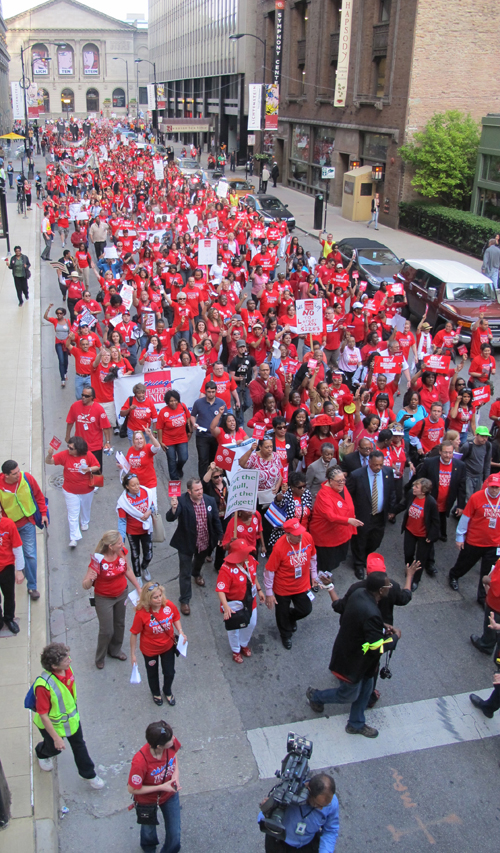
In support of all the teachers, parents, and kids in Chicago who are marching, striking, and honking their horns for public schools.  And in special memory of George Schmidt, who gave me this shirt when I was in Chicago in 2013 promoting my first book.

Carry on!


Tuesday, October 11, 2016

The Second Karen Lewis Sellout?

A Chicago teachers' strike that had been advertised for all the blogs to post about did not happen.  You need to read George Schmidt at Substance News to get the story.  A clip:
. . . .Despite sometimes emotional defenses of the vote to accept the proposed contract and push the union's members into the deal, by early October 11, as people began studying the eight-page PDF outlining the deal, it was clear that the deal was in trouble. And in the context of the trouble, more and more members were asking by what authority in the union's own laws had the current CTU leadership unilaterally inserted an entity called the "Big Bargaining Team" (all appointed by CTU President Karen Lewis) between the legal responsibility of the House of Delegates and the final legal power of the union's rank and file members.

And aside from a few shrill posts on Facebook and some hurt feelings on the internal email system of CORE (the Caucus of Rank and File Educators, which has been leading the union since winning the June 2010 CTU election), the union's leaders and the members of the Big Bargaining Team were unable to answer the questions raised by so many controversial -- if not odious -- parts to what has so far been seen of the deal. . . . .

Thursday, March 28, 2013

The Fight in Chicago to Stop Mass School Closings: Model for the Nation


From SubstanceNews:

Thousands march, 127 arrested in massive March 27 Chicago Loop protests against school closings, Emanuel dictatorship

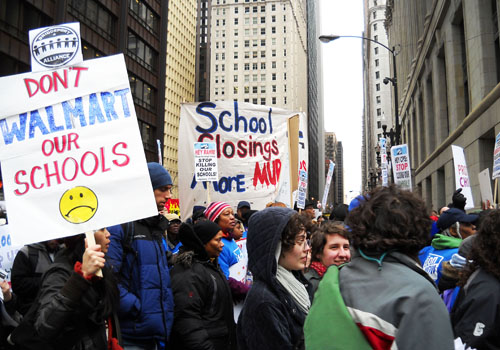
More than 3,000 teachers, parents, students and other citizens rallies and marched against school closings in Chicago on March 27, 2013, and 129 were arrested during civil disobedience to protest the largest number of public school closings in U.S. history, according to a number of Substance reporters and other sources who were present at the events. The rally, marches, and sit-ins, are a continuation of the protests that began when the current "Chief Executive Officer" of Chicago's public schools, Barbara Byrd Bennett, announced in October 2012 that she had secured an extension of the deadline required by state law to announce the closing list for the 2013-2014 school year.
Protesters filled the block alongside Chicago's City Hall (right in the above photograph) and numbered in the thousands despite the attempt by Rahm Emanuel's out-of-town Chief of Police, Garry McCarthy, who ordered the police to downplay the size of the protest in a move reminiscent of the days when the Nixon administration was downsizing official estimates of anti-war protesters against the Vietnam War. Substance photo by Susan Zupan.On March 27, 2013, the protests, coordinated by the Chicago Teachers Union, others unions, and a broad range of community groups and faith-based entities, began the final assault against the mayor's drive to privatize and sabotage the public schools in the nation's third largest school system.
Press reports begin below here

Sunday, February 17, 2013

Will Chicago Public Schools Be Sued Duing Black History Month for Its White Curriculum?


CHATHAM — State Rep. Mary Flowers (D-Chicago) is urging a community group to file a lawsuit against Chicago Public Schools for not complying with a 22-year-old state law that requires all public elementary and high schools to include black history as part of its regular curriculum. 
"I encourage you to file a lawsuit against CPS to make them comply with the state law," Flowers said at a Saturday meeting with community group We Can Inc. at Josephine's Cooking restaurant, 436 E. 79th St. . . . 
In 1986, Flowers sponsored a state law, which took effect in 1991, mandating public schools make black history a part of their regular curriculum and not just taught during Black History Month in February. 
"The proposed curriculum CPS has presented is unacceptable," said Florence Cox, president of We Can Inc. and the first black president of the Chicago Board of Education.  
"It lacks our history and language arts. There is nothing in here about who [African Americans] are and where we came from." 
Barbara Byrd-Bennett, chief executive officer for CPS, did not attend the meeting, but was represented by Phillip Hampton, chief community and family officer for CPS. 
"Barbara needs to meet with you. I do know she is aware of this situation," Hampton told the community group. "I will speak with her on Monday and elevate this issue to her, so that by Tuesday you have a response back. " 
State Rep. Monique Davis (D-Chicago) attended the last meeting held on Jan. 27. At that meeting she said too many black kids are attending schools named after blacks, and the students don't even realize it. 
"Most of the students who attend Paul Robeson High School [on the South Side] don't know anything about him other than he is a black man," said Davis. "And that's a shame." 
According to CPS data, 99 percent of the students at Paul Robeson are black, and at William Harper High School, also on the South Side, 93 percent of the students are black. 
John Thuet, 28, teaches world studies to freshmen at Harper High School and has worked at the school the last four years, but he doesn't know who William Harper is. 
"You know, that's a good question. I don't know who William Harper is, but now that you've asked I plan on looking him up to see," Thuet, who also chairs the school's history department, said. 
Examples like this, said Hampton, are not good, but fall within the leadership of the school. 
"We have a lot of challenges with teachers. When I was a business teacher at DuSable High School, I made sure my students knew who [Jean Baptiste Point] DuSable was, even though I was not a history teacher," said Hampton. 
Possible school closings also were discussed at the meeting. 
Many of the 129 elementary schools CPS is considering closing in June are located in black neighborhoods on the South and West Side, said Flowers. 
While Hampton acknowledged that the recently released list contains "many schools on the South and West Sides," he denied Flowers' allegations that those areas were targeted by design. 
"None of these schools being considered for closure are overcrowded," Hampton said. "As for the empty school buildings, once the closure process is complete, the buildings would probably be sold." 
The method CPS is using to determine which schools to close is a broken formula, added Flowers. 
"School closings are done purposely to drive [black] kids out of certain areas experiencing gentrification," said Flowers. "The closings of these schools are criminal."

Read more: http://www.dnainfo.com/chicago/20130217/chicago/cps-could-be-sued-for-lack-of-black-history-schools#ixzz2LDnYQxDp

Tuesday, September 11, 2012

Advice to Chicago Teachers: Steer Clear of Weingarten

President of the AFT, Randi Weingarten, emerged today with a statement to the New York Times that  feeds that vitriol that corporate ed deformers are trying to promote against Chicago teachers:
“You have a situation where the teachers feel totally and completely disrespected,” said Randi Weingarten, president of the American Federation of Teachers, the parent union of the striking teachers. In this case, she said she blamed Mayor Emanuel for an aggressive push to extend the length of the school day and for a promised raise that was later rescinded. “He created the seeds of a lot of frustration and mistrust,” she said.
Why does Randi try to make this about money issues, when it is not?  Because the real issue of corporate control of public schools and the crackpot scheme for evaluating teachers based on test scores have already been embraced by Weingarten.  How could she come out in support of a strike that is all about a policy that she and the NEA prostisuits have already signed on to.  

My advice to Chicago:  don't have Randi Weingarten anywhere close to the microphones in Chicago.  She has shown her fealty to the oligarchs, and she and Dennis Van Roekel of the NEA cannot be counted on to advocate for children or teachers.

The real issues?  From the same NYTimes article:
Outside the schools here, though, in the lines of marchers, the issues seemed ever broader. Many teachers said they were troubled by a new evaluation system and its reliance on student test scores. Teachers spoke of rising class sizes, much-needed social workers, a dearth of air-conditioned classrooms and slow-to-arrive reference books, and, again and again, a sense of disrespect.

Thursday, August 16, 2012

Chicago Teachers Union Versus Astroturf Billionaires

Billionaires like the Koch Brothers, Betsy DeVos, and Bill Gates fund astroturf tools like Jonah Edelman, Rebecca Nieves Huffman, and Kyle Olson. Working with anti-working class politicians like Rahm Emanuel, these groups and individuals strive to privatize public education, union bust, and profit off the sufferings of the poor. Chicago Teachers Union (CTU) is on the front lines of the battle to save public education, but they are fighting right-wing forces with limitless resources. Their bold actions in the face of overwhelming odds may well be the turning point in the battle to prevent the neoliberal project from eliminating public education nationwide. They need our support, please contribute to the CTU Solidarity Fund.

Here's CTU's introduction to the film:

The Chicago Teachers Union is currently on the front lines of a fight to defend public education. On one side the 30,000 members of the CTU have called for a contract that includes fair compensation, meaningful job security for qualified teachers, smaller class sizes and a better school day with Art, Music, World Language and appropriate staffing levels to help our neediest students.

On the other side, the Chicago Board of Education—which is managed by out of town reformers and Broad Foundation hires with little or no Chicago public school experience—has pushed to add two weeks to the school year and 85 minutes to the school day, eliminate pay increases for seniority, evaluate teachers based on student test scores, and slash many other rights.

Teachers, parents and community supporters in Chicago have fought valiantly—marching, filling auditoriums at hearings and parent meetings, even occupying a school and taking over a school board meeting. Most recently, 98 percent of our members voted to authorize a strike. But now we find ourselves facing new opponents—national education privatizers, backed by some of the nation's wealthiest people. They are running radio ads, increasing press attacks, and mounting a PR campaign to discredit the CTU and the benefits of public education.

Friday, June 08, 2012

Chicago Teachers Voting Now to Authorize Strike If Negotiations Fail

What is going on in Chicago among teachers should be a lesson for the country, especially the cowardly and appeasing pack of lawyers and PR men who are running the NEA and AFT.

CTU has a group of leaders who have not forgotten the democratic and social justice missions that unionism is built upon, and their goals are much deeper than preserving the half-million dollar salaries of the Weingartens and Van Roekels of the world.

Below is a terrific background piece from GapersBlock.com to help everyone understand what is going down in Chicago, where hope is alive among fearless and proud teachers who are not afraid to stand up for children, families, and for themselves.

May the rest of the nation take heed.  Don't lie down in the street unless you want to get run over.  Stand and fight!

Keep track of what is going on by reading SubstanceNews.
_________________________


A Long Time Comin': Chicago Teachers Strike Authorization Vote Begins Today

Beginning today, over 20,000 Chicago teachers will vote on whether or not to authorize their bargaining committee to call for a strike should negotiations with the Board of Education over new contract terms fail. For authorization, 75% of non-retiree union members would need to approve. The voting takes place over three days. This high threshold is the result of legislation passed last year. As state public employees, teachers' collective bargaining rights and terms are governed by state, rather than federal, law.
The legislation in question, known as SB7, was passed after intense and stealth lobbying efforts by Stand for Children, a well-funded non-profit that operates at the state level to encourage entrepreneurial changes to public education that incrementally privatize school systems. Stand for Children co-founder Jonah Edelman famously bragged at a conference that they used access to important and influential political figures like Rahm Emanuel and Michael Madigan, and insiders like Jo Anderson to tighten restrictions on the Chicago Teachers Union. Part of the strategy was to take away one of the union's more potent tools, the strike threat. Unable to take away the right to a work stoppage, Stand settled for a 75% approval threshold.
Now, it is looking like Stand's strategy might backfire, if teachers ultimately vote to authorize a strike. After all, the question teachers will vote on is whether to authorize a strike, not whether to go on strike. Arguably, winning an authorization vote by 50%+1 would not be a real show of strength. A significant portion of teachers would have expressed their opposition to a strike, and maintaining the strike, once called, would be exceedingly difficult. The organizational capacity teachers build by being forced to get over 75% means a resilient strike, should things come to that, and a battle-tempered organization prepared to push hard during negotiations.
Besides the mechanics of it, there are the underlying social conditions that are bringing this to a head.
Why, after all, did Edelman and his cohorts go after arcane (to the public) collective bargaining rules in their effort to, as their mission statement says, "ensure that all children, regardless of their background, graduate from high school prepared for, and with access to, a college education"? What is the connection?
Edelman and the small but wealthy coterie of donors and activists who want to overhaul education by partially privatizing it view teachers unions as the primary obstruction to their vision, which is by all indications sincerely held. Politicians have, by most measures, been pliant. In the last two State of the Union addresses, one of the only points of agreement between the President and the GOP responder was education policy. Big city Mayors, most of them Democrats, have eagerly promoted high-stakes testing and charter schools. The only institutional resistance these reformers regularly meet is from teachers organized into unions. The tactical solution then is to weaken teachers' credibility and undermine their organizational strength. (Which, again, Edelman essentially detailed.)
Part of this tactic has been to blame teachers for poor student outcomes, and characterize arguments and research that show the connection between family income and educational outcome as "excuse-making." Over the last ten years in particular, "bad teachers" have been elevated as the primary reason for poor student performance, and teachers unions have been attacked by implication for "protecting" them. Whatever the objective value of this reasoning (and the data supporting such arguments is at best conflicting), the social reality is that teachers feel besieged and disrespected, while at the same time seeing the profession of teaching as an institution collapse in a real way.
That type of disrespect isn't an abstraction. Teachers, like other professionals, have invested enormous time, energy, emotion, and money into growing into their profession. When outside forces undermine that very real and viscerally felt investment, there is going to be a strong reaction, and resort to extreme measures.
What adds to this is that the privatization process sets off an endowment effect among parents. In order to eliminate unionized teachers, privatization groups work with politicians to institute "turnaround" programs that suddenly shut down neighborhood schools. People generally react more strongly to losing something they have than they do to failing to achieve something they want. The turnaround process has beentraumatic for thousands of Chicago families, and it's a cumulative phenomenon; in the early days of turnarounds, the impact was scattered. Over the years, and particularly with Mayor Emanuel's outspoken desire to pump up the number of charter schools, the sheer numbers of those impacted has grown and grown, networks of aggrieved and distrustful parents have emerged, and common cause with teachers who want to preserve public, neighborhood schools has been found.
So the top-down, political-relationship heavy, marketing strategies of groups like Stand for Children lose their efficacy over time (and ironically, it's a strategy with its roots in the pro-NAFTA campaign partially engineered by Mayor Emanuel). Such strategies rely on the vast majority of people being unaffected in an immediate material way by the policy changes being proposed; the sophisticated marketing with inoffensive, abstract visions appeal to people in the way most advertising does. But the campaigns enjoy diminishing returns as more and more people feel the effects of a policy, particularly in localized conditions, because the effects are concentrated.
And this is not mere speculation. Because charter schools in particular have objectively not had the spectacular results promised, there is no attendant surge in support for the privatization agenda on the ground, of the kind necessary to, for example, defeat a strike authorization vote, break a strike, or dominate local school council elections. Because of the proportions and numbers involved, high-level operations (relationship making with editorial boards, politicians, and social and economic clubs) are less effective. In other words, the proportion of people adversely effected by a given set of policies will be higher in localized conditions; and in adversarial situations involvingonly those policies, public relations-heavy tactics won't penetrate and persuade. It'd be like if a Red Bull bottling plant leaked thousands of gallons of concentrated Red Bull into the water supply of Eureka, Illinois, causing thousands of cases of acute kidney pain. Probably Red Bull sales would plummet in Eureka, no matter how many Flugtags they hold.
It remains to be seen whether Chicago's teachers end up authorizing a strike, and if authorized, whether they will take the major step of actually striking. Since this would end up taking place in the fall, there will almost certainly be pressure from national Democrats, including the President, to keep a teachers strike from erupting in the President's home city, where the policies of his Secretary of Education are still basically in effect. The 75% threshold will be exceedingly difficult to meet, and since the Board of Education is seeking fairly draconian changes to the collective bargaining agreement, they have plenty of ground to give in negotiations to avoid a strike.
If nothing else then, SB7 changed the lay of the land such that teachers could not afford to be slack. As a result, the union is in a state of heightened readiness that a top-down style of campaign organization is ill-equipped to handle.

Saturday, August 20, 2011

Tribune Lines Up Behind Brizard, Chicago's New Broadie

Just as Booker T. Washington was groomed by white philanthropists during the first Gilded Age to advance the cause of segregation, containment, and indoctrination of African-Americans, the philanthrocapitalists of our Gilded Age 2.0 have a whole slew of Booker T.'s to push the message of miseducation, austerity, and oppression of today's minority children in America's urban centers.

The latest trainee from Eli Broad's Big House Superintendent's Academy to be placed in charge of mangling another urban school system is Jean-Claude Brizard (Class of '07), who is fresh from a spectacularly-failed administration in Rochester, New York, where he earned an overwhelming no-confidence vote from Rochester educators (2,713 to 140).

So now Jean-Claude is Rahm's black face for white Chicago-style corporate-run schools, and the Tribune's Wall Streetwalker editorial board couldn't be happier.  After all, Jean-Claude has been placed there to impose corporate austerity measures by downsizing the workforce, outsourcing public jobs to corporate contractors, increasing class sizes, and shutting down public schools in order to make room for the corporate chain gang charter schools that will receive large financial incentives for replacing teachers and schools with testing factories managed and staffed by positivized and glassy-eyed TFA CEOs and line managers.

Yesterday's glowing editorial, which includes Jean-Claude's marching orders from Eli Broad, calls this the "Fourth Revolution," coming as it does on the heels of the other three led by the three stooges, Vallas, Duncan, and Huberman.  And yet the Tribune notes the job is far from complete, which is the fault not of the people who have been in charge of policy for the past 16 years but, rather, the people who haven't--the students, parents, teachers, and principals.  In fact, there is not the slightest hint of irony from the Tribune editorial writers, when Jean-Claude quips (about principals) during his sit-down with the Editorial Board that
"if you've done a job 15 years and you can't move achievement, you shouldn't have your job" . . .
And so Jean-Claude will begin Year 17 of the same failed corporate education policies that have wreaked havoc on Chicago's children and teachers and parents for almost two decades, even as poverty, misery, and murder have reached unprecedented levels.

My suggestion to all of Chicago's citizens: Listen to Jean-Claude, even though he has no idea about what he has said.


Friday, February 04, 2011

Sunday, January 02, 2011

Wow, There's a Chicago Mayoral Candidate that Favors Democratically-Controlled Public Schools

No, it's not Reptilian Rahm or Mosely-Braun or Gery Chico.  It's Danny Davis for Mayor.  From the Chicago Tribune:

The major candidates in the Chicago mayor's race are split on today's proposal that the city’s school board be elected instead of appointed by the mayor, though none of them embraced the plan wholeheartedly.

Three candidates --- former White House chief of staff Rahm Emanuel, ex-U.S. Sen. Carol Moseley Braun and Gery Chico, who once served as Chicago Board of Education president --- each said they are opposed to the idea and argued it could further politicize public education in Chicago.

U.S. Rep. Danny K. Davis said he supports the concept of an elected school board, although he didn’t necessarily back the proposal presented today by a group led by the Chicago Teachers Union. 

City Clerk Miguel del Valle said he supports the “eventual transition” to an elected school board, but said in order for it to be effective, the city needs to implement public financing of political campaigns. He also said there should be provisions in the law to guarantee the mayor has some accountability for the condition of the schools. . . .
 

Monday, November 08, 2010

Mayoral Control of Schools? Not So Much

A top priority of the handful of oligarchs who control federal education policy and Arne Duncan is the elimination of public governance of the public schools by ceding power to CEOs, once known as mayors, and eliminating elected school boards.  Mike Klonsky gives us a rundown on how it's going in Chicago.  Not well.  Here's a clip, but do read it all, please at HuffPo:
. . . . Duncan couldn't deliver a victory for Fenty, even while resorting to threats of pulling millions of federal grant dollars from D.C. schools should Gray win. This left many wondering if Duncan only favored mayoral control if he could control the mayor.

But now, with Chicago's schools in a state of leaderless limbo, the problems of having a single autocrat running big-city school systems have become obvious to all. After a decade and a half of Daley's top-down reform efforts, seven of those years with Duncan as the CEO, neighborhood schools remain pretty much as they were. Scores have flattened out. The so-called "achievement gap" continues to widen. Violence has reached pandemic proportions and the school system is on the brink of insolvency. Daley's pet reform project, Renaissance 2010, has been discarded and the phrase banned from usage within the bureaucracy.

Daley's appointed school board has been riddled with scandals, including probes of patronage and civil rights violations. Daley's former board president Michael Scott committed suicide when faced with an investigation of his misuse of school board funds.

The mayor's announced retirement has been followed by the departure of Duncan's successor, Ron Huberman. As the crisis deepens, both he and the mayor, it seems, suddenly want to spend more time with their families. So much for stability and strong leadership.. . .

Friday, May 14, 2010

Teachers, Parents, Students Revolt in Duncan's Backyard

From CORE:

Download this flyer and distribute to teachers, parents, and other community members.

For a set of large, glossy posters for your school (or community), contact your area captain:

* North of Fullerton — Jesse Sharkey 773/791-7006

* Between Fullerton and Roosevelt – Liz Brown 773/606-4876

* South of Roosevelt, East of State – Michael E. Brunson 708/903-7061

* South of Roosevelt, West of State — Alix Gueverra-Gonzalez 773-988-2252
Despite Arne Duncan's delusion that he has "zero" opposition to the Walmart plan for public education, Chicago is getting organized to wage war on corporate ed reform in Chicago. Here's some details from a great report from Chicago Labor and Arts Festival Blog:

Teachers, parents, and students are not happy at Chicago’s education leadership–there is mounting frustration with the Board of Education, the CPS bureaucracy, and the Chicago Teachers Union (CTU) leadership. As President Obama and Secretary of Education Arne Duncan take the Chicago model of slow-burn privatization national, Chicago may just be seeing a full fledged revolt against it. With the recent revelation that there are now no educators among the CPS’ top leadership, scrutiny of a reform program dominated by entrepreneurs and private interests (including a Board of Education stacked with financiers and real estate developers) is likely to sour people further.

Teachers, Parents, and Students, Oh My

Chicago’s teachers are angry; but that matters less than the fact that even more are discouraged, leaving the profession, burning out and warning the next generation away from teaching all together. Teachers have been under a full assault by corporate interests and the disingenuous reformers they underwrite for decades, and this assault has only intensified since the election of Barack Obama to the White House and the elevation of former CPS CEO Arne Duncan to the top of the Department of Education. Obama and Duncan have undertaken to bring Chicago-style education reform to the level of national policy, without any evidence whatsoever that that reform works.

The (arguably illegal) Race to the Top program, which embodies Chicago Renaissance 2010 model of school turnarounds, privatization, and “pay-for-performance” incentives, is just getting underway, and teachers around the country are finding out, too late, that Obama et al are hostile to public educators.

But here in Chicago, where the method to this madness was born, teachers and parents are organizing revolts to protect their schools. Unhappy teachers are lining up to challenge a union leadership they characterize as ineffective or accommodationist and an insular Board of Education, as parents and students are fighting to keep their schools public and democratically controlled. And what happens here, at ground zero of school privatization, could presage what happens nationally as the federal government tries to strong arm school districts into dismantling their public schools; a policy instituted as a sop to “centrism” could end up sparking a serious fight in the moderate liberal wing of the Democratic Party as urban community groups and teachers union factions resist.

. . . .

Despite efforts to deploy typical false equivalence in characterizing the fight against privatization as one between free market “reformers” and teachers union “special interests”, CPS families have been in the vanguard of the fight against school closures and privatization schemes.

While the free market zealots hype the “warchest” of teachers unions (funded by small dollar amounts contributed by tens of thousands of people), their underwriters are few but with enormous pockets. Families have seen the painful results of school turnarounds, as students lose long-time mentors, communities lose the institutional memory of master teachers, and students are forced to cross neighborhood lines–and gang territories–to attend alien schools, all with no evidence that this trauma has any positive effect.

It is not trivial that these traumas are not accompanied by any attendant increase in positive results; free market reformers are acting on faith, not data, and in fact are often working against data.

Results are trickling in that the suite of privatization schemes–including vouchers and charter school expansion, based on the outright harmful No Child Left Behind testing metrics–have done little or nothing to improve education, while also undermining public education and favoring students with already active parents. Even if we charitably assume that more time is needed to gauge the effectiveness of school privatization, the explosion of privatization schemes–and its official, heavy-handed sanction by the federal government–is hardly justifiable. For the state to bring so much pressure on states to privatize their school systems, you’d assume that there was hard data behind the move; but there isn’t, just new economy sloganeering about “efficiency”, and execrable race-baiting.

No Child Left Behind has led to an obsession with testing that has enriched the test making companies but done nothing to improve critical thinking or education. In fact, the standardized tests themselves often verge on the meaningless. The ed reformers’ major proposal is that teachers should be judged solely or primarily on standardized test scores, which is patently absurd. Is there any other profession where pay and job security rests solely on one measure?

Intellectual fuel flowing from several quarters is adding to the growing conflagration, perhaps none so combustible as that coming from Diane Ravitch, a universally respected scholar of education policy and history in the United States. Her latest book, The Death and Life of the Great American School System, details how a good-faith effort to inject accountability into failing urban school systems was exploited and eventually transmogrified into a scheme to “measure and punish” schools.

Ravitch took direct aim at the Renaissance 2010 failure in a recent appearance on WBEZ, as catalogued by Progress Illinois:

It’s 2010. Has Chicago had a renaissance yet? … Usually when you set a goal, that’s the goal you plan to meet. I’ve looked at the evaluations of the Chicago plans and what I’ve seen is that when schools are closed, communities are disrupted — in some cases, shattered. Kids are sent to unfamiliar neighborhoods. Gang activity intensifies. About half the kids in the closed schools are sent to other low-performing schools. And overall, there is no difference in performance. I’ve seen the same thing in New York City, where small schools are created, old schools are closed, and in the meanwhile the existing schools get overloaded with the most low-performing kids because the new, small schools don’t want them. So they push them off and they destabilize yet another school.

I think this is a terrible way to reform schools. The results are certainly not impressive. I don’t know of any place that can say kids are learning better, that education is better. And we’ve at the same time created this aggressive private sector that wants to take over public schools. And I don’t think that’s a good thing for the future of public education.

In her Washington Post editorial, Ravitch lays it out:

The districts with the most choice for the longest period — Cleveland and Milwaukee — have seen no improvement in their public schools nor in their choice schools. Charter schools have been compared to regular public schools on the National Assessment of Educational Progress in 2003, 2005, 2007 and 2009, and have never outperformed them.

The public discussion about school reform, since its hijacking, has never been about outcomes, but about process. School district leaders like Duncan and Washington D.C.’s Michelle Rhee get lauded in the petit liberal press not for improving outcomes but for “having guts” in “taking on” special interests. While scholars have been waiting to see if the wave of privatization that swelled to a tsunami with the passage of NCLB would be effective, the popular political discourse got hooked on the “social entrepreneurs versus the self-interested unions” and began rewarding those who picked a fight just for the fact of picking a fight; Michelle Rhee was the patron saint of school reformers because she promised to go after unionized teachers. Duncan similarly was praised in December of 2008 basically for publicity stunts:

Chicago has become a laboratory for reform in Duncan’s seven-year tenure. Officials here court new charter schools, teacher training is being reinvented, and some low-performing schools have been shuttered and reopened with new staff. Officials are also offering some students cash for good grades and seeking proposals for boarding schools. In addition, Duncan backed a plan to start a gay-friendly high school.

As a supporter of the sciences, I’m all for laboratories. But generally scientists conduct experiments pursuing educated hypotheses based on past findings. Not a premise that the experiment itself is a de facto good. (Not to mention using human subjects against their will is generally frowned upon.) Changes need to be instituted: but simply unraveling publicly funded and guided primary and secondary education does not seem to be the answer.

Here is what is facing us from the petri dish: public education in Chicago has been seriously undermined as charter schools have proliferated and neighborhood schools deeply stigmatized. . . .


Friday, March 26, 2010

Arne Duncan's Chicago Charade Goes National

From Democrcacy Now:
When President Obama’s Education Secretary, Arne Duncan, was the head of Chicago’s Public Schools, his office kept a list of powerful, well-connected people who asked for help getting certain children into the city’s best public schools. The list—long kept confidential—was disclosed this week by the Chicago Tribune. We speak with the Chicago Tribune reporter who broke the story and with two Chicago organizers about Duncan and his aggressive plan to expand charter schools.

Wednesday, January 20, 2010

Duncan's Chicago Failure With Corporate Charter Schools Slated to Become National Model

Just as Rod Paige's Houston Miracle became our national nightmare, so another miracle turned mirage, this time by Arne Duncan, will serve as a model to "turn around" the nation's poorest schools by turning them into corporate charter schools. The only problem for Duncan: we know this time the solution will do nothing for children before the charade is ever played out.

When you have the corporate water carriers at The Chicago Tribune going negative on your propaganda machine, you have to know that your vehicle just blew a rod before the race to the top ever got started. A prime chunk of the Sunday article:
. . . .The business community embraced the reform agenda and has ponied up $50 million to the Renaissance Schools Fund, a nonprofit created by the Civic Committee of the Commercial Club of Chicago. The group has awarded about $30 million to 63 new schools.

Currently, 92 Renaissance 2010 schools enroll 34,000 children -- about 8 percent of the district total. Seven new schools will open in the fall, and the city plans to announce new school closings within the next few weeks.

The new schools mirror the district demographically, except they enroll fewer special education students and those who speak English as a second language.

Chicago school officials don't publicly track the performance of the Renaissance 2010 schools. But Ron Huberman, who took the helm of the city schools when Duncan left, said he has crunched the numbers and about one-third of the new schools are outperforming their neighborhood counterparts; one-third are identical in performance; the rest do worse.

A Tribune analysis shows that in Renaissance 2010 elementary schools, an average of 66.7 percent of students passed the 2009 Illinois Standards Achievement Test, identical to the district rate. The Ren10 high school passing rate was slightly lower on state tests than the district as a whole -- 20.5 percent compared with 22.8 percent. But it's identical at 17.6 percent when selective enrollment schools, where students test to get in, are removed from the equation.

Only a quarter of Renaissance 2010 schools had test scores high enough to meet the federal goals set by No Child Left Behind, the signature education policy of the George W. Bush administration. Chicago students as a whole still post some of the lowest test scores on national math and reading exams.

A series of studies released last year paints an unimpressive picture of Renaissance 2010.

One report, commissioned by the Renaissance Schools Fund, found that children in the fund-supported schools had low academic performance and posted test score gains identical to students in the nearby neighborhood schools.

"The Renaissance Schools Fund-supported schools will need to rapidly accelerate the academic performance of their students if they are to realize their own expectations," researchers wrote. . . . .
If anyone needs more evidence that the corporate solution is no solution, read on.

Tuesday, December 29, 2009

Arne Turns Sour On Testing?

(Click chart from Washington Post at right to enlarge for viewing)
Some of us knew that Arne Duncan's claims of a Chicago Miracle were fraudulent when he went before a Congressional Committee to make his case for his style of "portfolio management."

I am thankful that the big dogs have come off the porch finally to see what we have been barking about out here in the yard for a year now. From Nick Anderson's story today in WaPo:
Soon after Arne Duncan left his job as schools chief here to become one of the most powerful U.S. education secretaries ever, his former students sat for federal achievement tests. This month, the mathematics report card was delivered: Chicago trailed several cities in performance and progress made over six years.

Miami, Houston and New York had higher scores than Chicago on the National Assessment of Educational Progress. Boston, San Diego and Atlanta had bigger gains. Even fourth-graders in the much-maligned D.C. schools improved nearly twice as much since 2003.

The federal readout is just one measure of Duncan's record as chief executive of the nation's third-largest system. Others show advances on various fronts. But the new math scores signal that Chicago is nowhere near the head of the pack in urban school improvement, even though Duncan often cites the successes of his tenure as he crusades to fix public education.

Now up until this time, before reporters finally began to ask Duncan about the details of the Chicago Mirage, the Secretary has loved testing. More testing, bigger testing, harder testing. National testing. And testing used to pay teachers and to fire them as well. Testing to tell which schools to turn over to charters. Testing to get ready for the test, and testing in kindergarten. Why, Duncan has loved high-stakes testing so much that conservative historian, Diane Ravitch, has called him Margaret Spellings in drag:
. . . .based on what I have seen to date, I conclude that Obama has given President George W. Bush a third term in education policy and that Arne Duncan is the male version of Margaret Spellings. Maybe he really is Margaret Spellings without the glasses and wearing very high heels. We all know that Secretary Spellings greeted Duncan's appointment with glee. She wrote him an open letter in which she praised him as "a fellow reformer" who supports NCLB and anticipated that he would continue the work of the Bush administration. (Recall, Deborah, that the media today defines an education reformer as someone who endorses Republican principles of choice and accountability.)
Now all of a sudden--overnight, you might say--these reporters with their rude questions may have just spoiled Arne's love for testing. Arne seems, in fact, to be rethinking his commitment to testing entirely, or at least when it comes to his own "accountability" in Chicago as CEO. Hoist with his own petard, shall we say?
"Obviously, you always want to get better faster," Duncan said in an interview when asked about the federal math scores. "I was focused on outcomes -- improving graduation rates, making sure that students who graduated had a chance to pursue higher ed. You can have the best test scores in the world, but if kids aren't going that next step, you're not changing their lives."
Remember that, teachers. Focus on changing lives, rather than the stupid test. Arne says so, after all.

Wednesday, October 07, 2009

Huberman Moves to Fix Violence That Duncan Plan Made Worse

While Chicago Schools CEO, Ron Huberman, was Director of the Office of Emergency Management and Communications for Chicago, he signed 130 purchase vouchers. The largest one for $2.25 million was also the one that he did not bother to review. And now it is the subject of a scathing report by the City of Chicago's Inspector General, as reported four days ago by the Sun-Times:

Chicago schools chief Ron Huberman -- Mayor Daley's former corruption-fighting chief of staff -- is being accused of a "significant management failure" that set the stage for alleged contract irregularities at the city's 911 center that cost taxpayers $2.25 million.

In an explosive new report, the city inspector general's office characterizes Huberman as so derelict in the oversight of a contract with Motorola while he was executive director of the Office of Emergency Management and Communications that he should be suspended if he still worked for the city. . . .

So now as CEO of CPS, Huberman is glad to be focused on another contract, this one worth $60 million over 2 years for a data system and intervention program to identify and assist 10,000 of over 400,000 Chicago school students who are thought to be most at risk for violent attack or murder. As a real data hound, Huberman's office has studied 500 of the recent youth shootings in Chicago, and Huberman sees a pattern. From the NYTimes:
From the study of the 500 shootings, Mr. Huberman said, officials know that deadly violent outbursts are not truly random. The students at highest risk of violence, by statistics, are most likely to be black, male, without a stable living environment, in special education, skipping an average of 42 percent of school days at neighborhood and alternative schools, and having a record of in-school behavioral flare-ups that is about eight times higher than the average student.
And poor? One must wonder what kind of correlation exists between Huberman's list, which avoids the criterion of poverty entirely, and the the list of Chicago's poorest 10,000 segregated high school children.

Another interesting correlation would be to determine the relationship between the rash of beatings, shootings, and deaths to the plan to create apartheid corporate charter schools, fire teachers, and displace tens of thousands of school children. George Schmidt at Substance News has been reporting on this, and now comes this AP story today and this at HuffPo:
. . . .Since 2005, dozens of Chicago's public schools have been closed and thousands of students reassigned to campuses outside their neighborhoods – and often across gang lines – as part of Renaissance 2010, a program launched by Mayor Richard Daley when Duncan was Chicago Public Schools chief.

While the plan has resulted in replacing failing and low-enrollment schools with charter schools and smaller campuses, it has also led to a surge in violence that has increasingly turned deadly, many activists, parents and students say.

Before the 2006 school year, an average of 10-15 public school students were fatally shot each year. That soared to 24 deadly shootings in the 2006-07 school year, 23 deaths and 211 shootings in the 2007-08 school year and 34 deaths and 290 shootings last school year.

Few deaths have occurred on school grounds, but activists say it's no coincidence that violence spiked after the school closures.

"You have a trail of blood and tears ever since they launched (Renaissance 2010)," said Tio Hardiman, director of the anti-violence organization CeaseFire Illinois. "There's a history of violence associated with moving kids from one area to another."

Albert, an honor roll student at Christian Fenger Academy High School, was attacked on Sept. 24 when he got caught up in a mob of teens about six block from school. Video shows him curled up on the sidewalk, as fellow teens kick him and hit him with splintered railroad ties. So far, four teens have been charged in his death.

Students and prosecutors say the fight was part of an long-running dispute between neighborhood teens and those from Altgeld Gardens, a public housing complex about five miles away in one of the city's poorest neighborhoods and where Obama got his start as a community organizer in the 1980s.

When the high school closest to Altgeld Gardens was converted to a military academy several years ago, many area students transferred to Fenger.

Chicago police have acknowledged that Albert's slaying was related to the mixing of students from different neighborhoods, but they didn't respond to questions from The Associated Press about whether the violent deaths were related to school closings.