"A child's learning is the function more of the characteristics of his classmates than those of the teacher." James Coleman, 1972

Wednesday, October 11, 2006

No Undergrad Left Behind - No Intellectual Left

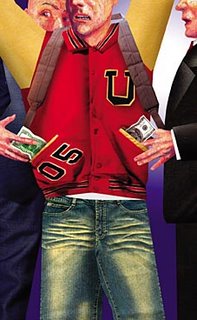
Eugene Hickok's attack on higher education, intellectual freedom, and academia in today's New York Times should be a wake up call to anyone who believes No Child Left Behind was strictly intended for K-12 and that the United States is not teetering on the edge of fascism.

Americans should have more information about higher education curriculum and teaching. Higher education in this country differs substantially from elementary and high school education, most obviously in what is offered and how it is offered. The academy responds to the demands of disciplines and faculty. It is a culture that cherishes independence and freedom. And it is a culture seriously out of touch with much of America.

The blatant contempt for one of the last bastions of educational freedom and autonomy, universities and colleges, on the part of right wing think tanks and corporate interests is transparent in this dangerous drivel, which even a bright college student at Brandeis and a concerned citizen in Daytona Beach, Florida can see through.

Joe Farbeann, writing in the Brandeis newspaper, The Justice, points out the "absurdity" of it all:

The absurdity of the plan is quite striking. Grade school tests measure basic progress in reading and mathematics, but how can a test go about evaluating college students? After all, it would be difficult and misleading to attempt to judge a chemistry major and a theater major by the same test. Such a program would likely cause colleges to narrow their curricula, cutting interesting, specialized programs in favor of general education courses that would prepare students for the test. Instead of taking a wide array of classes, college students could find themselves stuck in survey courses designed to equip them to pass a test. But why let college students choose what they want to study when Big Brother can do it just as well?

In seeking to apply the principles of No Child Left Behind to colleges, the Bush administration is trying to expand a failed program. The increased standardized testing and increased federal intrusion into K-12 education represented by that law has caused such an outcry that 47 states have either challenged it or are considering doing so. Across geographical and ideological spectrums, there is an agreement that the federally mandated tests are a failure. The conservative state legislature in Utah passed an act instructing school districts to ignore certain portions of No Child Left Behind, and the liberal legislature of Connecticut has challenged it in court. Why take a policy that has caused uproar in grade schools and use it in the even less appropriate environment of universities?

Bill Archer in the Daytona Beach News provides the answer:

Under the banner word of "accountability," the state and federal governments have conspired to create an education system that will mold citizens into the feckless, fearful and forgetfully mindless peons that will do as they are directed, believe what they are told and forget about what true intellectual freedom without boundaries ever felt like. But the "accountability" they refer to has nothing to do with what most of us still remember as accountability.

Hickok and his gang of thugs, who are trying to steal hopes of maintaining and sustaining any possibility for a democratic future, are preying on the fears of the American people, who are increasingly insecure about the chances of realizing the American dream:

For generations, a college education has been a big part of the American dream. Much of the world has come to America to get a higher education. But nothing guarantees that this will be the case in the future. Indeed, for more and more American citizens, that dream is coming into question. It is time for serious reflection and reform in higher education — before it is too late.

Like most good scam artists, the folks at the Heritage Foundation have succeeded in showing their true colors and can no longer hide behind empty rhetoric and lies. All the more reason to make sure college students like Joe Farbeann understand what Chief Justice Louis Brandeis said,

"America has believed that in differentiation, not in uniformity, lies the path of progress. It acted on this belief; it has advanced human happiness, and it has prospered."


Let's keep it that way -- before it's too late.

Tuesday, October 10, 2006

Testing as Institutionalized Child Abuse

WaPo begins a new series today on our current abusive and immoral orgy of tabulation:

By Valerie Strauss
Washington Post Staff Writer
Tuesday, October 10, 2006; A09

Pop quizzes, spelling bees and the three letters that strike dread into high school students across the country -- SAT. We have become a Test Nation, and the results can determine the course of a student's life. Some are beginning to question: Is it all too much? Has our obsession with testing pushed students too hard? Just what do tests really tell us? Over the next few months, The Washington Post will examine the nature of testing and its effects. First in a series:

Along with painting and gluing and coloring and playing, Kisha Lee engages the youngsters in her day-care program in another activity: testing.

Three- and 4-year-olds take spelling tests of such words as "I," "me" and "the," as well as math tests, from which they learn how to fill in a bubble to mark the right answer.

Test preparation for children barely out of diapers is hardly something Lee learned while getting her education degree at the University of Maryland, she said. But it is what she says she must do -- for the kids' sake -- based on her past experience teaching in a Prince George's County elementary school.

"Kids get tested and labeled as soon as they get into kindergarten," said Lee, who runs the state-certified Alternative Preschool Solutions in Accokeek. "They have to pass a standardized test from the second they get in. I saw kindergartners who weren't used to taking a test, and they fell apart, crying, saying they couldn't do it.

"The child who can sit and answer the questions correctly is identified as talented," Lee said. "It hurts me to have to do this, but it hurts the kids if I don't."

Lee's approach underscores the culture of testing that reigns in the United States. Americans like tests so much that they have structured society around them.

Newborns are greeted into the world with the Apgar test to measure activity, pulse, reflex, appearance and respiration. Getting a 3 or below is like getting an F. Soon to follow are assessments -- the first of many -- that will compare them with their peers. Are they crawling, sitting, walking at the correct age?

In no time, kids are facing tests to measure school readiness.

Four-year-olds are tested in literacy and math in Head Start programs, and kindergartners undergo tests to see who is "gifted." By then, they are firmly ensconced on the testing treadmill.

"We are obsessed with tests," said Occidental University education professor Ron Solorzano, who used to teach in Los Angeles public schools. . . .

To Kisha Lee and every other teacher and administrator in America who continues to engage in this child abuse: The Nuremberg Trials determined that just following orders is not a defense for morally-reprehensible acts. Eventually, history or your own conscience will demand accountability that will count. The rest of the WaPo story here.

A Price to Play

One of the consequences of the pressure cooker schools that children have been placed in as a result of the impossible test targets of NCLB is the elimination of recess. Where kids once had play time with their friends, many of them, particularyly the poor, now sit with teachers or tutors doing the mindless direct instruction of parrot reading and math programs sold to their schools by Bush insiders. The resulting cost to this generation of educationally-abused children remains inestimable.

So just as schools in poor communities have been turned into work camps for the preparation of a new generation of mindless and unquestioning drones, a new report from the American Academy of Pediatrics has just been issued that concludes that what children need most today is some good old-fashioned play.

My question to these esteemed pediatricians: where were you six years ago when our national education establishment declared war on childhood? What treatment protocols will you now recommend for the anxious, depressed, and obese generation of children who have been sacrificed in the hopes of realizing a political agenda? Where was your expertise when it was needed? In the same protected cocoon of professional practice that the psychologists hide in, that apolitical nook that offers cover from the potential wrath of the fascistic crooks who have hijacked our public institutions?

From the AP's story yesterday:
. . . Numerous studies have shown that unstructured play has many benefits. It can help children become creative, discover their own passions, develop problem-solving skills, relate to others and adjust to school settings, the academy report says.

"Perhaps above all, play is a simple joy that is a cherished part of childhood," says the report, prepared by two academy committees for release today at the group's annual meeting in Atlanta.
A lack of spontaneous playtime can create stress for children and parents alike. If it occurs because young children are plopped in front of get-smart videos or older children lose school recess time, it can increase risks for obesity. It may even contribute to depression for many children, the report says. . .

Monday, October 09, 2006

A Big Joke, But Not Very Funny

It goes like this: A kid in a black raincoat walks into a middle school with an AK-47, points the gun at students and administrators, and then shoots up the ceiling, breaking a water pipe. He says, "don't make me do this" and is arrested.

Punchline: Bush and Spellings will have a big summit this week on school violence, but measures to limit access to AK-47s or any other guns will not be on the table for discussion.

Here is part of the AP story from CNN:

JOPLIN, Missouri (AP) -- A 13-year-old student wearing a mask and a long, black trenchcoat fired an AK-47 into the ceiling at his school Monday morning after confronting a pair of students and administrators, telling them "please don't make me do this," officials said.

No one was injured, and the boy, who police said was following a well-thought out plan, was taken into custody.

The seventh-grader pointed the gun at the two students, Principal Steve Gilbreth and Assistant Superintendent Steve Doerr, telling them "not to make me do this," Superintendent Jim Simpson said.

He then fired the shot into the ceiling, breaking a water pipe, and said again "Please don't make me do this," Simpson said.

Doerr and Gilbreth persuaded the youth to leave the building, and he was confronted by two police officers who had their weapons drawn. The student dropped the rifle and was taken into custody, Simpson said.

"It was a very close call," he said. . .


Eliminating Rights and Options on the Road to School Choice

When you hear privatizers talk about school choice, you can be sure that they have in mind the elimination of the most viable option, public schools. By offering church schools and chain gang charters as "choices" for desperate parents who want something other than their under-resourced and under-staffed public school in their rotting neighborhood, the privatizing politicians play to their theocratic and corporatistic power base.

But what about the choices and rights of students and teachers that become constrained or eliminated by a lack of public protections under the law. The New York Times has this story today on the discriminatory practices that become protected by a church-state separation clause that is never mentioned when federal money is being dumped to the faith-based, but comes front and center when church-state separation can be used to protect the Church and its institutions from legal and ethical responsibilities to employees, acolytes, or students:

J. Jeffrey Heck, a lawyer in Mansfield, Ohio, usually sits on management’s side of the table. “The only employee cases I take are those that poke my buttons,” he said. “And this one really did.”

His client was a middle-aged novice training to become a nun in a Roman Catholic religious order in Toledo. She said she had been dismissed by the order after she became seriously ill — including a diagnosis of breast cancer.

In her complaint, the novice, Mary Rosati, said she had visited her doctor with her immediate supervisor and the mother superior. After the doctor explained her treatment options for breast cancer, the complaint continued, the mother superior announced: “We will have to let her go. I don’t think we can take care of her.”

Some months later Ms. Rosati was told that the mother superior and the order’s governing council had decided to dismiss her after concluding that “she was not called to our way of life,” according to the complaint. Along with her occupation and her home, she lost her health insurance, Mr. Heck said. Ms. Rosati, who still lacks health insurance but whose cancer is in remission, said she preferred not to discuss her experience because of her continuing love for the church.

In court filings, lawyers for the diocese denied her account of these events. If Ms. Rosati had worked for a business or almost any secular employer, she might have prevailed under the protections of the Americans With Disabilities Act. Instead, her complaint was dismissed in December 2002 by Judge James G. Carr of the United States District Court for the Northern District of Ohio, who decided that the order’s decision to dismiss her “was an ecclesiastical decision” that was “beyond the reach of the court” because “the First Amendment requires churches to be free from government interference in matters of church governance and administration.” . . .

Democracy On the March--Out of America's Cities

A clip from WaPo yesterday on the D.C. school board race:
. . .Over the past decade, the power base of the school board has decreased significantly, largely symptomatic of a multitude of problems.

Only 28 of 146 schools made academic targets on the last student assessment -- a number that dropped from 75 the previous year under a different test.

The system has lost nearly 15,000 students to charter schools and to private schools participating in the federal government's experimental voucher program. If trends continue, according to a recent study, taxpayer-funded and independently operated charter schools will represent the majority of public schools in the city by 2014.

That prompts some to wonder whether the school board is fading into irrelevancy. . .
D.C. schools serve as a good case study for the privatization of American urban education and the de-democratization of America's cities. As the process plays out and power over educational decisions is put in the hands of big city mayors and the companies they hire, schoolchildren remain the pawns that are dragged around the chess board.

Does anyone really believe that we needed high-stakes testing to know that DC schools and schoolchildren were seriously behind less impoverished schools and more affluent schoolchildren? No. Has testing improved the lot of DC schoolchildren? No. Has high-stakes testing made it possible to move schoolchildren from inadequate public schools to private and charter schools that are no better, and sometimes worse? Yes. Will this strategy eliminate the need for publicly-elected school boards? Absolutely--who need public school boards if you no longer have public schools! Do the privatizers care that the same children will be left behind again, except this time any potential recourse for educational improvements will have been put in the hands of church or corporate officials, rather than elected school boards? I think not.

Sunday, October 08, 2006

NCLB: Strategic Ingenuity Disguised As Full Absurdity

The full absurdity of the federal No Child Left Behind law is hitting home. Perry Elementary is in trouble despite impressive progress on reading test scores. Gov. Tom Vilsack and every member of the Iowa congressional delegation should personally contact U.S. Education Secretary Margaret Spellings to protest.

They should ask her for the logic of labeling the school as "in need of assistance" when:


- The share of fourth-graders overall who scored proficient or better in reading comprehension on the Iowa Tests of Basic Skills grew to 78.3 percent from 65.4 percent.

- Low-income fourth-graders pushed the percentage testing as proficient to 69.7 from 53.4.

- Hispanic fourth-graders scoring as proficient leaped to 69.4 percent from 42.6 percent.

It's the score for special-education students that's the problem. Just 22.7 percent scored proficient in reading. And that's where the law is particularly unreasonable.

Students getting special-education services obviously face bigger academic challenges than other youngsters. Expectations ought to be high. But at the same time, those students must overcome or compensate for acknowledged disabilities. That can make achieving big increases in test scores much harder.

More intensive efforts should be made, just as Perry plans to do, but singling out its elementary school as deficient in the meantime is ridiculous.

Across Iowa, 249 schools are being singled out for not meeting one requirement or another of the education mandate signed by President Bush in 2002. Its goal is noble: All children are supposed to be proficient in math and reading by 2013-2014. To its credit, the law has forced districts to pay more attention to improving basic skills for disadvantaged students, which is very important.

But it is not the federal government's role to interfere in local schools to this extent, with a maze of bureaucratic rules that often lack common sense.

What this Des Moines Register op-ed writer and most Americans fail to see is that this NCLB labeling, which most citizens would agree is absurd, has had, since its inception, a policy purpose that goes to the heart of the conservative education agenda: the replacement of public schools through the implementation of vouchers and charters. NCLB is a grand strategic maneuver to crush public schools that is disguised as a well-intentioned, but short-sighted, intervention. However, there is nothing short-sighted about NCLB.

You see, when it became apparent in 2001 that a school voucher provision would not be included in NCLB, the White House’s inside man in the Senate, Sen. Judd Gregg, rallied support among disappointed Republicans. In doing so, he offered this glimpse into the Rovian education strategy to bring down public schools and, in the process, dump billions into the laps of tutoring concerns run by corporate and fundamentalist supporters:
“Well, the supplemental services [tutoring] are a foot under the door for vouchers. They’re going to show that these schools aren’t working properly, and we’ll finally be able to show that the schools aren’t doing well. The assessments are going to prove the same thing” (Debray, 2006, p. 96).
And, of course, this strategy is working. More and more schools, teachers, and children are being labeled as failures each year as we move inexorably toward impossible test targets that were cynically crafted to produce failure, rather than success. If that is not grounds for criminal child abuse, I don't know what would qualify.

In the meantime, Spellings and Bush promise more Federal cash for tutoring companies, while promoting more charter schools and a $100,000,000 voucher inititative. From the Decider's speech at the Washington charter school on Thursday:

We're going to work with school districts to help more students take advantage of free [paid for from the school's Title One funds], intensive tutoring . You'd be amazed at the number of districts that don't use this extra tutoring. They don't take advantage of the extra money to help an individual child. Oh, they'll figure out ways to spend it, don't get me wrong. But the money is aimed for helping an individual succeed, and it's the cumulative effect of bringing these students up to grade level that will enable us all to say we're more competitive for the future.

I believe in opportunity scholarships [vouchers]. I believe that the program here in Washington, D.C. ought to be replicated around the country. I call on Congress to create such a program for 28,000 low-income children as a beginning step to help parents challenge failure.
Any remaining doubts about the agenda? Any remaining doubts that NCLB is the weapon being wielded to win the war against public schools?

Saturday, October 07, 2006

Bush Promotes Sibling Ventures to Cash In

As The Decider hopped on the presidential whirly-bird today for a family outing to christen an aircraft carrier named after his father, he made sure that no photograph of him could be taken without a clear shot of his sister's new book, "My Father, My President." Whether or not sister Dora's new book will challenge today's No. 1 bestseller about the current President, State of Denial, only time will tell. I am sure The Decider will do what he can to help, just as he and Gramma Bush have done for son/bro, Neil, who is sure to pocket a few million of NCLB funds in his education venture, Ignite, Inc.

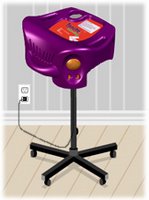
SM had this story in March on Neily's company and its investors in United Arab Emirates. Neil is hawking a computer-on-wheels to schools that he calls the COW (Curriculum on Wheels). Cute, huh?

Now Business Week has picked up the story. Here is a taste:

No Bush Left Behind
The President's brother Neil is making hay from school reform


Across the country, some teachers complain that President George W. Bush's makeover of public education promotes "teaching to the test." The President's younger brother Neil takes a different tack: He's selling to the test. The No Child Left Behind Act compels schools to prove students' mastery of certain facts by means of standardized exams. Pressure to perform has energized the $1.9 billion-a-year instructional software industry.

Now, after five years of development and backing by investors like Saudi Prince Alwaleed Bin Talal and onetime junk-bond king Michael R. Milken, Neil Bush aims to roll his high-tech teacher's helpers into classrooms nationwide. He calls them "curriculum on wheels," or COWs. The $3,800 purple plug-and-play computer/projectors display lively videos and cartoons: the XYZ Affair of the late 1790s as operetta, the 1828 Tariff of Abominations as horror flick. The device plays songs that are supposed to aid the memorization of the 22 rivers of Texas or other facts that might crop up in state tests of "essential knowledge."

Bush's Ignite! Inc. has sold 1,700 COWs since 2005, mainly in Texas, where Bush lives and his brother was once governor. In August, Houston's school board authorized expenditures of up to $200,000 for COWs. The company expects 2006 revenue of $5 million. Says Bush about the impact of his name: "I'm not saying it hasn't opened any doors. It may have helped with some sales." (In September, the U.S. Education Dept.'s inspector general accused the agency of improperly favoring at least five publishers, including The McGraw-Hill Companies, which owns BusinessWeek. A company spokesman says: "Our reading programs have been successful in advancing student achievement for decades; that's why educators hold them in such high regard.")

The stars haven't always aligned for Bush, but at times financial support has. A foundation linked to the controversial Reverend Sun Myung Moon has donated $1 million for a COWs research project in Washington (D.C.)-area schools. In 2004 a Shanghai chip company agreed to give Bush stock then valued at $2 million for showing up at board meetings. (Bush says he received one-fifth of the shares.) In 1988 a Colorado savings and loan failed while he served on its board, making him a prominent symbol of the S&L scandal. Neil calls himself "the most politically damaged of the [Bush] brothers." . . .
The rest here.

Bush, Spellings, and the Charter School Lie

When the corruption-plagued President took his corruption-embattled Secretary of Education on a field trip Thursday, they chose, of course, one of those "high-flying" charter schools, the type that is intended to replace the regular public schools of D.C. and everywhere else in America where vouchers haven't already done the same thing. As Jon Stewart might say here in his hilarious but bad impression of Bush, "you see, a one-two punch, vouchers and charters, hee-hee."

The President's advance men did a good job yesterday, a good job of finding one of the 3 soaring charters that exist in D.C. The D.C. Public Charters School Board operates 34 charters, and 2 of them made Adequate Yearly Progress (AYP) last year (it was earlier believed that there were 4, but a story in WaPo on Oct. 5 made it clear that two of those charters previously stated as successes had fallen short of regular AYP) . The D.C. Board of Education operates 13, and one of those made AYP. So here is the scoreboard:
  • D.C. Charter Board Schools: 2/34 = 5.8% making AYP
  • D.C. Board of Education: 1/13 = 7.6% making AYP
Truly impressive, Mr. President. I can tell that you are speaking from your heart when you spoke at one of those three successful (out of 47) charter schools on October 5:
I'm here to remind people that charter schools work, and they can make a difference in the lives of our children.
Stay the course--success is in the air.

In other areas of the country, some people aren't as optimistic about the corporate welfare solution to K-12 education:

Coleman argues that allocating facility monies for charter schools will take state funding away from neglected neighborhood campuses. Rather than pump funds into the charters, he says, pump money back into the community. "The charter system is a threat to the standard public education system," he says. "It causes districts, politicians and others to ignore the local school's quality."

Such sentiments may be gathering support across the country. In Ohio, Republican candidate for governor J. Kenneth Blackwell drew boos in a gubernatorial debate in Akron when he said that publicly funded charter schools were good for the overall educational system. By contrast, his Democratic opponent, Ted Strickland, drew thunderous applause when he stated: "About $500 million, I believe, was taken out of our public system to fund underperforming charter schools last year. I think that's a waste of resources — for-profit charter schools trouble me greatly."

Friday, October 06, 2006

Boehner's Buddies Banking on Bond Market

House Majority Leader John Boehner's friends at Nelnet and other lending institutions (see story from The New Republic for background) are banking on Wall Street to bail them out now that most Republicans have flip flopped on their support for that juicy 9.5% deal on student loans.

The OIG report on the student loan scandal at ED, (not to be confused with the Reading First scandal at ED), could bring the gravy train for private lenders to a screeching halt. The problem is the regulations being imposed by ED could also bring the bond market to a halt and even higher costs for financing education.

Dire warnings about the future stability of the bond market, reported in this Dow Jones story, have already led 14 senators to write a letter to Spellings implying any "retroactive" applications of the regulations could "unsettle the market for student loan-backed tax-exempt bonds."

Bond holders, issuers and underwriters are warning that U.S. Department of Education regulations issued in September could unsettle the market for student loan-backed tax-exempt bonds.

The regulations are intended to implement student loan provisions in two recent pieces of legislation, the Taxpayer-Teacher Protection Act of 2004 and the Higher Education Reconciliation Act of 2005. But while Congress intended the changes in those bills to be prospective, industry groups and their allies in Congress say the department's regulations appear to be retroactive.

"Such a retroactive change would harm existing bondholders who made investment decisions based on the good faith representations of underwriters and dealers," The Bond Market Association wrote in a letter to Education Secretary Margaret Spellings last month.

Harmful education policies and incompetence at ED that undermine teachers and students is one thing, but the prospect of investors losing confidence in the bond market is another.