Friday, December 29, 2006

Goals 2007

On the eve of 2007, those of us concerned with education and the reauthorization of No Child Left Behind, might take a good look at a recent article by Richard Rothstein and Rebecca Jocobsen on The Goals of Education that appeared in the December issue of Phi Delta Kappan.
It's time to reexamine the goals of education for 2007 and beyond within a reality-based framework as the nation begins to heal from the past seven years of lies, corruption, greed and mythology that has characterized the policies of this administration and members of Congress on every front.

It's time to take a look on the Goals 2000 established during the Clinton administration used to justify NCLB and the rush to "standards" in the 1990's and ask ourselves how many of these goals have been achieved. It's time for this administration and Margaret Spellings, who is so concerned with measurements, to be held accountable for their own complete failure to measure up and accomplish even one of these goals.

By the Year 2000 -

- All children in America will start school ready to learn.

- The high school graduation rate will increase to at least 90 percent.


- All students will leave grades 4, 8, and 12 having demonstrated competency over challenging subject matter including English, mathematics, science, foreign languages, civics an government, economics, the arts, history, and geography, and every school in America will ensure that all students learn to use their minds well, so they may be prepared for responsible citizenship, further learning, and productive employment in our nation's modern economy.

- The United States students will be first in the world in mathematics and science achievement.

- Every adult American will be literate and will possess the knowledge and skills necessary to compete in a global economy and exercise the rights and responsibilities of citizenship.


- Every school in the United States will be free of drugs, violence, and the unauthorized presence of firearms and alcohol and will offer a disciplined environment conducive to learning.


- The nation's teaching force will have access to programs for the continued improvement of their professional skills and the opportunity to acquire the knowledge and skills needed to instruct and prepare all American students for the next century.

- Every school will promote partnerships that will increase parental involvement and participation in promoting the social, emotional, and academic growth of children."
----------------------------------------------------
What do we have instead? Thanks to the work of Rothstein and Jacobsen at the Economic Policy Institute we KNOW what we have:

The shift in curricular coverage is also at odds with the consensus about the goals of public education to which Americans historically have subscribed. More surprisingly, it is also starkly at odds with the apparent intentions of school board members and state legislators, who are responsible for implementing the policy, and with the intentions of the public whom these leaders represent. We will discuss the evidence with regard to these intentions later in this article. For now, let us begin by documenting the goal displacement stimulated by NCLB.

The federal government's periodic national survey of teachers demonstrates the curricular shifts. In 1991, teachers in grades 1 to 4 spent an average of 33% of their classroom instructional time on reading. By 2004, reading was consuming 36% of instructional time. For math, average weekly time went from 15% to 17%. Meanwhile, time for social studies and science decreased. Since 1991, instructional time spent on social studies went from 9% to 8%, and time spent on science went from 8% to 7%.

These seemingly small average changes mask a disproportionate impact on the most disadvantaged students. The Council for Basic Education surveyed school principals in several states in the fall of 2003 and found that principals in schools with high proportions of minorities were more likely to have reduced time for history, civics, geography, the arts, and foreign languages so that they could devote more time to math and reading. In New York, for example, twice as many principals in high-minority schools reported such curricular shifts as did principals in mostly white schools. In high-minority elementary schools, 38% of principals reported decreasing the time devoted to social studies (usually meaning history), but in low-minority schools only 17% reported decreasing such time.

A 2005 survey by the Center on Education Policy (CEP) found that 97% of high-poverty districts had new minimum-time requirements for reading, while only 55% of low-poverty districts had them. The CEP had previously found that, where districts had adopted such minimum-time policies, about half had reduced social studies, 43% had reduced art and music, and 27% had reduced physical education.

Thus, although NCLB aims to narrow the achievement gap in math and reading, its unintended consequence is to widen the gap in other curricular areas. This is how one former teacher describes her changed classroom activities:


From my experience of being an elementary school teacher at a low-performing urban school in Los Angeles, I can say that the pressure became so intense that we had to show how every single lesson we taught connected to a standard that was going to be tested. This meant that art, music, and even science and social studies were not a priority and were hardly ever taught. We were forced to spend ninety percent of the instructional time on reading and math. This made teaching boring for me and was a huge part of why I decided to leave the profession.

Even retired Supreme Court Justice Sandra Day O'Connor has joined the chorus of NCLB critics:

O'Connor now co-chairs a "Campaign for the Civic Mission of Schools," which laments that, under NCLB, "as civic learning has been pushed aside, society has neglected a fundamental purpose of American education, putting the health of our democracy at risk."
-------------------------------------------------------------------------------
It is precisely this catch-22 created by NCLB that prevents us from really improving education, closing the achievement gap, and investing in a collective future. Instead, the emphasis on testing and standards with punitive consequences have placed the nation on a dangerous path towards mediocrity and ignorance in a nation that is being left behind.

"Whatever America hopes to bring to pass in the world must first come to pass in the heart of America." -- Dwight David Eisenhower

Thursday, December 28, 2006

Creeping Fascism?

Some food for thought from this veteran teacher for those who still think the problem with No Child Left Behind is that it is not fully funded.

Memorization, Standardized Tests, and Official Policy
By Jack Blatherwick, PhD truthout/commentaryl
Thursday 28 December 2006

Teaching answers to standardized tests should not be called "education," especially when problem-solving will be the most important tool for a generation of students destined to inherit the incredible problems we will leave as our legacy.

To repeat the answers we feed, is at best, preparing future "patriots" for greater acceptance of official policy. The consequences of this blind trust have become painfully apparent. Our government spent millions of dollars on propaganda to sell a peace-loving populace on an illegal invasion of a sovereign country.

Of all the multiple-choice reasons for this invasion, the one remaining is that Iraq sits in a strategic position for our military to control Asian oil. Imagine the mark this answer would have received on a government-generated standardized test.

In our name, and with our unwitting approval, the United States has aggressively squandered a peace that was earned by the blood of generations before us. We the People unknowingly "agreed to" torture of prisoners, non-compliance with international treaties, destruction of the environment, and proliferation of a nuclear arsenal that was already excessive for its insane, outdated, imaginary purpose. We've widened the gap between the wealthy and the less-fortunate; denied affordable access to health care, and - to avoid any sacrifice - we've left our children with the tab.

We acquiesced, because to dissent would have been unpatriotic, non-supportive of the troops,
and part of a far-left agenda. Standardized tests have just as little room for dissent, and might be the perfect preparation for naive acceptance of creeping fascism. After all, many neo-conservative leaders believe THE problem in our country is a lack of patriotic indoctrination at the elementary levels of public education.

Rote memorization of answers to tests will not prepare anyone for this mess we leave. Furthermore, it defies logic to insist that our answers are the ones that should be memorized. Many of our answers have been abject failures, and those of our government have been criminal.

Better we teach our children no answers - only questions and suspicions, courage and insight to detect official ideology. They will need wisdom beyond ours to rebuild our trusted position of leadership in a peaceful world - to restore environmental health to a wounded planet - and to redefine concepts like patriotism, democracy, and morality.

They will need an extraordinary education, not short answers. Testing and retesting is no substitute for investment in education. We wouldn't consider cutting the budgets of failing governmental services that affect our own quality of life. If the military needs more money, it is appropriated, as it would be for police, fire, or highway departments if we thought their product was substandard. But, if irrelevant tests suggest that schools are struggling, our solution is to cut funding, rather than to give them what they need.

Will our generation be remembered as the most self-centered in history? Or will we recognize the problems we've created and leave the one thing we can - a quality education? Our ancestors sacrificed proudly to provide for us - with hammer and saw, they built the best schools in the world.

We, as custodians of this tradition, might even have to raise taxes to pass our own final examination.
--------
Jack Blatherwick has been a physiologist and teacher for 40 years.
-------

Tuesday, December 26, 2006

Bush, Gradgrind, and NCLB

Part of a nice piece at Huffington:
. . . . What Bush's NCLB has done has been to impose an insupportable burden on the dangerously overcrowded and underfunded public school system in America, all in the name of helping the children of the poor, without actually helping to change the living conditions which so contribute to their failure rate. God save us all from such helpers. Worst of all it has imposed that greatest burden on all our beleaguered children. They are overworked and under-stimulated at the time of life when we learn more from discourse than by memorizing, when we learn from the pleasure that comes from exploring our own possibilities: practicing the arts, playing wild games (as distinguished from organized sports) and by not turning the world into a set of flash-card facts and winners and losers. A truly child-concerned program would include Civics courses so that every child knows how government works, thus nobody would ever vote for the likes of a George Bush again and have such educational programs imposed upon young lives. We might even produce the creative adults that we need for our future. Yes, there is factual information that a child must have to move forward in the world, but I don't for a moment believe that improved test scores will make for a better educated or more productive society. It is an Orwellian way to regulate minds, train children for robotic future jobs, rather than learning for the living of a better life. Does a hand-made education sound elitist? Utopian? Sure it does, but education is elitist and utopian or it is not education. It must be tailor made, one size cannot fit all, otherwise it is not education; it is regimentation. Our hope is to raise children with a love for learning because learning can be a joyful experience, right up there with sex and rap and iPods and computer games. Expensive? Undoubtedly. Hard to accomplish? Certainly. But there is no short-cut to the educated mind. Most of all there is no cheap quick fix for the problems facing our schools. It will cost for smaller class sizes and better paid, better prepared teachers, but nowhere near as much as a year in Bush's bottomless war. When we invade the public schools as we invaded Iraq with some Bushian fantasy we have those unintended consequences of educational casualties, creative children who are left behind. This learning by testing is the educational version of those missing WMDs, the product of a willful ignorance. You only need to read Charles Dickens "Hard Times" and you will see the NCLB method as practiced by Mr. Grandgrind, that horror of sadistic educational practice. It was Grandgrind who famously said, "Now what I want is Facts. Teach these boys and girls nothing but facts. Facts alone are wanted today." . . .

Monday, December 25, 2006

Competing in the Global Economy

Some argue the reason we should maintain the testing hysteria in schools is to make sure children grow up able to compete in the global economy. There is some logic to this, but it is such an indirect and time-consuming syllogism. It requires, in fact, years of reverse engineering and retooling that, in the end, turn thinking, autonomous organisms (children) into command-sensitive robots (workers), ready to do anything required, without complaint, for the greater good of global economic dominance by a handful of ultra-rich robber barons with a single loyalty to lucre. Work hard, be nice.

On the other hand, there seem to be some things we could do quickly and without abusing children in order to compete in the global economy. Let us count the ways:

Americans could produce the energy-efficient cars that Americans and other citizens of the world want to drive. The American auto industry is so tied up by Big Oil that a fealty to gas guzzling machines has now jeopardized the futures of millions of American workers. Solution in Michigan? More and harder tests in the schools.

The American energy industry could develop energy alternatives that produce the safe, cheap, and renewable energy that Americans and other citizens of the world want to use. Instead, we have an energy industry so wedded to the quick and oily dollar that it has jeopardized the future of the planet, while allowing other countries to gain the edge in carbon-neutral technologies. Solution: More testing on a national level, and control of university research by the corporationists who are melting Mother Earth.

Do you have your favorites? Please leave a comment if you do.

Why Do We Measure?

A thoughtful piece in WaPo this morning on the tectonic shift from test factory high schools to university. Of course, if Spellings and the corporationists have their way, that shift will become a non-shift, just as sense will become nonsense:
By Susan Kinzie

Washington Post Staff Writer
Monday, December 25, 2006; B01

By the end of last year, Elizabeth Fleming had taken the SAT, the PSAT, four AP exams and seven IB exams. At Richard Montgomery High School, her classmates agonized over the scores they needed to get into a good college, and the entire jittery month of May was spent cramming for exams.

This year, she got a culture shock.

Fleming enrolled at St. John's College, a tiny liberal arts school in Annapolis where scores are irrelevant: no exams to speak of, and no grades unless students request them.

She went from one extreme to another. In a country where "benchmarking" and "high-stakes testing" continue to be buzzwords, many Washington area high schools stand out for their competitiveness, their emphasis on testing and the stress students feel to get good numbers. "It escalates every year," independent college counselor Shirley Bloomquist said.

College is a change for most students, a shift from memorization to analysis, from weekly did-you-do-the-homework quizzes to weighty final papers. "In this era of No Child Left Behind, these students that will be coming to college are tested within an inch of their lives so regularly and so intensely," said John Bader, associate dean for academic programs and advising at Johns Hopkins University, who is co-writing a book on admissions and success.

Some college departments, such as political science, do not give college credit for AP scores, because the tests are mostly multiple choice. In many college courses, Bader said, "Most of what you learn is that there is no clear answer. There is no right or wrong. Yet when you test all the time, you're of course suggesting there is." . . . .

Teacher Revolt?

A good sign--a very good sign:

Modesto teachers are frustrated and angry with the No Child Left Behind Act because of the manner in which district officials are interpreting it.

For example, at the elementary level, district officials have been emphasizing that teachers use focus walls, post state academic standards in the classroom, and use pacing calendars. There is scant educational research that suggests that doing any of these things will boost the academic achievement of students.

These practices appear to be based on apriori assumptions, supposition and pretense about teaching. They simply represent cosmetic measures that do not address the deep instructional issues related to increasing student achievement. Many teachers are losing faith in the school district's leadership, and it goes beyond mere testiness to genuine indignation.

If the teachers and administrators collaborated to develop a plan of action, we might see the way forward while we are still in the NCLB environment. Such a solution-oriented effort would require teachers with integrity, not sycophants; it would require administrators who are collaborators, not autocrats. The circumstances of the day demand this.

PAUL RIGMAIDEN

sixth-grade teacher,

Franklin Elementary School

Modesto
Saturday, December 23, 2006

Segregation of Students, Segregation of Teachers

A new report from the Civil Rights Project at Harvard, which will soon be moving to UCLA:

This report shows that in an increasingly segregated national system of schools, faculty segregation tends to add to — rather than counteract — the separation of students. We see that the white teachers, who continue to dominate the teaching profession, tend to grow up with little racial/ethnic diversity in their own education or experience. Not only did white teachers, on average, attend schools when they were elementary school students that were over 90% white, they are currently teaching in schools where almost 90% of their faculty colleagues are white and over 70% of students are white.

“America’s public schools and schools of education must work to create a diverse teaching force to serve a changing nation and assure that all schools seek integrated faculties to better prepare our students,” commented Gary Orfield, Director of the Civil Rights Project.

Additional findings include:

  • White teachers teach in schools with fewer poor and English Language Learner students. The typical black teacher teaches in a school were nearly three-fifths of students are from low-income families while the average white teacher has only 35% of low-income students.
  • Latino and Asian teachers are in schools that educate more than twice the share of English Language Learners than white teachers.
  • The South has the most diverse teaching force of any region in the country, along with the most integrated students. One-quarter of southern teachers are nonwhite, and 19% of southern teachers are African-American. Early concerns about the loss of African American teachers at the beginning of desegregation in the South no longer holds.
  • The West is the only region of the country with a sizeable percentage (11%) of Latino teachers. The majority of students in the West are nonwhite, with a large share of Latino students.
  • Nonwhite teachers and teachers that teach in schools with high percentages of minority and/or poor students are more likely to report that they are contemplating switching schools or careers.
  • The percentage of white teachers is lower in schools that did not make adequate yearly progress, a standard defined by the No Child Left Behind Act.
  • Schools with high concentrations of nonwhite and poor students tend to have less experience and qualified teachers despite NCLB’s emphasis that qualified teachers be equally distributed.
  • Nonwhite teachers are often teaching in schools that may be more difficult to teach in.

Friday, December 22, 2006

Odds on NCLB Reauthorization?

With the likes of Petrelli and Rotherham downplaying the likelihood for reauthorization in 2007, it is time to keep your ear to the ground, sharpen your bayonet, and make sure your powder is dry. Some time after January 1, a stealth attack to reauthorize is sure to develop.

Here is a piece from Potomac News that includes typical comments from all the now-familiar cast of cariacatures:

'No Child' faces battle for '07
By GIL KLEIN
Media General News Service
Friday, December 22, 2006

It has shaken every teacher in every classroom, and when the No Child Left Behind law comes up for renewal next year, it faces a political battle that could last until after the 2008 election.

"We did a survey of Washington insiders and it is almost unanimous that it won't happen until 2009, regardless of what all the politicians are saying," said Michael Petrilli, an education analyst with the Thomas B. Fordham Foundation, who worked in the Education Department when the law passed.

President Bush touts No Child Left Behind as a "significant education accomplishment" and says its reauthorization next year is "an important part" of his legislative agenda.

Education Secretary Margaret Spellings has compared the five-year-old law to the old advertising slogan for Ivory Soap - 99 percent pure.

Yet most education analysts scoff at such high praise and say political forces are arrayed against it.

Conservatives are angry that the law intruded into state education responsibilities, Petrilli said. Liberals say the government never spent enough to pay for the law's requirements. Bush no longer has the political capital to overcome opposition, and the law soon will become part of the presidential campaign.

Teachers' unions, a major constituency of the Democratic Party that will control Congress, want significant changes.

"Children do not learn at the same rate, at the same speed, at the same time, but this law expects that to occur," said Reg Weaver, president of the National Education Association, the nation's largest teacher union. "Our folks just cannot continue to be under this gun."

That doesn't mean the law dies if Congress fails to renew it in 2007. It will continue as it stands now until Congress finds the political will to reauthorize it with changes.

"Important parts of it are not working well," Petrilli said.

Some critics say the law's requirement that every child in America be proficient in math and reading by 2014 is unrealistic. Others say states are avoiding reform by making the tests too easy. Still others say it is impossible to have challenging tests and still have 100 percent proficiency.

The law, which is aimed mostly at grades three through eight, requires that every student group - minorities, English-language learners, the disabled, the economically deprived - advances or the entire school is cited for failing to made adequate yearly progress.

"The nation can't walk away from the mission of NCLB," said Amy Wilkins of the Education Trust, a think tank that supports educational standards. "This cannot be about watering it down."

Education philanthropists, led by the Bill and Melinda Gates Foundation, created a commission to review education reform options. The commission - chaired by former Health and Human Services Secretary Tommy Thompson, a Republican, and former Georgia Gov. Roy Barnes, a Democrat - is slated to report in February.

"Some of our recommendations are tweaks, and some are major overhauls," said Alex Nock, the commission's director.

Spellings says the law has forced schools to examine how they are teaching poor, minority and special education students and has begun to close the gap with white suburban students. To answer critics, she has allowed some changes.

She insists that fundamentals of the law remain.

Some education analysts hope the commission will produce a specific proposal that would reduce political wrangling and lead to passage next year.

Rep. George Miller, D-Calif., who will chair the House education committee, plans to start hearings next month. In the Senate, Edward Kennedy, D-Mass., championed the bill in 2001.

"I could see where Kennedy, Miller and Bush come to an agreement, cut a deal with a mostly status quo reauthorization based on the commission's blueprint," said Andrew Rotherham, co-director of the Education Sector and a member of the Virginia State Board of Education.

But he put the odds against that happened next year at nine to one.

Gil Klein is a national correspondent in Media General's Washington Bureau.


Bloomberg Names Ex-Whittle Exec For Next Privatization Step

Bloomberg has made the next move in his plans to privatize New York public schools. From the Times:

Schools Chancellor Joel I. Klein yesterday appointed the former president of Edison Schools Inc., the world’s largest for-profit operator of public schools, as a deputy chancellor, perhaps the boldest move yet in the Bloomberg administration’s effort to increase the role of the private sector in managing city public schools.

The former Edison president, Chris Cerf, is a longtime friend of Mr. Klein and has been a consultant to the city’s Education Department since early this year, paid with private donations. He is part of a team that has been re-evaluating virtually every aspect of the overhaul of the school system in Mayor Michael R. Bloomberg’s first term.

The consulting deal ends Dec. 31, after which Mr. Cerf will be deputy chancellor for operational strategy, human capital and external affairs — a $196,571-a-year post that will formalize his role in Mr. Klein’s inner circle and make him the system’s top official for labor relations and negotiations, principal and teacher recruitment and training, media relations and political affairs.

Thursday, December 21, 2006

More on Midnight Privatization Bill in Ohio

From CantonRep.com:
By now the pattern is clear: When public schools in Ohio take a step forward, the Legislature kicks them two steps back.

The latest kick came Tuesday during a ridiculous frenzy of year-end activity. As they have for days, legislators acted like little kids throwing handfuls of tinsel at a Christmas tree, hoping some would stick and leaving the mess for someone else to clean up.

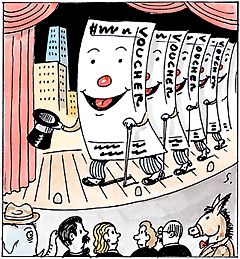
Both the House and Senate passed a bill that included an amendment - added just hours earlier at about midnight, with no public notice or debate - to broaden Ohio's school voucher program. Though the number of vouchers available would stay at 14,000, the number of public schools whose students could use vouchers to attend private schools grew to about 240 from 99.

Here's the kick: The change punishes schools that have finally escaped the worst academic classifications.

Currently, students can use vouchers if their school has been in academic watch or academic emergency for three consecutive years. If Gov. Bob Taft signs the bill passed Tuesday, students can go a private school - taking thousands of education dollars with them - if their school has been in academic watch or academic emergency for two of the past three years.

Timken High School is a perfect example, as Sen. Kirk Schuring of Jackson Township noted. Timken was in academic emergency in the 2003-04 school year and moved up to academic watch the next year and to continuous improvement last year. Where is Timken's reward for improving test scores and graduation rates? Don't waste your time looking. . . .


NCLB a Fraud, Says Superintendent

From the Rochester Democrat & Chronicle (ht to Monty Neill):

(December 21, 2006) — The No Child Left Behind law is a fraud. That may be strong language from a school superintendent, but the law is a definite political, social, and economic con.

First, the law's basic premise — that public schools are performing poorly and need to be improved, or else something really bad is going to happen to America — is political nonsense. Right-wing zealots have used the phrase "failing public schools" so often that some think it's a fact, when it isn't.

American public education is the backbone of our democracy. It's the great equalizer. Gerald Bracey, an independent, highly regarded education researcher, notes in an article for the Stanford University Alumni Association that since the end of World War II, the proportion of high school graduates among those 25 or older has grown from 34 percent to 74 percent, and the percentage of college graduates has increased from 6 percent to 19 percent.

Bracey points out that according to a 2006 report published by a Columbia University research center, public schools outperform private schools when controlling for poverty. And, a 2004 U.S. Department of Education report found that despite all the rhetoric about charter schools, they're "less likely to meet state performance standards than traditional public schools."

No Child Left Behind is deceptive in social and economic ways as well. The law helps hide two of America's dirty little secrets:

  • The first is the incredible amount of poverty in America. Thomas Smeeding, professor of economics and public policy at Syracuse University's Maxwell School of Citizenship and Public Affairs, has found that among the world's nine richest industrialized nations, America has the second highest poverty rate in general, and the highest rate of poverty among children. And, as we know, America's poverty is concentrated in rural and urban areas.
  • Probably the most troublesome and scheming aspect of NCLB is, as Bracey states, that it depends on punishment for schools that don't meet its standards. And its standards are rigged to make good schools look bad. NCLB arbitrarily requires that all schools show "adequate yearly progress" by subgroups, 37 or so of which are based on race/ethnicity, special education, gender, etc. If a school misses the target in just one of these subgroups, it could be deemed "failing," possibly triggering sanctions.

    In districts with high poverty rates, the everyday social and economic needs of students are more about survival than passing a test.

    So it's America's dirty little secrets, not public schools, that are failing.

    Actually, we've been down this road before. In 1983, when the report A Nation at Risk was published, public schools were blamed for every social, economic and military ill that faced our nation. Thirty years later, America is the world's only leading military power and our economy is second to none. That report was a fraud then, as No Child Left Behind is a fraud now.

    The No Child Left Behind law doesn't need to be reformed. It needs to be abolished.

    Maffucci is superintendent, East Rochester School District.

  • If you agree Dr. Maffucci, go to Educator Roundtable, sign the petition, make a statement, and find out what else you can do the end the madness.

    No Accountability Required for Brennan's Charter Chain-gangs

    Late Tuesday night, under cover of darkness and deception and with no public debate, school privatizers within the Ohio Legislature slipped a voucher extension rider into a bill intended to address background checks for prospective teachers. Also included was a big Xmas present for corporate socialist, David Brennan, whose drill-and-kill work camps for poor children now gets a free pass on performance requirements that every other publicly-funded school in Ohio must meet, charter or otherwise. Apparently, Brennan now owns the Ohio Legislature to go along his other purchase, the Ohio Supreme Court. Nice shopping, Dave! From the Akron Beacon Journal:

    . . . The bill exempts dropout recovery charter schools -- such as the Life Skills centers run by Akron businessman David Brennan -- from the closure sanction.

    Ohio Rep. Tom Raga, R-Mason, the bill's sponsor, said these schools were not included because ``their mission is different'' from that of other charter schools. He noted that Brennan's White Hat Management operates nondropout recovery charter schools that would still be subject to the closure penalty.

    ``That's an acknowledgement to their mission and is not targeted to any one operator,'' Raga said.

    Others call the exclusion unfair, arguing that all of the state's charter schools should be held to the same standards.

    ``This is another example of them setting up a completely separate system for David Brennan's schools and everyone else's schools,'' said Lisa Zellner, a spokeswoman for the Ohio Federation of Teachers, a critic of charter schools.

    Zellner was also critical of the voucher expansion, saying it was done ``at the last minute, in the dead of night, with no public discussion.''

    She said the voucher program has so far garnered little interest from eligible students.

    ``Why are they broadening it now?'' she asked. ``The market has shown no interest.'' . . .

    So while poor public schools are being turned into White Hat charters if they don't make the impossible AYP targets, the charters are given a free ride because "their mission is different"?

    Wednesday, December 20, 2006

    A Constructivist KIPP Teacher?

    Jay Mathews is a shameless and unceasing promoter of KIPP, the modern-day solution to what liberals referred to early in the previous century as the "Negro problem." The KIPP classroom sweatshops are viewed by Mathews and his circle as the best way to solve the ills of urban and rural poverty by changing the minds of children, rather than changing the conditions of poverty.

    With concern growing among humanitarians about the growing acceptance of eugenicidal KIPP model, Mathews has obviously been on the prowl for some evidence that KIPP schools are something other than than the "work hard, be nice" re-education camps that they are. Well, he found something, something very interesting, in fact--a KIPP teacher who uses accepted suburban methods based on thinking, rather than the anti-thought that characterizes the direct instruction abuse that is heaped on poor children (Mathews refers to such poor-child curricula as "no frills approach that often works well with students whose parents did not go to college").

    And guess what--her kids are showing much greater gains as measured by test scores.

    In D.C. KIPP has been using the Saxon math series, a no-frills approach that often works well with students whose parents never went to college. Suben said she did not have anything against Saxon. She still has copies of Saxon books and a rival program, Everyday Math, in her classroom. But she thought all the textbooks she had seen had flaws.

    "I've found that most traditional textbooks oversimplify and isolate concepts, and yet, are still too difficult for non-readers to use. They don't generally push students to think, but offer repetitive, and boring, practice," she said. She started writing each lesson nightly. This was a remarkable feat of youthful energy when you consider that KIPP teachers work 10 hours a day, and Suben was putting in another three hours each night at home composing the next day's lesson on her Dell laptop.

    Suben said: "My primary goal as a teacher is to help my students understand the reasoning behind math rules and procedures. I have several core beliefs about this: (1) Understanding is constructed by the learner, not passively received from the teacher. (2) Understanding is built by making connections between as many strands of knowledge as possible. (3) Understanding is galvanized through communication. (4) Understanding is only valuable when you reflect on it and question it."

    The core of her method is the workbook she produced last year on the fly. It "lets students build their own notes and create their own examples. It is incredibly active learning," she said. They were encouraged to write down the meaning of important terms and strategies they used that worked with certain kinds of problems.

    "I certainly refer to traditional textbooks for ideas and guidance as I write," Suben said. "My sequence and pace are set by a long-term plan that I have designed to catch the students up on second-, third- and fourth-grade material as well as introduce every single D.C. public schools fifth-grade standard by testing time. I model my word problems after the eighth-grade text that I used in Louisiana because those problems require the level of understanding that I am looking for. I focus on non-traditional problems so that students are forced to think."
    . . . .

    But there is no question of the importance of what Suben is doing, and what is happening in other schools, like KIPP, where teachers are convinced their disadvantaged students can learn a great deal if given the time and encouragement to do so.

    Suben's efforts to encourage students to think about, discuss and write down their best strategies gave them confidence. They knew when they got the right answer, it was because of their intellectual ability, not because they memorized something.

    Suben said when her class corrects homework, she hears little whispers of "YES!" from kids who got a hard one right and feel like giving themselves a quiet cheer.

    "Basically, there's ownership," Suben said. "That's the key. It's not that my lessons are so dramatically better than anyone else's lessons. It's just that we, the students and I, own our lessons."

    Kozol once expressed his skepticism about the voucher advocates' support of school choice for poor parents by saying that the moment that voucher advocates are willing to give every poor child a voucher to go to Exeter, or a school of its quality, that is the moment, he said, that he would become a Republican. I have a similar skepticism about Mathews' good-news news: the moment that KIPP offers the same content, instruction, and assessments to its chain-gang charter kids that kids get regularly at Dalton or the best publics of Westchester County, that is the day I will become a KIPPster.

    NCLB and IRAQ

    I have argued for some time that NCLB is the domestic equivalent of our Decider's FUBAR war on Iraq, from the lies to get us to get us there, to the lies to keep us there, to the tons of cash being shoveled out of the federal treasury into the pockets of corporate crooks and cronies, all while the troops on the front lines have to buy their own body armor and teaching supplies. And the end game? $$$, of course: a fifty year supply of oil and a never-ending stream of corporate welfare checks for Macschools to manufacture a reliable inventory of soldier-worker widgets whose knowledge of their Republic's past is as blank as their hopes for the future of it.

    David Berliner says it much nicer in this piece that is circulating among Web discussion groups:
    Berliner, D. C. (2006). No Child Left Behind: It cannot work, it does not work, and it causes harm along the way. (Unpublished manuscript.)

    Although bi-partisan support was obtained for both the Iraq war and the No Child Left Behind (NCLB) act, the current administration handling both the act of war and the act to improve education showed a serious lack of understanding of the problems that needed to be solved. For example, in Iraq, there was no understanding of how we would be greeted by the Iraqi people, with ignorant and arrogant officials of the present administration saying that we would be greeted by well-wishers throwing flowers at our troops. And in the passage of NCLB there was no mention of childhood poverty, and the development of racially isolated schools throughout the US, despite the clear understanding that the schools that need the most improvement are those that serve the poorest most racially isolated children in the country. Before committing to a war or a reform in education it would be nice to believe that our government understood what the problems in each domain really are.
    Other similarities are obvious, since both the act of war and the NCLB relied upon sources of information whose credibility is dubious. The forged documents from Niger, Ahmed Chalbi, and Dick Cheney have their equivalents in Rod Paige, Phyllis Schaffly, Bill Bennett, the Manhattan Institute, Ed Trust, and the Heritage Foundation.
    Similarly, some deliberate lies and distortions have been promoted about both the war and our schools. I note that Secretaries Donald Rumsfeld and Colin Powell lied about the war to the public, while Secretary Rod Paige and his deputies lied about the state of the schools, teacher preparation, and the effectiveness of programs designed to help our schools.
    Pursuing the similarities reveals also that vast sums of money are being made from our war, and from our educational system, by corporations with close ties to the administration. Halliburton and Kellog, Brown and Root in the war, McGraw-Hill in education.
    Also, our soldiers, like our teachers, are not equipped for the fight they have been asked to engage in. Our soldiers had neither body armor nor armor for the undersides of vehicles, and many of the teachers of the poorest children in America have no certification, teach out of field, or are inexperienced.
    Also, in its presentations to the public about the war and about our schools, the press has been manipulated and undermined. For example we now know that Judith Miller of the New York Times wrote what the administration told her about the war, while Armstrong Williams sold stories in praise of NCLB for cash from the department of education.
    Furthermore, cronyism has shown up in appointing leaders to run the War and the NCLB Act. Rod Paige, his deputy, and Reid Lyon were cronies from Houston, Texas, who ran what is arguably the most corrupt school system in the history of America. Our new Secretary, Margaret Spellings, has been Bush’s political advisor, and a lobbyist, but neither an educator nor educational researcher.
    Another similarity is that for both the war in Iraq and for the NCLB act, a mission accomplished has been proclaimed, with progress, we are told, being made every day. But actually, in both cases, victory seems to have been announced a little too prematurely. In fact, there is no evidence that American involvement in Iraq or America’s use of high-stakes testing has accomplished their missions at all. On the contrary, there exists considerable evidence that we have screwed up Iraq and education for at least a generation.
    Perhaps the worst similarity of all is that despite overwhelming evidence of failure, the war act and the NCLB act continue to be defended, and our military and our schools are asked to meet impossible demands.
    See, too, Daniel Pryzbyla's dead-on commentary from 2004, Privatizing War in Iraq, NCLB fuels deception.

    Tuesday, December 19, 2006

    Money Laundering Charges Against All Children Matter

    The education privatizers will stop at nothing, including the law, to get at the half-trillion a year that Americans spend on education. How deep does the corruption go, and where will the money trail lead? From the Journal Times:
    By Associated Press

    MADISON - All Children Matter, a pro-school voucher group based in Michigan and operating in many states, laundered money and failed to register as required under Wisconsin state law, according to a new election complaint.

    The complaint filed Friday with the state Elections Board says an All Children Matter political action committee based in Virginia should have registered in Wisconsin before it donated $35,000 in October to its Wisconsin PAC.

    The complaint also alleges that a $90,000 donation made to the Virginia PAC from a group not registered with Wisconsin election officials - the Milwaukee-based Alliance for Choices in Education - violated a state law barring corporate contributions.

    The complaint argues the $90,000 wound its way back to Wisconsin through the $35,000 donation spent on ads criticizing three Democratic legislative candidates - John Lehman and Cory Mason of Racine and Pat Kreitlow of Chippewa Falls. All went on to win.

    "Such a scheme to launder campaign contributions frustrated the right of Wisconsin's voters and citizens to know who provided the $35,000," the complaint said.

    The complaint asks the Elections Board to require the Virginia PAC to comply with reporting and disclosure requirements under Wisconsin law, showing who made contributions, and return the $90,0000 to the Alliance for Choices in Education.

    Attorney Richard Saks of Milwaukee, who filed the complaint on behalf of two individuals, the Wisconsin Federation of Nurses and Health Care Professionals and the Milwaukee Teachers' Education Association, said ACE faces a penalty of up to three times its donation, or $270,000.

    State Elections Board spokesman Kyle Richmond said the complaint likely will be taken up at the board's Jan. 17 meeting.

    The new complaint is in addition to one the board took up at its November meeting related to All Children Matters' spending in the election.

    Elections Board Chairman John Savage said at that meeting that the board may pursue criminal charges for making a false filing against All Children Matter if there is evidence showing that someone other than the Wisconsin PAC paid for the ads in question.

    All Children Matter attorney Kevin St. John of Madison said he had not seen the latest complaint and had no immediate comment. George Mitchell, director of the Wisconsin arm of the group, referred all questions to All Children Matter executive director Greg Brock in Grand Rapids, Mich. He did not respond to telephone or e-mail messages seeking comment.

    The Wisconsin president of Alliance for Choices in Education, Susan Mitchell, did not immediately return a call seeking comment.

    All Children Matter was formed in 2003 by Michigan billionaire Dick DeVos to promote private school voucher programs that allow children to attend private schools at taxpayer expense. The group also supports tuition tax credits and charter schools.

    It has been active across the country in political races, including Wisconsin where it paid for a TV ad this fall attacking incumbent Democratic Gov. Jim Doyle.

    Just who funds the group, and its involvement in campaigns, has been an ongoing question in many of the states where it operates, including Texas and Florida.

    Connecting the Dots for the NEA

    While Marc Tucker and the Chris Whittle and the other corporate socialists stand by to watch NCLB assure the failure of America's public schools, thus assuring the irrelevance of teacher unions, the NEA has decided that it is good public relations to denounce the Educator Roundtable petition to dismantle NCLB. Go figure.

    Here is the response posted, not to the Suits, but to the rank and file who pay the salaries of the Suits. Posted at DailyKos:

    Here Horse Philosopher presents the Educator Roundtable's response the NEA's denunciation of our petition to end No Child Left Behind

    Dear Fellow Educators,

    On November 21, 2006 the Educator Roundtable launched an online petition drive to repeal the 2002 reauthorization of ESEA, the so called No Child Left Behind Act (NCLB). The response to the petition has been exceptional; in less than 30 days more than 20,000 signatures have been collected, all via the Internet without media support.

    Unfortunately, the national leadership of the NEA has come out against our efforts to repeal this disastrous legislation, legislation that diminishes the professionalism of teachers, cedes local control of classrooms to federal and corporate manipulation, and, most distressingly, subjects our children to an endless regimen of high-stakes tests that provide little, if any, benefit to their lives.

    Aside from being an ineffective way to educate children, the new educational culture of NCLB is patently destructive. Our children, in lieu of being prepared for contributive citizenship in our democracy, or even being prepared for the world of work, are being reduced to nothing more than passers of minimum competency tests. Your teaching is being judged only on whether you can bring your lowest performing students to meet the lowest of expectations on simplistic reading and mathematics tests, at the expense of all else -- including your best and brightest. For what purpose then does public schooling exist? Do we school to help all children develop into critical, reflective, engaged participants of their communities, or do we school to try to meet the expectations of ill-informed legislators and lobbyists who clearly have no interest in your children?

    Considering the dire consequences unfolding for public educators, students, their families, and the communities housing them, one would think that the NEA would be the foremost voice of opposition to NCLB. Instead of demanding that America's classrooms be free from corporate intrusion, the NEA's leadership offers a watered-down approach seeking only to mitigate a few of the law's more egregious effects.

    For the past four years the NEA leadership has failed to see the proverbial forest for the trees and, in so doing, has failed the very teachers it purports to represent. Now, when concerned educators and their supporters organize themselves to oppose reauthorization of the law, we are denied out of hand by the leaders of an organization that should be our greatest ally. Sadly, we have arrived at a time when the leadership that once protected our interests is willing to dismiss them in order to protect its own.

    In contrast to their policy, the members and supporters of the Educator Roundtable, now 20,000 strong, are acting in the original spirit of unionism, organizing many small voices into a meaningful wave of self-advocacy. The Educator Roundtable asks teachers and their supporters to speak openly about the impact of the No Child Left Behind Act. We encourage everyone with a stake in public education—and that is everyone— to engage in a vigorous, heartfelt debate about what we want for public education and what we want for our children and our future.

    In order to allow this broad debate to carry forward towards real education reform, we seek to end the current format of ESEA. We do not want to simply and stubbornly oppose the law without proposing "any positive changes or alternatives," as the NEA leadership accuses us, but we must establish an environment where open debate is possible—an environment free of NCLB—to move beyond the original ESEA to the betterment of our children rather than the destruction of public education. The key to this effort is, of course, openness, amongst ourselves, with the public, and with millions of disenfranchised educators both within and without the NEA.

    While it appears that openness is not the policy of the NEA leadership at present, we hold faith that the rank and file members of the NEA are able to think for themselves, and we encourage them to read our public statements and to sign our petition. It might comfort them to know that many union members are sitting at our roundtable; several have been paying dues since the late 1960s. We hope you recognize that when leaders make mistakes, their supporters must make tough decisions, holding leadership accountable for the paths they choose.

    It would be a different country if more Americans learned to do so.

    The NEA has chosen to initiate a national campaign to discredit our organization, urging their members not to sign the petition. We believe that teachers, union members or not, are tired of being told what to do, when to do it, and how it is best done. If you share our belief, we urge you to join us by signing the petition calling for and end to NCLB.

    The Educator Roundtable is an organization made up of teachers, parents, students, and educators with a shared vision for our public schools that preserves the ideals of vibrant and meaningful teaching and learning. We join the thousands of teachers who find it impossible to stay silent in the face of the destructive path of NCLB, and we will not be deterred by the leadership of an organization that ignores the voices of its own members. Please direct all inquiries to Dr. Philip Kovacs, Director of the Educator Roundtable, at www.educatorroundtable.org.

    The Incredible Lightness of the Washington Post

    Looking for the truth, the whole truth, or nothing of the truth? If the latter, have a look at this piece from the Post on the NSTA-Inconvenient Truth controversy. This could have been written for Anderson Cooper's 360--one of those she said, he said, and zero investigation by the reporter. In short, modern journalism the way we most often see it: cheap, very profitable, and entirely ineffective in informing the public.

    More Spring Planning

    Seems like others are finding hope in the air, too. Here is some of it from Scott Parker's piece in the Dallas Morning News:
    • Public schools will stop treating the beleaguered parents of special education kids like enemies and potential litigants. School administrators will put more effort into helping parents understand what the law requires schools to do for their children. Why? Because it's the right thing to do.

    • Thought leaders in public education will abandon the zany notion that all children must be prepared for college. They will refocus on how to provide solid vocational education programs for students who want to start careers after high school.

    • Every student will get a textbook as required by law. Secondary schools will stop withholding textbooks because they fear too many students will lose or damage them.

    • Lawmakers blinded by the computer hardware and software lobby will stop advocating the idea that laptops should replace textbooks.

    • Parents will stop jumping to the conclusion that the evil teacher is to blame when little Johnny gets a bad grade or gets disciplined. Instead, they start with the assumption that the teacher is right and go from there.

    • School board members will reject Texas Association of School Boards brainwashing. They will regularly bypass the superintendent to visit campuses and to speak with teachers and staff to find out what's really going on in schools.

    • School boards, the elected representatives of the people, will reject the TASB concept that they are on "a team" with the superintendent as "quarterback." Instead, they will act like bosses and treat the superintendent like a valued employee. The conceptual difference is small but important.

    • The school voucher movement will wither and die along with the Republican Party's ill-conceived drive to privatize management of "failing" public schools.

    • Courageous principals will fire lazy teachers who don't want to teach and who waste precious class time by (1) assigning students to read a chapter and answer the questions at the end of it (2) showing a film to the class while e-mailing friends and munching snack food.

    • Superintendents will support legislation that requires them to file annual financial disclosure statements with the Texas Ethics Commission.

    • School board members, superintendents and other administrators will stop taking free meals, free trips, gifts, consulting fees and other gratuities from companies that want to sell them products and services. Why? Because it looks bad.

    • Lawmakers will pass a law requiring high school students to take a course in media literacy to teach them how to analyze the unrelenting barrage of advertising aimed at young people.

    • More companies and private-sector volunteers will adopt public schools to make sure students get exposed to the thoughts and ideas of adults who aren't part of the public education bureaucracy.

    • More teachers will focus on the exhilarating challenges and rewards that first drew them into the classroom and stop obsessing about what they find maddening in their workplace.


    Monday, December 18, 2006

    Planning for Planting

    During these shortest of days, it is the time that some begin to think about new Springs, new beginnings, new opportunities once the insanity passes.

    I offer these mild bromides to all policy and curriculum writers, whether middle school or middle life ones:

    10 Sane Bromides With Implications for Educational Renewal
    • There should be no single path to learning or living. Diversity and adaptability in biological and social worlds are key to survival.
    • The strength of a democracy can be gauged by the levels of participation and the continuing sustenance by its constituents.
    • Economic success without personal happiness is misery; personal happiness without economic well-being is a myth.
    • Real freedom is composed of equal proportions of liberty and responsibility.
    • The greatest threat to freedom is a shortage of trust. As trust recedes, policing moves forward.
    • Civilization requires both conservation and growth. Too much of either is the source of all moral and intellectual ill health.
    • Leadership, in the classroom or the boardroom, requires equal proportions of support and challenge. Support without challenge breeds complacency and false competence. Challenge without support breeds intimidation and withdrawal.
    • The offering of opinion is an eliminative act and serves a purgative purpose. Understanding, on the other hand, is the metabolic act that sustains human organizations.
    • Ethical caring occurs at the intersection of cool reason and warm compassion.
    • Play that is neither therapeutic nor constructive is never fun.

    More Data, More Theft


    If there are any deep data mining enthusiasts left for the Business Roundtable, i. e., ED, call for more and bigger student information databases, have a look at this Times piece on the grand scale of data theft:
    . . . the incident involving the University of California, Los Angeles, announced last Tuesday, there was really no question about the motive and the quarry. A hacker, or hackers, had been entering the restricted database — which contained the names, addresses, Social Security numbers and other private information of current and former students and faculty —for over a year before the breach was discovered.

    A commenter at the Wired News blog, giving only the affirmative “yea” as a name, had this to say:

    “I was a U.C.L.A. student that got my info lifted. I think it’s horrible not only that these companies are so sloppy and careless about our data but that we have such a weak link in the chain of our security. Congress has let companies use SSN in ways they were never meant to be used and now we are paying the price for it. Add a debt-happy culture to the mix and you have a truly toxic brew of misery if someone gets a hold of your SSN.”

    As it turns out, educational institutions have a particularly acute problem when it comes to the nation’s leaky data issue.

    A study by the Public Policy Institute for AARP last July, using data compiled by the Identity Theft Resource Center, determined that of the 90 million records reportedly compromised in various breaches between Jan. 1, 2005, and May 26, 2006, 43 percent were at educational institutions.

    In fact, educational institutions were twice as likely to report suffering a breach as any other type of entity, with government, general businesses, financial service and healthcare companies pulling up behind.

    “College and university databases are the ideal target for cyber criminals and unscrupulous insiders,” said Ron Ben-Natan, the chief technology officer of Guardium, a database security and monitoring company based in Waltham, Mass. “They store large volumes of high-value data on students and parents, including financial aid, alumni and credit card records. . .


    11th Grade CP--Christian Proselytizing

    Apparently youth pastor, David Paszkiewicz, didn't waste any time when school began in September in getting to the heart his 11th grade American history curriculum: science bashing and religious conversion.

    KEARNY, N.J. — Before David Paszkiewicz got to teach his accelerated 11th-grade history class about the United States Constitution this fall, he was accused of violating it.

    Shortly after school began in September, the teacher told his sixth-period students at Kearny High School that evolution and the Big Bang were not scientific, that dinosaurs were aboard Noah’s ark, and that only Christians had a place in heaven, according to audio recordings made by a student whose family is now considering a lawsuit claiming Mr. Paszkiewicz broke the church-state boundary.

    “If you reject his gift of salvation, then you know where you belong,” Mr. Paszkiewicz was recorded saying of Jesus. “He did everything in his power to make sure that you could go to heaven, so much so that he took your sins on his own body, suffered your pains for you, and he’s saying, ‘Please, accept me, believe.’ If you reject that, you belong in hell.”

    The student, Matthew LaClair, said that he felt uncomfortable with Mr. Paszkiewicz’s statements in the first week, and taped eight classes starting Sept. 13 out of fear that officials would not believe the teacher had made the comments.

    Since Matthew’s complaint, administrators have said they have taken “corrective action” against Mr. Paszkiewicz, 38, who has taught in the district for 14 years and is also a youth pastor at Kearny Baptist Church. However, they declined to say what the action was, saying it was a personnel matter.

    “I think he’s an excellent teacher,” said the school principal, Al Somma. “As far as I know, there have never been any problems in the past.”

    Staci Snider, the president of the local teacher’s union, said Mr. Paszkiewicz (pronounced pass-KEV-ich) had been assigned a lawyer from the union, the New Jersey Education Association. Two calls to Mr. Paszkiewicz at school and one to his home were not returned.

    In this tale of the teacher who preached in class and the pupil he offended, students and the larger community have mostly lined up with Mr. Paszkiewicz, not with Matthew, who has received a death threat handled by the police, as well as critical comments from classmates.

    Greice Coelho, who took Mr. Paszkiewicz’s class and is a member of his youth group, said in a letter to The Observer, the local weekly newspaper, that Matthew was “ignoring the First Amendment to the United States Constitution, which gives every citizen the freedom of religion.” Some anonymous posters on the town’s electronic bulletin board, Kearnyontheweb.com, called for Matthew’s suspension.

    On the sidewalks outside the high school, which has 1,750 students, many agreed with 15-year-old Kyle Durkin, who said, “I’m on the teacher’s side all the way.”

    While science teachers, particularly in the Bible Belt, have been known to refuse to teach evolution, the controversy here, 10 miles west of Manhattan, hinges on assertions Mr. Paszkiewicz made in class, including how a specific Muslim girl would go to hell.

    “This is extremely rare for a teacher to get this blatantly evangelical,” said the Rev. Barry W. Lynn, executive director of Americans United for Separation of Church and State, a nonprofit educational association. “He’s really out there proselytizing, trying to convert students to his faith, and I think that that’s more than just saying I have some academic freedom right to talk about the Bible’s view of creation as well as evolution.”

    Even some legal organizations that often champion the expression of religious beliefs are hesitant to support Mr. Paszkiewicz. . . .

    What a teachable moment! Wonder how many schools will take advantage of it. Here's some text for discussion:

    NEA Code of Ethics:

    In fulfillment of the obligation to the student, the educator--

    1. Shall not unreasonably restrain the student from independent action in the pursuit of learning.
    2. Shall not unreasonably deny the student's access to varying points of view.
    3. Shall not deliberately suppress or distort subject matter relevant to the student's progress.
    4. Shall make reasonable effort to protect the student from conditions harmful to learning or to health and safety.
    5. Shall not intentionally expose the student to embarrassment or disparagement.
    6. Shall not on the basis of race, color, creed, sex, national origin, marital status, political or religious beliefs, family, social or cultural background, or sexual orientation, unfairly--

        a. Exclude any student from participation in any program

        b. Deny benefits to any student

        c. Grant any advantage to any student

    First Amendment to the U. S. Constitution:

    Congress shall make no law respecting an establishment of religion, or prohibiting the free exercise thereof; or abridging the freedom of speech, or of the press; or the right of the people peaceably to assemble, and to petition the Government for a redress of grievances.


    Sunday, December 17, 2006

    "Tough Choices" Gets Tougher Reviews

    From Jerry Bracey at Huffinton Post:
    There is a cottage industry in this country that generates reports devoted to keeping Americans anxious about the future and laying the responsibility for that future on the schools which are never working as they should be. The latest of these scare tactics, Tough Choices or Tough Times, might be the dumbest, least democratic, least reality-based of them all.

    The notion that America's schools determine the nation's future developed just after World War II. During the Cold War, "manpower" was the term of the day and CIA chief, Allen Dulles, was telling politicians that the Russians were generating twice as many engineers, scientists and mathematicians as we were (doubt that CIA intelligence was any better then). Where would we get our manpower? From the colleges, of course, but the colleges depended on the schools and the schools were seen as wanting.

    The Russians' launch of Sputnik in October, 1957, proved to the school critics that they had been right. Blaming the current schools for letting the Russians get into space first was silly since those working on rockets were well past their K-12 and university educations. Education historian Lawrence Cremin quipped that Sputnik only proved that the Nazi scientists the Russians had absconded with after World War II had gotten a little ahead of the Nazi scientists we had absconded with after World War II.

    The schools were hit from time to time in the 1960's and 1970's with other critical reports, but the next big bombshell blew up in 1983, A Nation At Risk. The commissioners who wrote this golden treasury of selected, spun and distorted statistics were, like many Americans at the time, convinced that other nations, especially Japan, were going to eat our economic lunch. They wrote, "if only to keep and improve on the slim advantage we still enjoy in world markets, we must dedicate ourselves to the reform of our educational system."

    This assertion reflected the commissioners' erroneous assumption that high test scores were causally linked to thriving economies. But Japan's bubble burst in 1990 and it is only now coming out of 15 years of recession and stagnation. Beginning in 1991, on the other hand, the U. S. enjoyed the longest sustained economic expansion in the nation's history. Japan's kids continued to ace tests, but that didn't goose the Japanese economy. Our kids continued to score in the middle of the pack, but the economy boomed and the World Economic Forum ranked us No. 1 in global competitiveness among over 100 nations (this year the U. S. fell to No. 6 largely because of the incompetence in the Bush administration, the incompetence and corruption in both the Bush administration and the private sector, and the insanity of an open-ended, coffer-draining commitment to war coupled with the simultaneous commitment to continue cutting taxes).

    American kids were average on the various international comparisons in 1996, 1997, 1998, 2001, 2003, and 2004 and the "Oh ain't it awful, we're doomed" refrain was reprised over and over. Now comes Tough Choices. If successful it would accomplish what some have been intending for decades: the private control of publicly funded education. School boards would not operate schools. Private firms would do that.

    The report throughout emphasizes the importance of creativity and imagination, but it calls for kids to be tracked into different institutions after 10th grade based on scores from tests that cannot measure creativity or imagination. This is the commission at its most naïve. About the exams it writes "No one would fail. If they did not succeed, they would just try again." Oh, sure. The nature of human nature is beyond these guys. Given the inequality of opportunity in schools and society generally, one can quickly see the Brave New World this would lead to (it would save a lot of money currently spent on coaches, band directors and uniforms, though).

    Perhaps the most inane proposal from the report is to let the states, not localities, fund the schools based on some kind of formula. Excuse me, but aren't these the same states that have been sued by districts, state after state, because of inadequate, unconstitutional funding formulas? Just who would have the power to install this new funding scheme is not clear.

    The report claims that the future "is a world in which a very high level of preparation in reading, writing, speaking, mathematics, science, literature, history and the arts will be an indispensable foundation for everything that comes after for most members of the workforce" (emphasis added). Huh? Who really wrote this thing? Ayn Rand's ghost? The nation currently has 9 cashiers, 6 waiters and 5+ janitors for every computer programmer and it has no shortage of programmers. I want some of the commissioners' mushrooms.

    IB's for the Do-Be's

    Resume building and corporation preparation for your child can never start too early. Now, parents, you can begin in the rig-rig-rigorous world of IB (International Baccalaureate) Primary Schools, where children learn the virtues of economic globalism at the same time they are molded "from preschool age on, into 'transdisciplinary' and bilingual scholars who can deliver a major academic project by fifth grade and then move into deeper studies in secondary schools and beyond. (IB middle schools also exist.)."

    Out are Cat-in-the-Hat and nursery rhymes. In are economics and nonfiction writing. By the time your child graduates from an IB high school and enters an IB, or Ivy, college, he will be entirely immune to the crushing economic oppression in that flatter and and flatter world that remains farther and farther below him.

    I think I'll remain a Don't Be. From WaPo:
    . . . . Critics wonder whether it's all a bit much for a student demographic that still receives scratch-and-sniff stickers on written work.

    "We initially hear from parents that they're a little worried about the amount of work," said Sandra Coyle, a regional marketing and communications manager for the IB organization. "But they do realize the way it expands their children's minds and teaches them how to learn and how it helps them to manage their schedules. We like to say that IB prepares kids for success in college but also for success in life."

    So far, Randolph Elementary and the private Washington International and Rock Creek International schools in the District are the only ones in the region with authorized IB primary programs. But efforts to join them are underway in several local school systems. Prince William County is training staff for an IB rollout in eight elementary schools. Plans are made for five such schools in the District and three in Anne Arundel County. And an IB elementary awaits authorization in Montgomery County.

    For some schools with a sizable number of students from low-income families, IB's cachet helps lure -- and retain -- children whose parents are better off. At Ellis Elementary School, one of the chosen few in Prince William to get the IB program, transfer requests are trickling in. "We've already fielded a few phone calls, and most of them were from higher socioeconomic areas," Principal Jewell Moore said. At her school, 40 percent of students are considered economically disadvantaged.

    IB elementary classes differ from the ordinary in several ways. Subjects as varied as economics and nonfiction writing can be taught in a single IB class. When students begin learning new material, they are asked to think of numerous questions that get posted on the chalkboard under a title such as "What we want to find out," giving classes an investigative feel.

    "In the past, when students asked questions, they just mimicked mine," said Randolph science teacher Judith Kendall. "With IB, they have to think about what they know and what they really don't know."

    Teachers at IB schools, who receive special training, say the elementary program will help ensure that students will be able to compete globally and learn from an early age about the importance of other cultures. They also say that the programs can help students pass standardized state exams, especially in the many elementary schools serving low-income areas that face the threat of sanctions under the No Child Left Behind law if test scores fall short. . .

    Saturday, December 16, 2006

    Education for Democracy

    Here is a clip from a piece at Common Dreams about a conference put together by Richard Dreyfuss's in hopes of promoting civics education curriculum. As Katrina vanden Heuvel points out, it is not every movie star who is willing to give up a career to write curriculum:

    Last summer, Dreyfuss and his longtime friend and Martha's Vineyard educator, Robert Tankard, spoke with the island's Superintendent, James Weiss, about teaching a new civics curriculum. They wanted parents, teachers, students, historians, and others to collaborate on it, use the Martha's Vineyard school system as a laboratory, and then offer it as a model for a national civics revival. Weiss said that if they could generate interest in the local community he would implement the classes.

    "I never heard such a great offer in my life," Dreyfuss says. "It's the difference between walking and talking." And that's how Citizen Dreyfuss found himself talking civics with the community last week.

    Dreyfuss spoke about the risk of doing nothing. Without doing the rigorous work, the training, and learning "the tools of democracy, we leave the running of our system to happenstance and luck. We can kiss it goodbye in the lives of my children and yours."

    Dreyfuss found a receptive crowd. On the importance of civility an elderly man said, "You were born with two eyes, two ears, one nose, and one mouth. Use them in those proportions." Others complained of people "making up facts in order to win arguments." Or "bashing others to score political points instead of working to solve problems." They felt that civics education needed to start younger so that by the time people finished high school they were practicing citizenship rather than learning it. Historian Gordon Wood told the group, "We are a nation of immigrants.... What holds us together? It can't be Starbucks and McDonald's. That's why we go back to the Founders--equality, liberty, self-government.... If younger people don't know [this foundation], they will lose any sense of collectivity, identity as Americans." Sociologist James Loewen, author of Lies My Teacher Told Me, also participated in the meeting and called the teaching of civics "one leg of many in our culture to revive and renew us." A retired principal spoke of the obstacles created by No Child Left Behind--the forced focus on reading and math, and the consequent cuts to music, arts and other programs. "To be successful, we need to think of the whole child again," he said.

    There was another target on the mind of Dreyfuss and many of the citizens at the meeting: the media, and especially television. (Dreyfuss calls television "possibly the worst thing that ever happened to us. I think it shortened our brains. I think it created road rage. I think it killed rumination. I think it allows us to think that we are discussing serious public issues when we're not. I think that it has become the place of serious public discussion of issues but it isn't. And it just passes for that.") He said that television is where we go for news information. It delivers information through image (rather than text) instantaneously, leaving no time for rumination. He cited 9/11 coverage as an example--the instantaneous images of the Twin Towers replayed over and over again--leaving room for nothing other than feelings of "grief and revenge." Dreyfuss believes television has caused us to reinterpret what makes a good politician (the image being more important than the text). He called people in the industry "like addicts--denying that a problem exists." Meanwhile, he says, we accept the medium as offering the same level of reflection and insight as reading and rumination. There was general agreement that we have lost our way in teaching young people to be critical thinkers and sort through the information industry.

    As the meeting ended, Dreyfuss asked: "Are you in favor of teaching civics in American public schools?" He called for the nays and there was silence. Dreyfuss allowed it to linger. Finally, he asked for the yeas, and hundreds of people responded with enthusiasm. The contrast was striking, and Dreyfuss had clearly drawn on his skillful sense of timing to orchestrate the moment. Dreyfuss and Tankard had achieved their objective of demonstrating strong public support. Participants were invited to attend a follow-up session at a local high school the next day where the focus would shift to developing a pilot program.

    After the meeting Superintendent Weiss said that there is an eighteen-month window of opportunity to revamp civics education on the island. The standardized testing in social studies for the state will be decided during that time period and curricula will be revised. He said that eighteen months was "just enough time" to succeed.

    The Gathering Storm Against NCLB

    From the Florida Times-Union--ht to Susan O:
    Let's drop No Child Left Behind

    The television news recently captured my attention with iconoclastic filmmaker Michael Moore blasting the Democrats. Yes, the Democrats.

    He was demanding those now in control of the government's budget immediately order a withdrawal of troops from Iraq.

    While no fan of Moore, it is tantalizing to think of a similar tirade he might direct toward federal interference in control of education through the No Child Left Behind Act.

    Now that the election has been decided, politicians are talking of bipartisanship. What we really need is nonpartisanship, not bipartisanship.

    We need to find out whether the majority of Democrats really care about the issues facing schools.

    Politically informed citizens of either party are displeased with No Child. Conservatives have expressed their displeasure with No Child's federal control. Liberals criticize the law that places accountability measures on teachers whose unions are among their largest benefactors.

    It is important to recognize the contradiction inherent in supporting local control through charter schools and vouchers while unloading federal education mandates on the nation's public schools, many of them unfunded. It has been well documented that No Child is not improving education quality. The current administration is using misleading statistics to support No Child.

    Also, corruption issues are emerging:

    First, seeking to build support for its education reform law, the Bush administration inappropriately paid commentator Armstrong Williams $240,000 with federal tax dollars to promote No Child on his nationally syndicated television show.

    Then according to the U.S. Department of Education's own inspector general, the $5 billion "Reading First" program showed preference in funding curricula developed by publisher McGraw-Hill. As reported in a previous column, the Bush and McGraw families have been personal friends since the 1930s and the McGraws have been generous donors to the Bush presidential campaigns. Under No Child, the administration populated the committees charged with approving states' curriculums with individuals having "significant professional connections" to another profitable McGraw program, "Direct Instruction."

    In October, the Los Angeles Times documented that "Ignite Learning," a company owned by President Bush's brother and his parents, is benefiting from federal dollars targeted for economically disadvantaged students. Many U.S. school districts were convinced to use federal funds to purchase products from Neil Bush's company, such as Ignite's "portable learning centers" that cost $3,800 each. Ignite does not offer reading instruction, and the Ignite math program is not scheduled to be available until next year.

    Department of Education officials appointed by a president elected as a "compassionate conservative" are now hinting at a new Washington, D.C., controlled "national standardized test." This, in turn, will require billions of dollars in development and implementation costs.

    Before such a test could be developed, additional contracts would be let and national content standards would have to be developed. Efforts would likely rely on firms like McGraw-Hill that are currently reaping the benefits of the flawed No Child legislation.

    Public schools were created to provide every child an opportunity to succeed. It is high time federal interference in our schools be "Left Behind." Democrats have the power of the purse strings needed to step up and abolish No Child.

    While it is rare for Democrats to reduce federal involvement, the new congressional leadership needs to empower local governments to:

    1. Better address problems of children who are homeless, live in poverty and lack health care, by reducing federal taxes in lieu of state initiatives in this area.

    2. Realize that testing alone does not increase performance.

    3. Eliminate No Child's culture of simplistic criterion referenced tests by simply abolishing them. Before No Child, the country had excellent nationally normed tests in use in all states.

    4. Reclaim governance of public education, a function documented in state constitutions, but
    not anywhere in our national constitution.

    5. Receive federal dollars spent on education without restrictions from Washington, D.C.

    Simply put, No Child can never reach its stated goal for every child to be proficient in reading and math by 2014.

    Instead of helping to tinker with No Child, as is being discussed, Democrats now need to lead the effort to abolish the law they have continually criticized.

    William Bainbridge of St. Augustine is CEO of SchoolMatch, a national educational auditing, research and data organization.

    Friday, December 15, 2006

    A 401K Under Every Teacher's Tree

    One of the few advantages of the noblest, yet most disrespected and under-funded, profession in America is the public pension benefits that have assured a modicum of security for retired teachers over the years. Now the America' Choice privatizers that make up The Commission on the Skills of the American Workforce have joined the larger privazation effort to try scare up support nationwide for ending defined benefit pension plans by states. There is this today at Huffington Post by Gerald McEntee. A clip:

    Despite this year's victories at the ballot box and against Social Security privatization, a recent article in The New York Times made clear that right wing attacks on Americans' retirement security continues.

    The story itself was overly alarmist. It omitted key facts about a San Diego public pension case and failed to mention that, by and large, public pensions are well funded and backed by law.

    The truth is, public employee pensions overall are fiscally sound and subject to strict oversight.

    But these inconvenient facts mean nothing to right wing ideologues who want to gut Americans' retirement security. And they think the public will go along if they gin up a false crisis about the state of public pensions today.

    Sound familiar? It should. That's exactly the strategy that Social Security privateers pursued last year. They failed miserably. But now they're back with a new plan to gut retirement security: pick off public employee pensions, then raid pensions in the private sector.

    Their ultimate goal, of course, is to make pensions altogether a thing of the past; to promote a society in which the wealthiest continue to horde huge resources while the American Dream is dismantled for everyone else. To real people, that means risking financial turmoil just by getting sick or growing old. . .

    Then there is this news today from Morgan Stanley on an all-time, anywhere, record-setting $40,000,000 holiday bonus for CEO, John Mack. How long do you think Americans will put up with this madness? What will be the tipping point to send an enraged public into the streets?

    America's Choice Redux

    Want to guess the origin of this document?:
    The task force, composed of 34 individuals from all sectors of business and education and co- chaired by two former secretaries of the U. S. Department of Labor, argues that improving productivity is the only chance the country has to raise, or even maintain, its current standard of living. However, in the past two decades, real productivity growth has slowed to a crawl, relying almost entirely on women entering the workforce and creating two- wage- earner families in order to maintain current standards of living. The commission concludes that if productivity continues to falter that the country can expect only one of two futures: either the top 30 percent of the population will grow wealthier while the bottom 70 percent becomes progressively poorer, or all will slide into relative poverty together.
    This is from the first circulation of Master Tucker's reform agenda 16 years ago in 1990. It would appear that the the major change from then and now is that an exclamation point has been added to the end of the title,
    AMERICA'S CHOICE: HIGH SKILLS OR LOW WAGES. It is interesting to note that the 1990 dire warnings about falling productivity were followed by the most sustained decade of economic growth in the history of the world. Wonder if we can expect a similar boom following this year's do-it-or-we're-cooked rhetoric.

    Next post: Is Marc Tucker America's Choice?

    Thursday, December 14, 2006

    America's Choice: Schools of Educational Reform or Educational Reform Schools

    First came A Nation at Risk to scare the be-jesus out of us about the schools. Then a generation later came Rising Above the Gathering Corruption, er, Storm, an apocalytic tale of educational doom that called for an oversupply of scientists and engineers and, more importantly, for public universities to take over the costs and responsibilities of R&D for corporations. Now comes, alas, a new blue-ribbon panel report, America’s Choice: High Skills or Low Wages!, this time calling explicitly for the destruction of public schools as we know them. If you thought that A Nation at Risk was based on some scary lies, try this one from Panel Seer, Marc Tucker:
    “This report basically says, if we don’t find a whole new formula, what we can confidently look forward to is a declining standard of living, probably not for everybody, but for most people. And that could create a kind of social instability that could be the undoing of the United States.
    Is this from the Pat Buchanan school of educational reform?? Or is that educational reform schools.

    Here are some of the highlights of the new report recommendations, none of which is based on any research findings, or even crude experimentation. This over-reaching piece of undocumented dreck is destined to be the deadest on arrival of any blue-ribbon report in the history of American education. And if this is not the last and final encore of Privatizers Gone Wild Club, I cannot imagine what they might have in store that could hope to top this exhibition of full-frontal, embarrassing stupidity:
    • Out are elected school boards and local public control. In are state-paid private contractors like Edison and White Hat. In short, the charter model on a national scale: "Schools would have complete control over staff hiring, school organization and management, their program, and how their funds were spent, as long as they provided the curriculum and met state testing and accountability requirements."
    • Out are university teacher education programs that Reid Lyon has so long wanted to "blow up." In are "Teacher Development Agencies, established by the states, [to] write performance contracts with a range of providers interested in preparing teachers . . . . providers that met the state’s performance requirements would get a larger number of slots than providers whose graduates performed less well." Test scores by each teacher candidates' future students will then determine which teacher prep programs get funded.
    • Out are low salaries and local salary schedules for beginning teachers. In are 401Ks to replace state guaranteed benefit retirement plans. In, too, are cuts to retired teacher health plans and retirement funds. Hey, someone has to pay for those high starting salaries and those other high salaries that are earned by producing good test takers.
    • Biggest money-saver idea: let 10th graders take a state exit exam and go on to community college or tech school, thus saving all that cash spent on lower-performing students in their junior and senior years. Those who stick around would have to qualify of AP or IB courses that are intended for the less economically-deprived high flyers. Savings: $67 billion a year nationwide.
    • Out is the traditional husk of Head Start. In mandatory schooling for all 3-year old low-income children (the psychological programming cannot start early enough).
    • Finally, there are to be accounts established at birth for future job training: "Through Personal Competitiveness Accounts, created for each child at birth by the federal government, and supplemented with $100 each year up to age 16, people would accumulate money for continued education and training."
    Wonder if that money could be used when a child grows up to buy a boat ticket to India or China, where working and living conditions are likely be better.

    Ed Week closes its summary piece with this final quote from the sage, Marc Tucker:
    If something like this doesn’t happen, we’re cooked.
    I would suggest that if something like this does happen, we may avoid the cooking and simply be eaten raw.

    NCLB and Staying the Course

    Spellings and the testocratic press are going right along pretending that everything is on track for reauthorization next year of the NCLB political fraud--despite a storm that is building that could rival the one that is now swaying our foreign policy equivalent of NCLB in Iraq.

    Spellings declares 99. 44% purity for this policy train wreck, despite overwhelming disapproval among parents and teachers who know anything more about NCLB than they are offered by the cheerleading, the omissions, and the half-truths pumped out by a complicit media.

    Here are a few reminders from the Gallup/PDK poll earlier this year of how the public feels about NCLB, even before the unearthed corruption and law-breaking within the Education Department's Reading First program.
    • Two out of three respondents (69%) this year and a similar proportion in 2005 say that the use of a single state test as NCLB requires cannot provide a fair picture of whether or not a school needs improvement.
    • NCLB bases performance on testing in English/language arts and math only. Four out of five respondents (81%) say that this will not give a fair picture of a school and that other subjects should be included.
    • Nearly four out of five respondents (78%) say they are concerned that the focus on English/language arts and math will mean less emphasis on art, music, history, and other subjects. This is down 4% since 2005.
    • Four out of five respondents (80%) prefer offering help to students in schools in need of improvement. Only 17% prefer transferring those students to a different school.
    • NCLB requires that test scores be broken out by race and ethnicity, English-speaking ability, and poverty level. A majority of respondents (54%) oppose this strategy, up 6% from 2005.
    • The test scores of special education students are included in determining whether a school is in need of improvement. Nearly two-thirds of respondents (62%) say the scores of special education students should not be included. This percentage is unchanged since 2005.
    • NCLB requires that nearly all special education students be tested against grade-level standards. Three-fourths of respondents (75%) believe these students should not be tested against the same standards as other students. This figure is up 7% since 2005.
    • Four-fifths of respondents (81%) say the proper measure of performance is the improvement made by students during the school year. This figure is down 4% from last year.
    • The half of the respondents who claim to know a great deal or fair amount about NCLB disagree with the strategies of the law with percentages slightly higher than those of the total group. . . . The responses of those who claim knowledge of the law bear out this poll’s 2003 conclusion that greater familiarity with NCLB was unlikely to increase public support.
    Four out of five Americans believe that it makes more sense to measure academic growth than an arbitrary benchmark that all schools must meet, despite huge disparities in teacher quality, funding, family income, etc. Some, in fact, hold out hope that Spellings' purity remarks conceal a fall-back position that she plans to move to when push comes to shove, a position that includes growth models.

    The kinds of growth models that the ed privatizers are interested in, however, do not waver from the impossible and failure-assuring 100% proficiency target that all schools are asked to achieve by 2014. To do otherwise would undercut ideological purpose of NCLB to begin with--the demonstrated manufactured failure of public education and the dismantling of public schools for preferred market models.

    So growth model advocates, keep this under your pillow as you dream about a more flexible and compromising ED who is willing to entertain an alternative to "staying the course":

    This summer [2005] my department convened a working group to explore how states could use growth models for state accountability plans under No Child Left Behind.

    We met with experts, researchers and policymakers, including many of you who have used growth models as part of your state accountability systems for years. We discussed what's required to implement a growth model and how they can show how schools and students are improving from year to year.

    At the same time, we're not just looking for any level of improvement. We're working to meet specific goals within the next decade, as laid out in the law. A successful growth model under No Child Left Behind must put all students on track to be on grade level by 2014. That means when a student is behind, one year of progress for every year of instruction is not enough to close the gap. We will expect more. We must not—and I will not—back away from this important goal.

    NSTA and the Educational-Industrial Complex

    A clip from Laurie David's post at Huffington, a follow-up to her outing of NSTA's cozy relationship with Big Oil and its snubbing of An Inconvenient Truth:

    The scandal at the National Science Teachers Association (NSTA) just keeps getting worse.

    Since the Washington Post published an op-ed I wrote asking if NSTA's puzzling decision to reject 50,000 free DVDs of Al Gore's global warming documentary An Inconvenient Truth might - just might - have had anything to do with more than six million dollars the organization has accepted from ExxonMobil, Shell Oil, ConocoPhillips and the American Petroleum Institute, the muck keeps piling up.

    ExxonMobil, of course, remains the standout among a large group of fossil fuel companies that have done everything in their considerable power to delay, deflect, and derail any serious effort to cut global warming emissions. Funding scientific disinformation has long been one of their favorite tactics.

    New evidence flatly contradicts statements NSTA has made in defense of its suspect partnerships, and efforts appear to be underway to wipe out online evidence showing that what the oil industry got in exchange was the group's imprimatur on classroom videos, teaching guides, and other "educational" materials that play down threats like global warming and play up the glories of continued oil dependence.

    We also learned that NSTA is willing to sell direct access to America's schoolteachers to any Tom, Dick or Exxon that shows up with a checkbook.

    And here's the icing on the cake: NSTA Executive Director Dr. Gerry Wheeler - a top figure in the world of science education, remember - confessed to at least one reporter this week that he hadn't actually bothered to see the acclaimed film before he turned it down.

    Cuddling Up to Conoco

    NSTA's initial rejection e-mail included comments from a staffer worried that accepting the offer would "place unnecessary risk upon the capital campaign, especially certain targeted supporters."

    Now NSTA is arguing that distributing An Inconvenient Truth to teachers would violate their 2001 policy against endorsements. But that policy didn't stop them from shipping out 20,000 copies of a whopping 10-part video funded by ConocoPhillips in 2003.

    In fact, Gerry Wheeler himself is listed as executive producer of the film series, alongside a ConocoPhillips corporate PR man named Ron Stanley. His interest in cinema apparently didn't extend to An Inconvenient Truth, however. At least not until it landed him in the paper.

    Wheeler says this is OK because NSTA had editorial control of the project. If that's true, then maybe he can explain why the only scientist cited in the largely dismissive global warming section appearing in chapters six, nine and ten of the teaching guides is Dr. Robert Balling - a well known global warming skeptic who has acknowledged taking more than $400,000 from the fossil fuel industry (others say the figure is higher).

    Shredding the Evidence

    We also discovered that somebody somewhere is meticulously shredding the online evidence of NSTA's cozy corporate partnerships.

    NSTA now says it is no longer partners with the American Petroleum Institute, asserting that the project ended five years ago. Yet it looks as if the curriculum was alive and well until reporters started asking about it these past few weeks.

    As of November 26 - the day the Post article appeared - both NSTA and API were promoting the course materials they produced together on their web sites. Immediately after the article appeared, however, we noticed that references to the joint "Science of Energy" program were quickly disappearing from the web.

    The 'Science of Energy' website itself is now gone altogether, and API has rewritten language touting their relationship with the science educators. But we captured some telling links before they started vanishing.

    To see the disappearing documents, go here.

    Democracy v. Religious Fundamentalism

    Daniel Dennett in WaPo:

    This week’s question could not be more important. Events around the world in recent years amply demonstrate that the religious freedom we enjoy in the United States is one of the essential building blocks of our democracy.

    What we tend to lose sight of, however, is the price we must pay for this religious freedom: we must commit ourselves to the First Amendment principle of separation of church and state even when the principle works against the interests of our particular religion.

    “If it ain’t broke, don’t fix it.” This wise maxim, applied to the First Amendment principle of the separation of church and state, has permitted the principle to drift into disrepair. People are encouraged to think that while there may be all sorts of borderline cases and vexing conundrums about just where to draw the line, examining them will only arouse anxiety and discord--so let’s just cover everything with a fine fog of pious, presumed consensus. We all honor the First Amendment and that’s that, and that’s fine. So it would be, if it weren’t for the steady pressure of those who would exploit our benign neglect, encroaching gradually on what makes the principle work–to the extent that it does.

    For instance, the Christian conservatives in the country who wish to declare that this is a Christian nation are becoming bolder and bolder in their willingness to impose their own viewpoint on those who disagree. Fortunately, there are the beginnings of an organized resistence to this takeover, such as the Interfaith Alliance, chaired by Walter Cronkite. I enthusiastically support this effort, even though I am myself an atheist. Atheism is one of the live rails of American politics-touch it and you're toast. Fair enough. Those are the current facts of life. Not so long ago, you couldn’t be elected if you were Catholic, or Jewish, or African-American. But shouldn't we install another live rail, on the opposite side of the religious spectrum? . . .

    The rest here.

    Wednesday, December 13, 2006

    Movement Against Charter Schools

    From the Times Union:
    ALBANY -- Officials from the City School District, its PTA and teachers union rallied at the state Capitol Tuesday to urge state lawmakers to set a moratorium on new charter schools in the district. . .
    Spellings and testocratic press are going right along pretending that everything is on track for reauthorization next year of the NCLB political fraud--despite a storm that is building that could rival the one against our foreign policy equivalent of NCLB in Iraq.

    Spellings declares 99. 44% purity for this policy train wreck, despite overwhelming disapproval among parents and teachers who know anything more about NCLB than they are offered by the cheerleading, the omissions, and the half-truths pumped out by a complicit media.

    Here are a few reminders from the Gallup/PDK pollearlier this year of how the public felt about NCLB, even before the unearthed corruption and law-breaking within the Education Department's Reading First program.
    • Two out of three respondents (69%) this year and a similar proportion in 2005 say that the use of a single state test as NCLB requires cannot provide a fair picture of whether or not a school needs improvement.
    • NCLB bases performance on testing in English/language arts and math only. Four out of five respondents (81%) say that this will not give a fair picture of a school and that other subjects should be included.
    • Nearly four out of five respondents (78%) say they are concerned that the focus on English/language arts and math will mean less emphasis on art, music, history, and other subjects. This is down 4% since 2005.
    • Four out of five respondents (80%) prefer offering help to students in schools in need of improvement. Only 17% prefer transferring those students to a different school.
    • NCLB requires that test scores be broken out by race and ethnicity, English-speaking ability, and poverty level. A majority of respondents (54%) oppose this strategy, up 6% from 2005.
    • The test scores of special education students are included in determining whether a school is in need of improvement. Nearly two-thirds of respondents (62%) say the scores of special education students should not be included. This percentage is unchanged since 2005.
    • NCLB requires that nearly all special education students be tested against grade-level standards. Three-fourths of respondents (75%) believe these students should not be tested against the same standards as other students. This figure is up 7% since 2005.
    • Four-fifths of respondents (81%) say the proper measure of performance is the improvement made by students during the school year. This figure is down 4% from last year.
    • The half of the respondents who claim to know a great deal or fair amount about NCLB disagree with the strategies of the law with percentages slightly higher than those of the total group. . . . The responses of those who claim knowledge of the law bear out this poll’s 2003 conclusion that greater familiarity with NCLB was unlikely to increase public support.
    Four out of five Americans believe that it makes more sense to measure academic growth than an arbitrary benchmark that all schools must meet, despite huge disparities in teacher quality, funding, family income, etc. Some, in fact, hold out hope that Spellings' purity remarks conceal a fall-back position that she plans to move to when push comes to shove, a position that includes growth models.

    The kinds of growth models that the ed privatizers are interested in, however, do not waver from the impossible and failure-assuring 100% proficiency target that all schools are asked to achieve by 2014. To do otherwise would undercut ideological purpose of NCLB to begin with--the demonstrated manufactured failure of public education and the dismantling of public schools for preferred market models.

    So growth model advocates, keep this under your pillow as you dream about a more flexible and compromising ED who is willing to entertain an alternative to "staying the course":

    This summer [2005] my department convened a working group to explore how states could use growth models for state accountability plans under No Child Left Behind.

    We met with experts, researchers and policymakers, including many of you who have used growth models as part of your state accountability systems for years. We discussed what's required to implement a growth model and how they can show how schools and students are improving from year to year.

    At the same time, we're not just looking for any level of improvement. We're working to meet specific goals within the next decade, as laid out in the law. A successful growth model under No Child Left Behind must put all students on track to be on grade level by 2014. That means when a student is behind, one year of progress for every year of instruction is not enough to close the gap. We will expect more. We must not—and I will not—back away from this important goal.

    Educator Roundtable Announces Petition

    The Educator Rountable issued a formal press release today announcing the petition calling for the repeal of No Child Left Behind. To date, the petition has nearly 20,000 signatures. If you have not yet signed it, please do so and pass it along to parents and teachers:
    PRESS RELEASE

    A Petition Calling For the Dismantling of the No Child Left Behind Act

    December 13, 2006

    Thousands of educators, parents, and concerned citizens are participating in a coordinated movement to end the No Child Left Behind Act (NCLB). Spearheading the effort is the Educator Roundtable, which has issued a petition calling on legislators to vote against reauthorizing the law. In its first week the petition received over 12,000 signatures. For the full text of the petition see http://www.educatorroundtable.org.

    Longtime educator Marion Brady—one of the petition’s authors—explains that opponents of the legislation are “fed up with the law's simplistic approach to education reform and how it wastes student potential, misallocates teaching resources, shrinks the curriculum, and threatens the future of our democratic republic by undermining public education.”

    News of the petition has spread with great enthusiasm among parents and teachers, who often leave poignant commentary along with their signatures. Writes one teacher, “I am retiring early. We feel we are fleeing a sinking ship, after giving our entire lives to our students and our profession. It is a sad way to end a career.” And a parent offers, “I feel like my little boy is being groomed for a life on an assembly line rather than being taught how to think and be creative.”

    “When Congress passes No Child Left Unfed, No Child Without Health Care and No Child Left Homeless,” notes Susan Ohanian, one of Roundtable’s founders, “then we can talk seriously about No Child Left Behind.”

    The Educator Roundtable petition cites several arguments against NCLB. Chief among them are:

    • NCLB misdiagnoses the causes of poor educational development, blaming teachers and students for problems over which they have no control.

    • NCLB uses pseudo-science to justify policies and programs that are damaging public
    education—including diverting taxes away from communities into corporate coffers.

    • NCLB rates and ranks public schools using procedures that will gradually label them all “failures” by creating unrealistic Adequate Yearly Progress goals, which set schools up to be “saved” by vouchers, charters, or privatization.

    Up for reauthorization next year, the legislation had bipartisan support when President Bush signed it into law in 2002. The Educator Roundtable seeks similar bipartisan support to end the increasingly controversial act. According to Dr. Philip Kovacs, a lead organizer of this national effort, “individuals from both political parties were sold a false bill of goods, and it will take individuals from both political parties to stop NCLB from doing any more harm.”

    In its place they call for formal state-level dialogues led by working educators, rather than by politicians, ideology-bound "think tanks," or business and industry activists who have little or no direct experience in the field of education.

    CONTACT: Dr. Philip Kovacs, Assistant Professor, Department of Education, University of Alabama in Huntsville, Huntsville AL 35899, 678-612-9242, philip.kovacs@uah.edu

    Tuesday, December 12, 2006

    KIPP and other "eloquent discourses full of deceit"

    In a reflection on reading from Freire's Pedagogy of the Oppressed (1972), a student has reminded me of this great quote that speaks volumes to Bill Gates and the other privileged boosters of KIPP who see this preppy reform school model as the solution to the poverty and racism that we choose to ignore:
    ". . . the dominant class insists, in eloquent discourses full of deceit, that what is important is not class, but the courage to work and be disciplined, and the desire to climb and grow. Therefore, those who triumph are those who work hard without complaining and are disciplined; that is, those who do not create problems for their masters."
    The KIPP motto: Work hard, be nice.

    Thanks, Corrie.

    Another Business Roundtable Commission--Snap!

    In a the best time-tested tradition of corporate media school-bashing stupidity, a breathless Time Magazine has issued the first press release disguised as a news story announciing, alas, a new report by the New Commission on the Skills of the American Workforce. This CEO-packed commission is out to change everything educational again. The Report, due out later this week, will, for instance, call for a shift in the social studies curriculums of high schools. Tired of the old "fixation" on the history of our democratic republic, "Mike Eskew, CEO of UPS, talks about needing workers who are "global trade literate." You know, the flat world, any-wage-is-okay-with-me curriculum.

    Time is not telling us too much before the suspense-filled release of the report, but they obviously could not help from gushing this:
    Can our public schools, originally designed to educate workers for agrarian life and industrial-age factories, make the necessary shifts? The skills commission will argue that it's possible only if we add new depth and rigor to our curriculum and standardized exams, redeploy the dollars we spend on education, reshape the teaching force and reorganize who runs the schools.
    Apparently the Business Roundtable is planning to go public with their school privatization agenda, rather than hiding behind a bunch of scab politicians to do their bidding, who, themselves, continue to hide behind the biggest of all educational lies, No Child Left Behind?

    Can you imagine a national strike by parents, teachers, and students to protest the attempted corporate takeover of our educational system? Can you imagine a million people in the streets of Washington demanding a return to educational sanity and to the core values of democratic living? Can you imagine an America ready to tell the international economic anarchists to go to Hell?

    Monday, December 11, 2006

    No Child Left on the Playground

    The phone is ringing off the hook at the American Association for the Child’s Right to Play (AACRP) from parents concerned about their children's physical health and social development as play time or recess becomes a thing of the past. This article in Saturday's New York Times about first graders in Highland Park New Jersey with little time on the playground during the school day shows yet another destructive consequence of this legislation.

    “There’s almost no recess and all the emphasis is on academics,” Ms. Buch said. “It’s nothing like it was in Denmark or in my own childhood. Children need free play.”

    She joins a growing legion of parents and educators who fear that recess is disappearing from the school schedule and needs to be rescued.

    “It’s been a hot topic at our Parent-Teacher Organization meetings,” said Ginny Deatz, a P.T.O. officer at Irving Primary School, which Ms. Buch’s son attends. “There are a lot of people who are passionate about this.”


    Why is this happening?

    A survey of 15,000 school districts conducted in 1999 by Dr. Clements’s association found that 40 percent were either eliminating recess or cutting back on it or considering one or the other, she said. The cutback on recess started in the late 1980s, she said. Before that, elementary school pupils often had a 10- to 20-minute recess in the morning, another after lunch and a third in the afternoon.

    But that was before a battery of national and state testing was initiated, educators say. “Now schools are so accountable to test scores,” Dr. Clements said.

    Irving Primary School has a 45-minute lunch period, and the time can be used for both eating and recess; when the weather is good, all students go outside. After that, recess is at the discretion of teachers.

    “With No Child Left Behind, there is so much more that we have to fit into the day,” said Nancy Romano, Irving’s principal. “The children do need to go outside and they do need to run around
    .”

    However, the end of recess isn't a concern in private schools that are not subjected to the draconian mandates of NCLB.

    Dr. Clements said that private schools tended to view recess, like art, music and drama, as an enhancement. She said that she had never heard a complaint from a private-school parent that recess had been cut. “In the private school sector, it’s valued,” she said.

    ------------------------------------------------------------------------------------

    It's valued in the public sector, too, Dr. Clements, but unfortunately it has become just another luxury many public schools can no longer afford. Unless, of course, politicians and business leaders can find a way to test, measure and collect data on it. Hmmm...standardized play -- another chance to create a new category of winners and losers. The possibilities are endless.

    On Teacher Education

    A reader responds to this earlier post on teacher preparation programs:
    At 12:25 PM, Anonymous said...

    I just traveled to Mississippi and met with a state director there who is heading the federally mandated flagship component of perfunctory NCLB which will remain nameless here. She touted the benefits of testing students in her state and were eager to report that in conjucntion with publically-funded state universities the state has mandated 15 hours of reading currculum for all teachers prior to becoming certified to teach elementary school in the state.

    It is frightening to think that despite your teaching intentions one is mandated to complete courses in literacy instruction that are not the best ways to teach. Not all children are going to learn to read by killing and drilling with phonics, and nor should they be condemned to failure if they don't know the differences between the long a and short a vowel sounds. This type of teacher education reform is wrong. It's misguided and destroys any creativity teachers are offerd in thier classroom.

    I was recently discussing with a friend, if our schools looked like schools in India and China (which is what neocons would love so we could churn out more math and science majors), we would lose our competitive edge in areas like innovation, creativity, and leaderhsip skills that this country's schools teachs better than any other nation in the world. Teachers that don't allow thier students to explore int he classroom and garner academic freedom upon thier students, then we are doomed to become a nation of compulsively obient machines.

    I think that there is something to Mr. Levine's report; however, it is not in preparing teachers for standards-based curriculum in schools. Standards for teacher education is not such a bad thing if it is done well and advocates the good things that all teachers should know. Teacher education should have a common approach and teachers should definitely learn how to design invigorating, motivating and challenging curriculum; learn how to assess students' learning FAIRLY and ACCURATELY; write thorough lessons plans that are flexible in meeting the needs of all students; engage in community outreach to extend teaching beyond the classroom; and learn how to continue with their own teacher education to be life-long learners themselves (that all schools advocate in their own mission statements, and want their own students to become).

    I've thought about this while in the midst of my own applciaitons for teacher ed programs. What sets teacher education programs apart from other professional programs such as medical schools that trains doctors or law schools that trains lawyers (do we really need more lawyers anyway)? In other countries, for example a colleague from Scandinavia has mentioend that becoming a teacher there is considered an honor and in many cases can be extremely competive. When will Americans begin to show similar respect?

    The Irreparable Flaw of NCLB

    Kenneth Strike weighs in on the education reformers' cynical diversion of blaming schools alone for what schools alone can never correct:

    To the Editor:

    Re “Why the Achievement Gap Persists” (editorial, Dec. 8):

    There are no doubt repairable weaknesses in the No Child Left Behind law. Nevertheless, it has an irreparable flaw.

    It is rooted in the myth that school-only solutions can cure educational inequality.

    In 1983, a presidential report, “A Nation at Risk,” launched the standards movement. This book encouraged two illusions that still undo efforts at school reform.

    The first is that the problems of American education are systemwide and require solutions that touch all schools.

    In fact, the ills of American schools are largely an urban problem resulting from the fact that many urban schools are overwhelmed with the children of poor and minority parents, who are concentrated in urban areas.

    The second is that schools have the power to overcome inequalities in achievement apart from other reforms that address the circumstances of disadvantaged children’s lives.

    There is no credible research to substantiate either assumption.

    We cannot successfully reform education if we decouple educational productivity from broader issues of inequality. President Bush has described such views as the soft discrimination of low expectations.

    In fact, No Child Left Behind helps perpetuate the hard discrimination of allowing many children to grow up in circumstances that make the job of schools almost impossible.

    We need to emphasize better health care for urban children, stabilize their housing, provide preschool and finance the many additional improvements that will enable schools to do their jobs. Only then will reforms like No Child Left Behind have a real chance.

    Kenneth A. Strike
    Thendara, N.Y., Dec. 8, 2006
    The writer is a professor of cultural foundations of education and philosophy at Syracuse University.

    Sunday, December 10, 2006

    The Nanocultural Curriculum

    Just like the human recalcitrants in the Matrix movie trilogy, multiculturalists have moved far underground in hopes of re-grouping someday when rule by the Illusion Machine finally runs down from a shortage of fresh, fleshy batteries willing to be sucked dry and discarded like so many husks. You have go get 2-3 pages deep, nowadays, into a Google News Search before finding anything going on in what was once celebrated at ground level as multicultural education. One of the few hits I could dig up was this conference at SUNY-Birkenstock (New Paltz), where they have a surviving degree program in multicultural education. Even here, we see the sucking tentacles of the metrics matrix in the title of the conference: “Opening Minds, Closing the Gap: Fostering Achievement and Equity for All.” Could there truly be anything sadder!

    Today's real-world illusion farm is driven by a political machine stoked 25 years ago by the coalition of conservative elitists and blue-collar racists (Reagan Democrats). One of the chief educational accomplishments of those technocratic conservatives and social reactionaries over the past 25 years has been the elimination of equality and multiculturalism as principal concerns of K-12 education. The election of Reagan, in fact, signaled that the civil rights work in the schools was over. Furthermore, the gains made by minorities during the 60s would have to be paid back with the acceptance of a never-ending series of confidence-crushing exams that became central to the new accountability-driven schooling based on privilege by test score--thus privilege by income. The rich get richer, the poor get dumber.

    By the time Bush Co. arrived in Washington with the Texas Miracle ready to go live uplink to everywhere 24/7, the think tanks, talk radio, and the corporate media had already marginalized anything multicultural as politically-correct groupthink that threatened national sovereignty. No Child Left Behind, with its threats, sanctions, and mandates, would then accomplish what no amount of bad-mouthing could complete--the casting out of multicultural, racial, and gender concerns into utter oblivion. What got tested got taught, and there was nothing on the McGraw-Hill or Harcourt tests that could be even vaguely associated with cultures, any cultures. The only culture to survive would be the one that can be bought.

    The predictably-weak results on mandated standardized tests in poor communities would lead, then, to the jettisoning of any remnant of multicultural curriculums and the stripping down of content to the bare bones, followed by the implementation of direct instruction and straight-jacket behavioral mod techniques. This would, indeed, put black pride and the minority esteem back in their places at the back of the bus.

    Recall America's doddering dopey granddad, Reagan, in 1983 (the year of A Nation at Risk) in his thinly-disguised repudiation of our recent civil and human rights gains:
    The schools were charged by the federal courts with leading in the correcting of long-standing injustices in our society. Racial segregation. Sex discrimination. Lack of support for the handicapped. Perhaps there was just too much to do in too little time.
    Yes, yes, those activist Courts that now, after a generation of conservative re-packing, are on the brink of re-writing the Brown decision, thus re-activating Apartheid in America. What is that tinny echo I hear being transmitted to all those warm, wired cocoons, No Child, what?

    Saturday, December 09, 2006

    No Credibility Left, Period

    Jerry Bracey has this at Huffington Post:

    Things Fall Apart: No Child Left Behind Self-Destructs

    For the record, my first anti-No Child Left Behind (NCLB) article was commissioned by Newsday in late 2000 and published January 28, 2001. At the time, NCLB was a no-name plan, the administration not yet having ripped off the slogan of the Children's Defense Fund. But even then I saw not a great civil rights act as some, but yet another Orwellian double-speak program like Clear Skies, Clean Waters, and Healthy Forests--a program to accomplish the opposite of its avowed intent.

    NCLB would funnel large sums of public funds into the private sector through vouchers, transfer much control of public education to private companies, and to reduce or destroy the influence of two Democratic power bases, the teachers unions. Congress killed the voucher provisions, substituting "Supplemental Educational Services" (SES) through which mostly private firms currently gobble up about $2 billion a year. SES consists mostly of tutoring programs or small group instruction that must occur outside the normal school day.

    But as the law enters its fifth year, even its supporters can no longer ignore that the law is imploding. On November 30, Frederick Hess, Education Director for the American Enterprise Institute and Chester E. Finn, Jr., president of the Thomas B. Fordham Foundation convened a conference, "Fixing Failing Schools: Are the Tools in the NCLB Toolkit Working?" I attended.

    After the first four presentations, moderator Finn declared that instead of providing sweet cakes and coffee, "I should be handing out mood altering pharmaceuticals, those that deal with depression." No later presentations offered anything to elevate Finn's mood as one scholar after another delivered evidence on this failed provision or that failed provision and the law's failure to accomplish its stated goal: to elevate the achievement of poor children and minorities.

    Charged with summarizing the day, former assistant secretary of education for Bush I, Diane Ravitch, declared that the answer to the conference title's question was clearly, "No!"

    THE CHOICE TOOL IS NOT WORKING.

    First off, she had seen NCLB label as failures schools that she thought were terrific. That can happen because of how NCLB judges schools. The law requires schools to report test scores by many subcategories of students: by grade, ethnicity, special education status, English Language Learner status, etc. Most schools have 37 subcategories. If for two years any one subcategory in a school fails to make an arbitrary, predetermined gain in test scores called "Adequate Yearly Progress," (AYP), the law declares that the whole school has failed and requires it to offer all students the option to transfer to a "successful" school. It is absurd to call a school with one lagging sub-category "failing." It's like saying a pennant-winning baseball team is actually a loser because its stolen-base production is below average.

    Ravitch noted that few parents in "failing" schools choose to send their children to other schools: in overcrowded city schools there are no seats and in the sparsely populated rural regions there are no other schools. It can be a 2 hour drive to find a "successful" rural school except in parts of Alaska and Hawaii where planes are necessary. Most importantly, often only one subgroup fails to make AYP and thus most parents--rightly--don't perceive the "failed" school as failing.

    THE SES TOOL IS NOT WORKING.

    If one subcategory in a school fails to make AYP for three consecutive years, the school must offer the tutoring available through the SES provisions. Not many people make use of this either. Some accuse schools of failing to tell parents about SES and they do have a "perverse incentive" to hold back information on SES: They lose part of their funding to pay for these services. More importantly, though, there is no evidence that these private companies can do the job better. Ravitch opined that some of them were clearly "fly-by-night outfits and hucksters."

    THE RESTRUCTURING TOOL IS NOT WORKING.

    After four or more years of failing to make AYP, schools can be "restructured" in a variety of ways--by a state takeover, by firing the staff or by reconstituting as a charter school. It's a rare occurrence. District administrators rationally point to the fact that usually only one or subgroups are failing, most often special education students or children who do not speak English as their native tongue. Under these circumstances, why should they disrupt the entire school?

    These depressing data on the failure of the toolkit were coming from people most of whom can be considered friends of NCLB. They might have entertained doubts about a provision or two, but they hardly constitute critics of the law. Michael Petrilli of the Fordham Foundation worked at the U. S. Department of Education for four years helping to craft it and put it in place, yet on this day he coined a neologism for it: "unimplementable."

    In contrast to the conference speakers, Secretary of Education Spellings last August said, "I talk about No Child Left Behind like Ivory soap: It's 99.9 percent pure or something. There's not much needed in the way of change." Asked by reporters if she really meant the law was 99.9 percent close to working properly, she said, "I think it is that close."

    If Spellings still believes that, the operations of her department could be the subject of a book except that the title that comes most readily to mind has already been used: State of Denial. NCLB comes up for Congressional reauthorization in 2007. Radical revision is required.

    The entire conference can be viewed or listened to at www.aei.org. Click on "events" then on "past events."

    Friday, December 08, 2006

    KIPP As New Age Psychological Sterilization

    I've seen several commentaries on the Tough New York Times Magazine KIPP ad from a week ago Sunday, but the following comments sent to EDDRA by Howard Berlak get very close, it seems to me, to the heart of the matter regarding KIPP:
    I visited a local KIPP school about a year and a half ago after the SF Chronicle published a puff piece announcing KIPP as the answer to failing schools and the race gap --essentially the same story told in the recent NY Times article. When I was there children who followed all the rules were given points that could be exchanged for goodies at the school store. Those who resisted the rules or were slackers wore a large sign pinned to their clothes labeled "miscreant." Miscreants sat apart from the others at all times including lunch, were denied recess and participation in all other school projects and events. They could return to the regular population only after earning sufficent points. The school was orderly and quiet, teachers were working hard and were energetic. The arts and drama teacher was excellent and all classrooms were well provisioned. Several teachers confided that it was impossible to devote the time expected by KIPP and still have a family life. Though they were generally positive about their work , three teachers I spoke to said that could keep it up only for a few years.


    I've spent many years in schools. This one felt like a humane, low security prison or something resembling a locked-down drug rehab program for adolescents run on reward and punishments by well-meaning people. Maybe a case can be made for such places, but I cannot imagine anyone (including the Times reporter) sending their kids there unless they have no other acceptable options. What is most disturbing is the apparent universal belief by KIPP staff and partisans that standardized tests scores are the singular and most important measure of a truly good education. The Times reporter appears to buy into this.

    John Derbyshire in the New English Review has this take:

    The Knowledge is Power Program is a network of intensive . . . schools for inner-city kids started up in 1994 by two idealistic young teachers, David Levin and Michael Feinberg, in Houston. There are now 52 of these schools nationwide.

    . . . .

    even supposing you could establish a free market in public-school teachers, how could the worst schools—inner-city schools serving black neighborhoods—ever outbid leafy, affluent suburbs for those “best teachers”? And how many “best teachers” are there, anyway? As the Thernstroms point out, a lot of these prescriptions for school reform assume an unlimited supply of “saints and masochists”—teachers like those in the KIPPS schools, who, Mr. Tough tells us, work 15 to 16 hours a day. I am sure there are some people who enter the teaching profession with the desire to crunch their way daily across the crack-vial-littered streets of crime-wrecked inner-city neighborhoods in order to put in 15-hour working days, but I doubt there are many such.

    Both of these commentaries offer important insights for appreciating the KIPP lovefest now breaking out across America among conservatives and liberals, alike. What is missing, however, in these comments and in the minds of most Americans, liberal or conservative, is the acknowledgement and the understanding that, even if you could get the best teachers into these mean street schools for any length of time, that would still not be enough to close the achievement gap. Until the sociological and economic realities of poor people are acknowledged and changed, there will be no closing of the achievement gap, which is, in fact, a healthcare gap, opportunity gap, income gap, housing gap, and finally, an education gap.


    So what is Tough's favorite pick for a solution? A shortcut, of course--and a shortcut that focuses on the ideology of liberal wishful thinking as a remedy for symptoms of the large problems we have refused to acknowledge, much less solve. Tough's (and the New York Times's) kind of progressive idealism is nothing new, to be sure. It is the same patronizing do-gooderism that bound together both scientific and religious progressives, as well as conservatives and liberals, a hundred years ago in embracing eugenics as the way to engineer a society dominated by healthy, prosperous, and moral white Christan elites.


    To be fair, most liberals of that earlier era were more supportive of the positive eugenics than they were of the more hard-nosed negative variety that social conservatives embraced. Positive eugenics focused on the need to breed, if you will, large numbers of white, patriotic, middle-class Christians in order that their numbers dominate the gene pools of the country. On the other hand, negative eugenics, which came to dominate the politics and policy of the movement in the early 20th Century, focused on controlling or eliminating the polluted "germ plasm" from the population by "scientific" social sorting via primitive IQ tests, by the passage of mandatory sterilization laws, and by segregating "defective" populations. In short, the race concerns among the elite could not be addressed simply by producing more citizens with their likenesses; the continuing waves of immigrants and the move by minorites to urban centers required solutions that postive eugenics could not offer.


    Now a hundred years later, we are on the brink of falling prey to another pseudo-scientific solution driven by fear, self-imposed blindness, and unacknowledged racism. The present day methods are less dramatic, perhaps, than our eugenicist forefathers, but they are no less dangerous to the future of a democracy. Because we are unwilling or even blind to the need to end poverty, some, then, would change the way these kids think about their lives in poverty: let's, in fact, mess with their minds so that they start to parrot and act out the verbal and behavioral patterns of confident, bright-eyed middle class children who have every reason to expect that they will have happy and successful lives.


    Peter Campbell recently had this in a post at his blog that asks a central question that cannot be ignored:

    Michel Foucault's chapter on discipline in Discipline and Punish keeps coming to mind, "the body as object and target of power" and the notion of "docile bodies" that are "subjected, used, transformed, and improved."

    These docile bodies in KIPP schools are uniformly brown and black. No white body is subjected to this same kind of disciplined transformation. Indeed, the school motto is "Be nice, work hard." What white, suburban, middle-class parents would want this to be the goal of their child's education?

    This does not stop many solutions-by-eliminating-symptoms thinkers, both conservative and liberal, from embracing a kind of New Age eugenics that ignores the need to change sociological realities of poor children in favor of working feverishly to change their individual psychologies. Enter Martin Seligman and the power of positive non-thinking, er, psychology. Seligman is at the hub of an effort that links up the human capitalists of the John Templeton Foundation with the psychological capitalists and the academic drips from the Mihaly Csikszentmihalyi days of Flow, to form a potentially-lethal interdisciplinary matrix aimed at psychological engineering. This movement, in fact, provides the theoretical underpinning for KIPP, as Tough acknowledges in his piece:

    Toll and Levin are influenced by the writings of a psychology professor from the University of Pennsylvania named Martin Seligman, the author of a series of books about positive psychology. Seligman, one of the first modern psychologists to study happiness, promotes a technique he calls learned optimism, and Toll and Levin consider it an essential part of the attitude they are trying to instill in their students. Last year, a graduate student of Seligman’s named Angela Duckworth published with Seligman a research paper that demonstrated a guiding principle of these charter schools: in many situations, attitude is just as important as ability.

    Less crude, perhaps, than the biological and social engineering of the early 1900s, this new movement has all the potential to represent the contemporay new age equivalent of the eugenics movement applied to schooling. Make no mistake about it: attitude adjustment, or psychological sterilization, is the more important pedagogical goal at KIPP and at the other chain-gang scripted schools in poor neighborhoods. Work hard, be nice, indeed. In the hands of liberal idealists of the KIPP cult, the psychological capital movement stands to become a pernicious indoctrination strategy to alter the thoughts and behaviors of poor children to mimic middle class white children, while leaving them in communities where they serve as targets for gangs as they skip merrily all the way home, where they might or might not find there is something for dinner.


    Just as the earlier eugenics movement had its postive and negative advocates, so does this current dystopic incarnation of futuristic mind management. There is the positve human capital group led by psychometric psychologists like Camilla Benbow at Vanderbilt. These folks are interested in accentuating the positive, if you will--by identifying talented and gifted children who can be identified early (with tests) and then provided the enriched learning experiences that their peculiar talents merit. As Benbow reminds us, children with IQs of 200 require different educational treatments than children with IQs of 140. Never mind the rest, who are involved, anyway, in learning to work hard, be nice.


    Then, on the negative side, there is Seligman and his disciples, Toll and Levin, whose enthusiasm for the new positive psychology could easily be mistaken for preemptive interventions for imminent psychological abnormalities. Abnormal psychology was, after all, the focus of Seligman's work before he decided to shift to the sunny side of life, if you will.

    Here are a couple of quotes from Seligman that put more light on his brave new world that resembles an unending happiness therapy session, where we all may become, regardless of our hunger pangs, capable of exercising mindless optimism over matters of fact that we are unwilling to change:

    But perhaps we are blinded to the survival value of positive emotions precisely because they are so important. Like the fish who is unaware of the water in which it swims, we take for granted a certain amount of hope, love, enjoyment, and trust because these are the very conditions that allow us to go on living. They are the fundamental conditions of existence, and if they are present, any amount of objective obstacles can be faced with equanimity, and even joy. . . .


    We predict that positive psychology in this new century will come to understand and build those factors that allow individuals, communities, and societies to flourish. Such a science will not need to start afresh. It requires for the most part just a redirecting of scientific energy. In the fifty years since psychology and psychiatry became healing disciplines, they developed a highly transferable science of mental illness. They developed a usable taxonomy as well as reliable and valid ways of measuring such fuzzy concepts as schizophrenia, anger, and depression. They developed sophisticated methods-both experimental and longitudinal-for understanding the causal pathways that lead to such undesirable outcomes. And most importantly they developed pharmacological and psychological interventions which have moved many of the mental disorders from "untreatable" to "highly treatable" and in a couple of cases, "curable." These same methods, and in many cases the same laboratories and the next generation of scientists, with a slight shift of emphasis and funding, will be used to measure, understand, and build those characteristics that make life most worth living.

    During the early enthusiasm for the new "science" of eugenics in the previous century, luminaries like Alexander Graham Bell and philanthropies such as the Carnegie Foundation gave their support to those wicked perversions of science. No one at the time could have known that just a few years later, a madman would inspire a nation to implement a killing machine based on that "science" that would end in the deaths of six million individuals.

    In this century, we have history to remind us of the capacities of our darker natures. It is worth recalling, I believe, what John Dewey noted way back in 1897, even though his truth then was no less neglected than it is today:
    I believe that this educational process has two sides - one psychological and one sociological; and that neither can be subordinated to the other or neglected without evil results following.

    Harcourt and the Mangling of the Mismeasurement

    Business is so good at Harcourt Assessment that they just can't keep the orders straight or the presses from jamming. It was probably not a good omen of things to come when tests arrived last spring at Illinois schools, with tests forms missing pages or with duplicate pages. Special charter flights had to be hastily arranged to make sure that everyone had a test with all the same questions.

    Now having waited since late October for 2006 state testing results, Illinois citizens will now wait "several" more weeks while Harcourt continues the FUBAR piecing together of student test forms and answer sheets. Forget about the tutoring, the transfers, or analyses of individual strengths and weaknesses, Illinois officials are now just hoping to get 2006 tests back before the 2007 tests begin. From Ed Week 12/06/06:

    The Illinois Standards Achievement Test, or ISAT, is the test given to students annually in grades 3 to 8 in reading and mathematics, and in grades 4 and 7 in science. Generally, the state releases results before Oct. 31.

    Although scoring is complete on the Illinois tests, the testing company, San Antonio-based Harcourt Assessment, must do clean-up work because hundreds of tests still can’t be matched with the appropriate students. Once the data are complete, it will be four or five weeks before student-score reports are done and the school and district report cards can be completed, according to state education officials.

    Thursday, December 07, 2006

    NCLB and Soviet Style Micro-Mismanaging

    Here are some clips from a steaming letter (pdf) from Arizona Ed Superintendent, Tom Horne, to members of the Arizona Congressional delegation. What Horne recounts is the now-predictable, carcinogenic levels of duplicity, lying, incompetence, arrogance, and bullying that have become the trademarks that this U. S. ED uses to fabricate the failure of American public schools, regardless of the costs to both adults and children in the process:
    . . . The federal department negotiated separate agreements with each of the 50 states in 2003, eventually achieving 50 separate state agreements which were then celebrated in a Rose Garden ceremony. In the case of Arizona, the most significant problem being negotiated was that of English Language Learners, because of our geography and our high number of English Language Learners. . . . The ultimate compromise was that the test scores would be counted in the first year, but that any schools not making adequate yearly progress could appeal and those appeals would be granted with respect to students in their first three years of being English Language Learners. Attached to this letter is a memorandum by a representative of the federal government in the negotiations, confirming this agreement. The federal department asked to keep the agreement oral, so that other states would not copy it, but the contemporaneous notes to which the memorandum refers furnish irrefutable written proof that the agreement was reached.

    This past year, the federal department indicated that they were reneging on the agreement. Normally, oral agreements are enforceable with exceptions not applicable here (such as agreements for sale of real estate). I have therefore brought suit to enforce the agreement. But what is of more general interest is that there can be no rational basis for the rule the federal department is imposing.

    . . . .Accountability should mean rewarding good schools, and calling attention to the weaknesses in unsuccessful schools that must be addressed. What the federal department is doing now is simply condemning to failure any school with more than 40 students in a given grade level that are English Language Learners, no matter how good the school is.

    If a community knows that a school is good, and the federal government labels it as failing, the community is not fooled. They know how good their school is. What happens is that the credibility of accountability in that community is destroyed.

    . . . . Schools are caught in the kind of dilemma that many feel is typical of what happens when the federal government tries to micromanage the details of people’s lives. Whatever they do, they will violate a federal law – either special education law or No Child Left Behind. If they disallow the nonstandard accommodation that is contained in the student’s individual education plan, they are violating special education law. But if they allow the student to have the nonstandard accommodation, then they are doomed to failure under No Child Left Behind, because it is not uncommon to have more than five percent of special education students at some grade level needing nonstandard accommodations. Some of the highest academically performing schools in our state failed to make adequate yearly progress this year because they refused to bow down to an irrational rule, and they allowed the students the nonstandard accommodations provided for in the students’ independent education plans.

    . . . . One thing that is particularly frustrating is that the federal Department of Education is not honest in its dealings with the press. When reporters called the federal Department of Education about the nonstandard accommodations issue a department employee falsely laid the blame with the State Department of Education – me. She said that the federal government has nothing to do with determining what is a nonstandard or standard accommodation, that that is up to the state. That is a false statement. If I were to count as standard accommodations, accommodations that change the results of test, I would be sanctioned by the federal government.

    The situation is even worse with respect to the English Language Learners’ problem. A PR person for the department, Chad Colby, was shopping around a false story about me to newspapers. He claimed that I was lying about the English Language Learner agreement and that Arizona assessment system was a “sham.” The attached memorandum, written by representative of the federal department proves that I was telling the truth. All but one paper were too knowledgeable to buy his story, but a young reporter at one paper did. When we showed the facts to that paper, they ran an editorial stating that what I had done was proper.

    . . . .The current system of both the statute, and the federal Department of Education’s interpretation of the statute, which micromanages details, can no more be successful than the Soviet government was successful in managing a continent-wide economy.

    Horne, by the way, has been and remains a proponent of "accountability" and testing.

    The College Test Score Race Has Begun

    The kind of bragging-rights story that follows has, until now, been the main fare for K-12 media coverage. With the help of PR and marketing from college campuses, themselves, and with deep pockets of the Council for Aid to Education (now dedicated to spreading standardized testing in colleges), we can expect the testing wars to heat up in a hurry. The agenda: control the curriculums of colleges, especially colleges where the poor and the minority attend.
    Students at the University of Charleston were ranked first in the United States on a recent college learning assessment test.

    The Council for Aid to Education reported this week that on Rand's Collegiate Learning Assessment, which measures students' learning gain from their first year in college to their last, UC students did better than students at any other participating school.

    The university was invited as one of 40 colleges in the country to participate in the council's pilot test.

    The project began five years ago when UC freshman were first tested. This year, they were tested again before graduating.

    Students at the school ranked above the 80th percentile in each of the testing areas, which measures things like how many books they've read, how many papers they've written, how many times they've talked one-on-one with a faculty member and their satisfaction with other learning experiences.

    UC's freshmen ranked in the top 15 to 20 percent of participating schools, and seniors ranked in the top 10 to 15 percent.

    The testing is part of a federal initiative to make colleges and universities more accountable for helping students succeed.

    Wednesday, December 06, 2006

    Over 15,000 and Counting

    Ohio Charter School Corruption Continues

    How do you have students dismissed for truancy, which requires 21 days of non-attendance, while at the same time having 100% attendance? That's what the State is asking some of sloppier corporate corruption schools in Ohio. From the Toledo Blade:
    Eleven Ohio charter schools, including Aurora Academy in East Toledo and a Maumee-based online school, have been warned by the state to accurately record student attendance or risk losing some public funding.

    The 11 schools, nine of which are online schools where students work on computers at home, have been ordered by the Ohio Department of Education to explain why they reported 100 percent attendance for the 2005-06 school year while also reporting students removed or withdrawn for chronic truancy. Each school must file a corrective plan to deal with the reporting problems by the close of the business day Jan. 10 or face a reduction in state funding.

    "We are very concerned about this," said J.C. Benton, a spokesman for the state Department of Education. "It didn't make sense to have 100 percent attendance if you have students withdrawing for truancy."

    The department started the investigation after some of the schools told the state they had not counted students expelled for chronic truancy, which means a student was absent for at least 21 days. . . .

    From a Texas Miracle to the Florida Delusion

    As Florida teachers and parents are ready to light the torches and march against the FCAT, their soon-to-be unemployed governor appears predictably detached (like brother, like brother) and unaware that anyone disagrees with the NCLB school privatization plan. In fact, Jeb plans to team up with Mayor Test-and-Retain Bloomberg in promoting reauthorization of brother W's war against the public schools:

    Gov. Jeb Bush and New York Mayor Michael Bloomberg said Monday they will lobby Congress to reauthorize the No Child Left Behind Act, but with some of the changes championed in their own school districts.

    The announcement was an extension of the Republican politicians' previous appearances together in New York and a jointly written editorial in The Washington Post in which they said the federal education law, which expires at the end of 2007, requires modifications before lawmakers should again approve it.

    "Rewarding progress is what's lacking in this very good bill," said Bush, who leaves office next month. "So there's some tweaks that can be done that I think everyone from Orrin Hatch to Ted Kennedy can agree with." . . .

    It is going to take more than a tweak for this turkey to have a chance.

    WASL and the Cul-de-sac Revolution?

    Will Washington State's revolution against the stupidification of America's children be born in the burbs? From the blog of the Northwest Progressive Institute:

    Back to basics in math

    There is an interesting Washington Post article about a new proposal from the National Council of Teachers of Mathematics:
    It says the typical state math curriculum runs a mile wide and an inch deep, resulting in students being introduced to too many concepts but mastering too few, and urges educators to slim down those lessons.

    Some scholars say the American approach to math instruction has allowed students to fall behind those in Singapore, Japan and a dozen other nations. In most states, they say, the math curriculum has swelled into a thick catalogue of skills that students are supposed to master to attain "proficiency" under the federal No Child Left Behind mandate.

    The report urges teachers to focus on three broad concepts in each grade and on a few key subjects -- including the base-10 number system, fractions, decimals, geometry and algebra -- that form the core of math education in higher-achieving nations. Some are calling Focal Points the most significant publication in the field since the 1980s.
    I went looking for information about Washington's math standards, and found this draft PDF of grade level expectations, or GLE's, that one can download from the Office of Superintendent of Public Instruction. It's um, 40 pages.

    As the debate moves forward in this state, nominally about the WASL but in reality about how best to educate children, we need to listen to teachers. They're the ones doing the work, and while we parents certainly demand and get a seat at the table, the education system has been inundated with top-down requirements, leading to greater bureaucracy and inefficiency. The national "No Child Left Behind" act has become a sort of sad lament among many parents.

    The WASL is a ticking political time bomb, and perhaps an educational time bomb as well. Our family is fortunate to live in a good neighborhood with good schools, and when parents of straight-A students are concerned that the WASL might mess up their kids' lives, politicians best sit up and take note. My informal "cul-de-sac" polling may be anecdotal, but I'm telling you, there is serious and wide-spread concern out there about the WASL.

    You would think most folks would be willing to take a look at a proposal that seeks to re-focus math education on a core set of skills. It's unfortunate that, in some circles, efforts to apply common sense towards standardized testing are declared "giving kids a pass." It's an easy swipe for political columnists to take, but it's too easy and ignores the reality of the situation. Our children are not guinea pigs and they're not political props.

    The national math teachers' proposal raises the possibility that we're not going to get good results under the current system, because the unrealistic demands presented by high stakes testing make it difficult to develop the core skills needed to succeed.

    For all you math people out there, that's called irony.

    Tuesday, December 05, 2006

    Tests Drive Increase in Kindergarten Failures

    What was once the child's garden is now the briar patch where children who are deemed phonemically unaware (based on the crap pseudoscience of Reid Lyon and Doug Carnine) are labeled as failures before they can ever know about success.

    In Texas, where our current national policy of sanctioned child abuse began, 11,684 kindergarteners were failed in 2004 because they posed potential threats to passing rates when (and if) they reach the third grade TAKS. We have just demonstrated that our sanity and, now, our humanity bave been sacrificed on the alter of a monstrous notion of accountability--accountability where children no longer count. This will, no doubt, join the eugenics era as forming the most sordid chapters in American educational history.

    A clip from an in-depth piece from the San Antonio Express-News:
    Jeanne Russell and Jenny LaCoste-Caputo
    Express-News
    The use of standardized testing as a key means to improve public school performance has been a fact of life in Texas since 1993. A lesser-known fact: More kindergarten students have been held back each year during that period.

    Both the number and percentage of Texas students repeating kindergarten has inched up each year since the 1994-95 school year. Some San Antonio area districts are retaining kindergarten students at particularly high rates, despite the concerns of early childhood experts who criticize the practice as ineffective and confidence-sapping for young children.

    It is not clear whether the emphasis on standardized testing performance alone has led to more 5-year-olds repeating kindergarten here. Nationally, the retention rate has remained flat. What is clear in Texas, however, is that those who teach the youngest children are feeling pressure to prepare their students, not for first grade or even for second, but for third grade, when students take the Texas Assessment of Knowledge and Skills for the first time.

    In 2003, the state mandated that third graders must pass the TAKS to move on to fourth grade.

    "What we realized is that the third grade TAKS is not just a measure of your third grade, it's a measure of your kindergarten through third-grade program," said Alicia Thomas, associate superintendent for instruction in the North East Independent School District. . .

    The rest here.

    Monday, December 04, 2006

    Flat Worlds and Other Education Myths

    David Sirota has it so right in the S.F. Chronicle. Let's get real about what education cannot do:
    . . .the hard data tells us that, as comforting as this Great Education Myth is, we cannot school our way out of the problems accompanying a national trade policy devoid of wage, environmental and human-rights protections.

    Justice Department Seeks Resegregation of America's Schools

    The Times weighs in on the challenges to the Louisville and Seattle desegregation plans, now under attack by segregationists outside and inside the Justice Department:

    More than 50 years after the Supreme Court decided Brown v. Board of Education, the nation still has not abolished de facto segregation in public schools. But thanks to good will and enormous effort, some communities have made progress. Today the Supreme Court hears arguments in a pair of cases that could undo much of that work.

    Conservative activists are seeking to halt the completely voluntary, and laudable, efforts by Seattle and Louisville, Ky., to promote racially integrated education. Both cities have school assignment plans known as managed or open choice. Children are assigned to schools based on a variety of factors, one of which is the applicant’s race.

    The plan that Jefferson County adopted for Louisville has a goal of having black enrollment in every school be no less than 15 percent and no more than 50 percent. Seattle assigns students to its 10 high schools based on a number of factors, including an “integration tiebreaker.” This tiebreaker, which is applied to students of all races, requires that an applicant’s race be taken into account when a school departs by more than 15 percent from the district’s overall racial breakdown.

    Parents in both districts sued, alleging that the consideration of race is unconstitutional. In each case, the court of appeals upheld the assignment plans. In the Seattle case, Judge Alex Kozinski, a Reagan appointee who is highly respected by legal conservatives, wrote that because the district’s plan does not advantage or disadvantage any particular racial group — its pro-integration formula applies equally to all — it “carries none of the baggage the Supreme Court has found objectionable” in other cases involving race-based actions.

    The Louisville and Seattle plans are precisely the kind of benign race-based policies that the court has long held to be constitutional. Promoting diversity in education is a compelling state interest under the equal protection clause, and these districts are using carefully considered, narrowly tailored plans to make their schools more diverse.

    It is startling to see the Justice Department, which was such a strong advocate for integration in the civil rights era, urging the court to strike down the plans. Its position is at odds with so much the Bush administration claims to believe. The federal government is asking federal courts to use the Constitution to overturn educational decisions made by localities. Conservative activists should be crying “judicial activism,” but they do not seem to mind this activism with an anti-integration agenda.

    If these plans are struck down, many other cities’ plans will most likely also have to be dismantled. In Brown, a unanimous court declared education critical for a child to “succeed in life” and held that equal protection does not permit it to be provided on a segregated basis. It would be tragic if the court changed directions now and began using equal protection to re-segregate the schools.

    Open More Windows

    From the Lansing State Journal:

    . . . In a standards based world, there must be a method of measuring school progress. That is the purpose of the MEAP [Michigan Education Assessment Program]. The MEAP is a school accountability instrument. It doesn't demand that schools tear apart all the data generated from the test results. However, if schools wish to improve towards meeting those standards, they need to examine every piece of data possible. Therefore, the MEAP drives instructional improvement. The No Child Left Behind Act, (NCLB) is proof of this accountability system. Each school building "earns" a letter grade that is significantly based on the MEAP scores of its students.

    Is there another way? Some educators think so. Here is a short story that illustrates their viewpoint:

    A renowned expert on standards and benchmarks once visited a third grade classroom where the teacher was teaching her students about light and sound. The teacher could tell the expert exactly what standard she was teaching to and exactly what benchmark she was using to gauge learning.

    Suddenly a Monarch butterfly flew into the classroom from an open window. The students began talking about the butterfly and asking the teacher myriad questions. The teacher knew that to go on with her lesson was a waste of time and decided to devote the rest of the time to teaching her students about the stages of the butterfly.

    At the end of the day, the teacher had a chance to talk with the expert. "I wanted to stick to the standard," she said, "but I lost the kids and I needed to make a decision. What was I suppose to do?"

    The expert compassionately said, "You did the right thing in making the lesson change...next time...close the window!"

    Maybe we should be opening more windows, rather than closing them.

    Charles Dumas is the superintendent of the Portland Public School District.

    Sunday, December 03, 2006

    NCLB Widens Achievement Gap - Getting the Message Out

    What was not on the agenda of reform was often as important as what was debated.
    David Tyack & Larry Cuban

    The general consensus on No Child Left Behind among educators is that it is a colossal failure in terms of accomplishing its main goal of closing the achievement gap and is in need of serious reform. The mainstream media is beginning to finally pick up on this story and although the discussion is moving in the right direction, there are gaping holes in the public discourse when it comes to the true intent and consequences of this legislation that must be brought to the forefront as Congress begins to consider reauthorization.

    Paul Tough's cover story in the New York Times Magazine entitled "Still Left Behind" touched on the issue of poverty and asks "What It Will Really Take to Close the Education Gap." What is not on the agenda, or in the story, is the sad fact that those who are dictating education reform and policy have no intention of closing the education gap and are actually widening the education gap along with the economic gap, the health care gap and the racial gap.

    Since the mainstream media tends to promote the messages being formulated by corporate and political leaders who have self-serving interests in perpetuating the myths that surround NCLB, it is vital that academic research and empirical evidence on the decline in educational equality being caused by this so-called “reform” movement moves from scholarly journals to the public airwaves.

    David Hursh at the University of Rochester published an article in the British Educational Research Journal in 2005 that documents how NCLB, with its emphasis on high stakes testing, accountability and markets is actually causing a “decline” in educational equality. Through rigorous research and data, he pokes a hole right through the main arguments and assumptions that are at the heart of this legislation and education reform and explains why NCLB is actually doing the opposite of what it was intended to accomplish.

    Controlling the debate: how high stakes testing has been promoted in the USA

    In the USA, corporate and political leaders have promoted testing, accountability, markets, and choice by arguing that such reforms are necessary to ensure that all students and the nation succeed. Embedded in most proposals are three intertwined discourses: the need to increase educational and economic productivity in an increasingly globalized economy, to decrease educational inequality, and to improve assessment objectivity.

    Hursh explains why none of these goals are being accomplished.

    David Tyack and Larry Cuban, in Tinkering Toward Utopia, talk about “what is not on the agenda of reform.” In the case of NCLB, what is not on the agenda, or in the public discourse, yet, are the very real agendas of neo-conservative think tanks and market based reformers who believe that schooling, like everything else in America, should be privatized and subjected to the market forces of competition and privatization. Until the American public understands and becomes knowledgeable about exactly why their kids are being force fed a curriculum of tests as other educational opportunities and experiences that can really close the achievement gap are being driving out of public schools, the No Child Left Behind Act will continue to do its damage as it eats away at the intellectual and creative forces necessary to sustain a democratic society.

    That’s why it is essential to disseminate and promote the research by educational scholars who are working tirelessly to expose the transformation of education in the United States that will have huge consequences for generations to come. It’s time to move the discourse and the discussion to a new level and get beyond the myths and the lies towards reality and truth.

    Improving schools or privatizing education?

    One reason the NCLB is allowed to label thousands of schools as failing, restrict what schools may do to improve student learning including which curricula may be implemented, and reduces funding to so-called failing schools may be because the federal government is interested in replacing rather than improving public schools.

    Indeed, influential conservative and neo-liberal foundations and think tanks aim to radically transform education through market competition, choice and privatization (Laistsch et al., 2002). Organizations such as the Heritage Foundation, the Fordham Foundation, the Hoover Institution, and the Education Leaders Council emphasize the ‘principles of individual, economic, and political freedom; [and] private enterprise’ (Hoover Institution, 2005, p. 1) and ‘education, diversity, competition and choice’ (Thomas B. Fordham Foundation, 2005, p. 1).

    The Bush administration strongly supports voucher programs and charter schools. It dedicated $50 million for an experimental voucher program in Washington, DC and granted $77.6 million to groups dedicated to privatization through voucher programs. Some of the organizations receiving funding to promote or put in place voucher programs hope that NCLB will increase parents’ and students’ frustration with the public schools and increase support for privatization. Howard Fuller, founder of the pro-voucher organization Black Alliance for Educational Options (BAEO), in a 2002 interview with the National Governor’s Association, said: ‘Hopefully, in years to come the [NCLB] law will be amended to allow families to choose private schools as well as public schools’ (cited in Miner, 2004, p. 11).

    David Hursh’s article, The Growth of High-Stakes Testing in the USA: Accountability, Markets and the Decline in Educational Equality, can be found in the British Educational Research Journal, Vol. 31, No. 5, October 2005, pp. 605-622

    Update 11:40 AM:
    More recent examples of widening gap, with data, from North County Times.com (click to enlarge):


    Saturday, December 02, 2006

    Medical Models and Human Guinea Pigs at Upward Bound

    The geniuses on the Spellings Team have come up with another inspiration, this time to collect "scientifically-based" data on whether or not Upward Bound is working. Always willing to take bold action to apply cost-benefit formulae to programs intended to help poor kids get a leg up on going to college, the hard research goons (hard to believe, anyway) at ED are proposing that twice as many kids be recruited for Upward Bound, make all of them research guinea pigs, provide services to only half, and then measure the differences, thus arriving at a "scientific" conclusion on the worthiness of the program.

    Wonder whose IRB would sign off on this kind of human subjects abuse. From Diverse Issues in Higher Ed:
    . . . the department would require grantees to recruit double the number of students they need for their programs.

    From this larger pool of students, only half actually would receive services. The remainder would form control groups to evaluate the usefulness of Upward Bound.

    Organizations such as the Council for Opportunity in Education already have criticized the control groups, citing ethical objections. The council says the other changes would undermine local grantee flexibility, a view the senators echoed as well.

    “The requirements create a one-size-fits-all approach that removes individual projects’ flexibility in a way that runs counter to Upward Bound’s mission of helping all needy students get into college,” Kennedy and his colleagues say.

    The senators are seeking action by the Senate Appropriations Committee, which still is debating an education funding bill for fiscal year 2007. They have asked the committee to include language in its bill preventing the department from acting unilaterally on Upward Bound “without specific approval” from the House and Senate education committees.

    The proposed changes — particularly recruiting students who receive no services — are also drawing opposition from scholars familiar with education challenges facing low-income students and students of color.

    “This research design is wholly inappropriate for Upward Bound and other programs that serve disadvantaged students,” says Dr. Blenda J. Wilson, president of the Nellie Mae Education Foundation, in a letter to Education Secretary Margaret Spellings. Others signing the letter include Dr. Alberto F. Cabrera, a University of Maryland professor, and Dr. William Trent, an education professor at the University of Illinois.

    By using control groups, the department is adopting a medical model for education research, they said. Yet most medical studies do not entirely deny service to control group participants with a need for assistance. In Upward Bound’s case, however, students who want help may not receive any at all.

    “Disadvantaged students recruited to participate in the program but not ‘selected’ to receive the services would most certainly be harmed in terms of their college aspirations and pre-college preparation,” the scholars wrote.

    Orchestrated Blame Game Signals End Times for NCLB?

    Last evening I was listening to Mark Shields on the News Hour talk about the last days of American involvement in Vietnam, when the optimistic and reality-defying propaganda was replaced by laying blame for the failure of our imperialistic hubris on the Vietnamese people who were the victims of our failed policy. Shields pointed out that the same is happening now in Iraq, as right wing bloviators line up to disparage the Iraqi people, themselves, for not accepting our goal to set up for them a culturally-blind dollar-ocracy that we could patronize for the next fifty years while draining away their oil supply.

    While I watched David Brooks continue to flinch as Mark Shields wound up his points, I could not help but link those insights to the Bloomberg News piece yesterday, which reported on the most recent “research” by the right-wing crap tanks to lay blame on schools, teachers, and children for the devastating debacle of NCLB’s failed policy.

    We may, however, take consolation in this orchestrated blame game, for it signals an acknowledgement by the corrupt perpetrators inside and outside of ED that the NCLB war on the public schools is an acknowledged failure. Here is a taste (stand by with a glass of water to wash it down):
    WASHINGTON -- The federal No Child Left Behind law has produced only limited educational improvement because local school officials have too much power to resist change, a nationwide series of studies has concluded.

    The 12 studies, produced by researchers in eight states for the American Enterprise Institute, a conservative think tank, credit the five-year-old law with creating some school improvement, but doubted that it can solve some of the most intractable problems.
    “Too much power to resist change”—that's too rich! How about something more accurate like “too little power to resist an overreaching onslaught that would eventually be brought to its devastating conclusion by the dawning awareness of the American people who came to understand that their educational system was being destroyed, their teachers pushed into becoming jailers, and their children turned into test-taking automatons who knew little and understood less.”

    Friday, December 01, 2006

    SCOTUS Denies Appeal of Maine Voucher Ban

    Here's the decision in Anderson v. Town of Durham et al, and here is a news piece:
    By Gudrun Schultz

    WASHINGTON, D.C., November 30, 2006 (LifeSiteNews.com) - The U.S. Supreme Court has refused to hear an appeal seeking to overturn a decision by the top Maine court upholding a ban on religious schools in a state tuition voucher program.

    The program provides parents from regions without high schools with vouchers to cover tuition at schools of their choice. State school districts in 145 small towns with no high schools provide the vouchers to 17,000 students, who may use them at public or private schools, in-state or out-of-state.

    Religious schools are no longer included, however, after the state passed legislation in 1983, on the grounds that the inclusion of faith-based schools in the program would in effect force the state to fund a religious institution.

    The Institute for Justice represented a group of Maine parents who filed suit against the Durham School Department, in Anderson v. Durham School Department, arguing that the exclusion of religious schools from the program violated their First Amendment rights by discriminating against religion.

    The April ruling by the Maine Supreme Judicial Court upheld the state legislation.
    The court’s decision said the voucher restrictions were not unconstitutional but were an attempt by the state legislature and the attorney general to respect the Constitution by separating church and state, and were not motivated by any religious hostility, according to a report the Associated Press.

    Conservatives, Resegregation, and the Old Confederacy

    Yesterday Dartmouth President, James Wright, felt it necessary to stage a public rally to beat back the brushfire started when tan-shirted young journalists for the conservative Dartmouth Review published racist pictures against the Indian community there. This follows recent efforts at Boston U. by college Republicans to start a scholarship for whites only. If these displays of bigotry were only on college campuses, we might find a youth-related rationalization for them, but these excesses mirror a deeper racial resentment that is not simply due to youthful exuberance. This type of racism is at the heart of lawsuits in Washington and Kentucky, where public schools are in court defending their integration policies against elements of America's proto-segregationists who are inspired and assisted by the U. S. Justice Department.

    Since the Reagan era when the federal government (the courts included) turned its back to desegregation efforts, the resegregation of America and its schools has continued steadily. As Ruth Marcus points out in WaPo, the Civil Rights Project (which has just moved to UCLA, by the way) shows the "percentage of black children attending schools that are mostly minority increased from 66 percent in 1991 to 73 percent in 2003." Here is a clip:

    Communities trying to do better than this should be celebrated, not sued.

    The cases before the court involve school systems in Seattle and Louisville. Their plans differ -- Seattle's affected only high school assignments, Louisville's involved elementary through high school -- but they share common characteristics: They offer children a choice of schools and give weight to factors such as geographic proximity and sibling attendance. Race comes up only when a particular school's racial balance is far out of line with the city's student body as a whole.

    This is not the kind of invidious discrimination that is at the core of the Supreme Court's aversion to racial classifications. As federal appeals court Judge Alex Kozinski, a Reagan appointee, wrote in the Seattle case: "No race is turned away from government service or services. The plan does not segregate the races; to the contrary, it seeks to promote integration. There is no attempt to give members of particular races political power based on skin color. There is no competition between the races, and no race is given a preference over another. That a student is denied the school of his choice may be disappointing, but it carries no racial stigma and says nothing at all about that individual's aptitude or ability."

    Strikingly, Louisville was under court order to remedy intentional segregation in its schools from 1973 until 2000 -- at which point the Clinton Justice Department, arguing that the system hadn't yet eradicated the traces of its former discriminatory system, opposed freeing the district from court supervision.

    Now President Bush's Justice Department argues against giving Louisville flexibility to ensure that its schools don't spring back to their previous state of racial isolation. Under this upside-down logic, a school system that is under court order one day to use race-based remedies finds itself barred the next day from doing anything race-based to prevent its schools from reverting to segregated patterns. What happened to respect for local control of schools?

    The administration's position flies in the face of five decades of federal education policy, enshrined most recently in the No Child Left Behind law. For years the federal government has given money to schools, including money for programs that explicitly take race into account in making school assignments, to encourage efforts at integration. . .

    Who could have known that the rise of the Old Confederacy might be inspired by a blue-blooded former National Guard pilot and a handful of hacks purporting to lead the Party of Lincoln while dreaming of his retirement in Crawford, Texas?