Tuesday, October 31, 2006

Will Jim Davis's Position on FCAT Flunk Crist?

If Jim Davis comes from behind make up the difference on Charlie Crist in Florida's governor's race, it will be because he found an issue that resonates with parents who are fed up with testing hysteria that has taken over their state. Davis is quoted as saying that "I want to end the use of the FCAT as we know it."

At present, the race is too close to call. Here is the video link from CNN to the story: The politics of education.

Jay Mathews and the Convincing Mask of Stupidity

Jay Mathews has made a reputation and a fortune leveraging his signature bland stupidity for the Washington Post, a paper that would never stand for such levels of lazy ignorance if Mathews were covering any subject that mattered to the Editorial Board. If he displayed such disregard for facts an objectivity on, let's say, foreign policy reporting, he would more likely be working at the Washington (Moonie) Times, where faux news and flaky commentary are the order of the day.

As it is, Mathews represents the prevailing mainstream media's blathering, uninformed critique now crafted over the years to sell bad news on a story for which everyone already has expert opinions and no facts to support them--education.

The latest from Mathews once again takes on one of his favorite bogeymen, teacher education programs, which he or an unnamed expert chooses to characterize "as [teacher] hiring halls with a few textbooks." Is he referring to the same unnamed "educators" when he offers this critique of schools of education:
. . . a growing number of educators say ed schools fail to give teachers enough background in their subject matter, fail to prepare them for the difficulties of urban schools and fail to recruit the best students.
As to your first point, Jay, education schools do not teach courses in subject matter--that is done by the other schools of the university, and the amount of subject matter that is required for licensure is determined by each state, not by schools of education. To your second point, there is no preparation adequate to teachers who choose to serve in the poverty-riddled shells that we offer children in the inner cities who must dodge bullets on their way to and from school. As to your third point, recruitment opportunities are severely limited when teachers' starting salaries are grossly behind the majority of other professional career paths that require the same educational investment.

All in all, given the shallow levels of support combined with the unrealistic expectations and the insipid negative opinionating by dunces like Mathews, I am surprised that schools of education are doing as well as they are. Despite the prevailing idiocy in the media, we carry on. Of course, that is exactly what corporatizers like Mathews is resentful about to begin with.

Corrupt, Inefficient, and Oppressive Testing

From Mark Teeter, writing in the Moscow Times:
Using the Freedom of Information Act, test resisters this fall secured a copy of the chilling final page of a recent ETS exam:

Sect. IV. Reading Comprehension and Indoctrination.

Allotted time: 5 minutes.

It has been pointed out by certain biased observers that the confederation of states and principalities in early modern Europe commonly referred to as the Holy Roman Empire was in fact neither holy, Roman nor an empire -- and that a present-day U.S. educational testing institution, whose integrity, efficiency and patriotism are beyond question, allegedly offers a "historical parallel" or "analogy" to this phenomenon, since it does no educating at all, conducts no meaningful testing and performs no service.

1. People who make such unfounded and libelous assertions are probably:

a) terrorists;

b) never going to see their children score more than 350 on the verbal portion of this test;

c) likely to encounter unexpected problems with the U.S. Internal Revenue Service during Jeb Bush's first term as president;

d) all of the above.

Just kidding, of course. But the problems with standardized testing are all too real. Even granting that such testing was instituted with the best of intentions and equal-opportunity hopes, the fact is that the importance society invests in the results can make the tests an end in themselves. This is not good.

A test-beating industry grows up around the agency. States begin to pass truth-in-testing laws to make the agency's cryptic methodologies and imperfect scoring more transparent. And the agency itself becomes increasingly defensive about its ubiquity and influence on national life.

Nobody's very happy about the whole setup, but despite irregular spurts of remedial tinkering, no one can offer a significantly better way to do the large-scale sheep-from-goating that the education industry requires. Stalemate.

Most discouraging of all, perhaps, is that instead of identifying a student's academic strengths, weaknesses and potential, standardized tests very often serve as a reliable indicator of exactly one thing -- how well students take standardized tests. And this skill becomes more useful, of course, in a society which increasingly measures achievement and success by means of ... more standardized tests.

So my evaluation of this issue for my Russian colleagues is a resounding maybe. Standardized testing may prove a good thing here in the short term, at least as a change of pace. But beware of the future.

And what's the rush to get rid of the present system, anyway, when no one's even tried to bribe me yet?

Mark H. Teeter teaches Russian-U.S. relations and English in Moscow.

Monday, October 30, 2006

NCLB, Military Recruiters, and Yearbook Photos

When Lexie Welch and Sarah Ybarra found out they could opt out of the NCLB-mandated database that recruiters depend upon to freshen the supply of IED fodder for the roadsides of Iraq, they did not know that opting out would also mean that their names would be removed from yearbooks, honor rolls, and newspapers.

Now these brave young women are producing their own documentary on the subject, while they develop a strategy to get the policy changed in their hometown of Lawrence, Kansas. Here is clip from the story that carries the above photo:

Buried in the 670 pages of the federal No Child Left Behind law was a requirement that high schools provide lists of students’ names, telephone numbers and addresses to military recruiters.

Students can get off the list if they or their parents notify the school district in writing that they want to opt out.

But there’s a catch. Those who opt off the list find themselves also excluded from the lists provided to college and job recruiters. And opting out also means a student’s name cannot be published in yearbooks, honor rolls or newspapers.

Now, two Lawrence High School students are out to change that policy. They want students to be able to opt off the military’s list without being excluded from the other benefits of student life.

“It’s ‘all or nothing,’ and we don’t think that’s right,” said senior Lexie Welch, who, with junior Sarah Ybarra, is working to change the policy.

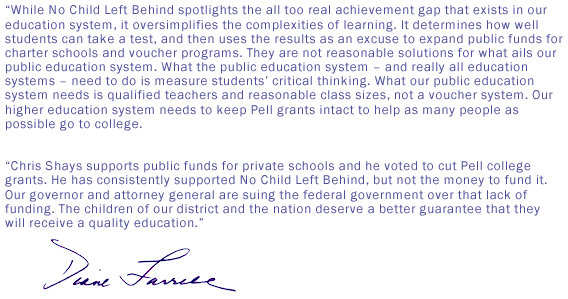
Diane Farrell Gets It!

(Click message to enlarge.)

A politician who will admit that NCLB is an effort to privatize education?

Indeed, a rare commodity and one that needs wholehearted support!

Sunday, October 29, 2006

Classroom-Based Assessment: Let the Rebuilding Begin

Part of re-democratization of America that will begin after Tuesday of next week will occur in America's classrooms. Some neglected ideas will be called upon to put public schools back into the hands of the public and to begin to rebuild those bombed-out, yet essential, bridges between teachers, administrators, parents, and children. America's most courageous and committed educators will be called upon. One of them will be Doug Christensen, Commission of Education from Nebraska.

After rejection from ED last summer for its classroom-based, and teacher/administrator directed, assessment system, Christensen led thousands of educators in making their case to ED officials to re-consider. They won.

The Commissioner has a different take on what is required to return assessment to the classroom as a tool to help teachers become more effective teachers, rather than as a tool to mete out punishment and sanctions and privatization schemes. Christensen believes that we do not need to think outside the box; to do so preserves the box as something that must be worked around. He believes, rather, that we need a different box with different boundaries and different configurations, one that can be used in many contexts without ignoring that those contexts exist.

So as a beginning point to the re-building of America's schools around an idea whose time is about to come, here is part of Christensen's recent keynote speech (Word file) at the Second Annual Conference
Leadership for Classroom Assessment: Classroom Assessment: A "Brave New World":

. . . I have found that in schools where classroom-based assessment is led by teachers in collaboration with their administrators, that cultures develop where personal and professional renewal lives and thrives. I have found in schools with classroom-based assessment to be places where passion is back and it is welcomed. I have found that classroom-based assessment creates places where the passion is back and in these schools it is okay to be passionate about our work; our profession, our kids--all of our kids. And, I have found classroom-based assessment to create places where the professional spirits of educators can thrive and places where their hearts embrace each child and every child. Aren’t these the kinds of places where all of us would like to live and do our work?

I can tell you that even though I am considerably removed from the classroom directly, this work has impacted me as well. I have never been so enthusiastic about our work. I have never been so anxious to see it fully evolve into these new places and these new futures.

Let me give you a specific example. I have never been so proud of our Nebraska educators as I was this past April. We were hosting representatives from the U.S. Department of Education to get them to understand what we do here in Nebraska with our classroom assessment model. Assistant Secretary Henry Johnson and two other staff members were in Omaha meeting with key Nebraska leaders who have helped us develop our assessment system and to meet with educator-leaders from the Elkhorn, Papillion-LaVista and Plattsmouth schools.

For an evening and most of a full day, the USDE representatives listened and asked questions during presentations led by teachers. What the U.S. Department of Education learned while they were here was not only what we were doing in our schools to measure student learning and provide for accountability but what we are doing to build assessment literacy and leadership. Even more important, they also learned about passion, commitment, and professionalism. One of the representatives related to our staff that this was a “wow experience!”

I listened to our educators talk. They were nervous for the first minute or so, but soon they got into it. It was incredible how the conversations flowed as our educators explained what our work is about. I was proud of the expertise and confidence they clearly showed. What made me most proud was their passion. When educators combine expert knowledge with confidence and passion, the sky is truly the limit. The educators knew their stuff, they were confident in what they were doing and they were proud. So was I.

As I listened to our educators present their processes and share their expertise, I confirmed in my mind a long held belief that this would never happen in a system of centralized assessment and high stakes. It is my belief that in a centralized assessment system, there is little space for classroom assessment and if the system is also high stakes there is absolutely no space for classroom assessment because it will have little if any meaning as long as the rules of the game are defined by centralization, standardization and high stakes consequences.

As I sat there and watched our educators and listened to their words, I swear I could hear their hearts and it was all I could do to keep tears from rolling. What a profound and proud moment that was. This is one of these new places and there are others.

There are more new places that are now possible for us but would never have been possible had we opted for the world of state-level testing that is defined by centralization, standardization and high stakes. Standardized high-stakes testing creates cultures that literally suck the oxygen out of the work. There is no oxygen in high stakes testing, There is no place to live and grow let alone be alive and thrive. There is no place for the hearts and souls of educators let alone the hearts and souls of the students.

The culture of high stakes testing is toxic. It not only takes the oxygen out of the work, it also makes all the wrong things important, as if they are the right things. For example, high stakes testing treats students, teachers and data as “commodities” to be manipulated as variables in some kind of strange economy or in some perverse experiment. In addition, I believe high stakes testing freezes the current system in place treating current practice as if it is good practice and practice that should be continued even though the whole point of accountability is to improve the system where a lot of current practice does not work. High stakes testing standardizes the current schooling model assuming it can work for all students, in all settings and under all conditions and we know that it does not and we know that it cannot. High stakes testing prevents the very innovation we should be encouraging.

If what I have just described is not enough perversion, consider this. High stakes testing also creates conditions where the students who will get our attention are the ones most likely to improve, not the ones with the greatest needs or the ones with the greatest gaps between them and their peers. It is simply more economical and more efficient to pay attention to the kids who are closest to being proficient. These are the kids who will make average proficiency scores go up and help schools met AYP targets. The kids who are farthest from proficiency are likely not to get the help they need because it is going to take too much time, too much effort and there will be little gain. So much for leaving no child behind.

Whether intended or not and whether informed or not, the creation of policy that has made testing an accountability tool has wittingly or unwittingly made assessment a policy tool. Assessment is an instructional tool and to rob it from the toolbox and repertoire of teachers is to tie the hands of teachers behind their backs and attempt to control the classroom remotely. In addition, when assessment becomes a policy tool, it becomes a hammer and its primary purpose is to force compliance and to establish control by controlling what, how and when the system measures what it does.

Jonathon Kozal is blunter than I am when he states: “Tests used judiciously are instruments of guidance to good teachers. But tests . . . (that) are not instruments of decent change . . . are simply clubs with which to bludgeon . . .”

In the world in which I want to spend my professional life and in the world in which I would like my grandchildren to go to school is not one where “bludgeoning” would be part of culture. And, is it any wonder that high stakes testing simply steals the joy from this profession? Is this not a perverse and toxic place?

Classroom-based assessment is a different world than the high stakes, standardized assessment world and it is a world that I welcome. I hope you welcome it as well. A world in which classroom-based assessment operates is a world with a culture in which I want to work. It is a world with a culture that I want our children to go to school.

Why is a culture created by classroom-based assessment so different? There are many reasons. First, classroom-based assessment recognizes that teaching and learning is the “core” of what “school” is all about. Second, classroom-based assessment places the classroom at the center of the school and places it at the center of the work of school. Third, classroom-based assessment recognizes that the work of school and the work in the classroom are about kids and their learning. Fourth, classroom-based assessment recognizes that the work is about all kids and there are no victories in inequality. And fifth, classroom-based assessment embraces the spirit and disposition of educators recognizing that the challenging work of being an educator where the agenda is equity must include a culture that will evoke not only their best efforts but will evoke their spirit, their will and their dispositions. . .
Christensen for next Secretary of Education? Someone who actually knows something about education? You be the decider of that. Please.

Saturday, October 28, 2006

The Corporate Art of Darkness

While the Business Roundtable and the education privatizers hold children accountable for the poverty they have no control over, they are busy as bees working to use their White House before 2008 to permanently protect themselves against public scrutiny and accountability. From the Times:

WASHINGTON, Oct. 28 — Frustrated with laws and regulations that have made companies and accounting firms more open to lawsuits from investors and the government, corporate America — with the encouragement of the Bush administration — is preparing to fight back.

Now that corruption cases like Enron and WorldCom are falling out of the news, two influential industry groups with close ties to administration officials are hoping to swing the regulatory pendulum in the opposite direction. The groups are drafting proposals to provide broad new protections to corporations and accounting firms from criminal cases brought by federal and state prosecutors as well as a stronger shield against civil lawsuits from investors.

Although the details are still being worked out, the groups’ proposals aim to limit the liability of accounting firms for the work they do on behalf of clients, to force prosecutors to target individual wrongdoers rather than entire companies, and to scale back shareholder lawsuits. . .

Support Our Schools--Bring Them Home

Most of the talk among clueless Democratic politicians regarding NCLB's war on public schools is about "full funding and fine-tuning." Either or both are mistakes. Full funding would be like adding addtitional troops to kill more citizens in a country that rejects them, and fine-tuning would be equivalent to designing new Iraqi benchmarks that simply make invisible the miserable failure of the entire war policy. In short, staying the course or adapting and changing are as likely to make NCLB successful as they are in saving from disaster the foolish and reckless war crime going on in Iraq.

A group of educators and activists inspired by Marion Brady and Phil Kovacs are beginning a project called Educator Roundtable. Their focus will be on providing a platform for multiple groups and individuals to coordinate efforts to end NCLB. Bookmark http://www.educatorroundtable.org./ and check in often to see what is going on with this effort.

One of the first actions will be to collect 10,000 signatures in support of NCLB repeal. I would like to see a million, done 10,000 at a time.

This is a grassroots effort, and Marion Brady and Philip Kovacs invite your suggestions, volunteerism and, of course, your dollars. Email Marion here: mbrady22@cfl.rr.com; Philip, here: philipkovacs@yahoo.com

Friday, October 27, 2006

LEAP and Educational Genocide as Accepted Practice

Next March it will be seven years since two graduate students and I began a research study (LEAP-ing Toward Accountability. . .(pdf) to find out how high-stakes testing (Louisiana Education Assessment Program--LEAP) was playing out in a poor urban elementary school in Louisiana.

Now the 2006 test results are back, and the only thing that has changed is that the educational genocide that began in 2000 is an accepted way of life now, as tens of thousands more poor children have been added to the heap of the "thowed away." Between 4 and 5 of every ten poor Louisiana children are held back in 4th grade every year as a result of not passing the LEAP. That does not take into acount the number of 8th graders and 12th graders, who must also run the same high-stakes gauntlet each year. (Photo above of 8th grader getting his LEAP test results: By Ted Jackson, winner of 2003 ASNE Award for Community Photojournalism)

In the meantime, administrators like Faith Joseph and school board elites like Phyllis Landrieu cling to a virulent ignorance or a preferred blindness that allows their crimes against children to continue unabated. Here is a clip:
Faith Joseph is confused.

After serving three years as assistant principal for the predominately African-American populated Woodlawn West Elementary School on the West Bank of Jefferson Parish, she tosses up her hands and shakes her head.

Joseph has tried everything to reverse an alarming decline in standardized test scores - tutoring, parent-teacher conferences and even disciplinary action.

Yet nothing seems to work, she said.

“I don’t know the answer. I’m not sure what to do. But if we don’t change what is going on, we’re going to be the new New Orleans. We’re going to be the ones getting picked on. What are we not doing that we can’t reach these black kids?

Yes, Ms. Joseph, meet the new boss/same as the old boss. Get it? Hellllllooooooo! Try this--read a book for starters: Richard Rothstein's Class and Schools: Using Social, Economic, and Educational Reform to Close the Black-White Achievement Gap.

A few weeks back Phyllis Landrieu was thanking Katrina for destroying the school system that she now plans to re-build as an uncharted charter system. She has since moved on from "I say, 'Thank you, Katrina' all the time," to now blaming parents for the effects of poverty:
She [Landrieu] said undiagnosed health problems, child abuse and neglect and “most important, lack of socialization training” are underlying reasons for poor performance.
And the "socialization training" derived from direct instruction is just what she has in mind as the key strategy for the chain-gang charters of the new New Orleans. The gamble here is that turning schools into detention centers will end the necesity for adult detention centers. Wish in one hand, Ms. Landrieu, and spit in the other--see which one fills up first.

I have to give credit to Ms. Joseph, however, for having at least a clue that is not being turned into a cudgel against the victims--which is more than I can ever say for Landrieu:

Joseph says there is a gap, or “school life bubble,” between home life and school that doesn’t always promote academic performance.

“A parent raising four kids and who worked a minimum-wage job once asked me, ‘What do you want me to do? Send my kids to school with clean clothes or help them with their homework? I can’t do both.’”

We did not need high-stakes tests to tell us how far behind poor children were and are, but now we can use those tests results to assuage our own guilt by blaming the victims, punishing the victims, and then by creating an orderly and invisible underclass. All the while we can pat ourselves on our backs for our color-blind and poverty-blind high standards and our bold determination to offer poor parents "choices."
(Photo by Ted Jackson)

Censorship on the Front Lines of the Freedom Fight

We know that the reasons for invading Iraq have proven to be the only aspects of that criminal debacle to have changed since the angry simpletons in the White House set it all in motion. As it is evident now that the first two reasons for invading have been jettisoned (stopping WMD and establishing Iraqi democracy), it seems that preserving American freedoms for American GIs has also been taken off the table in Iraq. From Wonkette:

We realize that when it comes to freedom of the press, the USA has fallen to Number 53 in the world — tied with our fascist homies in Croatia and the islanders of the Kingdom of Tonga! — but do we have to make is so damned obvious?

Another Marine stationed in Iraq has sent us a screenshot of what happens when you need some hot news on Macaca and Foley:
forbidden, this page (http://www.wonkette.com) is categorized as (Personal Pages) ALL SITES YOU VISIT ARE LOGGED AND FILED.
Free Image Hosting at www.ImageShack.us Nice little threat at the end, too. Asswipes.

Notice the other browser tabs. Two actual “personal pages” that rah-rah for Bush (What’s her name, the wannabe Coulter, and Hugh Hewitt) show up just fine, as our Marine Operative confirms. But “Talking Points Memo,” which is apparently one of the “left leaning” sites one hears so much about these days, is prohibited.

Writes the Corporal: “I think that this kind of censoring is a big deal. I can understand blocking porn, music and movies, and blatantly illegal sites, but blocking sites that some higher up just doesn’t agree with is disgusting. They are blocking a huge portion of voters from information that will help them determine which side to vote for. Because of this, the only news we get is from the big corporations or conservative based sites.”

EduCap, Inc., Student Loans, and Caribbean "Summits"

John Boehner is a lending rep's Rep who makes Tom DeLay look like a paragon of virtue. With government student loan funds slashed last spring, Boehner's primary constituency, the private student loan shark companies, have moved in big time. Their wine-and-dine strategy for corrupting university officials, of course, is the same one used to further corrupt the Congress, many of whose members will be picking up the pieces (and their paychecks) on K Street following November 7.

The light of day occasionally cast by the media is enough, however, to send these blood suckers scurrying back under their rocks. Example: today's story in the Times about EduCap, Inc.'s cancelled field trip planned for university officials and their spouses to warm and sunny Nevis during the cold and dark month of February. As the story goes, EduCap, Inc. has scored billions as a result of federal rules and regs they have essentially been allowed to write, and now they want to share some of that wealth with those university officials who can send more customers desperate for any way to fund their college educations--even if it means coming out of college swamped with debt.

Room rate at the Nevis Four Seasons? $655 per night:

It turns out there probably will not be much talk about education on the Caribbean island of Nevis this February. The student loan company that invited university officials and their spouses to an expenses-paid education summit meeting there has canceled the event.

George Pappas, a senior vice president of the loan company, EduCap Inc., had said the purpose of the conference, which was to be held Feb. 2 to 5 at the Four Seasons Resort, was to discuss education, not loans.

But some financial aid administrators have said the conference was EduCap’s way of wooing university officials who could steer student borrowers their way, for example, by putting them on so-called preferred-lender lists.

Students rely heavily on the lists when choosing a private lender, and loan companies have come up with a range of inducements to persuade officials to steer borrowers their way.

In a letter on Wednesday to people who planned to attend the conference, Mr. Pappas said the company was canceling the event “in light of recent inaccurate reports in the media regarding the financial aid community and the unfortunate perception these reports have created.”

The letter said more than 80 percent of attendees were “not members of the financial aid community.”

“Considerable confusion and misinformation exist about the purpose of the summit,” Mr. Pappas wrote, adding: “The goal of the conference was to foster an informed, thoughtful discussion about creating an educated citizenry.”

Michael Dannenberg, director of education policy at the New America Foundation, a public policy institute in Washington, called the cancellation “but a small victory for the integrity of financial aid,” saying, “larger conflicts of interest remain.”

EduCap is a nonprofit company in the Washington area that has reaped billions of dollars in the lucrative student loan business.

The company was to pay for airfare, the hotel stay and dining for each conference participant and a guest.

A standard room at the Four Seasons on the planned February dates cost $655 a night, not including “taxes, service charges and coastal protection levy,” according to the hotel’s Web site.

Thursday, October 26, 2006

More on the "65% Solution"

From Kevin Franck at PFAW:

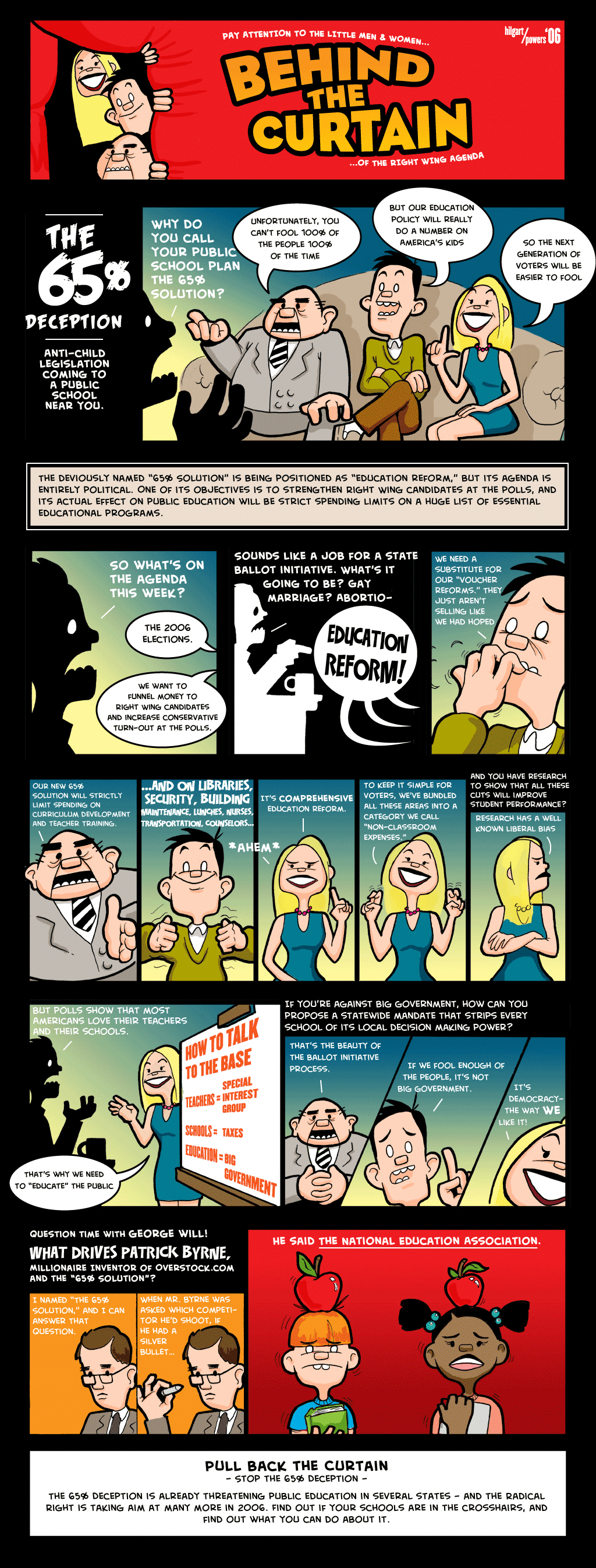
People For the American Way has just published a new educational tool to help explain the so-called “65% Solution.”

Behind the Curtain is a graphic comic strip that offers a brief introduction to the newest right-wing attack on public education, what we call the 65% Deception. A version of the comic formatted for printing on legal size paper can be found here

Please feel free to distribute this comic widely and let me know if you have any questions.

On Spellings' Redundant Database

Letter to the Editor in USA Today:

Ronald Crutcher, president - Wheaton College, Norton, Mass.

Tracking colleges USA TODAY'S editorial supporting the creation of a national student record-tracking system missed its most mind-boggling aspect: We already have the data to address the issues for which this expensive and dangerous system would be created ("Time to grade colleges," Our view, Higher education debate, Oct. 17).

Through the National Center for Education Statistics, the Department of Education conducts nationwide studies of college students. These studies help determine how students and families pay for education, help evaluate the effectiveness of higher education institutions and programs, and help measure the benefits of higher education in later life.

These ongoing, comprehensive studies address the issues that interest Education Secretary Margaret Spellings' commission. And they do so without establishing a $100 million national database that would compromise students' privacy and create expensive burdens on institutions already awash in regulations and struggling to improve financial aid packages.

Colleges and universities are accountable to more stakeholders — students, parents, alumni, trustees, employers and government — than any other imaginable U.S. enterprise. Ultimately, a free market — students voting with their feet, alumni with contributions, employers by their hires — is what keeps us accountable.

Colleges' opposition to this student-tracking system reflects our continuing commitment to affordability and accountability. We urge the federal government to invest its $100 million in the Pell Grant program rather than another big-government, Big Brother scheme.

Right-Wing Fear Factor and Higher Education

The same morally-bankrupt toadies that ginned up the big nation-at-risk fear in 1983 are at it again. Now instead of working for control of K-12 schools to turn them into job prep factories, the focus is our university system, which has thus far remained the envy of the world. Fortunately, their con game based on economic fears and lies is taken from the same playbook that was used in the Reagan heyday. No one is buying this time, except for those who prefer their own ignorance for either financial or psychical reasons.


Here is a clip from a great piece by David Paris that appears in Inside Higher Ed:

We’ve heard this before. Our schools are failing. International competitors are gaining on us. Our economic future is in jeopardy. This time, however, the educational institutions examined and found wanting are our colleges and universities.

In 1983, the National Commission on Excellence and Education declared that we were “A Nation at Risk.” The report asserted that a “rising tide of mediocrity” in K-12 education was putting America at an economic disadvantage in global competition. Now the Commission on the Future of Higher Education (the Spellings Commission) has delivered a similar message.

While acknowledging that “higher education in the United States is one of our greatest success stories,” the commission claims that “a lot of other countries have followed our lead and are “passing us by at a time when education is more important to our prosperity than ever.” The report warns that “[h]istory is littered with industries that, at their peril, failed to respond to — or even to notice — changes in the world around them ... institutions of higher education risk falling into the same trap.” Apparently, we are at risk again. . .

Would anyone really want the direction of American universities determined by the hacks and whores who have hijacked the U. S. Department of Education?

Paris closes with this:

. . . the best education — for the academy, the economy, and society — aims at more than creating productive workers. It also should produce good citizens and individuals capable of living full and meaningful lives. The best education for the economy is a broad education, one that emphasizes the full range of skills and knowledge. Liberal education outcomes such as critical thinking, quantitative literacy, communication skills, ethical reasoning, and civic engagement translate into workplace competencies in the broadest sense — an ability to understand and work with people and problems. These are the skills that business leaders most want.

The great achievement and ongoing project of higher education in the United States is giving all our citizens an opportunity for a full life in all its dimensions. That should be the aim of real, long-term reform in higher education.

Wednesday, October 25, 2006

Voters Beware

Pete weighs in on the importance of reading ballot initiatives:

Ballot measures appearing before voters next month require people to read them and know what they mean. At stake across the country are major pieces of legislation that have both intended and unintended consequences. Behind them are the efforts and dollars of professional lobbyists out to alter the course of the country.

Normally we rely on state legislatures and Congress to do the work of legislation. But legislators, esp. due to term limits, are more often than not puppets and spokespersons for lobbyists. A friend of mine in the MO state legislature, which has term limits, told me that she is presented with legislation already written by the lobbyists. She simply endorses it or not.

The appeal of these ballot measures is undeniable: let the people decide. It seems the ultimate tool in a democracy. But for this to work, we need to rely on the people, the demos of a democracy, to become an intelligent, critical electorate. Trouble is, when voting on ballot measures, most people have no idea what they mean; they hear about them for the fist time at the ballot box and are easily swayed by the way the proposals are written.

So how can we have a critical electorate that can be trusted with the awesome responsibility of making laws?

In its exclusive focus on reading and math, NCLB leaves aside the study of subjects crucial to forming a well-informed electorate. A survey released a few months ago by the Center on Education Policy found that since the passage of No Child Left Behind in 2002, 71 percent of the nation's 15,000 school districts had reduced the hours of instructional time spent on history, music, and other subjects to open up more time for reading and math. The center is an independent group that has made a thorough study of the new act and has published a detailed yearly report on the implementation of the law in dozens of districts. "Narrowing the curriculum has clearly become a nationwide pattern," said Jack Jennings, the president of the center, which is based in Washington.

The survey looked at 299 school districts in 50 states. It was conducted as part of a four-year study of No Child Left Behind and appears to be the most systematic effort to track the law's footprints through the classroom.

The historian David McCullough told a Senate Committee last June that because of NCLB, "history is being put on the back burner or taken off the stove altogether in many or most schools, in favor of math and reading."

For more and more children, the exposure to social studies --- the Constitution, the Bill of Rights, how the government runs, how laws are passed, US and world history, etc. -- has been eliminated. The sociopolitical implications of poor black and Hispanic children not learning about the Civil Rights movement, not learning about women's suffrage, not learning about the US Civil War, and not learning about any historical or contemporary instance of civil disobedience is more than just chilling. It smacks of an Orwellian attempt not merely to rewrite history, but to get rid of it.

But more importantly, NCLB works to dumb down an electorate that is increasingly being charged with the task of creating the laws of the land.

So what to do? (1) increase the threshold for getting things on the ballot; (2) sponsor forums for people to find out about the issues; (3) but the long-term strategy is to inject citizenry and civitas into the curriculum of every public school in the country and to reject the efforts of groups like The Business Roundtable and The U.S. Chamber of Commerce to make public education synonymous with job training. Dumbed-down schools produce dumbed-down citizens. And dumb-downed citizens are easily controlled, by both the government and by corporations.

Peter Campbell

Spellings Brings Back "Separate But Equal"

Margaret Spellings is always insistent upon scientifically-based research when she and her henchmen can stack the data deck to get the end result they set out for to begin with. The most glaring instance, of course, is the criminal operation of Reading First and its force-feeding of crony-supported reading materials backed by a cooked national reading report that was shaped by the crackpot notions of Mr. Reading Code, Reid Lyon.

No such scientific necessity is now required for Spellings to open the floodgates to a new generation of "separate but equal" schools based on gender. With nothing but a tissue of flaky pseudoscience and an iron-fisted determination to make males strong and females compliant, ED regulations have now been changed to roll back the social calendar even further toward the days when women were considered property. Clip from USA Today:
School districts across the nation this fall will have unprecedented freedom to open up all-girls' or all-boys' schools and classes under sweeping new regulations announced on Tuesday by U.S. Education Secretary Margaret Spellings.

The shift is the biggest in 31 years and for the first time allows schools to separate students by gender if they believe it helps — a standard that is under debate in the existing research.

Participation in such programs would be voluntary, but schools choosing to separate a class for one sex wouldn't have to provide an equivalent class for the other sex. They'd simply have to offer a "substantially equal" coed class in the same subject.

The rules, which take effect Nov. 24, also clarify rules on creating entire single-sex public schools.

Since the current rules went into effect in 1975, single-sex classes have been allowed only on a limited basis, such as in charter schools, sex education courses or gym classes involving contact sports. The Bush administration, supported by both Republican Sen. Kay Bailey Hutchison of Texas and Democratic New York Sen. Hillary Clinton, has favored loosening the rules.

About 240 public schools offer same-sex coursework, up from just three in 1995, says Leonard Sax of the National Association for Single Sex Public Education. He thinks about 1 in 10 of the nation's 90,000 public schools could decide to become single-sex.

Critics, such as the American Association of University Women and the American Civil Liberties Union, call the changes troublesome.

Emily Martin of the ACLU Women's Rights Project said the new regulations "represent a through-the-looking-glass interpretation" of the federal Title IX law, which prohibits excluding students from school programs on the basis of sex. She noted that schools could now "separate girls and boys for virtually any reason they can dream up — including outdated and dangerous gender stereotypes." . . .

Tuesday, October 24, 2006

The New Un-American Activities Committee

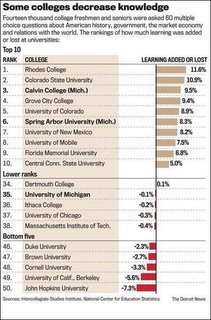
It is called the National Civic Literacy Board. It is packed with right-wing conservatives, and its intent is the purging of American universities. Check out the negative learning going on, according to the "research findings" shown in the chart at left (click it to enlarge). Is there any doubt which universities are in the cross-hairs?

The commentary below by John Seery is from Huffington Post:

Watch out. The conservative assault on our nation's colleges and universities continues.

We've seen David Horowitz's book warning about "dangerous" professors and his clumsy Academic Bill of Rights campaign. We've seen Sec. of Education Margaret Spellings' report on the Future of Higher Education and its proposal to submit our 6000 autonomous colleges and universities to strict federalization.

And now, last week, we received a report--"The Coming Crisis in Citizenship"--from the Intercollegiate Studies Institute's National Civic Literacy Board, which claims to prove that our colleges and universities (read: those bastions of liberalism) are failing to deliver a proper Preparation for Citizenship to our nation's young adults, and may even be corrosive to our American way of life.

The ISI-funded study was based on a multiple-choice examination given to 14,000 college freshman and seniors to assess their factual knowledge in four areas: American History, U.S. Government, America and the World, and the Market Economy. The National Civic Literacy Board assigned an "F" grade to college students in all categories. The Board emphasized that college seniors barely knew anything more about such matters than incoming frosh. And it emphasized that many of the most prestigious schools and most costly schools (read: most liberal schools) produced the worst overall scores, and it singled out Brown University, Georgetown University, and Yale University as places where "negative learning" seems to transpire between incoming and outgoing students. Finally, somehow on the basis of this multiple-choice examination, the Board claims to "prove" that students who have "demonstrated greater learning of America's history and institutions were more engaged in citizenship activities such as voting, volunteer community service, and political campaigns."

So what's going on here?

It just so happens that I attended a conference on civic education last week at Georgetown University. It just so happens that the ISI apparently helped fund that conference (unbeknownst to me beforehand). It just so happens that in my own talk at the conference I severely criticized the findings of the National Civic Literacy Board. I pointed out, for instance, that Stanford Professor of Education and History Sam Wineburg, in his award-winning book, Historical Thinking and Other Unnatural Acts, and in subsequent studies had already demolished the scholarly credibility of a fact-based diagnostic as a way of teaching and understanding American history. Moreover, the premise that you are a "better" citizen and will be more "engaged" because you can identify Yorktown as the battle that brought the American Revolution to an end is just silly.

After my talk, a tall gentleman came up to me and introduced himself: Lt. General Josiah Bunting III, President of the National Civic Literacy Board. Oops! He was eminently gracious, I must say. We exchanged a few polite words. And then I heard him deliver his own address to a lunchtime audience. Most of it was about the virtues of a proper university education, all very above board. But toward the end of his remarks Lt. General Bunting showed more of his own cards. He lamented the presence of so many liberal faculty members in U.S. colleges and universities today, and he concluded his talk thus: "This must change."

I did some Googling. Turns out that the National Civic Literacy Board isn't so national after all. It is simply stacked with conservatives. The directors, besides Lt. General Bunting, include a former Reagan administration official, a former George W. Bush administration official, and a retired Rear Admiral who was Director of Naval Intelligence. Board members include U.S. Senator George Allen; the CEO of the Philip M. McKenna Foundation; the CEO of the National Association of Manufacturers; a Senior Fellow from the Hoover Institution; Roger Kimball, Editor of the New Criterion; Robert George, Director of the Madison Program at Princeton; a former Secretary of the Army; a Wall Street Journal Editorial Board member; a retired Vice Admiral in the Navy; an American Enterprise Institute scholar; a former CEO of Household Finance Corporation; and Lewis Lehrman of the Lehrman Institute; and so on. Does the mission of investigating civic literacy really require such a one-sided, unrepresentative, and so obviously politicized panel?

Conservatives are jumping all over the report with glee, and you can bet that they will press hard for the Board's recommendation that these colleges need to be held "accountable" for the way they contribute to the "civic life" of America, or not.

After I started to realize what was going on at the conference, namely that some folks in attendance saw "civic education" as a proxy and euphemistic front for a conservative agenda, I approached Lt. General Bunting with another line of inquiry. I pointed out to him that I, too, sometimes give my own students a pop quiz on American civics and American civic values, but my questions aren't about the particularities of the Civil War or Keynesian economics. Instead, I ask the following:

How many of you believe in constitutional government? How many of you believe in the rule of law? How many of you believe in checks and balances and the separation of powers among different branches of government? How many of you believe in due process? How many of you believe in trial by jury? How many of you believe in contested elections? How many of you believe in a bill of rights that protects freedom of speech, freedom of assembly, etc.? How many of you believe in universal adult suffrage? How many of you believe in the basic equality of all humans, as opposed to a caste system or a system of inherited privileges? How many of you believe that sovereignty resides in the consent of the governed? How many of you believe in democracy, rather than monarchy or aristocracy or dictatorship?

Remarkably in my experience, I've found that my students understand those questions very well and are in lock-step unanimity in endorsing those civic values. They're not the civic dummies that the National Literacy Board is trying to make them out to be.

I heard at the conference several conservative commentators bemoaning the alleged fact many liberal academics refuse to assert the "moral superiority" of the American government over other governments. What I hear in those words is something ominous: the search for an unassailable American patriotism and therewith, the search for a blanket justification for war; and also as part of that campaign, a rearguard search for scapegoats for the current national malaise in our present wartime fiasco--to be attributed no longer to the "liberal media" or to "liberal politicians" or to "liberal judges" but now to "the liberal professoriate." Holding institutions "accountable" will mean promoting American civic virtues as these conservatives define those virtues, while silencing dissenters by other means.

Why didn't the National Civic Literacy Board simply call itself the new Un-American Activities Committee? Wouldn't that have been the more forthright and honest name?

Why won't mainstream media outlets conduct even a modicum of research to inform readers and viewers about the not-so-hidden agenda behind a report such as this, instead of merely reciting uncritically the Board's findings and recommendations? Shouldn't there be some civic education about the American founders' views about the importance of a vigilant Fourth Estate?
Monday, October 23, 2006

Testing Becomes Major Domestic Political Issue

If you don't think that the child abuse inherent in the current testing madness is resonating with voters, just look around you and ask any parent or teacher. Apparently, some state and national politicians have done just that, and what they are finding is a level of disgust among the electorate for the immoral testing practices and abuse of power that are being used against the most vulnerable of America's citizens. A clip from WaPo:

. . . "We have third-grade children who have been retained so many times they are wearing brassieres in the third grade," said Florida state Sen. Frederica Wilson, one of the leaders of the anti-testing movement here.

"When parents are dealing with children vomiting on the morning of the tests and seeing other signs of test stress, they're going to be motivated at the voting booth," said Gloria Pipkin, the president of a testing watchdog group, the Florida Coalition for Assessment Reform. "Texas and Florida are the poster children for excessive testing, and we're seeing an enormous backlash."

Polls are also registering growing voter discontent over tests.

A Zogby International poll for the Miami Herald last month showed that 61 percent of voters disagreed with grading and funding schools based on their test scores, and almost half said schools were allocating too much time for test preparation. A poll by the Florida Times-Union and the South Florida Sun-Sentinel showed similar results.

In Texas, a survey drafted by two polling firms, one Democratic and one Republican, and paid for by the Texas State Teachers Association, indicated that 56 percent of voters thought there was too much emphasis on state testing in their schools.

A national poll by a pro-testing group, the Teaching Commission, showed that 52 percent of respondents thought that standardized tests do not accurately measure student achievement; 35 percent thought they do. . .

ED Payola for Good News and Good Test Scores

It is only fitting that the Armstrong Williams payola case find its way back to the front pages on the same weekend that ED starts payola-ing its bonuses for teachers who have been able to "produce" higher test scores--and just before the elections. The whole illegal operation involving Uncle Armstrong has come to a final fizzle, with Williams being required to pay back $34 thousand of the $240,000 that ED paid him for favorable NCLB propaganda in black neighborhoods, where children are receiving their ongoing daily procedures of cognitive decapitations.

Apparently the illegality of ED's actions in promoting "covert propaganda" will be swept aside. In comparison to the other unprosecuted crimes of this Administration, from Iraq to Guantanamo to New Orleans and every American telephone in between, this crime seems like boyish pranks.

Here is part of the story on the teacher bonuses for test scores from a Ben Feller who seems suddenly to have figured out that Maggie won't be there to protect him much longer:

WASHINGTON -- In the closing weeks of the fall campaign, the Bush administration is handing out money for teachers who raise student test scores, the first federal effort to reward classroom performance with bonuses.

Sixteen grants totaling $42 million will go to schools in many states. The government has announced the first grants -- $5.5 million for Ohio -- where Education Secretary Margaret Spellings was to make the presentation today. Schools in Cleveland, Cincinnati, Columbus and Toledo will share the money.

The department will release the remaining grants right before the Nov. 7 elections in which the Republican Party is eager for good news.

Sen. Mike DeWine, R-Ohio, is trailing his Democratic rival. Also, Democrats have led for weeks in two House seats Republicans have held for a long time, and party officials talk of winning two or three more seats. Such gains could help the Democrats take over the House.

Sunday, October 22, 2006

Neil Bush's COW: The Milking and Bilking of Education Funds

Here is a clip from today's piece in the L. A. Times on Neily's business enterprise (background here), which seems to have ignited more controversy than Ignite, Inc. could have imagined:
Mixed reviews

Few independent studies have been done to assess the effectiveness of Ignite's teaching strategies. Neil Bush said the company had gotten "great feedback" from educators and planned to conduct a "major scientifically valid study" to assess the COW's impact. The results
should be in by next summer, he said.

Though Ignite's products get generally rave reviews from Texas educators, the opinion is not universal.

The Tornillo, Texas, Independent School District no longer uses the Ignite programs it purchased several years ago for $43,000.

"I wouldn't advise anyone else to use it," said Supt. Paul Vranish. "Nobody wanted to use it, and the principal who bought it is no longer here."

Ignite's website features glowing videotaped testimonials from teachers, administrators, students and parents.

Many of the videos were shot at Del Valle Junior High School near Austin, where school district officials allowed Ignite to film facilities and students.

In the video, a student named India says: "I was feeling bad about my grades. I didn't know what my teacher was talking about." The COW changed everything, the girl's father says on the video.

Lori, a woman identified as India's teacher, says the child was not paying attention until the COW was brought in.

The woman, however, is not India's teacher, but Lori Anderson, a former teacher and now Ignite's marketing director. Ignite says Anderson wassimply role-playing.

In return for use of its students and facilities, a district spokeswoman said Ignite donated a free COW. Five others were purchased with district funds.

District spokeswoman Celina Bley acknowledged that regulations bar school officials from endorsing products. But she said that restriction did not apply to the videos.

"It is illegal for individuals to make an endorsement, but this was a districtwide endorsement," Bley said in an e-mail.

New Orleans Schools: Dismantling a Community

A new report on the privatization of New Orleans schools is available from the Center for Community Change.

Dismantling a Community, a new publication from the Center, chronicles the selling-off of New Orleans Schools in the wake of Hurricane Katrina.

Rather than build the first-class public education system that New Orleans kids have deserved for decades, Federal Government officials and right-wing advocates used this tragedy as fertile ground for social experimentation on a grand scale.

Thousands of seasoned teachers have been let go and teacher's unions have been decimated while some $40 million has been spent to turn the New Orleans education system into a complex web of individually operated schools where parents have to vie for a quality education for their children.

Dismantling a Community tells the consequences of the ongoing assault that privatization advocates have unleashed on the fragile neighborhoods of New Orleans.

Click here to download the report.

Friday, October 20, 2006

The Sanders and Kress Tagteam

I am here in Washington for the PDK Summit on Public Education. Things got rolling yesterday with John Merrow moderating and sometimes dominating a panel of "policy superstars," brought in to mold the conference talk on NCLB. Front and center on the Hilton stage was Beelzebub himself, Sandy Kress. At his left hand was Bill Sanders, who nodded assent when Kress spoke, just as Kress did when Sanders spoke. These two dominated the discussion, and if I were a betting man, I would guess that Sanders and Co. have the inside rail position at the starting gun in the Growth Model Sweepstakes. Sanders even bragged that his outfit had helped one of the two successful supplicant states chosen by Spellings to pilot a growth model plan earlier this year.

So while growth model talk is dominating the conversation here, there is no sign in Kress's sneering face that the White House plans to give an inch in moving away from the impossible requirements of 100% proficiency. To do so would mean jettisoning the privatization plans that require the wholesale failure of public schools to make them work.

The consensus on the stage was that reauthorization will move forward next year, but that is not the talk among Senate Democrats who know something about the groundswell of resistance that is now beginning to emerge. This resistance is evident in the small group and individual discussions here at the conference, among those folks who were given no voice at the big Sandy and Bill Show yesterday. Merrow provided less than 20 minutes out of the 2 hours for questions from those who paid him to bloviate, rather than moderate, and he was downright rude to one gentleman who took the time to note that he had been a member of PDK for 50 years.

For a group like PDK dedicated to democratic education and living, I would suggest future moderators who are less blind to their own ego needs and some participants who know something besides their own ideological/business agendas.

Wednesday, October 18, 2006

Raising Concerns About NCLB With National Candidates

From Jan Resseger:
It is election season… Please raise concerns about the No Child Left Behind Act when you talk with candidates for national office (and people who already serve in Congress). Here are two things you can do right now:
  1. Take a copy of “Questions about the No Child Left Behind Act for Candidates for the U.S. Senate and House of Representatives,” (pdf) when you attend any candidates night. I actually did just that last Thursday night. At the event, having an opportunity to write out a question on a card, I copied off one of the questions provided. Lo and behold… my question got presented by the moderator to a candidate for U.S. Senate. Mine was the only question on NCLB, but mine was not the only intense interest in the candidate’s answer. The audience became quietly attentive … with much applause for this particular candidate’s comments. And the next night in his opening and closing remarks at a televised debate, this candidate mentioned that reform is needed in NCLB. Please make a difference by making sure this subject is raised often in this election season.
  2. Have you taken the time to participate in the “No Child Left Behind Letters to Congress Project” on-line at FaithfulAmerica.org? http://www.faithfulamerica.org/article.php?id=98 If not, check out this year-long project, which provides you with ten different opportunities to send a letter electronically to your Congressional representative and your two senators.

The project is tied to the simple National Council of Churches statement, “Ten Moral Concerns in the Implementation of No Child Left Behind.” http://www.ucc.org/justice/education/nclb-moral.pdf In our letters project, we have posted ten letters, each one lifting up one of the moral concerns. The important part is that you insert your own story into the letter at the point where your story is requested. Each letter gives you an opportunity to tell your elected officials how NCLB is affecting your child or a teacher you know, or your own school, or your community. Please take the time to participate in this project by telling your own truth as a person of faith to your elected officials.

Do share with your own contacts these opportunities to make a difference. Thanks! And peace to you.

Jan Resseger, Minister for Public Education and Witness
United Church of Christ Justice and Witness Ministries
700 Prospect Avenue, Cleveland, OH 44115-1100
216-736-3711

Tuesday, October 17, 2006

ED, Higher Ed, and the Highest Ed Thievery

Some time during the last year of Sally Stroup's stay as Asst. Secretary for Higher Ed, some mighty private documents got shipped off to a group of lawyers defending the online University of Phoenix against charges of bilking the Feds of $3,000,000,000. It seems that a "mistake" was made inside ED when a FOIA request came from University of Phoenix attorneys who were seeking information regarding details of a suit filed to recover part of the $3 billion that UP had garnered by allegedly paying enrollment recruiters to sign up anyone who could qualify for federal Pell Grants. As a result of the "mistake," the entire legal strategy of the whistleblowers was shipped off to the attorneys representing UP's parent company, the Apollo Group.

A couple of coincidences worth noting here: 1) Sally Stroup worked for University of Phoenix before hiring on at ED, and 2) Sally was responsible for writing the snippet that was included in the cons' big education bill last spring, the snippet that eliminated the need for real campuses for college programs funded by federal student loans and grants from ED. This change will result in many billions more going to the online for-profit colleges of the higher ed industry, which are now being heralded as the great equalizer for poor and minority students trapped in rural or urban hellholes, and who, most likely, will remain no less trapped after their virtual adventures in learning at the online for-profit diploma mills that are popping up faster than you can say, thank you Sally.

Thanks to Marty Solomon for the tip on the story, which appears at the Chronicle. Here is a clip:
It is unclear how the documents were released. The False Claims Act requires that plaintiffs' legal strategies and working papers be shared with the federal agencies involved in the lawsuits.

In a statement Monday, an Education Department spokesman said the agency "is aware that certain department records were released in error. ... The department is taking appropriate action to safeguard its records, but we cannot comment further as your questions concern matters in litigation." The spokesman, Jim Bradshaw, said he could not say if the department is investigating who approved the release of the records.

In this case, lawyers at the Department of Education were consulted as part of the review process for Apollo's Freedom of Information Act request. One of them, Christine M. Rose, who works in the general counsel's office, filed a declaration in federal court last week, saying the department had determined "that the disclosure statement and witness-interview notes are privileged documents."

"There are a lot of people over there trying to do the right thing," but they keep getting undermined, said Nancy G. Krop, another lawyer for the whistle-blowers.

Phoenix, the largest private university in the nation, has strong political ties. Its former chief lobbyist, Sally L. Stroup, was appointed assistant secretary for postsecondary education, the top higher-education office at the Department of Education, by the Bush administration. She left that post in April, after four years.

UofP, by the way, has other legal fronts to defend. It seems that non-Mormons have filed papers against UP for discriminatory practices:

PHOENIX - The University of Phoenix has been sued for religious discrimination by the U.S. Equal Employment Opportunity Commission.

The federal civil rights lawsuit, announced Wednesday, accuses the private university of favoring employees who are members of the Mormon church. Employees who are not associated with the Church of Jesus Christ of Latter Day Saints were treated less favorably on new student recruiting leads, tuition waivers and reprimands, the commission alleges.

You know how pushy those non-religious types can be!


No Pot of Gold for These Turnaround Specialists

Parker Land, Principal:

"I've learned an awful lot. I've learned that our kids, a significant number of those kids are in crisis. And there's a level of support that's needed that we just haven't realized yet. "


Turnaround specialists, traditionally associated with turning failing or struggling companies around with the promise of cash rewards in the end are now the "hottest" trend in education reform. Their mission is to find ways for struggling schools to make adequate yearly progress (AYP) and raise test scores. This last installment in the PBS NewsHour series looks at an inner-city school in Richmond, Virginia and tracks "turnaround specialist" Parker Land's efforts to fix Boushall Middle School's troubles with discipline and incentives. The spot reveals a troubling picture and is a scathing indictment of the current sytem with its relentless focus on standardized test scores and punitive consequences.

JOHN MERROW: Park Land wasn't the only turnaround specialist to struggle. Fourteen of the program's 21 principals failed to meet federal standards for improvement this year. The turnaround specialists made three-year commitments, but already more than half have either changed schools or left the program.

Here are some more excerpts from the NewHour interview:


JOHN MERROW: Madieth Malone teaches English.

MADIETH MALONE: A lot of time is being spent on how to take tests, what kinds of questions are on tests, how to read test questions, the facts that are needed to answer questions on a test.
We usually spend time reading novels. I would love to do that, but now I need to spend my time focused on the bare necessities, those absolute things that I know will be tested.
The next couple of days, we will be doing the diagnostic tests for the entire SOL...

JOHN MERROW: Test prep had also taken over Lois Smith's math class.

LOIS SMITH, Teacher: The goal is that they've got to pass the test. Some of the kids aren't going to learn all the concepts, but if they have some of the strategies, they still can pass.

MADIETH MALONE: I can't go along with that, no. I can't support that. The goal for all of our schools -- and I guess it's the goal for schools across the country -- is to pass standardized tests, but the goal of educators is to prepare children to become responsible, contributing adults.

PARKER LAND: My vision is that there's so much more. We can be -- you know, there's so much more to these kids that needs to be developed. But, you know, the educational world is one that says, "Show me academic test scores." That's life now. So that's the way it's going to be.

Tests Demoralize Learning Disabled

One of the more insidious aspects of NCLB can be found in regulations dealing with learning disabled (LD) students forced to take exams that most of them do not even understand. The failure and frustration associated with these tests has led one superintendent and former special ed teacher in Delaware to sue the state and challenge "the sytem" on behalf of children and their families.
------------------------------------------------
"If you are talking to someone in a different language, imagine the frustration when you have to perform and don't know what they are talking about," Andrzejewski said, adding that the constant failure demoralizes many. "It's more than frustration. These students, they cry. Sometimes they act out. They want to do [well]."

Andrzejewski, who believes federal law allows for alternate assessment, blames state leaders for not allowing it in Delaware. State officials, in turn, say they can't do much without approval from the U.S. Department of Education.

"Federal law has been very clear about what states can and can't do," said Robin Taylor, associate secretary of assessment and accountability with the state Department of Education. "They say they are giving us flexibility. States are sitting, waiting, poised, ready to go off and do something, but we don't know what to do yet."

Initially, No Child Left Behind offered three options: regular assessment, assessment with accommodations and assessment in an alternate format. In December 2003, a fourth option allowing for modified achievement standards was added, but it was exclusively for students with significant cognitive disabilities.

Last year, U.S. Education Secretary Margaret Spellings offered a fifth option to 31 states, including Delaware, on an interim basis to allow modified achievement standards for "gap kids" -- those who typically can perform at grade-level but at a slower pace. She set a 2 percent cap on the number of scores from modified testing that could be counted toward schools' yearly progress.
---------------------------------------------------------

Sunday, October 15, 2006

National Pandemic is a Reality

Given the existence of an idealized vision of the community, movements of protest are likely to occur within the political nation when the discrepancy between the image and the reality comes to seem intolerably wide.
-- J.H. Elliott

The historian J.H. Elliott may not have envisioned the huge disconnect between image and reality that now characterizes education reform under No Child Left Behind, but his observation on what drives people to stand up and protest can be applied to the growing rebellion taking place across the country and more parents, teachers, administrators and even some astute politicians are finding the current testing craze with its punitive consequences increasingly intolerable.

Bill Archer, a counselor at R.J. Longstreet Elementary in Daytona Beach, Florida provides us with a huge dose of reality:

What is happening is pandemic across the nation. Public education is under siege from state and federal politicos who are transforming what was once an arena of pure educational learning into a corporate state of testing.

This allowed well-connected publishing companies to gorge themselves on public school dollars in a frenzied testing environment that has been sold as "accountability" to the unsuspecting public.

Local administrators are intimidated and fearful of losing money for their districts, maybe even losing their jobs if they resist.You can hear them saying submissively, "We just have to play along."

R.J. Longstreet Elementary School is so much better than the A repeatedly assigned to it by evaluation processes that can't meet minimal standards of reliability and validity in the real world of accountability. It is a safe school, a community-involvement award winner, a place where kids enjoy coming to learn, socialize and play each day.Its parents are supportive and caring.Its biggest enemies are these tests and those behind these predatory programs that starve those in need and lavish the money saved on their corporate accomplices.

This current administration is working hard to change the face of the world into its own corrupt image, and it is succeeding in public education, the only place where a defense could have been mounted to defeat it.R.J. Longstreet Elementary is fighting to maintain its right to educate rather than become of victim of the testing craze.

Saturday, October 14, 2006

Privatization Ayes for the McGraw Prize

This year's recipients of the Harold W. McGraw, Jr. Prize in Education are
Norman Augustine, Retired Chairman and Chief Executive Officer, Lockheed Martin Corporation; Wendy Kopp, President and Founder, Teach For America;
Vincent Murray, Principal, Henry W. Grady High School, Atlanta, GA.

The Harold W. McGraw, Jr. Prize in Education annually recognizes outstanding individuals who have dedicated themselves to improving education in this country and whose accomplishments are making a difference today. Honorees are chosen by a distinguished panel of judges made up of thoughtful and influential members of the education community. Each winner receives a gift of $25,000 and a bronze sculpture. The Prize was established in 1988 to honor Mr. McGraw's lifelong commitment to education, and to mark the Corporation's 100th anniversary.
As for their efforts at improving education, it seems that improvement -- like beauty -- is in the eye of the beholder. From these recipients' vantage point, improving education means something very specific.

For example, to improve education, Norman R. Augustine chaired the National Academies Committee on Prospering in the Global Economy, which produced the report, "Rising Above the Gathering Storm." According to McGraw-Hill, this report was "designed to address student preparedness for the 21st Century." The report is filled with the same kind of alarmist rhetoric that followed the launch of Sputnik, the same that drove "A Nation at Risk," and gave corporations an entree into defining what "improving education" meant to them. It should be noted that Mr. Augustine is a member of the boards of Conoco Phillips, Black & Decker, and Procter & Gamble. It should also be noted that he is an expert in missile defense systems currently in use in Iraq and in educational reform. Apparently the two go well together.

Wendy Kopp has chosen to improve education by relying on the romantic idealism of 20-something college graduates who want to make a difference in the lives of disadvantaged children. A noble goal, without doubt. But Kopp and Teach for America have managed to help snuff out the call for the kinds of socioeconomic reforms that are at the heart of the educational achievement gaps between the haves and the have nots. Kopp, herself a romantic idealist who has never set foot in a classroom as a teacher, believes that it's up to teachers to try harder and teach better. She waxes elegiac as she relays anecdotes about TFA teachers working longer hours and on Saturdays. Admirable, indeed. Scalable, not at all. After all, TFA teachers only teach for 2 years. Some teach longer, but most don't. They -- by design -- move on to positions of power where they can better affect policy changes for public education. Their major argument, based on their own experience? Teachers need to work harder and teach better. Forget about all this poverty stuff. That's just an excuse.

So why would McGraw-Hill hold these folks up as the bright stars of education?

With Bush using the bully-pulpit of the Presidency to advocate for the policies of NCLB, supporters can line up behind him and advocate solutions that are similar to his. These proponents all have slightly different intentions. But one thing that most of them, at least the educational corporations, have in common is this: if Bush's policies are successfully implemented, all of them will be incredibly rich. Peter Jovanovich, chief executive of Pearson Education, a multi-billion dollar corporate publisher of tests and education materials, described NCLB by saying, "This almost reads like our business plan.”

So, funneling tax dollars into private institutions can certainly be seen as a way of holding public schools accountable. And funneling tax dollars into private institutions can certainly be seen as a way to eventually improve them. But funneling tax dollars into private institutions can also be seen as a way to make educational corporations more profitable and investors in these corporations more excited about these companies. For example, in its 2004 Annual Report, McGraw-Hill reported its revenue increased 7.4% to a record $5.3 billion, that net income increased 9.9% to $755.8 million, and that operating margins rose 3 percentage points to 25%.

Does this mean that McGraw-Hill is out to destroy public schools? Not at all. Does this mean that Peter Jovanovich of Pearson Education is secretly colluding with Bush to privatize public schools? No way. Does this mean that private, for-profit educational companies like to see poor kids get crappy educations? No. The stunning, heart-breaking thing is that as they all work to support reform through NCLB, the following happens: (1) the companies make more money, (2) public schools are destroyed, (3) more and more schools are privatized, and (4) more and more poor kids get crappy educations. None of these companies explicitly WANT these things to happen, but as their business practices seek to fulfill on the revenue-generating opportunities that NCLB affords them, we move inexorably towards the end of public education as we know it.

Peter Campbell

Friday, October 13, 2006

Eugene Hickok is Out of Touch

These six letters published in today's New York Times in response to the Op-Ed by Eugene Hickok "No Undergrad Left Behind" are a telling commentary on how out of touch the right wing conservatives at the Heritage Foundation and other think tanks are with the values and ideals that most Americans still cherish. Hopefully, the American people will wake up and take back their country in a few weeks.

This one is my favorite:

To the Editor:

In arguing for reform in higher education, Eugene Hickok makes a telling comment. He writes that higher education “is a culture that cherishes independence and freedom” but one that is “seriously out of touch with much of America.”

Maybe what needs reforming are those institutions that no longer cherish independence and freedom, rather than those that do.


Why is the right wing so fearful of independence and freedom? Indeed, those who speak in the service of conservative interests want to “reform” cultures of freedom and independence into cultures of policing and surveillance. This turns the notion of reform on its head.
If it is true that the culture of higher education is out of touch with much of America, how and why did America lose touch with its culture of freedom and independence and what can we do to get it back?


Eric J. Weiner West Orange, N.J.,
The writer is an associate professor of education at Montclair State University.

Thursday, October 12, 2006

Low $$ = Low Scores; High $$ = High Scores

No one can doubt that high stakes testing is an effective sorting tool to make sure that those who have, get more, and those who don't, won't. Here in the New York Times today is just another demonstration of the morally-bankrupt con game that has become the centerpiece of an education reform policy built on a rhetoric of sanctimonious platitudes, while consciously designed to reproduce social and economic inequity:
Published: October 12, 2006

The first results of a new set of New York State math exams show about two-thirds of students performing at grade level, with striking disparities between rich and poor school districts, according to scores released yesterday.

The share of students at grade level in affluent districts was more than twice as big as in impoverished urban districts.

The use of new tests, adopted to meet the federal No Child Left Behind law’s requirements for tracking annual progress, and changes in the state math standards made it impossible to compare the results released yesterday, from 2005-6, with those from previous years. But the state education commissioner, Richard P. Mills, said there was clearly no improvement. . . .

Imagine that. How long?

Manhattan Institute Bogus Research on Florida Retention Policy

In September the sludge tank, Manhattan Institute, pumped out a smelly report requested by Jeb Bush to justify his immoral and abusive retention policy in Florida, which has used a single test to label hundreds of thousands of children failures at an early age and to leave them behind permanently. Walmart scholar, Jay Greene, concluded that the retention policy is actually good for children, since retention raises subsequent test scores. Leaving out for a second Greene's self-imposed blindness to the psychological damage that results from school failure, we now find that, surprise, surprise, the research is rigged, faulty, and, otherwise, sludge.

Thanks to Marty Solomon for the tip to the new evaluation of the study from the Think Tank Review Project at Arizona State. Summary findings of the review:
1. Florida’s retention policy has three major elements; it includes more than just repeating the same grade twice. Retained students are also required to attend a summer school intervention and to receive ongoing intensive reading instruction. The effects estimated by Greene and Winters include all of these experiences. This makes it impossible to isolate the effect of repeating the same grade from the effect of attending the summer intervention and of receiving intensive reading instruction.

2. While the study’s methodological approach is in general appropriate for the analysis Greene and Winters have conducted, the authors omit important information necessary to understand and evaluate the particular model they specified. Particularly problematic is the omission of key descriptive statistics about the characteristics of samples analyzed over the study’s two-year time period.

Even under the assumption that their instrumental variable regression analysis has been appropriately specified, the authors appear to misinterpret the retention effect they have estimated. The upshot of this misinterpretation is that the magnitude of both the one- and two-year retention effects are overstated.

Wednesday, October 11, 2006

No Undergrad Left Behind - No Intellectual Left

Eugene Hickok's attack on higher education, intellectual freedom, and academia in today's New York Times should be a wake up call to anyone who believes No Child Left Behind was strictly intended for K-12 and that the United States is not teetering on the edge of fascism.

Americans should have more information about higher education curriculum and teaching. Higher education in this country differs substantially from elementary and high school education, most obviously in what is offered and how it is offered. The academy responds to the demands of disciplines and faculty. It is a culture that cherishes independence and freedom. And it is a culture seriously out of touch with much of America.

The blatant contempt for one of the last bastions of educational freedom and autonomy, universities and colleges, on the part of right wing think tanks and corporate interests is transparent in this dangerous drivel, which even a bright college student at Brandeis and a concerned citizen in Daytona Beach, Florida can see through.

Joe Farbeann, writing in the Brandeis newspaper, The Justice, points out the "absurdity" of it all:

The absurdity of the plan is quite striking. Grade school tests measure basic progress in reading and mathematics, but how can a test go about evaluating college students? After all, it would be difficult and misleading to attempt to judge a chemistry major and a theater major by the same test. Such a program would likely cause colleges to narrow their curricula, cutting interesting, specialized programs in favor of general education courses that would prepare students for the test. Instead of taking a wide array of classes, college students could find themselves stuck in survey courses designed to equip them to pass a test. But why let college students choose what they want to study when Big Brother can do it just as well?

In seeking to apply the principles of No Child Left Behind to colleges, the Bush administration is trying to expand a failed program. The increased standardized testing and increased federal intrusion into K-12 education represented by that law has caused such an outcry that 47 states have either challenged it or are considering doing so. Across geographical and ideological spectrums, there is an agreement that the federally mandated tests are a failure. The conservative state legislature in Utah passed an act instructing school districts to ignore certain portions of No Child Left Behind, and the liberal legislature of Connecticut has challenged it in court. Why take a policy that has caused uproar in grade schools and use it in the even less appropriate environment of universities?

Bill Archer in the Daytona Beach News provides the answer:

Under the banner word of "accountability," the state and federal governments have conspired to create an education system that will mold citizens into the feckless, fearful and forgetfully mindless peons that will do as they are directed, believe what they are told and forget about what true intellectual freedom without boundaries ever felt like. But the "accountability" they refer to has nothing to do with what most of us still remember as accountability.

Hickok and his gang of thugs, who are trying to steal hopes of maintaining and sustaining any possibility for a democratic future, are preying on the fears of the American people, who are increasingly insecure about the chances of realizing the American dream:

For generations, a college education has been a big part of the American dream. Much of the world has come to America to get a higher education. But nothing guarantees that this will be the case in the future. Indeed, for more and more American citizens, that dream is coming into question. It is time for serious reflection and reform in higher education — before it is too late.

Like most good scam artists, the folks at the Heritage Foundation have succeeded in showing their true colors and can no longer hide behind empty rhetoric and lies. All the more reason to make sure college students like Joe Farbeann understand what Chief Justice Louis Brandeis said,

"America has believed that in differentiation, not in uniformity, lies the path of progress. It acted on this belief; it has advanced human happiness, and it has prospered."

Let's keep it that way -- before it's too late.

Tuesday, October 10, 2006

Testing as Institutionalized Child Abuse

WaPo begins a new series today on our current abusive and immoral orgy of tabulation:

By Valerie Strauss
Washington Post Staff Writer
Tuesday, October 10, 2006; A09

Pop quizzes, spelling bees and the three letters that strike dread into high school students across the country -- SAT. We have become a Test Nation, and the results can determine the course of a student's life. Some are beginning to question: Is it all too much? Has our obsession with testing pushed students too hard? Just what do tests really tell us? Over the next few months, The Washington Post will examine the nature of testing and its effects. First in a series:

Along with painting and gluing and coloring and playing, Kisha Lee engages the youngsters in her day-care program in another activity: testing.

Three- and 4-year-olds take spelling tests of such words as "I," "me" and "the," as well as math tests, from which they learn how to fill in a bubble to mark the right answer.

Test preparation for children barely out of diapers is hardly something Lee learned while getting her education degree at the University of Maryland, she said. But it is what she says she must do -- for the kids' sake -- based on her past experience teaching in a Prince George's County elementary school.

"Kids get tested and labeled as soon as they get into kindergarten," said Lee, who runs the state-certified Alternative Preschool Solutions in Accokeek. "They have to pass a standardized test from the second they get in. I saw kindergartners who weren't used to taking a test, and they fell apart, crying, saying they couldn't do it.

"The child who can sit and answer the questions correctly is identified as talented," Lee said. "It hurts me to have to do this, but it hurts the kids if I don't."

Lee's approach underscores the culture of testing that reigns in the United States. Americans like tests so much that they have structured society around them.

Newborns are greeted into the world with the Apgar test to measure activity, pulse, reflex, appearance and respiration. Getting a 3 or below is like getting an F. Soon to follow are assessments -- the first of many -- that will compare them with their peers. Are they crawling, sitting, walking at the correct age?

In no time, kids are facing tests to measure school readiness.

Four-year-olds are tested in literacy and math in Head Start programs, and kindergartners undergo tests to see who is "gifted." By then, they are firmly ensconced on the testing treadmill.

"We are obsessed with tests," said Occidental University education professor Ron Solorzano, who used to teach in Los Angeles public schools. . . .

To Kisha Lee and every other teacher and administrator in America who continues to engage in this child abuse: The Nuremberg Trials determined that just following orders is not a defense for morally-reprehensible acts. Eventually, history or your own conscience will demand accountability that will count. The rest of the WaPo story here.

A Price to Play

One of the consequences of the pressure cooker schools that children have been placed in as a result of the impossible test targets of NCLB is the elimination of recess. Where kids once had play time with their friends, many of them, particularyly the poor, now sit with teachers or tutors doing the mindless direct instruction of parrot reading and math programs sold to their schools by Bush insiders. The resulting cost to this generation of educationally-abused children remains inestimable.

So just as schools in poor communities have been turned into work camps for the preparation of a new generation of mindless and unquestioning drones, a new report from the American Academy of Pediatrics has just been issued that concludes that what children need most today is some good old-fashioned play.

My question to these esteemed pediatricians: where were you six years ago when our national education establishment declared war on childhood? What treatment protocols will you now recommend for the anxious, depressed, and obese generation of children who have been sacrificed in the hopes of realizing a political agenda? Where was your expertise when it was needed? In the same protected cocoon of professional practice that the psychologists hide in, that apolitical nook that offers cover from the potential wrath of the fascistic crooks who have hijacked our public institutions?

From the AP's story yesterday:
. . . Numerous studies have shown that unstructured play has many benefits. It can help children become creative, discover their own passions, develop problem-solving skills, relate to others and adjust to school settings, the academy report says.

"Perhaps above all, play is a simple joy that is a cherished part of childhood," says the report, prepared by two academy committees for release today at the group's annual meeting in Atlanta.
A lack of spontaneous playtime can create stress for children and parents alike. If it occurs because young children are plopped in front of get-smart videos or older children lose school recess time, it can increase risks for obesity. It may even contribute to depression for many children, the report says. . .

Monday, October 09, 2006

A Big Joke, But Not Very Funny

It goes like this: A kid in a black raincoat walks into a middle school with an AK-47, points the gun at students and administrators, and then shoots up the ceiling, breaking a water pipe. He says, "don't make me do this" and is arrested.

Punchline: Bush and Spellings will have a big summit this week on school violence, but measures to limit access to AK-47s or any other guns will not be on the table for discussion.

Here is part of the AP story from CNN:

JOPLIN, Missouri (AP) -- A 13-year-old student wearing a mask and a long, black trenchcoat fired an AK-47 into the ceiling at his school Monday morning after confronting a pair of students and administrators, telling them "please don't make me do this," officials said.

No one was injured, and the boy, who police said was following a well-thought out plan, was taken into custody.

The seventh-grader pointed the gun at the two students, Principal Steve Gilbreth and Assistant Superintendent Steve Doerr, telling them "not to make me do this," Superintendent Jim Simpson said.

He then fired the shot into the ceiling, breaking a water pipe, and said again "Please don't make me do this," Simpson said.

Doerr and Gilbreth persuaded the youth to leave the building, and he was confronted by two police officers who had their weapons drawn. The student dropped the rifle and was taken into custody, Simpson said.

"It was a very close call," he said. . .


Eliminating Rights and Options on the Road to School Choice

When you hear privatizers talk about school choice, you can be sure that they have in mind the elimination of the most viable option, public schools. By offering church schools and chain gang charters as "choices" for desperate parents who want something other than their under-resourced and under-staffed public school in their rotting neighborhood, the privatizing politicians play to their theocratic and corporatistic power base.

But what about the choices and rights of students and teachers that become constrained or eliminated by a lack of public protections under the law. The New York Times has this story today on the discriminatory practices that become protected by a church-state separation clause that is never mentioned when federal money is being dumped to the faith-based, but comes front and center when church-state separation can be used to protect the Church and its institutions from legal and ethical responsibilities to employees, acolytes, or students:

J. Jeffrey Heck, a lawyer in Mansfield, Ohio, usually sits on management’s side of the table. “The only employee cases I take are those that poke my buttons,” he said. “And this one really did.”

His client was a middle-aged novice training to become a nun in a Roman Catholic religious order in Toledo. She said she had been dismissed by the order after she became seriously ill — including a diagnosis of breast cancer.

In her complaint, the novice, Mary Rosati, said she had visited her doctor with her immediate supervisor and the mother superior. After the doctor explained her treatment options for breast cancer, the complaint continued, the mother superior announced: “We will have to let her go. I don’t think we can take care of her.”

Some months later Ms. Rosati was told that the mother superior and the order’s governing council had decided to dismiss her after concluding that “she was not called to our way of life,” according to the complaint. Along with her occupation and her home, she lost her health insurance, Mr. Heck said. Ms. Rosati, who still lacks health insurance but whose cancer is in remission, said she preferred not to discuss her experience because of her continuing love for the church.

In court filings, lawyers for the diocese denied her account of these events. If Ms. Rosati had worked for a business or almost any secular employer, she might have prevailed under the protections of the Americans With Disabilities Act. Instead, her complaint was dismissed in December 2002 by Judge James G. Carr of the United States District Court for the Northern District of Ohio, who decided that the order’s decision to dismiss her “was an ecclesiastical decision” that was “beyond the reach of the court” because “the First Amendment requires churches to be free from government interference in matters of church governance and administration.” . . .

Democracy On the March--Out of America's Cities

A clip from WaPo yesterday on the D.C. school board race:
. . .Over the past decade, the power base of the school board has decreased significantly, largely symptomatic of a multitude of problems.

Only 28 of 146 schools made academic targets on the last student assessment -- a number that dropped from 75 the previous year under a different test.

The system has lost nearly 15,000 students to charter schools and to private schools participating in the federal government's experimental voucher program. If trends continue, according to a recent study, taxpayer-funded and independently operated charter schools will represent the majority of public schools in the city by 2014.

That prompts some to wonder whether the school board is fading into irrelevancy. . .
D.C. schools serve as a good case study for the privatization of American urban education and the de-democratization of America's cities. As the process plays out and power over educational decisions is put in the hands of big city mayors and the companies they hire, schoolchildren remain the pawns that are dragged around the chess board.

Does anyone really believe that we needed high-stakes testing to know that DC schools and schoolchildren were seriously behind less impoverished schools and more affluent schoolchildren? No. Has testing improved the lot of DC schoolchildren? No. Has high-stakes testing made it possible to move schoolchildren from inadequate public schools to private and charter schools that are no better, and sometimes worse? Yes. Will this strategy eliminate the need for publicly-elected school boards? Absolutely--who need public school boards if you no longer have public schools! Do the privatizers care that the same children will be left behind again, except this time any potential recourse for educational improvements will have been put in the hands of church or corporate officials, rather than elected school boards? I think not.

Sunday, October 08, 2006

NCLB: Strategic Ingenuity Disguised As Full Absurdity

The full absurdity of the federal No Child Left Behind law is hitting home. Perry Elementary is in trouble despite impressive progress on reading test scores. Gov. Tom Vilsack and every member of the Iowa congressional delegation should personally contact U.S. Education Secretary Margaret Spellings to protest.

They should ask her for the logic of labeling the school as "in need of assistance" when:


- The share of fourth-graders overall who scored proficient or better in reading comprehension on the Iowa Tests of Basic Skills grew to 78.3 percent from 65.4 percent.

- Low-income fourth-graders pushed the percentage testing as proficient to 69.7 from 53.4.

- Hispanic fourth-graders scoring as proficient leaped to 69.4 percent from 42.6 percent.

It's the score for special-education students that's the problem. Just 22.7 percent scored proficient in reading. And that's where the law is particularly unreasonable.

Students getting special-education services obviously face bigger academic challenges than other youngsters. Expectations ought to be high. But at the same time, those students must overcome or compensate for acknowledged disabilities. That can make achieving big increases in test scores much harder.

More intensive efforts should be made, just as Perry plans to do, but singling out its elementary school as deficient in the meantime is ridiculous.

Across Iowa, 249 schools are being singled out for not meeting one requirement or another of the education mandate signed by President Bush in 2002. Its goal is noble: All children are supposed to be proficient in math and reading by 2013-2014. To its credit, the law has forced districts to pay more attention to improving basic skills for disadvantaged students, which is very important.

But it is not the federal government's role to interfere in local schools to this extent, with a maze of bureaucratic rules that often lack common sense.

What this Des Moines Register op-ed writer and most Americans fail to see is that this NCLB labeling, which most citizens would agree is absurd, has had, since its inception, a policy purpose that goes to the heart of the conservative education agenda: the replacement of public schools through the implementation of vouchers and charters. NCLB is a grand strategic maneuver to crush public schools that is disguised as a well-intentioned, but short-sighted, intervention. However, there is nothing short-sighted about NCLB.

You see, when it became apparent in 2001 that a school voucher provision would not be included in NCLB, the White House’s inside man in the Senate, Sen. Judd Gregg, rallied support among disappointed Republicans. In doing so, he offered this glimpse into the Rovian education strategy to bring down public schools and, in the process, dump billions into the laps of tutoring concerns run by corporate and fundamentalist supporters:
“Well, the supplemental services [tutoring] are a foot under the door for vouchers. They’re going to show that these schools aren’t working properly, and we’ll finally be able to show that the schools aren’t doing well. The assessments are going to prove the same thing” (Debray, 2006, p. 96).
And, of course, this strategy is working. More and more schools, teachers, and children are being labeled as failures each year as we move inexorably toward impossible test targets that were cynically crafted to produce failure, rather than success. If that is not grounds for criminal child abuse, I don't know what would qualify.

In the meantime, Spellings and Bush promise more Federal cash for tutoring companies, while promoting more charter schools and a $100,000,000 voucher inititative. From the Decider's speech at the Washington charter school on Thursday:

We're going to work with school districts to help more students take advantage of free [paid for from the school's Title One funds], intensive tutoring . You'd be amazed at the number of districts that don't use this extra tutoring. They don't take advantage of the extra money to help an individual child. Oh, they'll figure out ways to spend it, don't get me wrong. But the money is aimed for helping an individual succeed, and it's the cumulative effect of bringing these students up to grade level that will enable us all to say we're more competitive for the future.

I believe in opportunity scholarships [vouchers]. I believe that the program here in Washington, D.C. ought to be replicated around the country. I call on Congress to create such a program for 28,000 low-income children as a beginning step to help parents challenge failure.
Any remaining doubts about the agenda? Any remaining doubts that NCLB is the weapon being wielded to win the war against public schools?

Saturday, October 07, 2006

Bush Promotes Sibling Ventures to Cash In

As The Decider hopped on the presidential whirly-bird today for a family outing to christen an aircraft carrier named after his father, he made sure that no photograph of him could be taken without a clear shot of his sister's new book, "My Father, My President." Whether or not sister Dora's new book will challenge today's No. 1 bestseller about the current President, State of Denial, only time will tell. I am sure The Decider will do what he can to help, just as he and Gramma Bush have done for son/bro, Neil, who is sure to pocket a few million of NCLB funds in his education venture, Ignite, Inc.

SM had this story in March on Neily's company and its investors in United Arab Emirates. Neil is hawking a computer-on-wheels to schools that he calls the COW (Curriculum on Wheels). Cute, huh?

Now Business Week has picked up the story. Here is a taste:

No Bush Left Behind
The President's brother Neil is making hay from school reform


Across the country, some teachers complain that President George W. Bush's makeover of public education promotes "teaching to the test." The President's younger brother Neil takes a different tack: He's selling to the test. The No Child Left Behind Act compels schools to prove students' mastery of certain facts by means of standardized exams. Pressure to perform has energized the $1.9 billion-a-year instructional software industry.

Now, after five years of development and backing by investors like Saudi Prince Alwaleed Bin Talal and onetime junk-bond king Michael R. Milken, Neil Bush aims to roll his high-tech teacher's helpers into classrooms nationwide. He calls them "curriculum on wheels," or COWs. The $3,800 purple plug-and-play computer/projectors display lively videos and cartoons: the XYZ Affair of the late 1790s as operetta, the 1828 Tariff of Abominations as horror flick. The device plays songs that are supposed to aid the memorization of the 22 rivers of Texas or other facts that might crop up in state tests of "essential knowledge."

Bush's Ignite! Inc. has sold 1,700 COWs since 2005, mainly in Texas, where Bush lives and his brother was once governor. In August, Houston's school board authorized expenditures of up to $200,000 for COWs. The company expects 2006 revenue of $5 million. Says Bush about the impact of his name: "I'm not saying it hasn't opened any doors. It may have helped with some sales." (In September, the U.S. Education Dept.'s inspector general accused the agency of improperly favoring at least five publishers, including The McGraw-Hill Companies, which owns BusinessWeek. A company spokesman says: "Our reading programs have been successful in advancing student achievement for decades; that's why educators hold them in such high regard.")

The stars haven't always aligned for Bush, but at times financial support has. A foundation linked to the controversial Reverend Sun Myung Moon has donated $1 million for a COWs research project in Washington (D.C.)-area schools. In 2004 a Shanghai chip company agreed to give Bush stock then valued at $2 million for showing up at board meetings. (Bush says he received one-fifth of the shares.) In 1988 a Colorado savings and loan failed while he served on its board, making him a prominent symbol of the S&L scandal. Neil calls himself "the most politically damaged of the [Bush] brothers." . . .
The rest here.

Bush, Spellings, and the Charter School Lie

When the corruption-plagued President took his corruption-embattled Secretary of Education on a field trip Thursday, they chose, of course, one of those "high-flying" charter schools, the type that is intended to replace the regular public schools of D.C. and everywhere else in America where vouchers haven't already done the same thing. As Jon Stewart might say here in his hilarious but bad impression of Bush, "you see, a one-two punch, vouchers and charters, hee-hee."

The President's advance men did a good job yesterday, a good job of finding one of the 3 soaring charters that exist in D.C. The D.C. Public Charters School Board operates 34 charters, and 2 of them made Adequate Yearly Progress (AYP) last year (it was earlier believed that there were 4, but a story in WaPo on Oct. 5 made it clear that two of those charters previously stated as successes had fallen short of regular AYP) . The D.C. Board of Education operates 13, and one of those made AYP. So here is the scoreboard:
  • D.C. Charter Board Schools: 2/34 = 5.8% making AYP
  • D.C. Board of Education: 1/13 = 7.6% making AYP
Truly impressive, Mr. President. I can tell that you are speaking from your heart when you spoke at one of those three successful (out of 47) charter schools on October 5:
I'm here to remind people that charter schools work, and they can make a difference in the lives of our children.
Stay the course--success is in the air.

In other areas of the country, some people aren't as optimistic about the corporate welfare solution to K-12 education:

Coleman argues that allocating facility monies for charter schools will take state funding away from neglected neighborhood campuses. Rather than pump funds into the charters, he says, pump money back into the community. "The charter system is a threat to the standard public education system," he says. "It causes districts, politicians and others to ignore the local school's quality."

Such sentiments may be gathering support across the country. In Ohio, Republican candidate for governor J. Kenneth Blackwell drew boos in a gubernatorial debate in Akron when he said that publicly funded charter schools were good for the overall educational system. By contrast, his Democratic opponent, Ted Strickland, drew thunderous applause when he stated: "About $500 million, I believe, was taken out of our public system to fund underperforming charter schools last year. I think that's a waste of resources — for-profit charter schools trouble me greatly."

Friday, October 06, 2006

Boehner's Buddies Banking on Bond Market

House Majority Leader John Boehner's friends at Nelnet and other lending institutions (see story from The New Republic for background) are banking on Wall Street to bail them out now that most Republicans have flip flopped on their support for that juicy 9.5% deal on student loans.

The OIG report on the student loan scandal at ED, (not to be confused with the Reading First scandal at ED), could bring the gravy train for private lenders to a screeching halt. The problem is the regulations being imposed by ED could also bring the bond market to a halt and even higher costs for financing education.

Dire warnings about the future stability of the bond market, reported in this Dow Jones story, have already led 14 senators to write a letter to Spellings implying any "retroactive" applications of the regulations could "unsettle the market for student loan-backed tax-exempt bonds."

Bond holders, issuers and underwriters are warning that U.S. Department of Education regulations issued in September could unsettle the market for student loan-backed tax-exempt bonds.

The regulations are intended to implement student loan provisions in two recent pieces of legislation, the Taxpayer-Teacher Protection Act of 2004 and the Higher Education Reconciliation Act of 2005. But while Congress intended the changes in those bills to be prospective, industry groups and their allies in Congress say the department's regulations appear to be retroactive.

"Such a retroactive change would harm existing bondholders who made investment decisions based on the good faith representations of underwriters and dealers," The Bond Market Association wrote in a letter to Education Secretary Margaret Spellings last month.

Harmful education policies and incompetence at ED that undermine teachers and students is one thing, but the prospect of investors losing confidence in the bond market is another.

Bloomberg's New Privatization Plans for New York Public Schools

Last spring we noted Bloomberg's latest round of intensive $5 million dollar meetings with a small army of corporate socialists to work out the details for the next steps in privatizing New York's public school system. Central to those powwows were Chris Cerf, former head of Whittle's Edison Schools and Michael Barber, who earned the reputation as Tony Blair's education "hit man" for his efficiency is shutting down British schools that were not meeting the national test targets.

Three years ago big-hearted Bill and Melinda Gates provided the seed money to plant private management groups in 50 city schools to take on part of the responsibility for curriculum, instruction, and hiring in those schools. Those grants will dry up next year, which is one reason Bloomberg's planning sessions this past April had some immediacy attached to them. It seems clear now that the privatizers have come up with a short list of options for 07-08, none of which has received public airing, and all of which are intended to use public money to pay private firms to begin the real takeover of New York's public schools.

It will, no doubt, require another public outcry to send these high-dollar corporate welfare artists packing once again, as they were in 2001 when Whittle launched his first failed raid on city schools. This time the best that Bloomberg's PR machine can produce goes something like this: These Gates-funded private groups have been stymied from true effectiveness in their work by having to partner their decision making with public education people. What they need to be truly effective is full public funding and responsibility, which will, in turn, make them accountable to, who else, Bloomberg's office. It is not control that they seek, but accountability. But they can only become accountable if they achieve control. Got it? Here is the way that Bloomberg smoothie, Garth Harris, frames the notion of private outfits running public schools:
“We are not abdicating any of our responsibility, but what we are doing is sharing some of that management responsibility,” said Garth Harries, the chief executive of the department’s Office of New Schools. “What we are trying to accomplish is greater accountability for partners that are involved in the schools over time and an alignment of management.”
Garth is in charge of Bloomberg's Office of New Schools. New schools, indeed.

Thursday, October 05, 2006

Spellings, the Cash Cow

Margaret is on the road again, this time in Dallas to spew the phony party-line rhetoric about caring for black children, while promising to the faith based fundamentalists part of the unregulated $1,000,000,000 a year that nows goes out mainly to private tutoring firms:

"The U.S. government, of course, is never going to get into the business of worship. But we certainly can and do and must support what President Bush calls the armies of compassion, the people who are saving lives, the people who are doing our most important social-service work."

"If you want to run a high-quality secular tutoring program, we're not going to ask you to change your identity or take your crosses off the walls. We're just going to ask you, 'How are you serving the children?'"

Onward Christian voting soldiers!

Reading Experts Find Their Voices, Finally

Better late than never, I say. This was put up on the ARN listserv this morning:
This op ed piece will be published in the Albuquerque Journal on Tuesday, October 10.
Every Child Left Ignorant or No More Excuses

Dr. Rick Meyer, PhD Reading Professor, UNM
Dr. Kyle Shanton, Reading Professor, NMSU
Dr. Priscilla Gutierrez, Outreach Specialist
New Mexico School for the Deaf
Dr. Anne Calhoon, Reading Professor, UNM

The recently released Inspector General report regarding Reading First programs (one of the central components of No Child Left Behind, specifically directed at struggling readers) indicates favoritism, mismanagement and widespread corruption are operating at the highest levels of the Department of Education. Every person in this state who has a school aged child, grandchild, niece, nephew, or pays taxes should be outraged.

Reading First was designed to provide money to states to teach reading to students and insisted on a higher level of accountability from schools in return. But instead of providing real support to states, the Reading First program became a sham that reaped huge profits for favored publishing companies and researchers, such as CTB McGraw Hill, and the University of Oregon Center for Teaching and Learning. This last group is largely responsible for the infamous DIBELS test (a five-minute test that demands children say non words such as pag or ret, after which the children may be categorized as 'at risk'). Students are expected to read nonsense words within poorly researched phonics programs in order to get ready for the DIBELS. Children are really learning that reading can be nonsensical. Interestingly, the authors of DIBELS just happen to also sit on the "Expert Review Panel" set up by the Department of Education to approve Reading First grant applications. Little wonder that solid teaching resources or programs that teachers had used previously were now relegated to the "dirtbag" (Reading First director's word) category, in favor of programs that use scripts, carnival clickers, and stop watches. The Expert Panel made sure that accountability became nothing more than test scores that could be manipulated for their own economic and personal advantage.

Our children deserve much more than a program that teaches them reading means barking out words (or nonsense words) as fast as they can. Our children aren't automatons coming down the assembly line beltway. Deep, proficient learning and literacy take time. This requires dialogue between teachers and students, something that is crucial for students learning English. Scripted programs that treat teachers like clerks and children like cogs in a spinning gear are the least desirable instructional option we have, and yet that is what the present structure of No Child Left Behind and Reading First forces upon our schools.

The National Reading Panel's recommendations formed most of the Reading First section of No Child Left Behind. The Panel specifically cautioned against using scripted programs, recognizing their extreme limitations; and cautioned against placing too great an emphasis on phonics, stating phonics must be only a part of a balanced program. The Panel further recognized the critical role the teacher plays in guiding children towards proficient literacy, especially those students from diverse backgrounds. Teachers know their students best, and with ongoing professional development and the appropriate tools, they can teach children to read.

The corrupt officials in Reading First hijacked the Panel's words and transmuted them into an endorsement for programs such as SRA, Direct Instruction, Open Court, and the DIBELS test. All are programs that downplay the importance of the teacher, as well as the diversity of children, and allow little dialogue or deep learning to take place. All are programs that ignore the diversity of our state. Some schools entering their second year of participation in New Mexico's Reading First had to waste precious allocated money to purchase these programs.

New Mexico has one of the highest poverty levels in the entire United States. Everyone here recognizes the critical difference a quality education can make. Without question, our schools are one vehicle for change for the children in this state. And yet billions of dollars have been wasted on ineffective mandated programs that ignore the rich cultural heritage that our students represent and leave them at the lowest levels of thinking and learning, all courtesy of the U.S. Department of Education.

One of the Reading First slogans repeated over and over again was "No Excuses." We couldn't agree more. No more excuses for the lack of oversight with Reading First. No more excuses for wasting precious learning time with nonsense programs. No more excuses for phony baloney "scientifically-based" instruction or accountability. And no more excuses for blindly accepting what we KNOW is counter to best instruction for our students. Demand the best from state and federal legislators for our children. Our children are worth the effort and deserve so much more than what they are getting from the current corrupt Reading First program.

Wednesday, October 04, 2006

AP: Advanced Placement or Added Pressure


I have never understood why parents, who can afford to have their children take college survey courses in history and literature and science and math, would opt to have their children chocked with facts in high school AP courses as an alternative. It seems like such a loss. Obviously, many of the best public school systems are beginning to do more than wonder about such practices:

This town’s public high school, well known for turning out some of the nation’s finest college prospects, is contemplating a step that would seem to betray its competitive reputation: eliminating Advanced Placement courses.

Scarsdale High School is a place where 70 percent of the 1,500 students take an A.P. course, and many take five and six to impress college admissions officers with their willingness to challenge themselves. But like a few private schools, Scarsdale is concluding that the A.P. pile-on is helping turn the teenage years into a rat race where learning becomes a calculated means to an end rather than a chance for in-depth investigation, imagination, even some fun to go along with all that amassing of knowledge.

“People nationwide are recognizing what an inhuman obstacle course college admission is, and a big element of that is A.P.,” said Bruce Hammond, director of college counseling at Sandia Preparatory School in Albuquerque, which dropped A.P. courses a few years ago.

Across the country, students in, say, A.P. American history who might better understand the Depression by taking time to read “Grapes of Wrath” are instead huffing and puffing through chronological parades of facts and documents.

Mastering that material will give them a better chance to score the all-important 5 on the College Board’s A.P. tests, which would help land them in an elite college and perhaps relieve them of some survey courses. But in that frantic atmosphere, little learning takes place for the zest of it, critics of the A.P. program say.

“The test unfortunately drives what you teach and how you teach,” said Kelley Hamm, Scarsdale’s assistant principal. . .

The rest from the New York Times here.

Straightjacket Teaching and Chain Gang Learning

If the Reading First standardistas and the Direct Instruction thugs get their way, teacher education in this country will resemble what has already happened in Britain. What is the most effective way to brainwash children and to cognitively decapitate them? Brainwash their teachers first. From the Guardian:

October 3, 2006 03:39 PM

Particularly pertinent in light of the new anti-ageism legislation was the TES'front-page headline last week: "New staff teach best: research explodes accepted myth of experience as young teachers outperform their colleagues". But behind the Institute of Education (IoE) and Nottingham University's findings lies a rather different story.

What might instead be deduced from this research is not that entrant teachers' dynamism makes for better teaching but that the just-trained teacher knows no better or worse than New Labour's prescriptive methodologies. As a result, they are both more compliant with government tick-box diktat and less jaded by the straitjacketing. (Research carried out by Ofsted arguably substantiates this idea with recently trained teachers scoring twice as well in inspection as their older counterparts trained under a different system - Ofsted's quality criteria heavily determined by government policy). The basis of good teaching in the IoE and Nottingham's research is test scores - including the very same sats results which have been so widely discredited. No wonder then, that new teachers are "better". Driven by the government's fixation with hitting targets, one thing today's teacher training certainly seems to instil are the benefits (in target terms) of teaching-to-the-test.

Autonomy and innovation have been almost entirely squeezed out of teaching today. The optimum teacher in the current system is a sort of automaton. Heavily dictated by rules disseminated through documentation and highly hierarchical in divisions between rule-makers (policy makers) and rule-abiders (teachers), the education system now resonates strongly with social theorist Max Weber's description of the bureaucracy. Particularly resonant is Weber's argument that bureaucratic organisation necessitates the eradication of the "talented amateur" in order to ensure a general level of competence - as Anthony Gidden's put it. In Weber's bureaucracy, the talented amateur is not an asset, staff instead trained to become "experts" in the system. Recently trained teachers, it might be argued, are the "experts" of the New Labour educational bureaucracy. The old teaching workforce, therefore, as non-experts of the new system, cease to be satisfactory.

Pedagogical issues aside, stripping teachers of their professionalism has taken an enormous toll on teacher morale and therefore on teacher supply. Yet the government's strategy to solve this morale crisis has not been to address it and thereby increase retention, but a policy of incessant recruitment. Apart from the huge disruption constant teacher turnover causes for pupils' learning, the government is squandering vast investment on training teachers who leave after a very short period in the profession.

It's worth noting that this research was sponsored by the government. Another piece of research undertaken by the Institute of Education for the government told us that class size didn't matter. Are these government-commissioned studies perhaps providing too many convenient truths for New Labour?

Moral Bankruptcy and Intellectual Repression

The unraveling of the Republican cover-up of the offenses committed by their House colleague and child predator, Mark Foley, will likely be remembered as the Chernobyl of the modern conservative movement. The exploits of Maf54 and the subsequent cover-up all occurred as these same right-wing ideologues were leading the charge to nullify the educational value of the Internet for school children across America. In China they just call it state-sponsored censorship: Foley, as sponsor and chief pedophile of the House Republicans, called their plan protective measures. Here is part of commentary by Larry Magid from back in August that succinctly makes the point that no one now will forget:
(AP / CBS)


(CBS) Last week the House of Representatives passed a well-meaning but ill-conceived piece of Internet safety legislation that could actually make the Internet a more dangerous place for children and teens.

The Deleting Online Predators Act (DOPA), approved Wednesday by an overwhelming margin of 410 to 15, now moves on to the Senate. While it's easy to understand why Congress would approve a bill like this, it is ill-conceived because, rather than "deleting" online predators, it deletes the ability of schools and libraries to determine whether kids can constructively take advantage of social networking and other interactive services that are extremely popular among teens. Maybe the law should be called DOTA (the Deleting Online Teenagers Act)?

As a bit of background, I've been working on Internet safety issues since 1993 when I wrote "Child Safety on the Information Highway" for the National Center for Missing and Exploited Children. I'm on the board of that organization and I also run SafeKids.com and SafeTeens.com and am co-director of BlogSafety.com. BlogSafety is a not-for-profit project that derives funding from social networking sites, including those affected by this legislation.

The bill (H.R. 5319) amends the Communications Act of 1934 "to require recipients of universal service support for schools and libraries to protect minors from commercial social networking websites and chat rooms."

The legislation, said Tim Lordan, Executive Director of the Internet Education Foundation which advises U.S. lawmakers on technology, "lumps social networking sites and chat rooms with previously blocked sites that are obscene or contain child pornography, as if social networking was somehow the same as those horrendous sites."

The bill defines social networking sites as being "offered by a commercial entity; permits registered users to create an on-line profile that includes detailed personal information, permits registered users to create an on-line journal and share such a journal with other users; elicits highly-personalized information from users; and enables communication among users.
Of course, we now know what chief sponsor, Maf54 was doing during the breaks as this Bill was being considered. The rest of the Magin's piece is here.

Monday, October 02, 2006

Reading First Crimes Hit Mainstream Media

Yesterday' WaPo had the first serious treatment of the Reading First debacle to appear in mainstream media. Not to be missed:

By Michael Grunwald
Sunday, October 1, 2006; B01

President Bush's No Child Left Behind Act was premised on three revolutionary goals. The first was to focus on low-performing schools and students; hence, No Child Left Behind. The second was to beef up the federal role in education, enforcing national standards through testing. The third was to bring facts and evidence to the notoriously squishy world of education policy, promoting teaching methods backed by "scientifically based research" instead of instinct and fad. This was the least-publicized goal, but arguably the most vital; the phrase "scientifically based research" appeared more than 100 times in the landmark 2001 law.

The centerpiece of the new research-based approach was Reading First, a $1 billion-a-year effort to help low-income schools adopt strategies "that have been proven to prevent or remediate reading failure" through rigorous peer-reviewed studies. "Quite simply, Reading First focuses on what works, and will support proven methods of early reading instruction," the Education Department promised.

Five years later, an accumulating mound of evidence from reports, interviews and program documents suggests that Reading First has had little to do with science or rigor. Instead, the billions have gone to what is effectively a pilot project for untested programs with friends in high places.

The rest here. Read it.

Educational Genocide and Immigrant Testing

When will educators band together to make the only ethical choice--and say NO MORE!

Educators are using adjectives like "catastrophic" and nouns like "torture" to describe a new English testing requirement affecting immigrant students.

Opposition is growing to a statewide policy that will force students with limited English to take the same reading and writing exam as other children.

In districts with high numbers of immigrants, teachers are scrambling to get hundreds more students ready for January's English Language Arts test for grades three to eight. That exam had been optional for up to three years for children who were still coming up to speed in the language. Now the exemption lasts one year.

"It's catastrophic for the self-esteem of a child who has to sit and endure a test like this," said Eileen Santiago, principal of Thomas A. Edison Community School in Port Chester. "It's equivalent to educational genocide."

Critics of the change say they don't have a problem with testing; they just want the right test used at the right stage in a child's development. The New York state teachers union called the switch "educationally unsound" in a letter to state Education Commissioner Richard Mills. Port Chester and other districts are pushing for a reversal, and superintendents in Rockland County are talking about banding together. Some say the test only sets children up for failure.

The rest here.

Reading First and Margaret LaMontagne Spellings


If there is a core claim that distinguishes every ED response to the emerging Reading First criminal conspiracy, it is that Margaret Spellings came on the scene long after most of the dastardly deeds were committed by Doherty, who has now been selected as the "Michael Brown" to be sacrificed in this debacle. Too bad that this core story line is another lie: Margaret LaMontagne (Spellings) was Bush's chief domestic policy advisor before she became Secretary of Education, and in 2000 she was spokesperson for Reading First and education advisor even before Bush was appointed President, when she and Lyon and Carnine's Oregon mafia built the infrastructure for the crackpot con game that would become the Reading First we now know about. On March 29, 2000 Margaret Warner had the story:

MARGARET WARNER: Bush calls his program "Reading First." It would spend $1 billion a year to do the following:

  • Help states develop and administer diagnostic tests to identify which kindergarten and first-grade students need special reading help
  • Subsidize special training for kindergarten and first-grade teachers in reading instruction, using research- tested methods such as phonics
  • And, subsidize intervention programs for the students who need help including tutors, after-school programs, and summer school.

Schools receiving the federal money would be required to adopt all these elements, and would be held accountable for the results. . . .

MARGARET WARNER: For more on Bush's plan, we're joined by Margaret LaMontagne, Governor Bush's education adviser, and William Galston, senior policy adviser for Vice President Gore and a professor at the School of Public Affairs at the University of Maryland. Welcome, both of you.

Ms. LaMontagne, first of all give us a few more details on this plan. How many students? The handout from the campaign talked about 900,000 students. Is that the scope of the problem? Is that how many students can't read at the grade level in those grades? And would this fully address it?

MARGARET LaMONTAGNE, Bush Education Adviser: Well, that's a good estimate and a good start. I mean, I think one of the things about trying to derive a number about how many kids are really in need of special help to be readers -- because we know that if kids are not on track to be readers by the end of third grade, the likelihood is very high that they won't ever be and that they'll not be able to succeed in school or in life. And so it's a game that's fought and won early.

But one of the things I think about the number is that it speaks to the need for more accountability, more data, but we do believe that approximately 900,000 children would need special assistance to make sure that they're on track to be readers. We've modeled this program after something the governor launched here beginning in '96. The governor called for all children in Texas on grade level reading by the end of third grade. And that was followed by some acknowledgment of reading as a major problem in the country by the Clinton-Gore administration. This is a plan that's developed on a successful model that we've used here in Texas.

What else was Reading First spokesperson and education advisor, Lamontagne-Spellings, talking about that evening in 2000? No Bush plan would be complete without a plan to destroy the public schools with vouchers. Over to you, Margaret and Margaret:

MARGARET WARNER: So, under the governor's plan though, if a school was in this program and after two or three years not many of their students were reading a lot better, what would happen?

MARGARET LaMONTAGNE: We would allow portability and up to $1500 per child to be matched by the state and to flow to the parents so that they could make a difference choice. I think what the governor laid out yesterday that expands on his previous proposal is that we're willing to put some skin in the game to make sure that we have as few kids as possible portable but at some point in time we have to say, if kids are not getting opportunities in public schools, then they need options.

AYP has always been a device to manufacture the failure necessary to usher in vouchers. For Spellings to deny innermost knowledge of what was going on at ED before she was promoted to Secreatary is just as believeable as any other lie emanating from the failed government in the White House.

Update7:40 pm:
And who was named to direct the expert policy group that would stage the transition at ED in January, 2001? You guessed it, same Margaret who now pretends to be out of the loop when the ED corruption mold was poured. Check out this list: Can you guess how many have already been exposed as crooks? (pdf) Washington Education News January 18, 2001 (January 17-18, 2001:

Transition Team
President-elect Bush has appointed a 31-member advisory group to assist Secretary nominee Paige in his transition to USDE. The group is to provide input and related outreach for the policy coordination group appointed earlier. The group includes Lamar Alexander (former USDE Secretary), Norman Augustine (Lockheed Martin), Keith Bailey (Williams Companies), Frank Brogan (Lt. Gov. of Florida), John Chambers (Cisco Systems), Sharon Darling (national Center for Family Literacy), Williamson Evers (Hoover Institution), Chester Finn (Fordham Foundation), Floyd Flake (Edison Schools), Howard Fuller (Institute for the Transformation of Learning), Lisa Graham Keegan (Chief in Arizona), Gene Hickok (chief in Pennsylvania), Phyllis Hunter (Texas Reading Initiative), Robert King (State University of New York), Reid Lyon (NIH), Mitch Maidique (Florida International University), Bruno Manno (Annie E. Casey Foundation), John McKernan (former governor of Maine), Charles Miller (Meridian Advisors, Ltd.), Darla Moore (Rainwater, Inc.), Lynne Munson (American Enterprise Institute for Public Policy), Diana Natalicio (University of Texas-El Paso), Susan Neuman (Center for Improvement of Early Reading Achievement), Hugh Price (National Urban League), Diane Ravitch (New York University), Ed Rust (State Farm Insurance), Ted Sanders (Education Commission of the States), Andrew Sorenson (University of Alabama), Paul Vallas (Chicago Public Schools), Maris Vinovskis (University of Michigan) and Mark Yudof (University of Minnesota).

The policy experts named by Bush are: Margaret LaMontagne (Bush’s senior education advisor in Texas), who will direct the group; Sandy Kress (attorney and former president of the Dallas school board), as the chief adviser; William Hansen (Education Finance Council); Sarah Youssef (from the campaign, formerly with the Heritage Foundation); Christine Wolfe (staff of the House Education and Workforce Committee); Becky Campoverde (same); and Nina Shokraii Rees (Heritage Foundation).

Sunday, October 01, 2006

Spellings' Crooked and Corrupt Commission to Control Higher Ed

From Bob Serry at Huffington Post:

The same folks who brought you Katrina Relief--Bush administration hacks and Republican party loyalists--now want their K-Street cronies to regulate the entire U.S. college and university system. These appointees and apparatchiks are proposing lock-step federal regulation and oversight over all colleges and universities--and tracking every single student's lifelong educational record--in order, they say, to better help consumers.

Yeah, right. . . .

. . . Let's be clear about this initiative: It represents a frontal assault on the U.S. higher educational system, under the guise of reform. The Bushites want to pull the purse strings on these supposedly liberal bastions of progressive thought, and to get dissenting people to kowtow and shut up along the way. Don't be fooled by the Trojan-horse cover language in the report claiming that what the Commission really wants to do is to make college more affordable and user-friendly. Don't be distracted if a few accommodating academics voice support for the proposal, or parts thereof (if the support is strong, however, follow the money trail). Basically the same folks who dismantled FEMA (and have been trying to do the same with other public agencies and institutions) now want to bring their politicized incompetence to all of higher education in America.

The rest here.