Wednesday, February 28, 2007

Is Dying a Legitimate Excuse for Failing?

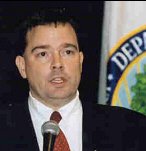
Can't let a little tooth infection get in the way of your impossible demands for all children, right, Ms. Spellings? (Photo by Linda Davidson, WaPo)

(From WaPo:

Twelve-year-old Deamonte Driver died of a toothache Sunday.

A routine, $80 tooth extraction might have saved him.

If his mother had been insured.

If his family had not lost its Medicaid.

If Medicaid dentists weren't so hard to find.

If his mother hadn't been focused on getting a dentist for his brother, who had six rotted teeth.

By the time Deamonte's own aching tooth got any attention, the bacteria from the abscess had spread to his brain, doctors said. After two operations and more than six weeks of hospital care, the Prince George's County boy died.

Deamonte's death and the ultimate cost of his care, which could total more than $250,000, underscore an often-overlooked concern in the debate over universal health coverage: dental care. . . .


Tuesday, February 27, 2007

Poverty and Neglect? No Excuses!

(Photo by Kevin Clark, WaPo)

Just down the road from the White House, the "no excuses" hardball of NCLB plays out in schools attended by the Capitol's bumper crop of impoverished children. These are the children who are commanded to perform on tests at the same level as Caitlin and Seth out in the rich suburbs of Alexandria. To expect less simply because of lead-laced drinking water, crumbling school buildings, and lives seared by poverty, would be to engage in the "bigotry of low expectations." A clip from WaPo:

Syreeta Williams, a parent at Martin Luther King Jr. Elementary School in Southeast Washington, puts bottled water in her children's backpacks rather than let them drink from the thin trickle that gurgles out of the school fountains.

Her son, Auvoen, 12, a fifth-grader, complains that the restroom near his third-floor classroom smells so bad that he walks to the second floor, a trip that keeps him out of the classroom longer, Williams said.

As a parent who also serves as a school volunteer, Williams said she wants to trust that school officials will treat King "like one of the best schools." . . .

Not the Soft Bigotry of Low Expectations, but, Rather,

. . . the case-hardened racism of unattainable demands:
School districts in North Carolina have a compelling opportunity to do the right thing for children by joining the protests in Virginia against No Child Left Behind legislation that requires all students, even those new to our country and culture, to take the same high-stakes tests.

Children who've moved to our country and are struggling with learning how to ask where the bathrooms are or how to find the music room are being asked after only one year in this country to take a reading test that requires not only literal understanding of text but high-level thinking skills and complex comprehension strategies.

To require that students new to our language take this test does not, as U.S. Education Secretary Margaret Spellings asserts (Feb. 20 news story "Schools balk at testing"), counter the "soft bigotry of low expectations." Instead, it sets them and their schools up for failure.

High expectations are indeed necessary for all students. But expectations that are unreasonable and contrary to research regarding the length of time required to become proficient in another language assault the dignity and rights of these students.

Frances Fincher

Raleigh

Monday, February 26, 2007

NCLB, er, Iraq

I hope Josh Marshall will not be offended if I use his comments about Iraq this morning to make the same points about NCLB--my brackets, not his:

"The reason our [NCLB] mission in Iraq has proven to be so disastrous and corrupt is very simple -- the advocates and architects of that [education policy] war are completely corrupt, inept, and deceitful." The words are Glenn Greenwald's. And though many others have said the same thing in slightly different words, it bears repeating again and again. The corruption and ineptitude aren't unfortunate add-ons to the effort. They're at the heart of it. It's a stain like original sin. And the same goes for the democratizing element of the [NCLB] mission. Even among critics of [NCLB] the war, it's often accepted as granted that a key aim of this effort was [closing the achievement gap] democratization -- only that it was botched, like so much else, or that the aim of [closing the achievement gap] democracy, in a crunch, plays second fiddle to other priorities. Not true. The key architects of the policy don't believe in [closing the achievement gap] democracy or the rule of law. The whole [testing scheme] invasion was based on contrary principles. And the aim can't be achieved because those anti-democratic principles are written into the DNA of [NCLB policy] occupation, even as secondary figures have and continue to labor to [close the achievement gap] build democracy in the country.

Sunday, February 25, 2007

Next Phase: Killing Off Thinking in College

John Young of the Waco Tribune-Herald has a fine op-ed on what is quickly emerging as the corporate socialists' first big move in Texas (where else?) to kill higher education the same way they are destroying K-12 education--with an anti-intellectual testing blitzkrieg and a bullying buyout of administrators who are willing to sell their integrity and trade their ethics for a wad of dollars. First though, a clip from Wikipedia on anti-intellectualism:

Anti-intellectualism describes a sentiment of hostility towards, or mistrust of, intellectuals and intellectual pursuits. This may be expressed in various ways, such as attacks on the merits of science, education, or literature. Anti-intellectuals often perceive themselves as champions of the ordinary people and egalitarianism against elitism, especially academic elitism. These critics argue that highly educated people form an insular social group that tends to dominate political discourse and higher education (academia).

Anti-intellectualism can also be used as a term to criticize an educational system if it seems to place minimal emphasis on academic and intellectual accomplishment, or if a government has a tendency to formulate policies without consulting academic and scholarly study.

John Young's op-ed from the Dallas Morning News:

Warning to students at Texas state colleges: You are about to get used again.

Students got used four years ago when, to reduce its share of college funding, the Texas Legislature deregulated tuition. College administrators then jacked the cost through the roof.

It was another hurtful wrinkle by which lawmakers could balance the budget with "no new taxes." But it was a tax on students.

Now with a new Legislature, colleges stand to play the foils again, and students stand to be on the receiving end of a royal scam.

Gov. Rick Perry has proposed to spend $362 million more on higher education, with conditions, including standardized exit-level tests. He wants to tie funding to test scores and graduation rates. He also proposes an initiative to move students through college faster.

The idea of new dollars tweaks college administrators' salivary glands. New tests? Where do we sign? We'll just make students pay for them, $25 a pop.

But college faculty members have raised an alarm.

Texas Faculty Association president Charles Zucker told the Web site Inside Higher Ed: "We've had massive amounts of teaching to the test in public schools. ... Now there's a consensus that that has failed, the governor wants to institute the same plan for higher education."

His use of "consensus" is open to debate. If education's quest is to roll out drones who, when drilled under threat of retention, will do certain state-assigned tasks, maybe Texas' "accountability" is a success. But we all thought higher education was, well, higher.

As proposed, the plan would not require college students to pass the state exams to graduate. A no-stakes test. So, no overemphasis, right?

Listen, if money is attached, those tests will be high-stakes faster than Deutsche Bank can convert rubles to yen.

What kinds of tests are we talking about?

Let's ask Education Testing Service, the General Motors of school accountability. It has exit-level tests for college seniors in several disciplines. But a host of disciplines don't have any. Sounds like new business.

Standardized testing has become a dead weight on our nation's schools with far less benefit than anyone wants to acknowledge. It is a particular drag on children at or above grade level. Meanwhile, those in the bottom reaches of achievement are subjected to stifling repetition and test prep.

With Texas leading the way, states have shown they can increase test scores, but not necessarily produce thinkers or innovators.

Speaking to Inside Higher Ed, Bob Schaefer of the National Center for Fair and Open Testing warned that with state-imposed standardized testing and with economic incentives attached, colleges would "narrow their curriculum to test preparation for the exit exam."

"Test scores may soar, but education quality will be undermined."

One of two things will happen under this proposal:

1. Time and money will be spent on tests that students know don't matter but which the state says are important in "rating colleges."

2. The state would impress on colleges how important the tests are, and more and more classroom content would be dictated by some far-off test maker.

Presto. You have homogenization and standardization of a once-vibrant creature, American higher education, long the envy of the world.

John Young is opinion page editor of the Waco Tribune-Herald. His e-mail address is jyoung@ wacotrib.com.

The Beautiful, the Bad, and the Pretty Just Got Ugly

This past week McClatchy Newspapers and the New Republic reported that 16,000,000 Americans live in severe poverty and that the rate soared by 26% between 2000 and 2005. Numbers living in the upper echelons of poverty have also increased as working people experience the full force of the "Sinkhole Effect"--or the Third-Worlding of America. The conservative solution: Close down the office at the U. S. Census Bureau that compiles these embarrassing numbers. Here is TNR's take:

So the reporters at McClatchy snapped on the rubber gloves, plunged into the dark cavities of the Census Bureau, and pulled out a stunning statistic: "Nearly 16 million Americans are living in deep or severe poverty"--a category that includes individuals making less than $5,080 a year, and families of four bringing in less than $9,903 a year. That number, by the way, has been growing rapidly since 2000. The article itself hits the usual refrains--noting that the United States spends less on anti-poverty programs than any other industrialized country outside of Russia and Mexico--but I found this bit near the end quite striking:

The Census Bureau's Survey of Income and Program Participation shows that, in a given month, only 10 percent of severely poor Americans received Temporary Assistance for Needy Families in 2003--the latest year available--and that only 36 percent received food stamps.

Many could have exhausted their eligibility for welfare or decided that the new program requirements were too onerous. But the low participation rates are troubling because the worst byproducts of poverty, such as higher crime and violence rates and poor health, nutrition and educational outcomes, are worse for those in deep poverty.

I doubt those are the only reasons for the low participation rates. As David K. Shipler reported in The Working Poor, welfare agencies spend a great deal of effort dissuading people from applying for assistance. They'll ask single mothers who come in a few perfunctory questions and then--illegally--refuse to give them an application. Or they'll design "Kafkaesque labyrinths of paperwork" that turn any attempt to obtain benefits into a full-time job. Anything to ease pressure on state budgets. Luckily, the Bush administration has taken note of all this and proposed to... eliminate the Census's Survey of Income and Program Participation, so that nosy researchers can no longer figure out how many eligible families are receiving assistance. Problem solved!

It was at least good to see that 7 of the 10 states with the highest poverty are already using high school exit exams to make sure that their citizens can compete in the global marketplace. Two others have exit exams proposed.

In the meantime, the Wall Street Journal reports this past week that bonuses for top Wall Street hustlers last year jumped 15-20%. With 2007 totals expected to exceed $26 billion, this year the average bonus will be between $2 milliion and $4 million. From the survey conducted by Prince & Associates (how appropriate), 14% of those millions paid out to the real men of Wall Street admittedly go toward " 'other' -- a category that includes hobbies such as horses and flying lessons, as well as 'mistresses and other lovers'."

And in a growing show of solidarity for the next generation of the hard-working men of Wall Street who deserve to be treated right by their women, Sam Dillon has a fascinating story on a college sorority that could represent a new national Greek strategy to weed out the brown, the black, and the heavy in order to keep their pledge numbers high and to make their coeds competitive in the local and global marketplace of highly-placed, unquestioning sluts that Wall Streeters prefer.

Perhaps these corporatist coeds will win future slots on the Fox Business News, a venue that will doubtless offer a whole new slant on the old term,"boobtube." Or at least there is the more realistic hope of sharing some of that 14% of the Wall Streeters' "other" spending that is not given over to horseback riding lessons:

GREENCASTLE, Ind. — When a psychology professor at DePauw University here surveyed students, they described one sorority as a group of “daddy’s little princesses” and another as “offbeat hippies.” The sisters of Delta Zeta were seen as “socially awkward.”

Worried that a negative stereotype of the sorority was contributing to a decline in membership that had left its Greek-columned house here half empty, Delta Zeta’s national officers interviewed 35 DePauw members in November, quizzing them about their dedication to recruitment. They judged 23 of the women insufficiently committed and later told them to vacate the sorority house.

The 23 members included every woman who was overweight. They also included the only black, Korean and Vietnamese members. The dozen students allowed to stay were slender and popular with fraternity men — conventionally pretty women the sorority hoped could attract new recruits. Six of the 12 were so infuriated they quit.

“Virtually everyone who didn’t fit a certain sorority member archetype was told to leave,” said Kate Holloway, a senior who withdrew from the chapter during its reorganization. . . .

Oh yeah, order your own t-shirt here while supplies last.

Saturday, February 24, 2007

Homegrown Terrorism and the School Privatizers

First it was the Secretary of Education, Rod Paige, referring to the NEA as a terrorist organization. Then came Reid Lyon wanting to blow up colleges of education. Now we have a local brown shirt in Minneapolis who suggests burning down a public high school. HT to Media Transparency--article from Star-Tribune:

Last update: February 17, 2007 – 7:11 PM

Samuels fans flames of public school bonfire

Don Samuels has apologized for his words, but not his views. And he isn't likely to. For the Fifth Ward City Council member from Minneapolis who suggested burning down North High School is not just one man with an opinion.

Don Samuels has apologized for his words, but not his views. And he isn't likely to. For the Fifth Ward City Council member from Minneapolis who suggested burning down North High School is not just one man with an opinion.

He is a stalking horse for a movement that wants to torch public schools. It has gotten frighteningly close to its goal.

The Center of the American Experiment, a local conservative think tank, is renewing the push for school vouchers, and it tapped Samuels to endorse its position paper. In his foreword to the recent publication, Samuels again displays a flair for the dramatic, writing that he wonders "how many future murderers are in the first grade classes of the four elementary schools within a mile of my home?"

Officer, arrest those first-graders!

But if you take Samuels seriously, it is not just his language that is lousy. It is his policies.

Samuels has become the darling of a coalition of mostly conservative, mostly suburban groups involved in a coordinated assault on "government monopoly schools." These groups are pushing hard in Minnesota for expanded tax-credit or tuition vouchers to allow public dollars to be spent on private schools. It isn't just people in the North High neighborhood who should worry about that.

Some groups pushing for vouchers have fought to outlaw gay marriage or to keep children from receiving sex education or learning about evolution. They have a right to send their kids to religious schools. They don't have a right -- Article XIII of the State Constitution bars public funding for "sectarian" schools -- to subsidize such schools with tax dollars.

Nevertheless, the crusade is on. And Samuels is its hero.

Other black leaders are being lobbied to convert to the vouchers cause. One, NAACP President Duane Reed, says he recently refused requests to testify on behalf of a vouchers/tax credit bill in the Legislature. He says the request came from a group affiliated with the Libertarian Party, whose platform praises tax credits and charter schools as "interim measures" that will help kill the public schools.

"This is not about Don Samuels," Reed said at Thursday night's public meeting at North High with Samuels. "This is about ... tax credits. Which is just a code word for vouchers. This is just teeing up a sensational issue."How many black leaders support vouchers?" he said to me later, proceeding to tick off a long list of black groups, starting with the NAACP, that oppose them. "Now Don Samuels all of a sudden is an expert, and he is going to speak for us? I don't think so."

Charter schools, funded with public funds, were supposed to help produce new teaching methodologies and education strategies. Other states limit their number. New York has a limit of 100. Iowa has a limit of 10. Minnesota has no limit. Today, we have 131 charter schools, with 23,600 students. At least 19 more charter schools are on the way.

How much is too much?

The largest sponsor of charter schools, Friends of Ascension, has ties to former state Republican chairman Bill Cooper, who has served on the group's board of directors. Friends of Ascension has 16 schools with 2,800 students (12 percent of charter school enrollment). Nor is Cooper the only former Republican Party chair to have found a keen interest in the inner city.

Former GOP chairman Ron Eibensteiner and his wife are the founders of KidsFirst Scholarships, which award privately funded vouchers to children (650 this year) to attend private schools. Those scholarships are funded by grants from right-wing billionaires such as Ted Forstmann and the late John Walton of the Walton Family Foundation. Critics such as the liberal People for the American Way point out an obvious motivation: By handing out private vouchers in the inner city, conservatives hope to create political momentum for state vouchers that will damage public schools.

Not to mention the teaching of evolutionary science.

The fire has been set. Public schools have lost thousands of students to charter schools and open enrollment, and that exodus has been folded into "drop-out rates" that have been recklessly exaggerated by radical opponents of public education, including Don Samuels.

This is not just an intramural squabble in the black community. All supporters of public education should be worried. It is not just North High that is under assault; it is the very idea of public education.

As an inner-city politician with friends in high places, Samuels didn't set the schools ablaze. He just fanned the flames. But his friends are dancing around the bonfire.

Nick Coleman • ncoleman@startribune.com

On a National Day of Teacher Conscience

In an America I never knew that I could know, teachers quiver and quake for their jobs as national policymakers demand of them actions that, in fact, assure the destruction of children, of public schools, of their own profession. They cower in teacher rooms and whisper about getting fired for signing a petition that calls for the repeal of the Big Lie, No Child Left Behind. They move from class to class with their idiotic slides and "dittos" and mastery motivational talks provided by the testing/textbook company chosen for its willingness to pay the most to get the business. They angrily proclaim over lunch how they have learned years ago to keep their mouths shut and to do what they are asked to do (anger is always the self-selected moral choice when cowardice is the only perceived alternative).

They grind from one school day to the next, cajoling and saluting and marching their children along shiny hallways like prisoners at the correctional facility. They are preoccupied by the bonus pay they could earn from higher test scores, as they shop the real estate ads for an affordable gated community carved into some barren red hillside in South Carolina, a place where they may retire in peaceful repose, knowing they served well--knowing that the next generation will be in good hands.

What will you do on a National Day of Teacher Conscience? Go the Walmart? Walk out? Stand up for the Code of Ethics that your professional organization has apparently forgotten they adopted?

They may have something specific that is emerging in Virginia. Could it be, conscience? Will you support them?:

. . . . Denunciations of the No Child Left Behind law's testing rules are multiplying in immigrant-rich Northern Virginia. In Fairfax and Arlington County, educators are preparing to defy the rules even though they are at risk of losing federal aid; other area officials are moving more cautiously.

Federal officials have said repeatedly that grade-level testing is needed for immigrant students after they have been in U.S. schools for one year, a requirement they say will help hold schools to high standards. Most states, including Maryland, are following the rules. So are D.C. public schools, officials say.

U.S. Education Secretary Margaret Spellings has criticized Virginia educators who are resisting. "It's time to remember that yes, Virginia, there is a Standards Clause," Spellings wrote recently in a caustic open letter.

Fairfax, with the region's largest school system, has led the state's rebellion. The county School Board voted in January to continue giving proficiency tests to immigrant students who have not progressed enough to take grade-level tests that assume language fluency. Fairfax school officials appear to be standing firm even though the U.S. Department of Education has threatened to withhold $17 million in aid if the county follows through with its plan. . . .

Friday, February 23, 2007

New OIG Report Exposes DIBELS, DI, and Open Court Corruption Links


Photos (Roland, Doug, Reid, and Chris) from the Know Your Reading First Offender Series.


The Reading First story just gets slimier and slimier. Now ED's own OIG comes with, yet, a new report (MS Word) detailing how the U. of Oregon's Carnine Cabal, Roland Good's DIBELS, and McGraw-Hill's Open Cult, er, Court were installed as the weapons of choice in the Reading First war on children's learning and thinking abilities.

After Lyon, the White House (Spellings), Paige's ED, and the Oregon Mafia put together the Reading First Program so that their expertise and products would be clearly advantaged in meeting program requirements they had just written (background here), the phonics phonies set about calling leaders and education officials from all fifty states to Washington for Reading Leadership Academies (RLAs). The cabal selected presenters, then, whose use of the Direct Instruction, DIBELS, and Open Court served as models for reading officials across America. Here are some clips from the Report. First, the agendas for the the 3 RLAs:
Reading Leadership Academy (RLA)
Panel Member - Position at the time of the RLA Reading Programs Discussed

RLA 1, Jan. 23-25, 2002 Principal, City Springs Elementary, Baltimore, MD Direct Instruction
Reading Facilitator, Parham School, Cincinnati, OH Direct Instruction
Principal, Parham School, Cincinnati, OH Direct Instruction
Teacher, Tovashal Elementary School, Murrieta, CA Open Court

RLA 2, Feb. 13-15, 2002
Principal, City Springs Elementary, Baltimore, MD Direct Instruction
Asst. Administrator, Washington Reads, WA Office of the Superintendent of Public Instruction, Olympia, WA Open Court, Read Well
Principal, Weaver Elementary School, Weaver, AL Soar to Success, Houghton-Mifflin,8

RLA 3, Feb. 20-22, 2002 Principal, City Springs Elementary, Baltimore, MD Direct Instruction
Principal, Parham School, Cincinnati, OH Direct Instruction
Asst. Superintendent, L.A. Unified School District, CA Open Court
Here are some of the comments from feedback forms of those attending the RLAs:

RLA Participant Comments

As a result of the Department not having controls to ensure compliance with the DEOA, and the NCLB Act prohibitions against endorsing or promoting programs of instruction, some attendees at the RLAs felt that the Department was endorsing the Direct Instruction and Open Court reading programs. The comments expressed on the evaluation forms from the first and third RLAs included--

· “The . . . Theory to Practice Panel – was very poor. It sounded like a sales job for a program as opposed to a description of enabling teachers to teach reading.”

· “I felt like it was simply a push for a national curriculum. I think I’ll go buy shares in Open Court!”

· “Panel was a sales job for Direct Instruction and Open Court.”

· “Please do not promote a program (Open Court) (Direct Instruction). This is not the Department of Education’s place to do.

· “I felt like I was in a Direct Instruction sales pitch all day. Thanks for including at least one other program.”

· “I felt it was wrong to showcase one specific program (D.I.) excessively . . ..”

· “Today’s sessions may have given an excessive government endorsement to Direct Instruction.”

From the OIG's Executive Summary:
With regard to the RLAs, we concluded that the Department did not have controls in place to ensure compliance with the Department of Education Organization Act (DEOA) and NCLB Act curriculum provisions. Specifically, we found that: 1) the “Theory to Practice” sessions at the RLAs focused on a select number of reading programs; and 2) the RLA Handbook and Guidebook appeared to promote the Dynamic Indicators of Basic Early Literacy Skills (DIBELS) Assessment Test. With regard to RMC Research Corporation’s (RMC) technical proposal for the NCRFTA contract, we concluded that the Department did not adequately assess issues of bias and lack of objectivity when approving individuals to be technical assistance providers before and after the NCRFTA contract was awarded.

We recommend that the Assistant Secretary for Elementary and Secondary Education –

*Establish controls to ensure compliance with, and avoid the appearance of violating the DEOA and the NCLB Act curriculum provisions, especially when organizing conferences where specific programs of instruction are likely to be formally discussed or presented at Department sponsored events;
*Establish controls to ensure it does not promote curriculum or create the appearance that it is endorsing or approving curriculum in its conference materials and related publications; and
*In coordination with the Chief Financial Officer, establish controls to ensure adequate assessments of bias and lack of objectivity for individuals proposed to perform Department contract work are conducted by the Department and its contractors.

"just tired of doing the wrong thing for kids"

Five counties in Virginia have banded together to stand up to the privatizing thugs at ED who are bent on sacrificing the most vulnerable children in order to manufacture the failure of American public schools. From Media General News Service:

. . . . Some superintendents say it is "morally wrong" to force students who cannot read English to take the same reading test as fluent English speakers.

Cannaday [Virginia's State Superintendent] sides with the school districts.

"If the coin was flipped and someone put a test in front of me in Mandarin Chinese, they'd see a grown man cry," Cannaday said. "No reasonable person would conclude this is fair and just."

Education Secretary Margaret Spellings says the tests tell schools whether they are on track to reach the law's goal of all students reading and doing math at grade level by 2014.

"You don't get there by saying, 'we'll wait another year or another two years,'" before testing the students, said department spokesman Chad Colby.

In a Jan. 31 letter to Virginia officials, Simon wrote, "If (the school districts) in Virginia do not comply ... this department may take appropriate action against the state."

School superintendents across the country are looking at Virginia's challenge, said Bruce Hunter of the American Association of School Administrators.

"The rules for assessing kids who don't speak English don't make sense to school people," Hunter said. "People have put up with this for five years, and they're just tired of doing the wrong thing for kids."

The No Child law is up for renewal this year. School districts want to make a statement that it needs to be changed, Hunter said.

At least six school districts in Virginia - Arlington, Fairfax, Frederick, Prince William, and Amherst counties and Harrisonburg city schools - have passed resolutions saying they will not comply with this regulation. Both Manassas and Alexandria city schools have a resolution on their agendas.

Cannady said the state has made good progress in teaching English to the children of immigrants and that school districts should not be held to a one-size-fits-all federal rule.

"We are being placed in a position by the Department of Education to do something that is morally wrong," said Harrisonburg Superintendent Donald Ford, who would like to exempt about 250 of the 1,600 students in the district's English as a Second Language program.

Fairfax County superintendent Jack Dale said most of the students struggling to learn English are recent arrivals to America.

"It's not like they have been sitting here since birth and they're still struggling to learn English," he said. "Kids should be exempt for at least two or three years after they arrive."

Bailey's Elementary School in Fairfax County sits just a few blocks from a 7-Eleven where immigrant day laborers gather to find work. This week Kent Buckley-Ess taught English language learners to use active verbs.

He wanted them to change the sentence, "The baby took the toy."

The fifth graders struggled to find the right words as they sorted through their limited vocabulary.

"The baby grabbed the toy," said Isael Ramos, whose parents are from El Salvador

"The baby whacked the toy," said Fatima Henriquez, who was born in El Salvador.

For Maria Magdaleno Quiroz, who arrived from Mexico last summer, the lesson was difficult. Asked through an interpreter whether she understands what's going on in school, she replied, "It's easier than in September."

Buckley-Ess said he constantly assesses the students' progress and makes changes to improve the lessons. Even the Education Department's own reports say it takes two to three years for a student to speak English socially, he said, and five or six years to understand school work.

Asked how many students in this class could pass the 5th grade reading evaluation, he paused. "Maybe one."

"That test will only tell us how good they are at guessing A,B,C or D," said Bailey's principal Jay McClain. "We need a test that is refined to where the students are and then we want to be held accountable that they are making progress."

(Gil Klein can be reached at gklein@mediageneral.com).

Thursday, February 22, 2007

Reading First and the Breaking of Federal Law

As a result of a nice piece of reporting from Kathleen Manzo at Ed Week, we now can see deeper into the inner workings of the Reading First corruption scandal that is still waiting for Congress to care enough to do something about it. In the meantime, of course, an entire generation of children are learning codebreaking rather than thinking as a result stormtrooper tactics by these dangerous crackpots with links all the way into the White House.

What Manzo's piece shows is a lean direct chain of command from Spellings to Reid Lyon to Reading First Director, Chris Doherty, who lost his job when the OIG first issued its report detailing some of the corrupt bullying that was standard operating procedure by political hacks and crazed ideologues, whose agenda could not deterred by the requirements of the Law. Just one example from of Chris-stroking that comes from the West Wing office of Spellings through her conduit, Reid Lyon:
"Mr. Lyon: 'wow – Talk about a guy with smarts, integrity AND balls,” he wrote. “I am talking about you Chris'."

Balls, indeed. A big clip:
E-Mails Reveal Federal Reach Over Reading
Communications show pattern of meddling in ‘Reading First.’

By Kathleen Kennedy Manzo

The Reading First initiative’s rigorous requirements have earned it a reputation as the most prescriptive federal grant program in education. Now, an Education Week review of hundreds of e-mail exchanges details a pattern of federal interference that skirted legal prohibitions.

In the midst of carrying out the $1 billion-a-year program, which is part of the No Child Left Behind Act, federal officials:
  • Worked to undermine the literacy plan of the nation’s largest school system;
  • Pressured several states to reject certain reading programs and assessments that were initially approved under their Reading First plans;
  • Rallied influential politicians, political advisers, and appointees to ensure that state schools chiefs stayed on track with program mandates; and
  • Pressed one state superintendent to withdraw grant funding from a district that demoted a principal in a participating school.
In regular e-mail discussions, Christopher J. Doherty, the Reading First director at the U.S. Department of Education until last September, and G. Reid Lyon, a branch chief at the National Institute of Child Health and Human Development until June 2005 and an influential adviser to the initiative, closely monitored states’ progress in applying for Reading First money, in issuing subgrants to districts, and in complying with the law’s provisions for scientifically based instruction. They also worked out strategies for intervening where they deemed more federal control was warranted.

“We ding people all the time in Reading First,” Mr. Doherty wrote in March 2005, after he pressured Illinois education leaders to pull funding from a district. “We don’t like to do it, of course, but we do it because otherwise RF turns to crap and means nothing, just another funding stream to do whatever it is you were going to do anyway.”

Some former federal officials and supporters of the program argue that such oversight was essential to its success, but a number of state and local officials took offense and questioned whether Reading First staff members exceeded their authority. Some policy experts say they came close to doing so.

“That’s an unprecedented level of interference,” said Christopher T. Cross, a policy consultant for Cross & Joftus LLC in Danville, Calif. Mr. Cross helped write the ban against federal intervention in curriculum and instruction into the Elementary and Secondary Education Act in the 1970s and later served as an assistant secretary in the Education Department under President George H.W. Bush.

The language was left in when the law was reauthorized as the No Child Left Behind Act in 2001. It states that federal employees are prohibited from exercising “any direction, supervision, or control over the curriculum, program of instruction, administration, or personnel of any educational institution, school, or school system.”

“The intention when that language was put into the statute,” Mr. Cross said, “was that these were decisions that had to be made at the local level in connection with local standards. I think there’s no question what went on [in Reading First] is right on the border of crossing the line on that provision.”

Showdown in Rockford

A highly critical report issued by the Education Department’s inspector general last fall concluded that federal officials may have overstepped their authority in crafting the strict requirements. Inspector General John P. Higgins Jr. also said those officials seemed to favor a particular instructional method while discrediting others. ("Scathing Report Casts Cloud Over ‘Reading First’," Oct. 4, 2006.)

The crass and sometimes vulgar e-mail exchanges that underpinned the inspector general’s findings stunned many educators and policymakers. The findings led to a shakeup in the department’s Reading First office.
But advocates of the program, and allies of Mr. Doherty, protested that the report was overblown and had unfairly selected sensational e-mails to paint a dedicated and effective employee as a rogue operator within the department. The e-mail record, however, shows Mr. Doherty’s aggressive and arrogant tone repeated in messages to Mr. Lyon and other colleagues.

The e-mails were obtained by Education Week and a complainant in a case against the Department of Education through the Freedom of Information Act.

E-mail Excerpts

I am going to review all my [Indiana] files on Monday. Having done no subgrants yet, it may be hard to make something stick, but if they are trying to go soft with the requirements, they are just as good a candidate as any other state to show them/the rest that RF is NOT just another federal reading program that can be flouted.
—Reading First Director Christopher J. Doherty to G. Reid Lyon, a branch chief for the National Institute of Child Health and Human Development, citing concerns that Indiana officials may not be taking Reading First requirements seriously enough, March 2, 2003

Monitoring will be key as usual. They will game the system if they can. They think they have already done everything and are getting the RF bucks to shine shit. How strong should I be with respect to guidance at the highest state level. I will meet with Gov. [Kathleen] Sebelius in the morning. How detailed should I be with respect to the shortcomings.
—Mr. Lyon to Mr. Doherty regarding Kansas’ Reading First program, April 16, 2003

I have been in good, regular touch with Everett Barnes, pres. Of RMC Research Corp., which does both [Reading First Technical Assistance] and some [Comprehensive] Center work, too re: the Shaywitz report and I am very happy to learn that you find it scathing and clear in its conclusions/recommendations. Not happy that NYC is doing something this bad, of course, just glad that the report is not the usual equivocating ‘On the one hand,..but on the other…’ kind of stuff.…this is not a ‘dueling experts’ kind of thing. This has the Flat Earth Society on one side and people who own/understand globes on the other.
—Mr. Doherty to Mr. Lyon, referring to a review of New York City’s literacy plan, Aug. 29, 2003

Confidentially: …Well, I spoke to [a New Jersey official] with a roomful of others on their end and they are HALTING the funding of Rigby and, while we were at it, Wright Group. They STOPPED the districts who wanted to use those programs. We won in Maine, we won in New Jersey. Morale is sky high across the country. State plans have gone from–on average–crap, to each one being–at least on paper–strong and aligned with [scientifically based reading research], and we have lots of monitoring muscle to flex and [technical assistance] brains to provide. Strong law, great funding, solid, guiding science. We are winning.
—Mr. Doherty to Mr. Lyon, in reference to the rejection of reading textbooks that they viewed as not meeting federal requirements, Sept. 5, 2003

Just got off the phone (again) with Randy Dunn. He confirms that [Illinois] has frozen Rockford’s RF remainder of $638,633 and we are working on finalizing this together. Please, close hold. There are/will be be consequences for Rockford’s idiocy. And kids, unfortunately, are paying for the decisions of adults, again.
—Mr. Doherty to Mr. Lyon, Feb. 15, 2005
SOURCE: National Institutes of Health

Some state and local officials said they felt bullied by Mr. Doherty. One such case played out in Rockford, Ill., in early 2005, after federal officials received e-mail messages about a principal at a Reading First school there. The principal was reassigned after battling with district officials over reading instruction at Lewis Lemon Elementary School. The new superintendent, Dennis Thompson, and district director of instruction Martha Hayes wanted the school to supplement its direct-instruction model with more varied reading selections and writing activities after determining that students weren’t being prepared for the more rigorous coursework of the later grades.

The principal received help from a local supporter of the National Right to Read Foundation, which promotes phonics instruction. Robert W. Sweet Jr., then an influential senior analyst with the education committee of the U.S. House of Representatives and the founder of the NRRF, asked Mr. Lyon to look into the matter. Mr. Lyon corresponded with Mr. Doherty, a direct-instruction advocate, about the need to apply pressure to state leaders in Illinois.

In March of 2005, after numerous telephone discussions and a meeting with state schools Superintendent Randy Dunn, Mr. Doherty sent a letter to the state, expressing his dissatisfaction with Illinois’ implementation of the grant. Mr. Doherty cited the Rockford case and the state’s hiring of an employee for the Reading First program who he thought did not subscribe to scientifically based reading research. He informed Mr. Dunn that the state was being “designated in need of corrective action,” and would be subject to additional monitoring, consequently risking the loss of millions of dollars in future grant funding.

“Clearly, there were issues of program compliance in Rockford, and we were working to address them,” said Mr. Dunn, the state schools chief until last month. “But the situation with the principal there had given a great entree to the feds to start wielding a heavy hand. They took an opportunity with a situation that was kind of separate from the Reading First program to get ahold of us, the state, directly by the throat.”

Mr. Thompson, the district chief, said the issue was a personnel matter, unrelated to Reading First. He said he wasn’t even aware that federal officials were involved and kept apprised of the situation in Rockford until informed by Education Week.

Mr. Doherty and Mr. Lyon e-mailed each other repeatedly about the situation, sometimes in response to Mr. Sweet’s queries. They expressed outrage at what appeared to them to be mistreatment of the principal and district officials’ undermining of the direct-instruction program with “their ill-fated wrong turn to balanced literacy.”

Although “balanced literacy” is viewed by many educators as an approach incorporating a variety of skills- and literature-based reading methods, it is considered code for “whole language” by Mr. Doherty and others pushing more explicit and systematic instruction.

The field of reading instruction has been marked for decades by disputes over the best approach to teaching reading—generally speaking, a phonics-based vs. a literature-based approach. Over the past decade, a consensus has emerged that a combination of approaches is best, although there is still considerable debate over how much skills instruction is needed.

In response to Mr. Doherty’s demands, Illinois tried to send a monitoring team to investigate Rockford’s Reading First program. Mr. Thompson refused to cooperate with the state officials and federal consultants who visited, saying the short notice would have disrupted schools’ operations. Mr. Doherty then directed the state to freeze the district’s funding, and ultimately to withdraw the grant. Those actions prompted another e-mail from Mr. Lyon: “wow – Talk about a guy with smarts, integrity AND balls,” he wrote. “I am talking about you Chris.”

The principal at Lewis Lemon Elementary sued the district. District officials said a settlement was reached in the case, but could not discuss the details.

“They made all these judgments about us when they knew absolutely nothing about what we were doing,” said Mr. Thompson, who added that he was perplexed how the revisions to the reading plan could be perceived as whole language. “We ended up getting into a war of labels.”

Mr. Doherty would not comment for this story. Sandi Jacobs, who helped administer Reading First as a senior program specialist with the Education Department, said she and Mr. Doherty believed that the Rockford district was “severely and significantly out of compliance.” They then pressed state officials to deal with the matter.

New York Story

In New York City, federal officials jumped into the fray over reading instruction months before the state even applied for Reading First money. When city Schools Chancellor Joel I. Klein unveiled his plans for a districtwide literacy framework in January 2003, his action drew criticism from a number of reading experts, who argued that a highly structured, phonics-based program would serve students better than the literature- and writing-based plan.

Rod Paige, the U.S. secretary of education at the time, asked Mr. Lyon to help city officials in understanding the research on effective instruction, according to an account of the events Mr. Lyon sent in an e-mail to a prominent reading researcher. A group of researchers associated with the NICHD, Mr. Lyon’s agency, then wrote a letter to Mr. Klein detailing why they believed his “balanced literacy” program was not sufficiently research-based. The researchers subsequently met with Deputy Chancellor Diana Lam and other district officials to discuss their evaluation.

“New York City was a big concern, and legitimately so,” Mr. Lyon said in an interview this month. “If you put in place a new program that changes the rules, and you have a city like New York get the money and flout the rules, then everyone else would want to do the same thing.”

After district officials added a stronger phonics text, one of the researchers involved in the review told Education Week she considered it a sound instructional approach. ("N.Y.C. Hangs Tough Over Maverick Curriculum," Oct. 15, 2003.)

Balanced Literacy Rebuffed

But later in 2003, as New York state was negotiating with federal officials over its final Reading First plan, federal officials and consultants took another stab at persuading city officials to take a different tack on reading instruction.

In the interview, Mr. Lyon said state officials requested guidance on how New York City could meet Reading First criteria. Sally Shaywitz, a Yale University professor and a member of the National Reading Panel—a congressionally mandated committee that issued an influential 2000 report on reading research—and two other researchers conducted the review.

Mr. Lyon helped arrange for those researchers to meet with Chancellor Klein to outline their findings and discuss how the city’s schools could benefit from a commercial core program for reading, instead of the customized framework the city had crafted.

A federal contractor for Reading First oversaw the review and recommended that a task force, consisting of Ms. Shaywitz and other key researchers, be appointed to help the district choose an appropriate program.
Mr. Lyon regularly checked in with Mr. Doherty of Reading First to ask, “Can you brief me on the status of the NYC RF application as I am getting Qs from higher.” The request continued: “Did they do the right thing?” Later, Mr. Lyon indicated that there was “WH interest.”

The former NICHD branch chief, who managed the $120 million grant program for reading research at the National Institutes of Health in Bethesda, Md., asked another researcher, an author of the Open Court commercial reading curriculum, to help him make the case for a structured, comprehensive core program. Mr. Lyon said he sought advice from the researcher, Marilyn Adams, because of her long-standing reputation in reading research. He did not consider her link to Open Court a conflict of interest because her commitment was to the research first. “I need good data fast,” Mr. Lyon wrote to Ms. Adams in August 2003, after describing Mr. Klein’s reluctance to adopt “an evidence based program like Open Court” because of the mixed results of the program in other big cities, and the alternative approaches being used in Boston and San Diego. “I think he will listen if we can show gains from evidence based programs.”

Mr. Lyon also acknowledges in the e-mail that the text was just one of the essential components, “teachers and implementation being as important.”

In e-mails to Margaret Spellings, who was President Bush’s chief domestic-policy adviser before becoming education secretary, Mr. Lyon discusses “NY City,” according to the subject line. All but one line was redacted under an exemption in the federal freedom-of-information law that considers pending decisions to be confidential. In the end, Mr. Lyon asks, “Let me know if you want me to do anything.”

In sharing the message with Mr. Doherty, Mr. Lyon commented: “Gees – this never stops – we have to win this one.”

When the Education Department inspector general’s report was released, now-Secretary Spellings said that the problems cited “reflected individual mistakes.” But at least one former Education Department official has suggested that Ms. Spellings was deeply involved in the program while working at the White House.

“She micromanaged the implementation of Reading First from her West Wing office
,” Michael J. Petrilli, who worked in the department from 2001 to 2005, under Secretary Paige and Secretary Spellings, wrote in the National Review Online last fall. “She was the leading cheerleader for an aggressive approach.”

Mr. Petrilli, now a vice president of the Thomas B. Fordham Foundation, a Washington think tank, has argued that Mr. Doherty did what officials in the White House and Congress expected him to do.

Ms. Spellings has not responded to the allegations about her role. The Education Department did not respond to a request for comment last week.

New York state was awarded it’s Reading First grant in September 2003. In the end, New York City relented and chose a commercial reading program—Harcourt Trophies—for its 49 Reading First schools, but stuck with the balanced-literacy program to guide reading instruction at other schools.

The 1.1 million-student district’s Reading First funding is considered vulnerable because the inspector general found its grant application should not have been approved, and recommended that the state take back its $107 million grant.

Chancellor Klein would not comment for this article. But in a August 2003 interview with The New York Times, he said: “I think it’s a ‘less filling/tastes great’ debate. I don’t believe curriculums are the key to education. I believe teachers are.”

Fingerprints Elsewhere

Many other Reading First details large and small came to the attention of Mr. Lyon and Mr. Doherty between 2003 and 2005, which they discussed by e-mail. Mr. Lyon also visited states to provide guidance on Reading First.

In March 2003, for example, he agreed to meet with a handful of Indiana legislators who requested his advice on ways to ensure that state officials adhered to Reading First mandates. Mr. Lyon suggested the state would need extra monitoring because of the potential for noncompliance, which could send a message to other states of the consequences of not adhering to the requirements. The legislators had suggested to Mr. Lyon that state education officials in Indiana were not ready to abandon its existing reading approach.

After meeting with officials in Louisiana and North Carolina, Mr. Lyon told Mr. Doherty that they needed to discuss various issues of concern, including the assessments and consultants that the states were planning to use under their Reading First grants. The two federal officials discussed Louisiana’s desire to use an assessment for Reading First schools that they did not deem research-based, and Mr. Lyon suggested to a North Carolina administrator that a textbook by a well-known reading researcher was inappropriate for use in Reading First training sessions.

Local educators, researchers, community leaders, or parents alerted them to some issues.

One New Jersey parent asked Mr. Lyon for help in July 2003, because state officials were allowing the use of a Wright Group reading program, owned by the McGraw-Hill Cos. She didn’t consider the text research-based. Mr. Lyon alerted Mr. Doherty. The Reading First director recalled that “we forced Maine to drop the bad program.” By September 2003, nearly a year after New Jersey’s grant had been approved, New Jersey officials disallowed funding for the text.

“As you may remember, RF got Maine to UNDO its already made decision to have Rigby be one of their two approved core programs (Ha, ha – Rigby as a CORE program? When pigs fly!) We also as you may recall, got NJ to stop its districts from using Rigby (and the Wright Group, btw) and are doing the same in Mississippi,” Mr. Doherty wrote in October 2003. “This is for your FYI, as I think this program-bashing is best done off or under the major radar screens.”

In May 2005, Harcourt Achieve Inc., which owns the Rigby Literacy program, issued a press release outlining changes it made to the program to ensure it aligned more closely with research. The changes were prompted, the company said, by deficiencies that were brought to light by the Reading First grant reviews.

And when a Texas consultant informed Mr. Lyon and Mr. Doherty of breaches in that state’s Reading First program by the interim state commissioner of education, they debated in a series of e-mail exchanges with a researcher how best to get state officials back in line. They discussed getting influential advisers to the Bush administration, and federal officials with Texas ties, to put pressure on the state education department. . . .

Wednesday, February 21, 2007

Let 'Em Eat Ivory Soap

"Since Spellings never worked in a school system, and has no formal training in education (her B.A. is in political science), she is free to make educational policy on purely ideological grounds, unencumbered by the real problems facing America’s teachers." -- Howard Karger, professor of social work at University of Houston.

Now that NCLB is well-entrenched in K-12, Margaret Spellings has set her sights on higher education and the view is anything but pretty.

The poster mom for NCLB, (or as I like to call it these days, PIS, since Spellings claims it is "pure as Ivory Soap"), is busy setting the table for bigger profits that could make her friends in the testing industry even richer. All this while sucking the quality out of institutions of higher learning and creating a world in which liberal thought or any thought for that matter, will be a relic of ancient history. If she and her cronies have their way, the United States sink into the economic and educational abyss.

A professor of social work gives us a glimpse into the educational world of the rich and famous and the world of everyone else. It is a world in which any real education will be reserved for those who can afford the price tag. In the new ownership society, education will become a luxurious commodity for those who can buy their way out of being tested and measured into oblivion, as it is now becoming with public schools struggling under the weight of number 2 pencils. And, all those professors who thought they could seek refuge from the testing madness and accountability in K-12 will find themselves and their students filling in the bubbles once again.
--------------------------------------------
Mandatory testing of college seniors will have a profound effect on higher education. Colleges with low scores on standardized tests—often heavily minority—could be punished by reduced state funding. Federal research dollars might also be linked to student test scores. Outcomes might determine whether some colleges are even denied federal student loan funds.

If the Spellings Commission report led the horse to water, Republican governors like Texas’ Rick Perry are ready to make that pony drink. Texas is the home of standardized testing—out of a 180-day school year about 120 days are devoted to testing or preparation. So it’s predictable that Perry’s new plan for educational reform includes standardized testing for college seniors. While students initially won’t have to pass the test to graduate, high scores will mean extra money for colleges, and extra money is something that cash-starved Texas universities can’t resist. The Texas Faculty Association’s Charles Zucker says, “It’s so ironic because, just at the point where we’re beginning to develop a widespread consensus that teaching to the test has been a miserable failure in K-12, now the governor wants to do it for higher education.” The danger, of course, is that other state governors will follow suit. (By the way, standardized testing for college seniors won’t be cheap. Education Week ’s annual report found that school districts pay many millions for these tests.)

Since money will be attached to scores, college administrators will push for more basic courses geared to the test material. Math and science will increasingly replace the soft subjects like anthropology, sociology, history and philosophy. Say goodbye to diverse and interesting college courses. There’s no room for nuance or variety in an outcome-driven learning model.

College professors who reject standardized testing will either be disinvited from the academy or leave out of disgust. Most casualties will be progressive instructors interested in teaching critical content. Their replacements will be educational technicians or hungry adjuncts willing to teach for peanuts. Textbooks—like those in high school—will be standardized and used across public universities, a move that will make textbook publishers happier and richer. Since cost-cutting is a concern for the Spellings Commission, cheaper teaching models like distance education and online courses will increasingly replace traditional and more expensive classroom settings. While some private schools will still offer a rounded education, it will be only for those who can afford the $30,000 to $40,000 a year in tuition and board.
----------------------------------------------------------------------------
Let 'em eat Ivory Soap.

It Takes Balls

Historically, schools have been ground zero for playing out the battles taking place in the world of grown ups. But, in a recent story taking place a few miles from New York City, both young and old Christian warriors are taking on 16-year-old Mathew LaClair who still believes that the U.S. Constitution should protect public school students from being told they that if they do not believe in Jesus they "belong in hell,"and that there is no scientific basis for evolution, and that dinosaurs were on Noah's ark.

The story was reported widely in the press a few months ago, but since Mathew recorded a popular history teacher and disseminated the tape outside the school district, he has received death threats and has been bullied by fellow students who don't understand why this is a big deal. Meanwhile, the school has since instituted a new policy that requires students to get permission from the administration, teachers and classmates to tape a teacher.
On the other side of this battle are the American Civil Liberties Union, the People for the American Way Foundation, and a partner from a large Manhattan law firm who are threatening to sue the Kearny Board of Education if their complaints are not resolved.
------------------------------------------------
Since Matthew turned over the tapes to school officials, his family and supporters said, he has been the target of harassment and a death threat from fellow students and “retaliation” by school officials who have treated him, not the teacher, as the problem.
The retaliation, they say, includes the district’s policy banning students from recording what is said in class without a teacher’s permission and officials’ refusal to punish students who have harassed Matthew. Matthew and his parents, Paul and Debra LaClair, are demanding an apology to Matthew and public correction of some of Mr. Paszkiewicz’s statements in class.

The LaClairs filed a torts claim notice on Feb. 13 against the school board, Mr. Paszkiewicz and other school officials. Such a claim is required before a lawsuit can be filed in New Jersey. “The school created a climate in which the students in the school community held resentment for Matthew,” said Deborah Jacobs, executive director of the A.C.L.U. in New Jersey. She said Kearny High School had “violated the spirit and the letter of freedom of religion and the First Amendment.”
------------------------------------------------------------
Meanwhile, on another battlefront, librarians are keeping children "scrotum free" and safe from the dark porn of the Newberry Award winning book The Higher Power of Lucky, a children's book. The story is about a dog that gets bit by a rattlesnake on his scrotum. Apparently, it has parents in an uproar and the Department of Education and Miss Margaret likely haven't been this outraged since they launched their war against Buster the Bunny.
-----------------------------------------------------
From the New York Times:
The inclusion of the word has shocked some school librarians, who have pledged to ban the book from elementary schools, and reopened the debate over what constitutes acceptable content in children’s books. The controversy was first reported by Publishers Weekly, a trade magazine.
On electronic mailing lists like
Librarian.net, dozens of literary blogs and pages on the social-networking site LiveJournal, teachers, authors and school librarians took sides over the book. Librarians from all over the country, including Missoula, Mont.; upstate New York; Central Pennsylvania; and Portland, Ore., weighed in, questioning the role of the librarian when selecting — or censoring, some argued — literature for children.
----------------------------------------------------------------------------
With all those balls being thrown around, it's likely someone is going to get hurt.


Tuesday, February 20, 2007

Bringing Your No. 2 into the Pew

Nick Lemann documents in the The Big Test Lewis Terman's crackpot notion to retrospectively derive the IQs of famous men, from Leonardo to Lincoln. Never mind that it was, as Lemann kindly puts it, a complete crock: it worked in the media to publicize Terman's new crude instrument for sorting people, the IQ Test.

In a development that makes Santayana's dictum about conditions for repeating the past ever the more prescient, the present-day orgy of tabulation has moved even into religious sanctuaries once more, and test enthusiasts such as Reverend Simms are eagerly measuring their flocks' profiles with assessments sold by religious publishers who are hitching a ride on the testing gravy train:

Greeting churchgoers as an usher or playing hostess at church socials never came easy to Vera Finney.

And after her pastor asked her to sit down with a No. 2 pencil and a multiple-choice questionnaire, the lifelong churchgoer finally figured out why.

"Hospitality" doesn't rank high among Finney's God-given gifts, the 110-question "spiritual gift assessment" revealed. Instead, Finney's responses suggested that God has bestowed on her the gifts of teaching, administration and exhortation.

The test Finney took is just one of a growing variety of assessments, or "spiritual inventories," offered by Christian publishing companies and denominations. Some types of assessments have been available for decades. But local pastors say their widespread availability for free on the Internet and a renewed interest in defining spiritual gifts have prompted them to begin offering the assessments in recent years.

"I believe that your gifts come from God, that he has gifted each and every one of us with something, and this helped me be confident in what my gifts are," said Finney, 54, who now focuses on the choir, teaching Sunday school and administrative work at Nashville's Mount Hopewell Baptist Church, which has been offering the tests for three years.

The tests are similar to personality profiling and assessment tools with roots in modern psychology.

But instead of revealing whether you're a Type A or B personality, the spiritual assessments are intended to reveal specific spiritual gifts described in certain passages of the New Testament, such as "mercy," "apostleship," "prophecy" or "shepherding." . . .

Does NCLB Need Fixing or Trashing?

When something is worth saving, you fix it, otherwise it needs to be thrown in the trash. The debate over how to "fix" No Child Left Behind has begun as the drumbeat for more funding and national standards dominate the discourse. A recent editorial in the New York Times on the "needed fixes" for NCLB yielded the following responses from around the country on why changes to NCLB won't fix what's broken.

To the Editor:

When a significant segment of the school-age population is homeless, hungry, upset by discussions over possible or actual loss of health insurance, inability to get health insurance, possible or actual loss of employment, and discussions on deficiencies in the household budget, they are not equipped to learn.

Students do not check these problems at the school door before they enter the classroom, and these students may often be absent from school.


The failure to deal with these problems makes improvement in this segment of the school population difficult.

Worse, the teachers who deal with these student populations will be unfairly judged deficient because of not being able to perform an impossible task.

This is not to diminish the needed improvements that your editorial notes.

Ken CurtisValley Park, Mo., Feb. 15, 2007 The writer is a retired high school teacher.

To the Editor:


You rightly recognize that school reform is at a historic crossroads in this country, but even if the 75 specific recommendations made by the bipartisan Commission on No Child Left Behind were carried out, they would do little in the final analysis to help students most in need.

The big deficits in socialization, motivation and intellectual development that they bring to class (through no fault of their own) will overwhelm efforts by the best teachers.


It will take intervention on an unprecedented scale in the lives of these students to significantly narrow the achievement gap that continues to plague the system.

Whether we have the will to take the necessary steps is another question.

Walt GardnerLos Angeles, Feb. 15, 2007 The writer taught for 28 years in the Los Angeles Unified School District and was a lecturer in the U.C.L.A. Graduate School of Education.

Monday, February 19, 2007

Countering Conservative Propaganda

What's the plural of "smackdown?" Smackdowns or smacksdown? Anyway, there are three of them here on the latest propaganda by Jay "Walmart Scholar" Greene, Louisa "In Your Eye" Moats, and Andrew "Sounds French to Me" LeFevre. Enjoy.

Hope, and Call

From the NEA website:

Ten United States senators have declared their support for significantly overhauling the No Child Left Behind Act's testing mandates and other changes as Congress prepares to tackle reauthorization of the massive federal education law.

The concerns are expressed in a letter dated Feb. 15, 2007 by Sen. Russ Feingold (D-WI) to the Senate Health, Education, Labor, and Pensions (HELP) Committee chaired by Sen. Ted Kennedy (D-MA). Work in the Senate on NCLB/ESEA reauthorization will start in this committee.

Others signing on to Sen. Feingold's letter so far include Senators Patrick Leahy (D-VT), Maria Cantwell (D-WA), Ben Nelson (D-NE), Debbie Stabenow (D-MI), Amy Klobuchar (D-MN), Ken Salazar (D-CO), Claire McCaskill (D-MO), Carl Levin (D-MI) and Richard J. Durbin (D-IL)

In the letter, the lawmakers state:

"We have concluded that the testing mandates of No Child Left Behind in their current form are unsustainable and must be overhauled significantly during the reauthorization process beginning this year."

"While we all agree that states and districts should be held accountable for academic outcomes and continue working toward closing the achievement gap among their students, federal education law should not take the form of a one-size-fits-all, cookie-cutter approach."

The senators articulate a wide range of concerns, including the effects of federal funding that is "well below the agreed upon authorization levels," that indicate a thorough understanding of the problems NCLB poses for administrators, teachers, and students as it has been implemented to date.

They wrote, "Time and again, we have heard from teachers and administrators who are frustrated by the lack of flexibility in the Department of Education's implementation of the law. Additionally, national reports have also called into question the effectiveness of NCLB's statutory provisions and the effects of these provisions on students and teachers."

Feingold and the other senators who signed the letter are calling on the Senate HELP Committee to focus its hearings on the following:

Adequate Funding and Financial Burdens Facing School Districts

  • the effect that federal funding well below the agreed upon authorization levels for crucial programs such as Title I and special education is having on schools' ability to meet NCLB and state standards;
  • the financial cost to states and school districts for the NCLB data collection and reporting requirements, and its effect on the overall education of our children as states and districts continue to face tight budgets;

Sensible Accountability Models

  • the inability of schools and districts to receive credit for student growth under the current AYP provisions of NCLB;
  • the concern and likelihood that nearly all public schools may not be able to meet the goal of 100percent proficient scores on reading and math tests by the 2013-2014 school year, even if those schools show a steady increase in student achievement each year;
  • the concern with the Department of Education's process for approving and denying states' amendments to their accountability plans and whether more transparency in the Department's process is needed;

Differences in School Districts Size and Composition

  • the unique circumstances of rural and smaller school districts, as well as large urban districts, and in particular, the special challenges that the supplementary services and public school transfer requirements and NCLB accountability structure pose for these districts;

Effect on Teachers Students and Curriculum

  • the long-term effects that meeting the one-size-fits-all adequate yearly progress provisions will have on students, schools, and school districts;
  • the toll that preparation for the mandatory reading and math tests for students in grades 3-8, including time spent teaching to the tests, is having on, and will have on, the ability of teachers to spend time on innovative and exciting approaches to instruction and assessment; instruction time available for such subjects as social studies, art, and music; the strength of state academic standards; and the morale of students and educators;
  • the degree to which requirements of NCLB are pressuring schools and teachers to narrow curriculums to the subject and content areas that appear on standardized tests;
  • the ongoing efforts to align the NCLB and the Individuals with Disabilities Act, and particularly how we can ensure that meeting the NCLB's accountability goals is not in conflict with the education goals in a student's Individualized Education Plan;
  • the unique challenges that the accountability provisions pose for special education students and students with limited English proficiency, including efforts to ensure that these students are tested in a manner that is tailored to their individual needs;
  • the ongoing problems with the Reading First program as documented in the recent Inspector General report;
  • the need for additional federal funding for professional development and for the costs of providing additional training for paraprofessionals, as well as the need for increased funding for teacher and principal recruitment and retention in light of the expected teacher and administrator shortage, on the ability of states and school districts to comply with the NCLB requirements for highly qualified teachers and paraprofessionals;

Supportive Interventions for Struggling Schools

  • the federal sanctions structure included in the law, which focuses more on taking away from schools than on targeting resources to what those schools need to succeed; and
  • the implementation of the supplemental services provisions, including implications for federal civil rights law.

Part of a commentary from Delaware Online:

. . . . Delaware had clear expectations of continuous improvement, with support and collaboration to make that happen. Under No Child Left Behind, the issue of improvement has been replaced by a time-certain deadline that school board members believe is impossible to achieve.

Sanctions -- such as placing a school "under watch" -- can actually hurt a school. Sanctions do not adequately take into account gains made. They are sometimes unfair when schools with particular demographics need not count small groups of high-risk students.

The No Child Left Behind labels can drive achieving students from a school. Many low-achieving students come from homes where parents are not involved in the schools or do not have good enough educations themselves to understand the options.

There are factors that affect the education of children that cannot be addressed appropriately within the current structure and finances of public schools. Under the specifications of NCLB, special education is one of the most critical. While schools have made some significant advances in this area, it remains one of the most difficult to conquer as student needs change.

Growing numbers of families move to Delaware to enroll children in our schools for the exceptional special-education services they provide.

School board members across this state are committed to providing for all children to the best of our ability. Our issue is an "absolute" percentage of special-education students allowed to be exempted from the standard tests when our programs are attracting more students with exceptional needs.

The ranking of an entire school and district based not on ability to continuously improve but rather on a target number in every student category -- and sometimes on a single category -- is not productive.

Another significant issue some of our schools are facing is the growing number of students who do not speak English. Many of these children are entering our classrooms directly from countries where they got little or no education. Their parents also have had little or no education and do not speak our language.

After a year, these children must take the same tests as the children who have been in Delaware schools since kindergarten. While we have the ability to issue tests in other languages, it is often difficult to adjust for the different educational experiences of such children in a year.

It would be helpful in coming deliberations if all the education needs of non-English- speaking students could be addressed along with the language barrier.

Finally but most important, the mandates currently in NCLB are not adequately funded. The appropriations provided are not even close to the allocations defined as necessary in the federal law.

The stakes and their costs have increased for the State of Delaware and local school districts in the past five years, while the federal funding remains at fiscal 2005 levels. The results of this gap is that local money that could be used for programs appropriate to a school or district -- and for which the citizens passed referenda -- is being used to support federal law and regulations. . . .


Sunday, February 18, 2007

The Irresponible Stupidity of the New York Times

As I have pointed out before, if any major editorial board writing about current events exhibited the twin levels of cupidity and stupidity that the New York Times consistently shows toward K-12 issues, that paper would be out of business. And if Brent Staples has been fired, the Times has found a replacement with an identical store of unrepentant ignorance and an unabashed disregard for the facts. Let me count the ways that intelligent readers are insulted and patronized by Thursday's pandering prompt to the Business Roundtable to proceed with its third-worlding of America and the stupidifying of America’s children:
“The bipartisan Commission on No Child Left Behind, financed by several private foundations to evaluate the law’s effect.”
Untrue. If the Commission had, indeed, bothered to evaluate the law’s effects (see examples here and here), rather than cherry-picking a couple of carefully-excised quotes and charts from reports to support its preconceived conclusions, it would have found that NCLB has done nothing to close the achievement gap (see urban students' 2005 'Report Card' in reading and Tracking Achievement Gaps and Assessing the Impact of NCLB on the Gaps: An In-depth Look into National and State Reading and Math Outcome; has had negative, rather than positive, effects on student learning (get CEPstudy here) by shrinking, rather than strengthening, the school curriculum under the crushing weight of high-stakes tests; has hastened the divisive resegregation of American schools, rather rescuing those left behind; has unleashed a corrupt, extortionate pedagogical orthodoxy based on cooked research findings, rather than improving teaching; and has systematically been used to manufacture failure and to privatize education, rather than improve the public schools.

And here is another paragraph from the Staples thought disorder:
In a suggestion that’s long overdue, the report recommends that colleges and universities, which rely on federal funds, be required to increase the number of graduates qualified to teach in underserved areas like math and science. At the same time, it suggests that school districts with high turnover rates be required to develop plans to train and retain their best teachers.
Now it does not take a graduate of even the public schools to know that colleges and universities have no power in choosing the course of study for college students, nor should they. What takes a few more active brain cells to understand is that another "requirement" placed on top of the existing impossible ones, i. e., 100% proficiency, for urban schools who are hemorraghing teachers will only to serve to reinforce the racist belief that these schools are responsible for the failure that has been mandated to them. Our NCLB system of non-stop testing chain-gangs, scripted Pavlovian teaching, teacher pay rewards for high test scores, and now teacher job security tied to test scores, make it certain that teachers who have any remaining choices in the matter will continue to flee the urban school-to-prison pipeline system, where only the incompetent and the sadistic teachers will remain when the schools are finally boarded up or transferred to Whittle to run.

The NCLB system that the New York Times embraces, and the tougher one they look forward to, promises to exacerbate the problems they, otherwise, would solve--and in the process, solidify the foundations for a new education-psychometric complex where corporate welfare mercenaries ply their dark trades based on a never-ending stream of human misery and failure. Here is part of the latest press release by Huntington Learning, which was offered up to prey on the anxiety of parents just in time to coincide with report cards going home in Virginia:
Huntington also provides the following tips for parents who may be concerned after reviewing their child's report card.
TOP 10 SIGNS YOUR CHILD NEEDS TUTORING
1) Your child's teacher or school counselor recommends it. This may happen at a parent-teacher conference. It may also occur when progress reports are issued, or at report card time.
2) Your child's grades start to fall independent of how hard he or she seems to be working, where before they were improving or holding steady.
3) No matter how long your child spends on homework, it's neither complete nor accurate. This may indicate a lack of basic skills or a weakness in a specific academic area.
4) Caught in a cycle of frustration and failure, your child shows an increasing lack of confidence and motivation.
5) Your child has lost interest in learning.
6) Your child experiences extreme anxiety before tests and exams.
7) Your child is reluctant to go to school, fearing failure and criticism from others.
8) Your child's teacher reports that he or she is acting out, becoming a behavior problem in class.
9) Your child says, "I'm too stupid. I'll never understand this stuff."
10) Your child says, "I give up." Or, worse, you hear yourself saying it.
The fact is, of course, that NCLB is responsible for, at least, Numbers 4, 5, 6, 7, 8, 9, and 10. And, of course, NCLB offers over a billion dollars a year to these mercenaries to solve the problem that NCLB created. Senator Judd Gregg, in 2001, called this child-abuse-for-profit system "getting a foot in the door" for privatization.

As for the New York Times and their complicity in all this, one must ask again when did the Gray Lady get turned into an Old Prostitute?

Saturday, February 17, 2007

Uncle Sam Walton Wants You!

If you were impressed by the shock and awe of the Aspen Institute's Commission on No Child Left Behind version of NCLB on steroids, then don't come out of your bunker yet. There is another democracy buster whistling down, this one funded by the U.S. Chamber of Commerce, the Center for American Progress (Clinton's think tank), and the American Enterprise Institute (Bush's think tank). In the escalating war on education for democracy, you might call it the Coalition of the Well-Heeled.

To be delivered on Feb. 28 with heavy h'ouderves for reporters not assigned to Anna Nicole Smith, Leaders and Laggards: A State-by-State Report Card on Educational Effectiveness has a title that harkens back a hundred years ago to the heyday of eugenics, when the weak and the poor and the immigrant were described as misfits, retards, and, yes, laggards. Today, however, the old-fashioned goal of eliminating or segregating the defective "germ plasm" of non-elites has been been traded up for a new, "progressive," and more virulent strain of economic eugenics that is aimed at the economic and cultural sterilization of the non-elite by the unceasing administering of "education" that guarantees the poor, the weak, and the immigrant will never be good enough to ask for more than their failure allows them.

The corporate takeover of American education, in fact, must be achieved if the American corporate vision of economic sustainability through globalization is to work. And work it must, if power is to remain in the hands of the descendants of the same WASPy Model T set who led that first eugenics wave a hundred years ago. With gaping economic discrepancies today between American workers and the Third World workforce, competition in the global marketplace demands that either the rest of the world's workers be brought up to meet our standard of living--or that American workers be brought down so that we can produce here what we would otherwise import from the multinational sweatshops. Competition, in fact, demands that American workers become poorer in order to sustain economic growth, i.e., to make the rich, richer.

Where does education fit into this? Obviously, self-serving American workers can't be counted upon to place themselves in a state of perpetual exploitation without the help of a national system of educational intimidation that is aimed at achieving workers' complicity in their own unending servitude. Even Friedman knows that the world does not get entirely flat without a good deal of pounding from above along the high spots. As long as American states and municpalities can be bullied, however, into voluntarily adopting the making-stupid-by-testing model of behavioral control of the Business Roundtable and the US Chamber of Commerce, then a nationalized testing and tracking system can be achieved by the less bloody tool of intimidation and constant threat. Thus, the need for this second big smart bomb on February 28 aimed at pushing forward the agenda of making the next generation of American workers entirely and equally stupid. From the Orwellian Center for American Progress:
The Center for American Progress invites you to the release of a new U.S. Chamber of Commerce report, Leaders and Laggards: A State-by-State Report Card on Educational Effectiveness. In April of 2006, the U.S. Chamber of Commerce partnered with the Center for American Progress and Frederick M. Hess of the American Enterprise Institute to assess how well each state’s K–12 education system is preparing students to compete in the 21st century. Unique partners in this endeavor, we share the common goal of creating opportunity for all children to succeed.

Please join us as we reflect on the performance of our nation’s 50 states and the District of Columbia in nine areas including academic achievement, rigor of academic standards, postsecondary workforce readiness, and return on investment. The Center for American Progress and the U.S. Chamber of Commerce will also introduce a joint platform for educational reform. The challenges to preparing a better educated workforce and citizenry necessitates that a wide spectrum of stakeholders join together in promoting substantial education reforms.

Bloomberg Acquires More "Human Capital" from Edison

The Chris and Chris Show gets tighter and tighter:
Chris Cerf, a deputy schools chancellor and former president of Edison Schools Inc., has hired as his chief of staff a former Edison official who ran a tutoring program criticized by investigators who found “questionable practices” in the city public schools. The chief of staff, Joel Rose, was from 2003 until 2006 the general manager of Newton Learning SES, an Edison division established to tutor children under the No Child Left Behind law. Last year, a report by the special commissioner of investigation for the public schools found that Newton had failed to conduct fingerprint and background checks of some workers, offered students gift certificates for attending tutoring sessions, and directly solicited students after being warned not to by the Education Department. After leaving Newton, Mr. Rose served as a consultant to the Education Department. Mr. Cerf declined to comment. An Education Department spokesman, David Cantor, said Mr. Rose was recovering from surgery and unavailable for comment but described his work with the department as “invaluable.

Friday, February 16, 2007

The Missing Link Between Higher Test Scores and Lower Poverty

This week's PEN Weekly Newsblast has up this pdf link to the new article by Anyon and Greene on the institutionalized lie that test scores are going to reduce poverty.
NO CHILD LEFT BEHIND AS AN ANTI-POVERTY MEASURE
This article in Teacher Education Quarterly argues that, although No Child Left Behind (NCLB) is not presented as a jobs policy, the Act does function as a substitute for the creation of decently paying jobs for those who need them. Aimed particularly at the minority poor, NCLB acts as an anti-poverty program because it is based on an implicit assumption that increased educational achievement is the route out of poverty for low-income families and individuals. NCLB stands in the place of policies like job creation and significant raises in the minimum wage which -- although considerably more expensive than standardized testing -- would significantly decrease poverty in the United States. In the article, Jean Anyon and Kiersten Greene demonstrate that there are significant economic realities, and existing public policies, that severely curtail the power of education to function as a route out of poverty for poor people. The weakened role of education in upward mobility vitiates any premise that better scores on achievement tests, and increased education, will secure for low-income folks the jobs and income they need. For more education to lead to better jobs, there have to be jobs available. Even a college degree no longer guarantees a decent job. When the federal government and the business communities rely on education to reduce poverty, the social costs of the failure of such an approach are enormous, and taxpayers shoulder the burden.
http://www.publiceducation.org/pdf/2007_NCLB_Anti_Poverty.pdf

NCLB: Treating the Poor the Same in Order to Justify Inequality and Racism

I ran across this piece from the Nashville Tennesseean that examines the madness that has penetrated the mindset of people like Professor Guthrie, whose unacknowledged racism has found a personally-preferred alternative that he parades about under the banner of ethical necessity. The result is a morally-blind replacement of caring by callousness that demands the same from students living under a bridge as from students who live in mansions on Belle Meade estates:

. . . .The law's ultimate goal is to have every child in the nation's public schools read and do math at grade level and to graduate 100 percent of students by 2014.

Yet, scores of local teachers and parents say that lofty ambition does nothing but set schools up for failure.

Lisa Craig says that no good teacher wants her students to fail. But she, like most of her peers, has students who do — because they have learning disabilities, don't speak English, come from broken homes or don't have homes at all.

"Last year, I had a student who was living under the bridge in town before finally being rescued," said Craig, an eighth-grade teacher at DeKalb Middle School in Smithville.

"Do you think this kid even cared if he scored well on the test, much less that he even had to take the test? So many are from drug homes, divorced homes, homes where parents don't care about them, homes where they don't even have food," Craig said.

A local education policy expert empathizes with that point of view, but says the education system cannot hold special-needs students to a lower standard simply because they have more pressing problems.

"I don't think it would be right to say: 'Oh, you poor low-income Hispanic child, we feel sorry for you. You just need to meet the lower bar over here,' " said James Guthrie, a professor of public policy and education and director of the Peabody Center for Education Policy at Peabody College at Vanderbilt University. "That's not what we want."

Guthrie, who said he favors reauthorization of the law with reforms, said the act "symbolizes a transformation in American schools from an institution that everyone just accepted as it was to an institution whose consequences are now going to be measured."

But some of those consequences, one mom of three kids said, have been placed on teachers unfairly. She has watched educators deal with kids who come to school hungry but who are expected to do just as well as their well-fed counterparts.

"It's a wonderful standard to strive toward, but different schools have different populations," said Kathy Fyke, whose girls went through the Lebanon city schools. Two now attend Lebanon High School and one graduated from college.

"When you have every school system to prepare every child at the same level, it's just a challenge. ... I wish the school wasn't penalized for serving the population it's presented with." . . . .

Stand Up to the Bullies of ELL, Poor, and Special Ed Kids

The greatest reward for a learner or a teacher is to experience those light-bulb moments when the "dawning organization of something new throws into confusion something that was certain before" (Eleanor Duckworth). Such is the case as millions of parents and teachers across the country begin to see that NCLB is designed to leave their children and their public schools behind while sacrificing the most vulnerable children in the process.

The sun is not up yet, however, as witnessed in the following commentary, which focuses on the unfairness for ELLs. The real dawning will happen when the unfairness for special ed students and poor students is acknowledged and turned back.

By Maria Neira
Niagara Gazette

You’ve heard of the schoolyard bully, the one who picks on the most vulnerable children on the playground?

The big bully standing around sneering today is none other than the U.S. Department of Education, and among the victims are some of Niagara County’s most vulnerable children -those who are new to this country and do not yet have command of the English language.

In a policy shift, the bureaucrats in Washington, D.C. earlier this month required New York’s 60,000 newly arrived English Language Learners to take the same grade-level tests as the general student population.

Requiring children to take inappropriate tests far beyond their current ability will likely have disastrous consequences for some Niagara County school districts. With 107 students labeled as having limited proficiency in English, Niagara Falls is likely to be hit hard by this unwarranted, ill-considered policy shift. Lockport, with 190 immigrant students, may even fare worse.

The likelihood is great that many of these foreign-born students — some living in the area for just 12 months — will fail the ELA tests. And, because of the unbending accountability requirements in the No Child Left Behind Act, too many failures will mean that Lockport and Niagara Falls’ schools will be falsely labeled as “in need of improvement” and penalized by the federal government.

Amazing, isn’t it? Despite the heroic efforts of Niagara Falls and Lockport teachers to help the city’s large immigrant population learn English and succeed academically, many of these newly arrived students will fail merely because they are being forced to take an unfair test of their skills. And, as a result, the city schools will be labeled as failures.

The real, measurable progress that districts have been making with these students and others toward closing the performance gap will be obscured. The sea of negative publicity will be devastating for teachers, parents and the city.

Teachers fiercely lobbied the Regents and State Education Department to allow English Language Learners to continue to take an appropriate assessment that would fairly measure their progress in learning to read and write English. This test, which had been used successfully since 2003 and had been recently revised to be better aligned with New York’s learning standards, was not even reviewed by the federal government.

Sadly, the Regents chose to let the U.S. Department of Education’s ruling stand.

Make no mistake, teachers — and their union, New York State United Teachers — strongly support accountability measures. Teachers support well-designed tests that are aligned with the curriculum, and which fairly measure students’ academic progress. These tests are important tools for teachers in learning which children are progressing satisfactorily, and which need additional support.

States and school districts should also be held accountable for the performance of all students, including special education students and recently arrived English language learners.

Yet, requiring new immigrant students who are not proficient in English - and students with moderate disabilities -- to take tests they are obviously not able to pass makes a mockery of both the testing and accountability provisions of NCLB.

Expecting a Niagara Falls eighth-grader, living in this country for a year, to read and write English as well as a native-born teenager is cruel. Requiring disabled students in special education to be assessed on material several academic years beyond their ability is totally unreasonable. Taken together, it amounts to a concerted effort by the federal government to set vulnerable children and school districts up for failure -- and then penalizing them when they do.

Teachers and parents are natural allies on many issues. In Niagara County, there must be a strong voice against unfair, unsound and unreasonable testing policies that pick on the weakest. It’s time to stand up to the bully.

Maria Neira, a former elementary school bilingual teacher, is vice president of the 575,000-member New York State United Teachers.

Thursday, February 15, 2007

Lead Poisoning Atrocities in D. C. Schools

WaPo reports today that Marc Edwards, a persistent engineering professor from Virginia Tech, has uncovered evidence through a FOIA filing that shows official manipulation of the lead testing done in DC schools following the 2004 media story on high levels of lead in school drinking water and across the City. So while Spellings pushes for more punishing tests to prove the failure of the most vulnerable, and while Mayor Fenty maneuvers to turn the schools over to private management companies, children and teachers who are the victims of "accountability" are also the continuing victims of lead poisoining through official neglect and cover-up. Who will be held accountable for the atrocity of allowing kindergarten children to be poisoned by lead levels up to 60 times the maximum allowable limits?? From WaPo:

. . . . In February 2004, seven D.C. public schools were found to have high levels of lead. The testing occurred a month after media reports disclosed excessive levels of lead in drinking water across the city. School officials determined that the problem was isolated to specific drinking fountains and not a contamination of the main water line connected to the schools. At the time, water was shut off to the problematic fixtures and school officials vowed to replace them with newer ones.

Marc Edwards, a civil engineering professor at Virginia Tech, said yesterday that he has been studying school lead levels for nearly two years. He said he discovered the problem after studying test data obtained through a Freedom of Information Act request of water samples in the schools.

Officials conducting tests for D.C. schools "did not follow standard protocols [in the tests]. They used methods to make the lead look low when it wasn't," Edwards said.

Test data in an August 2006 report provided by Edwards showed that 10 of 13 water fountains at Watkins contained elevated levels of lead. Still, in a second draw, three of the 13 samples were elevated. Edwards said the standard requires using results from the first draw.

Data from Kenilworth last month showed that six of 15 fountains had elevated lead levels. In a second draw, the number dropped to five. One fountain, in a kindergarten classroom, showed lead levels at 1,200 parts per billion on the second draw, Edwards said. "That is a hazardous level of lead," he said. EPA standards recommend school water fountains should be taken out of service if the lead level exceeds 20 parts per billion.

Last night, schools spokesman John C. White said that since September, all five schools except Deal have either replaced the water fountains or their filters.

"It's unconscionable that parents were not told and children were allowed to drink that water and this has gone on for years," Edwards said, adding that no one responded to his offer to conduct the water tests for free. "I suspect there are other schools with serious problems that they haven't sampled yet."

The National Safety Council has this on the effects of lead on children:

Children under the age of six—and fetuses—are those at greatest risk of the health effects associated with exposure to lead. They are particularly vulnerable because at that age, their brain and central nervous system are still forming. Lead is a powerful neurotoxin that interferes with the development of these systems as well as the kidney and blood-forming organs. Exposure to lead causes a wide range of health effects, and one of the interesting things about lead is that those health effects vary from child to child.

New research published in the New England Journal of Medicine in April, 2003, indicates that children can lose IQ points at levels of lead in blood below the present official CDC level of concern of 10 micrograms per deciliter (µg/dL). More than ten years ago, the National Academy of Sciences wrote that "There is growing evidence that even very small exposures to lead can produce subtle effects in humans [.and] that future guidelines may drop below 10µg/dL as the mechanisms of lead toxicity become better understood." (Measuring Lead Exposure in Infants, Children, and Other Sensitive Populations, National Academy Press, 1993, page 3.) As it turns out, today there is widespread recognition of the fact that there is no such thing as a "safe" level of lead exposure.

Even low levels of exposure to lead can result in IQ deficits, learning disabilities, behavioral problems, stunted or slowed growth, and impaired hearing. At increasingly high levels of exposure, a child may suffer kidney damage, become mentally retarded, fall into a coma, and even die from lead poisoning. Lead poisoning has been associated with a significantly increased high-school dropout rate, as well as increases in juvenile delinquency and criminal behavior.

Wednesday, February 14, 2007

15 Steps Toward an Alternate Education Universe and a Healthier Society

Advocates of education for democracy are in the fight of our lives. The touring kabuki theatre staged and acted out by the Aspen Institute windbags has concluded, and those naive enough to expect recommended alterations in the abusive and destructive NCLB are gasping today, rather than breathing a sigh of relief. As Monty Neill suggested yesterday afternoon, the Aspen Report is NCLB on steroids, thus making Margaret Spellings appear as the voice of moderation--which, of course, completes one of the prime tasks of the Commission from the beginning.

Anyone, such as the NEA, who believed they could play footsie with the Christo-corporate privatization steamroller got a cold dose of board room reality therapy yesterday with Tommy and Roy's 75 new ways to further make American education the laughing stock of the world. In this high stakes poker game that is about to be played out in the NCLB reauthorization debate, corporate America has gone "all in" for an education pot that includes a half-trillion dollars that Americans spend on education each year.

The fact that democracy's weak sister, the Democrats, have bought in to, while being bought by, the Business Roundtable solution for American education, exposes their culpability in the incredible shrinking American civic purpose of school and the overall destruction of the Republic. And Kennedy's solution to the effective elimination of social studies from school? Of course, a test to turn classroom discussion on America's public values into a catechism on the historic Heroes: "My own hope is that following science [testing], we can get into history."

I do not have 75 recommendations like Tommy and Roy, but I do have 15 that might make a humble start in the search and rescue, or is it recovery, effort for American education. Steal these talking points, please:

15 Steps toward an Alternate Education Universe and a Healthier Society

  • Rather than funding school privatization efforts with vouchers and EMOs, rebuild public schools and fund public school choice within and beyond district boundaries.
  • Fund efforts aimed at ethnic, religious, and economic integration, rather than devising testing schemes and testing sanctions that incentivize segregation and homogeneity of the weak in urban internments.
  • Recognizing that there is no single best approach that fits every learning context, encourage local choice in deciding curriculums and instructional strategies that are grounded in best practices as defined by teachers, researchers, and professional associations that represent the disciplines.
  • Base school funding decisions on first addressing the needs of the least advantaged before rewarding those who have demonstrated by their performance that they are the least in need of extra resources.
  • Make improvement to struggling schools an integral part of community and family infrastructure support and rebuilding, rather than pretending that school achievement is independent of family income and community health.
  • Build assessment systems with local and national components that use multiple measures and multiple methods, rather than a one-size-fits-all approach that really fits no one.
  • Build assessment systems that assess understanding, application, and factual knowledge for personal growth and future economic success, rather than using junk tests to simply measure the retention of desiccated facts that are irrelevant to prospering in the 21st Century.
  • Rather than defining academic expectations so that the majority of the disenfranchised, the weak, and the poor are sure to fail, build assessment systems that measure progress over time and that match resources with expectations for the special challenges to disabled, immigrant, and poor children.
  • Develop a focused school ecosystem intent on building and nurturing the intellectual, civic, physical, and emotional health of children, rather than the maintenance of maladaptive and dysfunctional testing chain gangs.
  • Rather than the intensifying the denigration of teaching with canned curriculums, the policing of standardization, and rewards for teaching to the test, rebuild the teaching profession by seeking the partnership of teachers in the shared goal of democratic living, economic autonomy, and creative problem solving.
  • Offer research and professional development incentives for teacher education programs to work directly with principals, teachers, and students in schools.
  • Offer funds to support universal mentoring for teacher candidates who are required to complete yearlong internships.
  • Require elementary education majors to have an additional major in a liberal arts discipline.
  • Establish interstate education communications and data links that encourage mutual assistance and shared responsibility among states and municipalities.
  • Plan and implement a formalized national dialogue on the purposes and aims of public schools in a democratic republic.

Any other ideas?

Sanity Returns to Kansas

From Reuters:
TOPEKA, Kansas (Reuters) - The Kansas Board of Education on Tuesday threw out science standards deemed hostile to evolution, undoing the work of Christian conservatives in the ongoing battle over what to teach U.S. public school students about the origins of life. . . .

Tuesday, February 13, 2007

The Charter Magic Bullet Another Dead Round

From the Times Leader:
Associated Press

A decade after the state allowed the creation of charter schools, achievement at most lags behind that of schools in their home districts, according to a newspaper study.

Pennsylvania charter school students on average are not performing as well on standardized tests as their public school peers, the Pittsburgh Tribune-Review reported Sunday. In addition, average scores of charter students fell below the averages in the students' home districts, the paper said.

The state in 1996 authorized the creation of charter schools, and there are now 120 such schools serving 60,000 students. School districts are required to pay for the education of charter school students living within their borders, but the state reimburses districts for only part of the cost.

The Tribune-Review said 49 percent of charter school students scored at the proficient level or higher in reading and nearly 48 percent did so in math. Averages in the state's public schools were 68 percent for reading and 70 percent for math.

Forty-two charter schools reported scores worse than their home districts in reading and math; another 19 did worse on one test and about the same on the other, the paper said. Two dozen schools did better on both tests and eight did better on at least one test, while 12 schools did about the same as their home districts on both tests.

"Evidence around the country demonstrates that those who considered charter schools a magic bullet were wrong," said Ron Cowell, president of the Harrisburg-based public policy group, Education Policy and and Leadership Center.

Gary Miron of The Evaluation Center of Western Michigan University in Kalamazoo has studied charter schools in eight states and says that Pennsylvania's rank in the middle in terms of performance.

Some of the problems in Pennsylvania, he said, include unstable school leadership, districts unwilling to sponsor charter schools, lack of oversight and poorly qualified teachers.

"The reality is, if your kid isn't performing, if you take him out of a regular school and put him in a charter school, he doesn't automatically become brilliant," said state Rep. James Roebuck, D-Philadelphia, who chairs the House Education Committee.

At Propel Charter School-Homestead, students scored 24 percentage points lower in reading and 29 points lower in math than host district Steel Valley's students. But principal George Fitch Jr. said many arrive one to three grades below the appropriate level. He said the students have improved since enrolling. . . .

The 2.5 Million Dollar Man

From Raw Story:

Following a sale of 400,000 shares of stock by the chairman of the board of a major student loan corporation just before its stock prices dipped, two Congressional committees have initiated an investigation into communications between the White House, Education Department, and the Sallie Mae Corporation. One nongovernmental analyst told RAW STORY that the situation was "reminiscent of Martha Stewart."

Mutliple news sources reported last week that Sallie Mae Corporation Chairman Albert Lord (pictured above) had sold 400,000 shares of his stock in the nation's largest student loan provider on Thursday, Feb. 1, and Friday, Feb. 2. The following Monday, Feb. 5, the federal government released its Education budget, which included a substantial cut in federal subsidies for aid providers.

Sallie Mae's stock price, which closed on Friday the 2nd at $46.46, fell to $42.37 on Monday the 5th. The sale before the roll out of the federal education budget saved Lord more than $2.5 million.

"This is reminiscent of Martha Stewart," said Michael Dannenberg, Director of the Education Policy Program at the New America Foundation, who also produces the Higher Ed Watch blog.

"The sale of 400,000 shares is an irregular sale by Mr. Lord," he added. "I don't know if there's fire behind the smoke, but there's certainly smoke." . . . .

Ed Week Picks Up on Spellings' Dissembling

From Ed Week's blog:

Ms. Spellings used statistics about English-language learners to make the point that the No Child Left Behind Act is working for ELLs.

Ms. Spellings' Feb. 4 letter was sent to the Washington Post and addressed the testing showdown between Virginia and the federal government regarding ELLs. In it, Ms. Spellings said that test scores in reading of English-language learners who were 4th graders on the National Assessment of Educational Progress "increased by 20 points from 2000 to 2005, more than three times better than their peers."

What Ms. Spellings failed to say, Mr. Crawford notes, is that the test scores for ELL 4th graders dropped 7 points just prior to 2000, and that most of the increase in scores for ELLs occurred before the federal education law was implemented.

Mr. Crawford posts his critique on the Web site of the Institute for Language and Education Policy, an organization that he helped to start in May after the National Association for Bilingual Education decided not to renew his contract as executive director. Three board members of NABE resigned over that decision and two of them--Stephen Krashen and Josefina Tinajero--helped to found the new institute. Some well-known researchers who specialize in ELLs, such as Alfredo Artiles and Lily Wong Fillmore, are also on the list of founders. Mr. Crawford is president of the institute and told me in an e-mail message that he wrote the analysis of Ms. Spellings' use of statistics.

Lord, Lord--See the Sallie Mae Corruption

CEO Al Lord has taken home $280,000,000 in salary over the past five years from Sallie Mae, but I guess that just wasn't enough. A few days before cuts in the student loan subsidies to Sallie Mae were announced, Al dumped a third of his stock. The story from Huffington:


Sallie Mae is the largest company that makes student loans. They were founded as a Government Sponsored Entity (GSE) like Fannie Mae or Freddie Mac, but in 2004 they became the first ever of the GSEs to go totally private. Their stock has returned over 1900% since 1995, while they continue receiving billions of dollars in federal subsidies every year.

Their record of manipulating politics for profit, all at the expense of students and taxpayers, gaining "powers that would make a mobster envious" to retrieve their cash plus penalties and fees, I believe could be up there alongside Halliburton or any other Bush and Cheney-crony you could name. And now, just maybe, they're going down.

See, last week, Al Lord, former chairman and CEO who masterminded Sallie Mae's transition to a private company, decided to unload 1/3 of his stock in the company. . . just days before President Bush unveiled a proposed multibillion dollar cut in subsidies to the industry, sending the stock to a 2-year low. And today, the chairmen of the House Financial Services and Education committees (both Democrats, natch) are writing letters to the White House and to Sallie Mae demanding information on the sale.

In three years of covering this issue, I have come to believe that the only thing that's stopped Sallie Mae from gaining the reputation it deserves is the public's lack of understanding about the egregiously complex issue of student loan debt, and debt in general. But a dirty stock sale? That we can all get.

Putting a Shoeprint on the Blueprint

Tweedledum and Tweedledee have ended their national listening charade paid forby the Business Roundtable, and like other listening campaigns sponsored by this Government's corporate bosses, the listeners could have saved their time and money for all the difference that was made. The decision to stay the course in the war on public schools was made before the Tommy and Roy Show hit the road pretending to have open ears to the devasatation caused by this failed and reckless NCLB policy. Some of the highlights from the Executive Summary of the Aspen Institute's bow to Margaret Spellings and the corporations who sponsor her:

The use of test scores to make hiring and retention decisions for teachers and principals:

Therefore, the Commission recommends requiring all teachers to be Highly Qualified Effective Teachers (HQET)—teachers who demonstrate effectiveness in the classroom. Under HQET, states would be required to put in place systems for measuring the learning gains of a teacher’s students through a “value-added” methodology, using three years of student achievement data, as well as principal evaluations or teacher peer reviews.
Title I schools fwill receive less (95%) in teacher pay than the country club schools in the suburbs. Guaranteeing that teachers are going to be paid less in the most challenging school environments does not seem to be a good way to get the best teacher to abandon their educational cul-de-sacs:
To ensure quality and effectiveness for all, districts should no longer be able to mask inequalities in resources for teacher quality by averaging the cost of teacher salaries across all schools in a district. Therefore, the Commission recommends ensuring comparability of access to quality and effective teachers by requiring that Title I and non-Title I schools have similar expenditures for teacher salaries and comparable numbers of HQETs. Districts should not be allowed to achieve comparability by salary averaging, comparing staff-to-student ratios or simply forcing teachers to transfer schools. Instead, districts must ensure that Title I schools receive at least 95 percent of the average spent on teacher salaries from state and local funds compared to non-Title I schools.
Makes the teaching to bubble kids (those on the cusp of proficiency) an even more pronounced problem than it is now by using growth projections:
Therefore, the Commission recommends improving the accuracy and fairness of AYP calculations by allowing states to include achievement growth in such calculations. These calculations would enable schools to receive credit for students who are on track to becoming proficient within three years, based on the growth trajectory of their assessment scores, when calculating AYP for the students’ school. Including growth as a factor in AYP will yield richer and more useful data on student performance—both for the classroom and for school accountability. . . . The procedures for including students with disabilities in AYP calculations must also be
clarified to ensure these students are treated fairly and are held to high standards—and schools are accountable for their achievement. NCLB has taught us that children with disabilities can achieve to high expectations with proper instruction and assessment.
Continues the testing abuse for special education students by nominally increasing to 2% the number of special ed students with "modified achievement standards." (No mention of accommodations for the poor and the English language learners). And makes it harder for many states to make AYP by making 20 students the minimum sub-group size:
. . . .Therefore, the Commission recommends holding schools accountable for the achievement of all students by restricting the minimum subgroup size to no more than 20 and confidence intervals to no more than 95 percent. In addition, we recommend improving the rules for including students with disabilities in AYP calculations. . . . thus, states could administer alternate assessments for up to 1 percent of their student population and administer assessments with modified achievement standards to an additional 1 percent of students.

Makes it easier for parents and "other concerned parties" (EMOs and tutoring companies) to sue schools:
. . . . Therefore, we recommend that parents and other concerned parties have the right to hold districts, states and the U.S. DOE accountable for faithfully implementing the requirements of NCLB through enhanced enforcement options with the state and the U.S. DOE. States and the U.S. DOE would be required to establish a process to hear complaints, with the only remedy being the full implementation of the law.

Requires district schools making AYP to offer some seats to students from failing schools. Unfunded mandate calling for schools to provide coordination and public space for tutoring companies to do their business:
. . . . Therefore, the Commission recommends a comprehensive approach to expanding the availability and quality of options for students in schools that do not make AYP.
This approach should include the following:
• Schools that make AYP must make available a number equal to 10 percent of their seats for transfers from schools in which students are eligible for choice
• An annual independent audit of the space available for public school choice transfers
• If a school district is unable to accommodate all of its requests for public school choice (as demonstrated in an annual audit), the school district must offer SES to eligible students
• Schools should be required to offer space in school facilities for private providers of SES if those schools offer the use of school facilities to other non-school-affiliated entities . . .
• Districts must identify and publicize a person or office that would operate as a point of contact for assisting parents in learning about options available for their children
An unfunded mandate calling for states to do the evaluation of tutoring companies, something that ED has never had any interest in (the "free market" will determine the good ones):
. . . . we recommend the U.S. DOE use a portion of Title I funding to study the nationwide effects of SES on student achievement and that states evaluate the impact of their SES providers on the achievement of children.

Monday, February 12, 2007

What Democracy Means

Part of another gem by National Treasure, Bill Moyers. from TomPaine.com. My favorite clip:
Jesus would not be crucified today. The prophets would not be stoned. Socrates would not drink the hemlock. They would instead be banned from the Sunday talk shows and op-ed pages by the sentries of establishment thinking who guard against dissent with the one weapon of mass destruction most cleverly designed to obliterate democracy—the rubber stamp.
. . . .As I watch and listen to our public discourse today, it seems to me we are all “institutionalized” in one form or another, locked away in our separate realities, our parochial loyalties, our fixed ways of seeing ourselves and others. For democracy to prosper it requires us to escape those bonds and join what John Dewey called “a life of free and enriching communion”—to become “We, the People.” The late James W. Carey, one of our noted scholars of communication, wrote that the very concept of “public” could once be defined as “a group of strangers who gather to discuss the news.” In early America the printing press generated a body of popular knowledge. Towns were small, and taverns, inns, coffeehouses, street corners, and the public greens—the commons—were places where people gathered to discuss what they were reading. These places of public communication “provided the underlying social fabric of the town and, when the Revolution began, made it possible to quickly gather militia companies, to form effective committees of correspondence and of inspection, and to organize and to manage mass town meetings.”

The public was no fiction, Carey said. The public had no life, no social relationships, without news. The news was what activated conversation between strangers, and strangers were assumed to be capable of conversing about the news. In fact, the whole point of the press was not so much to disseminate fact as to assemble people. The press furnished materials for argument—“information,” in the narrow sense—“but the value of the press was predicated on the existence of the public, not the reverse.” The media’s role was humble but serious, and that role was to take the public seriously.

It would be hard to argue that we do so today, except in isolated examples. Our public conversation is mediated by politicians who have mastered “sound bites” sculpted from polling data, by “pundits” whose credibility increases with the frequency of exposure despite being consistently wrong, and “experts” whose authority depends not on reason, evidence or logic but on ideology and affiliation. The public, J.R. Priestly observed, “has been transformed into a vast crowd, a permanent audience, waiting to be amused.”

What kind of “public intellectual” survives in such an environment? Turn on the television and you’re likely to see them talking about the war in Iraq, for which they were cheerleaders, or the upcoming presidential race—still a year away. Notice where they sit—in a Times Square studio or a media stage in Washington, their messages beamed across the public airwaves courtesy of huge media conglomerates whose intent is not the informing of citizens but the maximizing of profit through the delivery to advertisers of mass audiences addicted to consumerism.

How forlorn a figure Socrates of Athens would be in this environment. Arguably the first public intellectual, proclaimed by the oracle of Delphi as the wisest of men, Socrates went about Athens on a divine mandate of self-reflection, some celestial spark glowing in his breast, some voice whispering in his head that only he could hear. Led by this voice he went to the wise men and great poets and master technicians of the city to cross-examine them, casting doubt on their knowledge by exposing their received opinions and unexamined assumptions, the deep-seated corruption of thought which leads to grave moral danger; or sometimes simply pointing to the common failing of so many experts: that of mistaking their expertise in one subject or practice for universal wisdom about the human condition.

Exposing the ignorance of the leaders was Socrates’ way of helping the “cause of God,” as he explained when he was put on trial. He reasoned thus from his interviews with them that the wisest of men—as the oracle, remember, described Socrates to be—is the one who is most conscious of his own ignorance, most aware of the limits of knowledge which are introduced by our limited methods of obtaining knowledge. Meletus, the main accuser featured in Socrates’ Apology (as told by Plato), was a young religious fanatic who charged Socrates with believing in deities of his own invention rather than the gods recognized by the state. Scholars now believe that Meletus was simply a “front man” for political interests, put forward to stir the public against the philosopher—a forerunner of modern punditry, or maybe something quite like today’s political fundamentalism.

I sadly think of [former Secretary of State] Colin Powell addressing the United Nations in February 2003, with his artist’s renderings of those trailers that were supposed to be mobile biological warfare factories; and I think of all the rest of the cooked intelligence that sold so many of our public intellectuals on invading Iraq. It was too crude to even qualify as false wisdom on the Socratic model, really, but the resulting disaster—as great a blunder as Vietnam to which many of the same mistakes could be assigned—would result from relying on the knowledge of self-interested experts and deluded leaders. When they sentenced Socrates to death, he reminded them that they were proving how groundless knowledge made it impossible to escape from doing wrong. Succumbing to wishful thinking that leads to disastrous self-delusion, he pointed out, is the only real death. “When I leave this court,” he said of his jurors, “I will go away condemned by you to death.” But his accusers, he told them, “will go away convicted by truth herself….”

The Hebrew prophet was another kind of public intellectual, one who was also condemned and persecuted by the political elites he addressed. A century before Socrates, one of those prophets—Jeremiah—came from a small village into Jerusalem to preach repentance to a faithless Israel, with its houses full of treachery, and its rich kings and princes who gave no justice to the poor widow and the fatherless child.

And of course, near the end of his life, Jesus of Nazareth also went to Jerusalem, to preach the same message in an even more dangerous public way, confronting the ruling elites before great crowds on the Temple grounds. When he predicted their imminent destruction in his parable about the wicked tenants who hoarded the fruits of creation, his fate was sealed.

Jesus would not be crucified today. The prophets would not be stoned. Socrates would not drink the hemlock. They would instead be banned from the Sunday talk shows and op-ed pages by the sentries of establishment thinking who guard against dissent with the one weapon of mass destruction most cleverly designed to obliterate democracy—the rubber stamp.

A stock broker who makes bad picks doesn’t last too long. A baseball player in an extended slump gets traded. A worker made redundant by cheaper labor abroad or by a new machine—well, she’s done for, too. But four years after the invasion of Iraq—the greatest blunder in foreign policy since Vietnam—the public apologists and advocates of the war flourish in the media, while the costs of their delusions accrue in body counts and lost treasure. A public that detests the war is relegated to the bleachers, fated to watch from afar the playing out by political and media elites of a game that has been rigged.

Yet the salvation of democracy requires a public aroused by the knowledge of what is being done to them in their name. Here is the crisis of the times as I see it: We talk about problems, issues, policies, but we don’t talk about what democracy means—what it bestows on us—the revolutionary idea that it isn’t just about the means of governance but the means of dignifying people so they become fully free to claim their moral and political agency. “I believe in Democracy because it releases the energies of every human being.” So spoke Woodrow Wilson, the namesake of your foundation and, I would suggest, still your guiding spirit.

The only PhD ever to reach the White House was a public intellectual and genuine reformer who understood what a major battleground higher education was. He learned what the political struggle was about while a professor and later the president of Princeton, where he lost his share of institutional battles with wealthy alumni who largely controlled the university’s development, and the nation beyond.

In his forgotten political testament The New Freedom (1913), Wilson took up something of the ancient, critical task of the public intellectual, a fact all the more remarkable in that he was president at the time. Louis Brandeis, the people’s lawyer, was his inspiration and the source of this vision, but Wilson stood for it, right there at the center of power. “Don’t deceive yourselves for a moment as to the power of the great interests which now dominate our development.” “No matter that there are men in this country big enough to own the government of the United States. They are going to own it if they can.” But “there is no salvation,” he said, “in the pitiful condescensions of industrial masters. Guardians have no place in a land of freemen. Prosperity guaranteed by trustees has no prospect of endurance.” From his stand came progressive income taxation, the federal estate tax, tariff reform, and a resolute spirit “to deal with the new and subtle tyrannies according to their deserts.”

Wilson described his reformism in plain English no one could fail to understand: “The laws of this country do not prevent the strong from crushing the weak.” That was true in 1800, it was true in 1860, in 1892, in 1912, and 1932; it was true in 1964, and it is true today. We have often been pressed to the limit, the promise of the Declaration and the ideals of the Gettysburg Address ignored or trampled upon and our common interests brought low. But every time there came a great wave of reform, and I believe one is coming again, helped along by the bright young people this foundation is nurturing.

We cannot build a political consensus or a nation across the vast social divides that mark our country today. Consensus arises from bridging that divide and making society whole again, the fruits of freedom and prosperity made available to the least among us. What we have to determine now, as Wilson said in his day, “is whether we are big enough…whether we are free enough, to take possession again of the government which is our own. We haven’t had free access to it, our minds have not touched it by way of guidance, in half a generation, and now we are engaged in nothing less than the recovery of what was made with our own hands, and acts only by our delegated authority.”

As we face that challenge even today, a story about Helen Keller is worth remembering. Toward the end of her career, as she was speaking at a Midwestern college, a student asked: “Miss Keller, is there anything that could have been worse than losing your sight?” Helen Keller replied: “Yes, I could have lost my vision.”

Left Behind

Review


Mary-Ellen Deily (Moderator):
Thank you for joining us for today’s live chat with Susan Eaton, the author of The Children in Room E4: American Education on Trial. This is the first in what we hope will be a monthly discussion of books of interest to the education community. The Children in Room E4 considers issues of equity and segregation in the Hartford, Conn., schools up close and reports on the long-running school equity lawsuit, Sheff v. O’Neill.


Question from Patricia Daboh, Teacher, Sumter School District 17:
Ms. Eaton, what prompted you to write "The Children in Room E4: American Education on Trial?

Susan Eaton:
Hello Patricia -- Well, I was a young reporter in Connecticut in 1989, the year the Sheff case was filed. I remember coming across a copy of the complaint and being transfixed by its intellectual underpinnings and its argument -- that racial segregation and concentrated poverty overwhelm schools to the point that they hamper educators' abilities to deliver an equal educational opportunity. I had already spent 3 years reporting in an extremely segregated school district -- Holyoke, Massachusetts -- and the Sheff argument seemed to hit at the core of the problem. But more than that, the aspiration at the center of the Sheff case -- that in the United States of America, surely we can do better -- surely we can and should provide all children an equal chance in life, moved me emotionally. Sheff was, to me, and to the civil rights lawyers who constructed it, the Brown v. Board of Education of my generation. Once I got to Hartford, the children I met in Room E4 brought two things to life 1) the legacy of segregation, discrimination and the current day effects of racial and economic isolation and 2) the childrens' vast potential that's going to waste. I originally thought that this book would take me a year to write, but I discovered that in order to tell it properly and fully, it would take a lot longer. I ended up spending 5 years researching and writing this book. I believe it was time well spent. Susan


Question from O. Thompson, Parent:
I think one of the main things that contribute to this disparity is this incomprehensible educational system that hinges on generating funding from property taxes. Is there anything being done to try to change this? Why isn't education funded at the federal level? I'm really tired of the endless fundraisers that our children are made to get so excited about, so the school can raise money for needed supplies.

Susan Eaton:
Hi. I agree with you. However, many states have been sued and forced to equalize their funding schemes. There's been mixed success, with some legislatures dragging their feet, others simply not complying. I think it's important to focus on funding disparities and to ensure, especially that high-poverty schools get the dollars they need to provide a decent education. But focusing on money alone obscures other inequalities -- specifically the harm caused by concentrated poverty itself. I address this in my book, The Children In Room E4 and argue that while more money is likely necessary, it's not sufficient to provide true equal educational opportunity. There's actually far more social science evidence about the benefits of predominantly middle class schools than there is about the benefits of increased funding.


Question from Hayes Mizell, Distinguished Senior Fellow, Naitonal Staff Development Council:
I'm curious about what you observed regarding teachers' professional development in the Hartford school. To what extent was it present? How would you assess its quality? How did teachers respond to it? How could it have had a greater impact on teacher performance?

Susan Eaton:
Hello Mr. Mizell, Thanks for writing. Sadly, the professional development I observed during my time in Hartford consisted mainly of helping teachers better align the curriculum with the state's standardized tests. Also, there were workshops offered to help teachers better align the pre-packaged reading program, Success For All, with the skills tested on the state exams. Also, there was training available that taught teachers how to use the SFA program. However, I did not conduct a systematic assessment of teacher training programs or PD programs while I was in the district. Therefore, I really can't judge the quality of those programs, generally. I can say, though, that the district employed so many incredibly dedicated, talented educators. At least during the years that I was there, unfortunately, these educators couldn't have made use of high-quality PD programs because of the exclusive emphasis on preparing students for the state test.


Question from Bob Frangione, Educator:
What are some of the most difficult challenges to equalizing education for all children?

Susan Eaton:
Hello Bob - Two challenges come to mind. One, getting suburban-dominated state legislatures to recognize the moral imperative to ensure all children receive an equal educational opportunity. Also, when we think about inequality, our minds usually gravitate to financial inequities created in part by the property tax system. While I strongly believe -- based on years upon years of observation and study -- that providing more money to high-poverty schools is necessary, it is not sufficient. No matter how much money we provide, high poverty schools will still be overburdened and carry a disproportionate share of the educational challenges in a region. It seems to me, then, that educational equality is hampered by this condition. ALso, the vast inequalities that exist outside of school -- disparities in health outcomes, in decent housing, in neighborhood safety, even neighborhood pollution that leads to childhood illness -- weigh on schools that enroll disproportionate numbers of children from lower income families. There's clear social science agreement about the benefits of desegregated schooling and too, the benefits of providing children access to well-functioning, predominantly middle class schools.


Question from S.Tegano, Consultant:
Hello Dr.Eaton, Focusing on the role of the principal, what would you suggest administration preparation programs include to address the vast needs of this type of school, student, faculty?

Susan Eaton:
Hello, In my experience in and out of all types of schools over 2 decades, I think the principal is vitally important in setting the tone and direction of a school. The best principals are dedicated and passionate and treat their teachers as trusted professionals. This is much more difficult to do, of course, in an urban, high-poverty school where so many of the teachers are inexperienced. In a high-poverty school, it seems to me that the good principals I've known have a rapport with the students, let the students know that they care and will be fair with them and work to ensure that their more experienced teachers are able to mentor the less experienced teachers. The principal I write about in my book, The Children In Room E4, wasn't one to brag. However, the one thing he did admit to doing well was having a good eye in hiring decisions. That is, he felt he had a good instinct for hiring good teachers. -- Susan


Question from Lori Bouza, Wagner Early Learning Center:
Our families have a poverty rate of 75% and we struggle with the decreased value of education is their lives. Have you found a successful way to encourage parents to become more involved and supportive of the school?

Susan Eaton:
Hello Lori -- My book did consider the role of parents to some extent. And while I've been in a lot of urban schools that reached out to parents effectively and brought them into the community in positive ways, the general trend is far less involvement than you'd see in middle class districts. However, I think we need to be careful, here, about blaming parents for the lack of involvement. Often times, parents in urban communities I've been in, work two, sometimes three jobs to support their families. Single parenting leaves so many mothers and grandmothers exhausted at the end of the day. My experience in Hartford leads me to the conclusion that while parents are incredibly important in the educational process and can contribute mightily to a student's success, we have to remember that the parents can do little about the larger social environment, characterized by immense poverty, isolation and disenfranchisement, which has been decades in the making. A lot of times I've noticed that parents who administrators assume are uninvolved, actually are quite involved at home, working with their children and encouraging them in private ways we never see.


Question from Cynthia Pugh-Carter, Student of Education, Grand Canyon University:
What would your response be to a community whose parents want to send their children to a school where the quality of education is obviously better but the parents lack the resources (financial, transportation) to take advantage of "school choice"?

Susan Eaton:
Hello Cynthia -- I like your question. Ideally, the government would not only pass legislation for public school (as opposed to private school...) choice, but, in order to level the playing field, would also provide transportation for that child to attend another school outside of his or her district. When we talk about school choice in this country, it's usually referring (strangely) to private school choice. However, there's a good argument to be made for public school choice. In the No Child Left Behind Act there is a provision for children who are in so-called failing schools to transfer to another school. But that allows for choice only within ones current school district. In many urban districts, that means only that children will be allowed to transfer to another high-poverty, segregated, overwhelmed school. I think it makes sense to allow students to transfer outside their district. However, it's not enough to merely provide the option. Parents need information and assistance in making the switch in addition to adequate transportation.


Question from Jill Jacobs Cohen, Doctoral Candidate, Harvard Graduate School of Education:
Given that the political climate is so hostile towards the maintenance of race-sensitive policies, do you believe those interested in desegregation should focus our attention on pushing for programs that use economic criteria for student placement, as Kahlenberg suggests?

Susan Eaton:
Hi Jill-- Excellent question. You are at my alma mater! I think that, unfortunately, we do need to move in the direction of ensuring that all children have access to middle class schools. However, it still makes sense for our society and our democracy to maintain models of desegregated schooling and to ensure that those schools remain desegregated, high-functioning and accessible. As Kahlenberg notes, there is a social science consensus that children from lower-poverty backgrounds are likely to achieve at higher levels in middle-class schools. Based on past research, though, I don't think that this policy will achieve desegregation without conscious attention. However, while I think you are right about the political climate, in my experience, many parents and educators at the local level still very strongly support desegregation. For example, in Connecticut, where my book is set, several thousand urban and suburban parents sit on waiting lists for a handful of desegregated, high quality schools. -- Susan


Question from Lee R. McMurrin,Retired Supt.,Milwaukee Public Schools:
Would a Metropolitan School District bringing the rich and the poor together provide the political motivation to bring all schools up to the highest standards of equity of resourses and academic acheivement.

Susan Eaton:
Hello Lee -- Well, I don't think there are any magical solutions out there. However, I do think that a district that contains a mix of students from varying backgrounds (rather than just the poor) is more likely to win political favor and attention for a variety of reasons. Of course the poor are always vulnerable for educational neglect in every district. But an overwhelmed, high-poverty district is especially vulnerable to educational neglect.


Question from Ray Phelps North Hardin High School Racliff,Ky.:
There is a great disparity between rich/poor; black/white; urban/suburban;county/county/state/state. Local boards strive to provide the same dollar investment, per student, no matter the students situation/need. Most boards think this way. Equitable is not equal-money amount or time on task. There is not a one size fits all-same amount of money spent/same amount of time spent on content for all students. Do you think we are asking for students to fail having this type mindset?

Susan Eaton:
Hello Ray, I agree that we can't measure equity by dollars spent on time spent on task. Achieving true equality is a far more complex matter. Some states consider the challenges of a particular community (for example poverty level) and apportion dollars and other resources based on that need. I think that's far fairer and while high-poverty schools surely need more money and attention than their middle-class counterparts, I think, too, that creating predominantly middle-class schools for all children would be the more successful course. Thanks. Susan


Question from Chaney Williams-Ledet, Ed.D. Administor Houston,Texas:
How does this inequitable situation compare with the disparities that existed for African-Americans over 56 years ago (e.g Brown v Board of Education)?

Susan Eaton:
Hi Chaney -- Well, 56 years ago blacks in the South were required BY LAW to attend segregated schools that were inferior on every measure. After enforcement of Brown, the south became (and remains) our most integrated region. Our most segregated region now is the Northeast. Segregation outside the South, in most cases, was created by a complex mix/tangle of forces. But most of it, at least in the regions I've researched and written about, is a result of housing segregation borne from racial discrimination. African Americans have made substantial progress in the last half century. However, the learning gaps between white and black, particularly, remain large.


Question from Steve Kirkpatrick, Teacher, Monroe Co. High:
Mrs. Eaton, through all of your research on this subject what could you tell us as teachers how we can help the situation that some kids have no control over? Ex. race, welfare

Susan Eaton:
Hello Steve -- This is a tough question and I'm not sure exactly what you are asking. I hope my answer suffices. I think it's really important that policymakers, citizens and others construct a realistic view of teachers. Teachers do have the power to make huge differences in students' lives. There is no question about that. However, I think it's a shame that we focus so much on the "miracle" teacher who helped inner city kids "overcome the odds" so to speak. I'm not doubting that those teachers are out there. It's just that often times, we focus on the sentimental, happy, miracle stories to the point that we obscure the more typical story in which a teacher is overwhelmed by social problems in his or her classroom and is forced to teach dull material culled from old standardized tests. The best teachers I've seen develop personal relationships with children -- let the children know that they understand or want to understand them, set clear expectations (for performance and behavior) and remain consistent. The teacher I profiled in my book, The Children In Room E4, used the term "love, learning and limits..." She constructed a beautiful, healthy and productive classroom community by staying true to these values, getting to know each child well and investing herself in that child's success. A teacher can't do much about poverty and discrimination in the larger society. But from what I've seen, it means a lot to kids when a teacher acknowledges what his or students are up against instead of just repeating meaningless platitudes such as "Believe in yourself" and "You can do it." Better to do what Ms. Luddy, the teacher I write about does, which is to let the kids talk about the mayhem that characterizes their lives, the culture of the street, the murder that happened the night before rather than pretend it's all irrelevant. -- Susan


Question from Michael Baker:
Should NCLB be dismantled? I am a 27 year veteran teacher with National Board Certification and find NCLB to be a hindrance and invasion of my academic freedom.

Susan Eaton:
Hi Michael -- Well, this is a tough question for me. Generally, I think the impulse toward punishments and sanctions for "failing" schools is a negative one. This is because it blames schools for what are in large part social problems and vast inequities that are not being tended to. However, the one good thing that NCLB does, in my opinion, is that it does protect against extreme educational neglect. What I mean is that poor children in impoverished schools are our most vulnerable students and the one most likely to suffer from inexperienced teachers and the like. Because the challenges in these institutions are so overwhelming, administrators have far less time and resources to spend on monitoriing whether or not teachers and others are doing their job by kids. Therefore, NCLB does require that children get something from someone at least some of the time. Also, it controls for inexperienced teachers which predominate in urban schools and gives them a clear instruction about what to teach and when. THAT SAID, NCLB is NOT a route to equal educational opportunity. It is being touted as a grand reform, but it actually lacks substance and focuses only on testing and punishments, as you know. What's worse -- while it might control for bad or inexperienced teachers, it sacrifices the excellent, creative teachers who feel stifled by the standardized testing requirements. It's a Catch-22. My reading of the data shows NCLB has made absolutely no meaningful progress on improving the education of children of color in the nation. Thanks for writing -- Susan

Question from Lucia Villarreal, kinder teacher, Starlight Elementary School, Watsonville, California:
Ours school is in year 5 of School Improvement and will be "taken over" or "shut down" next year. What can you tell me about the edubuisness/edupreneurs that are taking over these "failing" schools? On an edupreneur site I found this: (http://www.ccsindia.org/edupreneurs.asp): "We believe that education should be granted the status of an industry and access to credit for opening schools should be made simpler. To this end, we also envisage the setting up of a body that would provide mentoring services to enthusiastic educational entrepreneurs or edupreneurs. Such a body can also develop on the lines of a venture capital fund that would provide the edupreneurs with funds to open schools and other educational institutions. We seek to empower educational entrepreneurs to fulfill their passion for the cause of education." I am very concerned about what education will look like under this "venture capitalist" model. Should we not fear for the future of our student's minds and our democracy?

Susan Eaton:
Hello Lucia -- Yes. Be afraid. Be very afraid. I don't know why people things the private sector should be the one to take over education for the poor. It's not as if private industry has ever been good to the poor. In Hartford, where my book was set, the public set their hopes on private management, only for everything to fall apart shortly thereafter just as has happened in many places across the nation. - Susan

Inside the Education Reform School

Each time I use parts of Kozol's Shame of the Nation with my students, I am sickened and enraged all over again at the "cognitive decapitation" gulags that we have designed for urban children in schools that we would never, in our worst nightmare, offer to wealthier suburban children. In case you have not visited these Stalinized testing camps, here is a chunk from the Harper's piece that appeared September 2005. Since then, the totalitarianism in urban schools has become even more concentrated as schools try to respond to impossible NCLB requirements:

. . . . As racial isolation deepens and the inequalities of education finance remain unabated and take on new and more innovative forms, the principals of many inner-city schools are making choices that few principals in public schools that serve white children in the mainstream of the nation ever need to contemplate. Many have been dedicating vast amounts of time and effort to create an architecture of adaptive strategies that promise incremental gains within the limits inequality allows.

New vocabularies of stentorian determination, new systems of incentive, and new modes of castigation, which are termed "rewards and sanctions," have emerged. Curriculum materials that are alleged to be aligned with governmentally established goals and standards and particularly suited to what are regarded as "the special needs and learning styles" of low-income urban children have been introduced. Relentless emphasis on raising test scores, rigid policies of nonpromotion and nongraduation, a new empiricism and the imposition of unusually detailed lists of named and numbered "outcomes" for each isolated parcel of instruction, an oftentimes fanatical insistence upon uniformity of teachers in their management of time, an openly conceded emulation of the rigorous approaches of the military and a frequent use of terminology that comes out of the world of industry and commerce—these are just a few of the familiar aspects of these new adaptive strategies.

Although generically described as "school reform," most of these practices and policies are targeted primarily at poor children of color; and although most educators speak of these agendas in broad language that sounds applicable to all, it is understood that they are valued chiefly as responses to perceived catastrophe in deeply segregated and unequal schools.

"If you do what I tell you to do, how I tell you to do it, when I tell you to do it, you'll get it right," said a determined South Bronx principal observed by a reporter for the New York Times. She was laying out a memorizing rule for math to an assembly of her students. "If you don't, you'll get it wrong." This is the voice, this is the tone, this is the rhythm and didactic certitude one hears today in inner-city schools that have embraced a pedagogy of direct command and absolute control. "Taking their inspiration from the ideas of B. F. Skinner...," says the Times, proponents of scripted rote-and-drill curricula articulate their aim as the establishment of "faultless communication" between "the teacher, who is the stimulus," and "the students, who respond."

The introduction of Skinnerian approaches (which are commonly employed in penal institutions and drug-rehabilitation programs), as a way of altering the attitudes and learning styles of black and Hispanic children, is provocative, and it has stirred some outcries from respected scholars. To actually go into a school where you know some of the children very, very well and see the way that these approaches can affect their daily lives and thinking processes is even more provocative.

On a chilly November day four years ago in the South Bronx, I entered P.S. 65, a school I had been visiting since 1993. There had been major changes since I'd been there last. Silent lunches had been instituted in the cafeteria, and on days when children misbehaved, silent recess had been introduced as well. On those days the students were obliged to sit in rows and maintain perfect silence on the floor of a small indoor room instead of going out to play. The words SUCCESS FOR ALL, the brand name of a scripted curriculum—better known by its acronym, SPA—were prominently posted at the top of the main stairway and, as I would later find, in almost every room. Also frequently displayed within the halls and classrooms were a number of administrative memos that were worded with unusual didactic absoluteness. "Authentic Writing," read a document called "Principles of Learning" that was posted in the corridor close to the principal's office, "is driven by curriculum and instruction." I didn't know what this expression meant. Like many other undefined and arbitrary phrases posted in the school, it seemed to be a dictum that invited no interrogation.

I entered the fourth grade of a teacher I will call Mr. Endicott, a man in his mid-thirties who had arrived here without training as a teacher, one of about a dozen teachers in the building who were sent into this school after a single summer of short-order preparation. Now in his second year, he had developed a considerable sense of confidence and held the class under a tight control.

As I found a place to sit in a far corner of the room, the teacher and his young assistant, who was in her first year as a teacher, were beginning a math lesson about building airport runways, a lesson that provided children with an opportunity for measuring perimeters. On the wall behind the teacher, in large letters, was written: "Portfolio Protocols: 1. You are responsible for the selection of [your] work that enters your portfolio. 2. As your skills become more sophisticated this year, you will want to revise, amend, supplement, and possibly replace items in your portfolio to reflect your intellectual growth." On the left side of the room: "Performance Standards Mathematics Curriculum: M-5 Problem Solving and Reasoning. M-6 Mathematical Skills and Tools ..."

My attention was distracted by some whispering among the children sitting to the right of me. The teacher's response to this distraction was immediate: his arm shot out and up in a diagonal in front of him, his hand straight up, his fingers flat. The young co-teacher did this, too. When they saw their teachers do this, all the children in the classroom did it, too.

"Zero noise," the teacher said, but this instruction proved to be unneeded. The strange salute the class and teachers gave each other, which turned out to be one of a number of such silent signals teachers in the school were trained to use, and children to obey, had done the job of silencing the class.

"Active listening!" said Mr. Endicott. "Heads up! Tractor beams!" which meant, "Every eye on inc."

On the front wall of the classroom, in hand-written words that must have taken Mr. Endicott long hours to transcribe, was a list of terms that could be used to praise or criticize a student's work in mathematics. At Level Four, the highest of four levels of success, a child's "problem-solving strategies" could be described, according to this list, as "systematic, complete, efficient, and possibly elegant," while the student's capability to draw conclusions from the work she had completed could be termed "insightful" or "comprehensive." At Level Two, the child's capability to draw conclusions was to be described as "logically unsound"; at Level One, "not present." Approximately 50 separate categories of proficiency, or lack of such, were detailed in this wall-sized tabulation.

A well-educated man, Mr. Endicott later spoke to me about the form of classroom management that he was using as an adaptation from a model of industrial efficiency. "It's a kind of `Taylorism' in the classroom," he explained, referring to a set of theories about the management of factory employees introduced by Frederick Taylor in the early 1900s. "Primitive utilitarianism" is another term he used when we met some months later to discuss these management techniques with other teachers from the school. His reservations were, however, not apparent in the classroom. Within the terms of what he had been asked to do, he had, indeed, become a master of control. It is one of the few classrooms I had visited up to that time in which almost nothing even hinting at spontaneous emotion in the children or the teacher surfaced while I was there.

The teacher gave the "zero noise" salute again when someone whispered to another child at his table. "In two minutes you will have a chance to talk and share this with your partner." Communication between children in the class was not prohibited but was afforded time slots and, remarkably enough, was formalized in an expression that I found included in a memo that was posted on the wall beside the door: "An opportunity . . . to engage in Accountable Talk."

Even the teacher's words of praise were framed in terms consistent with the lists that had been posted on the wall. "That's a Level Four suggestion," said the teacher when a child made an observation other teachers might have praised as simply "pretty good" or "interesting" or "mature." There was, it seemed, a formal name for every cognitive event within this school: "Authentic Writing," "Active Listening," "Accountable Talk." The ardor to assign all items of instruction or behavior a specific name was unsettling me. The adjectives had the odd effect of hyping every item of endeavor. "Authentic Writing" was, it seemed, a more important act than what the children in a writing class in any ordinary school might try to do. "Accountable Talk" was some thing more self-conscious and significant than merely useful conversation.

Since that day at P.S. 65, I have visited nine other schools in six different cities where the same Skinnerian curriculum is used. The signs on the walls, the silent signals, the curious salute, the same insistent naming of all cognitive particulars, became familiar as I went from one school to the next.

"Meaningful Sentences," began one of the many listings of proficiencies expected of the children in the fourth grade of an inner-city elementary school in Hartford (90 percent black, 10 percent Hispanic) that I visited a short time later. "Noteworthy Questions," "Active Listening," and other designations like these had been posted elsewhere in the room. Here, too, the teacher gave the kids her outstretched arm, with hand held up, to reestablish order when they grew a little noisy, but I noticed that she tried to soften the effect of this by opening her fingers and bending her elbow slightly so it did not look quite as forbidding as the gesture Mr. Endicott had used. A warm and interesting woman, she later told me she disliked the regimen intensely.

Over her desk, I read a "Mission Statement," which established the priorities and values for the school. Among the missions of the school, according to the printed statement, which was posted also in some other classrooms of the school, was "to develop productive citizens" who have the skills that will be needed "for successful global competition," a message that was reinforced by other posters in the room. Over the heads of a group of children at their desks, a sign anointed them BEST WORKERS OF 2002.

Another signal now was given by the teacher, this one not for silence but in order to achieve some other form of class behavior, which I could not quite identify. The students gave exactly the same signal in response. Whatever the function of this signal, it was done as I had seen it done in the South Bronx and would see it done in other schools in months to come. Suddenly, with a seeming surge of restlessness and irritation—with herself, as it appeared, and with her own effective use of all the tricks that she had learned—she turned to me and said, "I can do this with my dog."

There's something crystal clear about a number," says a top adviser to the U.S. Senate committee that has jurisdiction over public education, a point of view that is reinforced repeatedly in statements coming from the office of the U.S. education secretary and the White House. "I want to change the face of reading instruction across the United States from an art to a science," said an assistant to Rod Paige, the former education secretary, in the winter of 2002. This is a popular position among advocates for rigidly sequential systems of instruction, but the longing to turn art into science doesn't stop with reading methodologies alone. In many schools it now extends to almost every aspect of the operation of the school and of the lives that children lead within it. In some schools even such ordinary acts as children filing to lunch or recess in the hallways or the stairwells are subjected to the same determined emphasis upon empirical precision.

"Rubric For Filing" is the printed heading of a lengthy list of numbered categories by which teachers are supposed to grade their students on the way they march along the corridors in another inner-city district I have visited. Some one, in this instance, did a lot of work to fit the filing proficiencies of children into no more and no less than thirty-two specific slots:

"Line leader confidently leads the class.... Line is straight....Spacing is right.... The class is stepping together... . Everyone shows pride, their shoulders high ...no slumping," according to the strict criteria for filing at Level Four.

"Line is straight, but one or two people [are] not quite in line," according to the box for Level Three. "Line leader leads the class," and "almost everyone shows pride."

"Several are slumping.... Little pride is showing," says the box for Level Two. "Spacing is uneven.... Some are talking and whispering."

"Line leader is paying no attention," says the box for Level One. "Heads are turning every way. ...Hands are touching.... The line is not straight. ...There is no pride."

The teacher who handed me this document believed at first that it was written as a joke by someone who had simply come to he fed up with all the numbers and accounting rituals that clutter up the day in many overregulated schools. Alas, it turned out that it was no joke but had been printed in a handbook of instructions for the teachers in the city where she taught.

In some inner-city districts, even the most pleasant and old-fashioned class activities of elementary schools have now been overtaken by these ordering requirements. A student teacher in California, for example, wanted to bring a pumpkin to her class on Halloween but knew it had no ascertainable connection to the California standards. She therefore had developed what she called "The Multi-Modal Pumpkin Unit" to teach science (seeds), arithmetic (the size and shape of pumpkins, I believe—this detail wasn't clear), and certain items she adapted out of language arts, in order to position "pumpkins" in a frame ofstate proficiencies. Even with her multi-modal pumpkin, as her faculty adviser told me, she was still afraid she would be criticized because she knew the pumpkin would not really help her children to achieve expected goals on state exams.

Why, I asked a group of educators at a seminar in Sacramento, was a teacher being placed in a position where she'd need to do preposterous curricular gymnastics to enjoy a bit of seasonal amusement with her kids on Halloween? How much injury to state-determined "purpose" would it do to let the children of poor people have a pumpkin party once a year for no other reason than because it's something fun that other children get to do on autumn days in public schools across most of America?

"Forcing an absurdity on teachers does teach something," said an African-American professor. "It teaches acquiescence. It breaks down the will to thumb your nose at pointless protocols to call absurdity `absurd.'" Writing out the standards with the proper numbers on the chalkboard has a similar effect, he said; and doing this is "terribly important" to the principals in many of these schools. "You have to post the standards, and the way you know the children know the standards is by asking them to state the standards. And they do it—and you want to he quite certain that they do it if you want to keep on working at that school."

In speaking of the drill-based program in effect at P.S. 65, Mr. Endicott told me he tended to be sympathetic to the school administrators, more so at least than the other teachers I had talked with seemed to he. He said he believed his principal had little choice about the implementation of this program, which had been mandated for all elementary schools in New York City that had had rock-bottom academic records over a long period of time. "This puts me into a dilemma," he went on, "because I love the kids at P.S. 65." And even while, he said, "I know that my teaching SFA is a charade ... if I don't do it I won't be permitted to teach these children."

Mr. Endicott, like all but two of the new recruits at P.S. 65—there were about fifteen in all—was a white person, as were the principal and most of the administrators at the school. As a result, most of these neophyte instructors had had little or no prior contact with the children of an inner-city neighborhood; but, like the others I met, and despite the distancing between the children and their teachers that resulted from the scripted method of instruction, he had developed close attachments to his students and did not want to abandon them. At the same time, the class- and race-specific implementation of this program obviously troubled him. "There's an expression now," he said. "'The rich get richer, and the poor get SFA."' He said he was still trying to figure out his "professional ethics" on the problem that this posed for him.

White children made up "only about one percent" of students in the New York City schools in which this scripted teaching system was imposed,2 according to the New York Times, [Fearing a Class System in the Classroom; A Strict Curriculum, but Only for Failing Schools, Mostly in Poor Areas of New York - New York Times 19jan03] which also said that "the prepackaged lessons" were intended "to ensure that all teachers—even novices or the most inept"—would be able to teach reading. As seemingly pragmatic and hardheaded as such arguments may be, they are desperation strategies that come out of the acceptance of inequity. If we did not have a deeply segregated system in which more experienced instructors teach the children of the privileged and the least experienced are sent to teach the children of minorities, these practices would not be needed and could not be so convincingly defended. They are confections of apartheid, and no matter by what arguments of urgency or practicality they have been justified, they cannot fail to further deepen the divisions of society. . . .

2 SFA has since been discontinued in the New York City public schools, though it is still being used in 1,300 U.S. schools, serving as many as 650,000 children. Similar scripted systems are used in schools (overwhelmingly minority in population) serving several million children.

See video examples here at the Association for Direct Instruction.

The Test That Ate Our Democracy

Findings included in an editorial from Daytona Beach News-Journal:

A December survey commissioned by the Florida Association of Social Studies Supervisors questioned elementary-school teachers about the effect that the Florida Comprehensive Achievement Test has on instruction for nontested social studies subjects, such as history, geography, communities, citizenship and world relationships.

Conducted by Stetson University's Patrick Coggins, the study suggests that, due to FCAT preparation time, fewer hours are spent on non-FCAT subjects. Based on answers from the 1,766 teachers in nine districts (including Volusia County), the findings show:

· About 61 percent of these teachers reported that social studies instruction has declined in their classrooms since the beginning of FCAT testing in 1998. Only about 10 percent said that there was no decline.

· More than 67 percent spent less than 2 hours each week in social studies instruction while more than 32 spent 3-5 hours. In comparison, a minimum of 7.5 hours is spent on reading, 5 hours on math and 4 hours on science.

· About 73 percent of the respondents reported that they affirmatively reduced social studies instruction by 1-2 hours while about 18 percent reported a reduction of 3-4 hours a week. This data suggest that about 92 percent of the respondents agreed that social studies instruction time has been substantially reduced in order to focus on FCAT preparation for the language arts (reading and writing), math and science.

The Anti-Education Agenda

Since NCLB came to town, conservatives have embraced public education--like a boa constrictor--slowly squeezing out the life while mouthing the cynical rhetoric about making it stronger. One must wonder what would happen if a national candidate came along who was, in fact, an advocate, rather than an enemy, of public education.


In the meantime, another teacher finds a voice. From the Houston Chronicle:

I've been a full-time teacher for 15 years, and I'm about ready to throw in the towel. After all the news reports and commentary regarding the high school dropout rate, TAKS testing and private school vouchers — and all the hoopla about the importance of education — to me it all begins to sound like Charlie Brown's teacher. If you've ever seen an animated Peanuts cartoon where the Peanuts gang is in the classroom, whenever the teacher speaks it sounds something akin to a trombone with a mute stuck in the bell, played in slow, spearate notes. "Whoh wha, whoh wha, whah whah."

I can't count the times I've heard how invaluable education is to our country. It's become trite. Furthermore, it's a lie.

If it were true that education is so important to our country, then why isn't more done to attract the best candidates to the teaching profession and retain them? Why do so many of our legislators in Austin actually work against teachers, decreasing our retirement compensation, or denying it to us altogether (Social Security for example)? To be anti-education would be to commit political suicide; yet, every year many in the Texas Legislature attempt to weaken public education.

By failing to realistically address the high dropout rate (which eventually will weaken our society more than any act of terrorism ever could) and by continually making the teaching profession less attractive by reducing retirement benefits (while increasing their own, I might add), increasing the minimum service requirements for retirement, and placing undue and unrealistic emphasis on TAKS testing ("one size fits all") over teaching and learning, many of our state lawmakers are perpetuating an anti-education agenda. However, you can bet they will never run on an anti-education platform; and you can also bet that they will continue to be re-elected.

The fact is, education and educators are so little valued that our state government more often than not excludes us from the decision-making process. Take, for example, the recent changes to the official Texas school year calendar for 2007-2008, in which the Texas tourism lobby had unprecedented influence. Not one education association in Texas — not one — endorsed the new calendar. But evidently, our legislators couldn't resist the (monetary) offers being made by the state's tourism industry. By the time parents figure out what's been done, next year, the legislative session will be over and will not convene again for another two years.

Finally, the plan for the public school system, with the help of the TAKS Test, seems to be to eventually put it up for sale to the highest bidder. To understand what I mean, one need only follow the money trail.

When the TAKS scheme was first being cooked up, the originators made sure that their chums in business and elsewhere would be in charge of administering the test. TAKS testing is now a multibillion dollar industry, and those administering the test are involved neck-deep with the "creators" of the test.

Furthermore, when a school "strikes out," or doesn't achieve the minimum standard three years in a row, it is supposed to be closed or turned over to private administration.

It seems to me that many in our state government will not rest easy until our state lottery, highway system, public education system and who knows what else (state parks?), are sold to the highest bidder.

Unfortunately, Texas voters continue to elect and re-elect these dubious champions of public education. We can show we're serious about educating our children by paying closer attention to who is making the important decisions about education and why.

Otherwise, all this talk about education just ends up sounding like Charlie Brown's teacher.

Dial has worked for 15 years as a teacher, the last three in t he Spring Branch Independent School District. He can be e-mailed at dendial@yahoo.com.

Sunday, February 11, 2007

"Offended, Demoralized, and Outraged"

Following the Texas merit pay model that rewards the rich and punishes the poor while destroying good will among teachers, Bush is asking for another $200 million next year for teacher bonus pay based on test scores. It would be too much to ask that his Secretary close her mouth long enough to hear this from a Texas art teacher:

The confusion, criticism and anger that erupted across the Houston Independent School District in response to the new teacher merit pay program must seem both baffling and disappointing to HISD Superintendent Abe Saavedra. His intent was to reward good teaching, not stir up a storm of protest.

So why did so many teachers at all grade levels feel offended, demoralized and outraged by the bonus program?

I think he misses the point by apologizing for the manner in which the bonuses were publicized, for the implications of his remarks about "the cream of the crop" and for the details that need to be "tweaked" to improve the program. These glitches do not account for the intensity and magnitude of the negative response expressed by teachers who received the bonuses, as well as by those who did not.

Of course I cannot speak for all HISD teachers, but what has upset the teachers at my school is the district's message that teachers of "core" subjects are intrinsically more worthy than teachers of "other" subjects, and that a teacher's "value" is determined solely by a number on a standardized test. The system devised to calculate this "excellence" is so complicated that it almost defies comprehension and we question both the time and money that the district has spent designing and implementing it — but our greatest objection is that it ends up being divisive to our sense of community.

We believe it does "take a village" to educate a child, and we have worked long and hard to create a collaborative community that meets the diverse needs of all our students. The competitive nature of the bonus program rends the fabric of this community and interjects an element of "separate and not equal," which works at cross purposes to the "professional learning community" ideal espoused by the district.

And to what purpose? Will bonus money improve student learning? Will it increase teacher satisfaction and attract new teachers to the district?

I would like to see the district ask these questions of all HISD teachers. I suspect most of us would answer that we would prefer to have the money put into our salaries; we do the best we can every day, for every child, because we care.

There are no easy answers, but the best answers are simple. HISD should give us the help we need by providing a safe and comfortable environment, optimal materials, small class sizes, adequate time to spend with our students, supportive resource staff and let us teach!

Determining teacher excellence solely on the basis of test scores is like judging doctors on how well their patients follow medical advice — in both cases there is a variable beyond one's control. Perhaps the best way to improve test scores would be to pay the students (those who do well as well as those who show improvement) — this might motivate parents as well as students.

I know Saavedra says his commitment to merit pay will not change. I am asking him to reconsider his position in the context of the greater importance of affirming the integrity of the learning community as a whole. Collaboration is our greatest strength and our only hope for long-term success with our students.

Graham is an art teacher at Lovett Elementary School.

Platform Learning and the Missing $55 Million in Title I Funds

WadeIn the Spring of 2005 Eugene Wade, former EVP for Development of Edison Schools and co-founder of Platform Learning, complained to John Merrow in a News Hours piece that his company was being shut out of the tutoring biz in NYC. Obviously, his remonstrations had some major effect. In 2005, an estimated contract of $1. 89 million earned Platform Learning $44.5 million in Title I dollars. The following year, the estimated contract of $1.89 earned Platform another $17.1 million.

Never mind that ED does not have any accountability plan for performance. They obviously have no accountability plan how the money gets shoveled out of the treasury. With income like this, it's curious how Platform could be in bankruptcy. Maybe someone should ask Wade--he is a former bankruptcy lawyer.

Here is a clip from the New York Times:

Education officials have paid a troubled tutoring company almost nine times the amount it was to receive under agreements worth roughly $7.6 million over five years, City Comptroller William C. Thompson Jr. said yesterday.

Under two overlapping three-year contracts to provide supplemental tutoring services in failing schools, the company, Platform Learning, was to receive $5.67 million from Sept. 1, 2003, to Aug. 31, 2006, and $1.9 million from Sept. 1, 2005, to Aug. 31, 2008.

But according to a letter the comptroller’s office sent to the Department of Education this week, records show that the city has already paid the company $63 million. In addition, the letter says, neither the company nor city officials made the proper notifications or changes that would have clarified the discrepancy between what was in the contract and what was actually spent.

“There are supposed to be checks and balances in place that would have set off some of the bells and whistles, and that didn’t appear to happen,” Mr. Thompson said. . . .


Embracing the Police State Mentality at ED

A disturbing story from the Times about Spellings's latest intrusions into the lives of people who do work for the Department. This is the same ED that wants a national database to track students from the time they are subjected to their first kindergarten tests. A clip:

As a condition of his work for the federal government, Andrew A. Zucker was willing to be fingerprinted and provide an employment history. But then he was asked to let federal investigators examine his financial and medical records, and interview his doctors.

Dr. Zucker was not tracking terrorists or even emptying the trash at the Pentagon. He was studying how to best teach science to middle school students. He was stunned at the breadth of the request for information.

“To me, personally, it’s shocking,” said Dr. Zucker, who worked for a contractor doing research for the Education Department. He withdrew from the job. . . .


Extending the Argument to Include Poverty

WaPo prominently displayed this letter yesterday:
The argument made by the Bush administration's Education Department regarding testing students who are learning English runs counter to logic ["Virginia, Standards Are Long Overdue," Close to Home, Feb. 4]. The Fairfax County School Board's decision not to adhere to one of No Child Left Behind's more bizarre requirements is bold and overdue.

The argument against testing the youngsters in question can be illustrated by imagining a planeload of American 8-year-olds bound for a new life in China. They arrive tomorrow. According to Education Secretary Margaret Spellings's vision, these children should be subjected to testing, and the results carry dramatic ramifications not only for the students but also for the schools they attend, after one year and one day -- a mere 193 school days after their arrival. They must be tested in math, science and literature, all in Chinese.

They must be challenged to unlock the meaning of metaphors and complex Chinese writing conventions that are a challenge for native speakers who have spent their lives in a Chinese-speaking environment and who have been receiving all their academic instruction in that language.

If Ms. Spellings and President Bush can seriously say that they think this would be an intelligent way for the Chinese educational establishment to proceed with newly arrived English-speaking students, I'll go ahead and eat my hat.

JEFFREY S. HACKER

Bethesda

The writer teaches English to speakers of other languages in Montgomery County Public Schools

Now if you apply this same argument using "impoverished" and "middle class" as your comparisons, we will all see the systemic unfairness and racism that high-stakes testing and NCLB are based on. Low income equals low test scores:

SAT Scores 2002 from the College Board

Family Income Verbal/Math Scores

Less than $10,000/year-----417/442
$10,000 - $20,000/year-----435/453
$20,000 - $30,000/year-----461/470
$30,000 - $40,000/year-----480/485
$40,000 - $50,000/year-----496/501
$50,000 - $60,000/year-----505/509
$60,000 - $70,000/year-----511/516
$70,000 - $80,000/year-----517/524
$80,000 - $100,000/year----530/538
More than $100,000/year---555/568

So if we know, without a doubt, that most poor children, immigrant children, and disabled children are going to score, let’s say, 18-20% lower than middle class native-speaking ableist children, why should we treat their disadvantage of income differently than, let’s say, autism, especially when the same disparities in performance result? Why do we acknowledge a psychological disability, a biological disability, or a language disability at the same time we ignore the socioeconomic disability? Does the refusal to acknowledge poverty as a disability allow us to continue our unethical and inhumane testing practices that we could not allow ourselves otherwise?

Saturday, February 10, 2007

The Crashing Phoenix

For-profit diploma mill, the U. of Phoenix, is finding it harder and harder to sell its worthless degrees and its worthless stock. A clip from a Sam Dillon story, NYTimes:

. . . many students say they have had infuriating experiences at the university before dropping out, contributing to the poor graduation rate. In recent interviews, current and former students in Arizona, California, Colorado, Florida, Michigan, Pennsylvania, Texas and Washington who studied at University of Phoenix campuses in those states or online complained of instructional shortcuts, unqualified professors and recruiting abuses. Many of their comments echoed experiences reported by thousands of other students on consumer Web sites.

The complaints have built through months of turmoil. The president resigned, as did the chief executive and other top officers at the Apollo Group, the university’s parent corporation. A federal court reinstated a lawsuit accusing the university of fraudulently obtaining hundreds of millions of dollars in financial aid. The university denies wrongdoing. Apollo stock fell so far that in November, CNBC featured it on a “Biggest Losers” segment. The stock has since gained back some ground. In November, the Intel Corporation excluded the university from its tuition reimbursement program, saying it lacked top-notch accreditation. . . .


More Rebuttals of Spellings Propaganda

Spellings keeps pitching, but no one is buying.

Jim Crawford at Institute for Language and Education Policy has the latest smackdown on her NAEP claims for ELL students. Don't miss it.

Bloomberg's Corrupt Headmaster of School Privatization

When Jeb Bush allowed the Florida State Pension Fund to be raided of $174 million in 2003 to buy out the stockholders of, yet another, collapsing Edison Schools project, only two beneficiaries were named, and they were both named Chris: Chris Whittle and Chris Cerf. The Florida bailout deal was done by Liberty Partners, a NY equity investment firm that now handles Edison, as well as Chartwell Education Group, where former ED corruption experts (Sclafani, Paige, Danielson, Hansen, et al) settle into consulting roles for the educational-industrial complex).

Chris Cerf, of course, is one of a stable of school privatization experts hired by Bloomberg and Klein last year. Now Chris Cerf, whose expertise is supposed to include media affairs, finds himself in up to his ears in a conflict of interest "media affair," due to some questioning by a parent group that insisted on knowing more about the Bloomberg/Klein plan for school privatization. Bloomberg must be regretting his decision to keep the Parent Advisory Group, instead of ditching them like he did elected school board members. Here is bit of the chronology on Mr. Cerf:

April 16, 2001: Chris Cerf, Chief Operating Officer of Edison, announces $7 million in summer contracts (Edison Extra) with 8 midwest school districts.

October 28, 2002: Along with right-wing preacher, Floyd Flake, Cerf is named once more to Class A Board member of Edison:
The persons named in the enclosed proxy will vote to elect, as Class A Directors, John B. Balousek, Christopher D. Cerf, Joan Ganz Cooney, ReverendFloyd H. Flake, Ronald F. Fortune, Paul A. Lincoln and Benno C. Schmidt, Jr. andwill vote to elect, as Class B Directors, Charles J. Delaney, Lowell W.Robinson, Timothy P. Shriver and H. Christopher Whittle, unless authority tovote for any or all of the nominees is withheld by marking the proxy to that effect.

January 19, 2006: Cerf named by Klein as leader of Public-Private Strategy Group

2005-2006 School Year: Newton Learning, a subsidiary of Edison, Inc., pockets at least $9.6 million by New York City for NCLB-mandated tutoring.

April 21, 2006: Cerf tells New York Times: "This is entire system reform," Mr. Cerf said over a cheeseburger lunch at a downtown bistro. "This is the most important and urgent thing going on in American public education today. If it can be done well and right here, it will be a national pace car for change."

October 2006: Cerf resigns from Edison's Board of Directors.

December 21, 2006: Cerf named Deputy Chancellor by Klein, in charge of "all areas related to human capital."
The Times reports that
"before being named deputy chancellor, Mr. Cerf had sought a waiver from the city’s Conflicts of Interest Board allowing him to keep the shares [of Edison stock], but changed his mind this week.

Wednesday, February 7: Cerf dumps all of Edison stock purportedly worth $1-6.5 million.

Thursday, February 8: Cerf tells Parent Advisory Group,
"I have no financial interest in Edison of any kind. Zero.”

Saturday, February 10: Cerf in deep do-do.

Friday, February 09, 2007

The Second Coming--of the Fascists

Carl Kaestle argues in Pillars of the Republic that there are three interwoven and mutually-supportive components that shaped the American ideology in the early 19th Century: capitalism, protestantism, and republicanism. The growing fascist ideology in America today is a cancerous version of that same 19th Century ideology: capitalism has become a corrupted market manipulation based on unrestrained greed; protestantism, an oppressive Calvinist othodoxy operated by corrupt and hateful oligarchs who prey on the poor and the ignorant and the indoctrinated; and republicanism, now an autocratic and jingoistic authoritarianism aimed at iron-fisted
order. Look no further than than the corrupt voucher plan being bought in Utah: see Kevin Franck's post here.

And then read this book:
From Publishers Weekly
Starred Review. The f-word crops up in the most respectable quarters these days. Yet if the provocative title of this exposé by Hedges (War Is a Force That Gives Us Meaning)—sounds an alarm, the former New York Times foreign correspondent takes care to employ his terms precisely and decisively. As a Harvard Divinity School graduate, his investigation of the Christian Right agenda is even more alarming given its lucidity. Citing the psychology and sociology of fascism and cults, including the work of German historian Fritz Stern, Hedges draws striking parallels between 20th-century totalitarian movements and the highly organized, well-funded "dominionist movement," an influential theocratic sect within the country's huge evangelical population. Rooted in a radical Calvinism, and wrapping its apocalyptic, vehemently militant, sexist and homophobic vision in patriotic and religious rhetoric, dominionism seeks absolute power in a Christian state. Hedges's reportage profiles both former members and true believers, evoking the particular characteristics of this American variant of fascism. His argument against what he sees as a democratic society's suicidal tolerance for intolerant movements has its own paradoxes. But this urgent book forcefully illuminates what many across the political spectrum will recognize as a serious and growing threat to the very concept and practice of an open society. (Jan. 9)

Spellings' Rosy Pronouncements and the Smelly Truth

The Center for American Progress takes a closer look at ED propaganda regarding federal education funding:

By Scott Lilly

February 8, 2007

Skeptics of George W. Bush’s “No Child Left Behind” proposal believed from the outset that it was nothing more than a cynical ploy to give Bush credentials as an education advocate on the cheap. Instead of providing schools with the money to repair dilapidated buildings, hire competent teachers and replace badly out-of-date text books, Bush proposed to direct school districts across the country to use their limited resources on repeated testing of students—under the theory that additional testing would help identify problem schools and problem teachers.

Despite well-deserved skepticism, the “No Child” proposal became the signature component of Bush’s claim that he was a “compassionate conservative.” Six years later, Bush’s Secretary of Education, Margaret Spellings, continues to mask the administration’s cynicism in rosy pronouncements, as she did earlier this week when she claimed the president’s new budget would result in a 41 percent increase in education funding relative to 2001 levels.

A number of news organizations understandably interpreted that to mean funding had increased by that amount since the No Child Left Behind, or NCLB, law was signed. Nothing could be further from the truth. Indeed, a quick walk through the history of NCLB funding reveals that the increases have been paltry even counting the new budget request (see chart).

Here’s the backstory.

By the time Bush took the oath of office, it was apparent that he would need the support of skeptical Democrats if his campaign promise were to become law. Conservatives in the president’s own party had always worried about the federal government injecting itself into the affairs of local school districts and many did not feel the federal government should even have a Department of Education, much less one guiding reform policies at the local level.

But few Democrats believed that more tests were the magic bullet that the White House contended they would be. They felt that poor schools were largely the result of inadequate resources and the plan did little if anything in that regard. In fact, some Democrats felt the plan might well serve as a substitute for additional resources.

While the Congress was debating the No Child Left Behind legislation they were also deliberating on the Fiscal Year 2002 appropriation bills. As the year progressed, there was increasing pressure from Democrats and some pro-education Republicans to appropriate significantly more money for elementary and secondary education programs than the president had requested as a means of assuaging such concerns about the “No Child” law.

Ultimately, Congress forced the Administration to accept a $4.7 billion increase in FY 2002 funding for elementary and secondary education—more than 3.5 times the increase that the White House had proposed. As a further indication of good faith in “balancing resources with reform,” the White House agreed to substantially increase the authorized funding levels for key education programs in future years.

These “authorized” levels provided no guarantee of future appropriations. But they did indicate a willingness by the White House to work in the direction of substantially greater federal support for local schools.

Those two concessions provided Bush with the support needed to overcome conservative opposition and on Jan. 8, 2002, he signed the No Child Left Behind Act into law. But having gotten the cooperation necessary to win enactment, the White House quickly forgot about the resources that were supposed to accompany the reform. The small increases that were provided in the first years after enactment were followed by proposed cuts.

For 2007, the president proposed a funding level that was less than 6 percent above the levels in place when No Child Left Behind was signed into law. That was less than half of the increase needed to just keep up with inflation. What’s more, during the period enrollment in elementary and secondary schools grew by more than one million students.

Secretary Spellings tried to sweep that sad history under the carpet on Monday by proclaiming that the president’s new budget would result in a 41 percent increase in education funding relative to 2001 levels. But absent the Fiscal Year 2002 appropriation, which passed Congress in December 2001, the increases have been paltry even counting the new budget request.

The Fiscal Year 2002 funding for the programs contained in the No Child Left Behind Act amounted to about $466 in 2007 dollars for every child enrolled in elementary and secondary schools. The Fiscal Year 2008 proposal will bring that level down to $440 or a drop of 6 percent.

Spellings remarkable ability of turning bad news into good news could prove to be a valuable commodity in this administration. Perhaps the White House may consider reassigning her to reporting on U.S. efforts in Iraq.

Thursday, February 08, 2007

The Hard Racism of Impossible Testing Demands

It is clear that educators of conscience can no longer support the implacable racism that exudes from NCLB's impossible testing targets. From Loudoun County and Thursday's Leesburg Today:
The Loudoun School Board is debating whether to fall in line with their elected counterparts from other localities or with the U.S. Department of Education in a battle over testing requirements mandated by the federal No Child Left Behind law.

School boards from around the state-Fairfax, Harrisonburg, Frederick and Prince William, among others-have drafted virtually identical resolutions indicating they plan to defy the Bush administration and Secretary of Education Margaret Spellings concerning testing requirements for students with limited English proficiency.

Loudoun County, if the school board passes a resolution as recommended by its staff, would continue to use a test called the Stanford English Language Proficiency test, in place of grade level tests required by NCLB to measure progress. That test, which has been used in Virginia as a proxy test in recent years, was determined to not meet NCLB requirements in the areas of technical quality and alignment, according to a letter from Spellings to U.S. Sen. John Warner (R-VA), who along with the rest of the state's U.S. congressional delegation wrote to Spellings requesting an extension of the language proficiency test.

"Virginia is the only state still requesting to use an inappropriate and unapproved assessment for LEP students," Spellings wrote.

The topic came up for the first time in public Tuesday night when Sharon Ackerman, the assistant superintendent of Instruction for Loudoun, pitched a resolution that would join Fairfax and others, but defy the U.S. Department of Education. Neither choice, according to school board members, is a good one.

If the school board decides to continue to use the SELP test for lower-level limited English proficient students, then particular schools would be in danger of failing to make Adequate Yearly Progress because 95 percent of the schools' population must take the approved test. But if the school board chooses to test the students on grade-level material, they feel the students would fail, which also would bring down standardized test scores and, in turn, more schools would fail to make the yearly progress standards.

"I've got to say, it's kind of damned if you do and damned if you don't," said Committee Chairman J. Warren Geurin (Sterling). "If we don't test them we are going to fail for lack of participation. I think I would rather know which schools haven't been able to be successful in reaching grade level than I would fly in the face of requirement of participation."

Geurin introduced his own resolution to panel members, but as discussion stretched on, the committee did not vote on any course of action.

In a letter, Spellings stated that Virginia school districts need to meet the "Standards Clause" of the No Child act, essentially requiring those students with limited English skills to take and pass grade level tests. Level 1 and 2 LEP students have in some cases been in this country for just over one year, and Ackerman argued Tuesday those students aren't ready to take, understand or pass grade-level tests. In Loudoun, according to school staff, there are about 4,000 LEP students, and, of those, around 260 are in Level 1 or 2.

Blue Ridge District representative Priscilla Godfrey questioned Geurin's move to consider a resolution that supports the No Child Left Behind Act.

"You'd rather be seen to be in compliance with the law, even though the children can't pass. We let them fail, we let the schools fail," Godfrey said. "We'd have the participation factor taken care of but the success rate would plummet. Is that what you are proposing?"

In an opinion published in The Washington Post, Spellings said the Standards Clause is a key tool to combat "the soft bigotry of low expectations."

Ackerman said the school administration's position is "basic fairness to students."

"We haven't been instructing them at grade-level content," she said. "To give them the ]Standards of Learning] test we are going to see a lot more failures than we would if we used the [SELP test]. This is not as defiance but what is appropriate for students. We don't as a matter of routine ask students to do things for which we haven't prepared them."

Free Advice for Jonathan Alter

When Socrates went looking for wise men, he found himself disappointed by the politicians, the philosophers, and by the poets as well. He finally stopped in to see the artisans:
At last I went to the artisans. I was conscious that I knew nothing at all, as I may say, and I was sure that they knew many fine things; and hereI was not mistaken, for they did know many things of which I was ignorant, and in this they certainly were wiser than I was. But I observed that eventhe good artisans fell into the same error as the poets;--because they were good workmen they thought that they also knew all sorts of high matters, and this defect in them overshadowed their wisdom; and therefore I asked myself on behalf of the oracle, whether I would like to be as I was, neither having their knowledge nor their ignorance, or like them in both; and I made answer to myself and to the oracle that I was better off as I was.
So Jonathan Alter, Mr. Tough Guy No-Excuses-for the-Bum-Teacher reporter man, don't apologize for you blind and arrogant ignorance. Just stop pretending that that you are anything but; it just spoils that sliver of expertise that you may rightfully claim, otherwise.


Charters and Vouchers Draining Ohio Schools

Story from Columbus Dispatch:

. . . since 2000, the amount of state aid that Columbus schools have lost annually to charters has grown from $4.7 million to $56.7 million.

Uncovering the Privatization Snake in the NCLB Woodpile

I heard James Lytle speak on a panel discussing NCLB at Teachers College a year or so ago, before he retired as superintendent of Trenton Public Schools. When someone asked about how parents were responding to the growing list of failures that NCLB guarantees with its impossible performance targets, he noted that parents in Trenton have concerns other than what tests their children are being humiliated with: they are more worried about their children being shot on the way home from school. One may suppose they still are, just as their children are still expected to score the same on the State tests as children living in the leafy suburbs of Princeton. (Photo: Ron Sachs, Getty Images)

As Congress takes up the law’s reauthorization this year, it’s important to keep in mind the legislation’s time frame: Public schools and districts receiving federal funds must have all their students (less those with severely handicapping conditions) at proficient levels of performance in reading, mathematics, and science by 2014. The trick is that the performance standard increases every two years to ensure attainment of the required 100 percent proficiency. Thus, schools that have apparently been making progress are continually held to higher standards; those that have not been making adequate progress (even if they have shown improvement) have an even more difficult challenge; and those that have consistently met the standard may suddenly find their levels of performance no longer sufficient. As a result, the number of schools identified as needing intervention is likely to accelerate.

The emergent No Child Left Behind issue is the mandate that state departments of education intervene in schools (or districts) that have not made adequate progress for four or more years, and that the intervention follow the prescriptions in the federal legislation. These include the following (with the date they became applicable in parentheses):

    • Offer students public school choice (spring 2003).

    • Offer “supplemental educational services,” or after-school tutoring (2003-04).

    • Implement “corrective action” (2004-05).

    • Replace school staff members (2005-06).

    • Institute a new curriculum (2005-06).

    • Decrease school management authority (2005-06).

    • Extend the school year or day (2005-06).

    • Bring in outside experts (2005-06).

    • Restructure (2005-06).

If these actions do not produce the intended results, then the following additional prescriptions are available in 2007:

• Continue to offer choice and supplemental programs.

• Convert to charter schools.

• Make significant staff changes.

• Turn the school (or the district) over to a state agency or private firm.

There is no existing knowledge base in research or practice, however, that demonstrates whether universal proficiency is even possible. Nor is there accumulated research demonstrating that any of the sanctions mandated in the law, either singly or in combination, will lead to sustained improvement in student achievement or school performance. There are no explicit incentives offered—other than to avoid intervention, corrective action, reconstitution, or takeover. The presumption in the No Child Left Behind law is that the threat of sanctions will force schools and districts to implement research-tested best practices, yet the evidence on school change indicates that trust and willingness to risk are the precursors to sustained improvement.

The evidence to date for the efficacy of interventions already tried is limited. The choice sanction has been notably unsuccessful (fewer than 1 percent of eligible children participate), and the supplemental-services intervention has been the subject of heated controversy over who will provide the services and who will evaluate their effects. None of the other sanctions has yet been broadly enough implemented to yield a sufficient record for evaluation. But as the list of interventions indicates, spring 2007 is “showtime.” State departments of education and/or local school boards will have the authority and responsibility then to make drastic changes at schools that have not made progress.

. . . .

Thus the conundrum: How can schools and districts (and states, for that matter) be held to account for improvement that no one currently knows how to accomplish? Are the imminent sanctions really solutions? Shouldn’t the intervention timelines be postponed, modified, or extended until the knowledge base catches up with the policy?

Are the imminent sanctions really solutions?

The prospect of a rapid increase in the number of schools and districts in “corrective action” status and the inability of state departments of education to provide support and oversight are likely to open the door wide for private-sector management, choice, and consulting interventions. Leading-edge versions of this have already emerged in Philadelphia, Chicago, Washington, and Cleveland, cities whose central offices are becoming management corporations for diverse sets of schools and services: charters, private and nonprofit corporately managed schools, special-needs student outplacements, tutoring services, packaged curricula, and voucher programs for private and parochial schools. An increasing number of urban districts are complying with No Child Left Behind mandates by outsourcing low-performing schools, then changing vendors in the instances when a school doesn’t make adequate progress. Yet none of the vendors has been able to demonstrate that it can intervene in low-performing schools, whether elementary or high schools, and consistently help those schools meet AYP-mandated levels of achievement. In effect, the districts move the walnut shells each time the Education Department can’t find the pea.

This spring, the growing number of schools and districts in corrective action will provide the prospect of expanded corporate entrée. Shareholders, CEOs, and state bureaucrats may prosper, but nothing would suggest that kids will be better served.

The right thing to do is to slow down the sanctions timetable until the reauthorization debate is completed, funding for necessary supports is in place, and a research base has been developed that undergirds the proposed interventions. Otherwise, we are conducting another grand experiment with those least able to control their fates.


Wednesday, February 07, 2007

Louisa Moats and the Endless Reading First Money Stream

Louisa Moats is a former disciple of Reid Lyon and now a fellow high priest (ess) within the Crackpots of the Code movement, the primitive reading pseudo-science that has taken over literacy instruction in most of the country. Louisa is also one of the insider cronies to receive sole-source contracts from ED, one of the architects of Reading First, and now one of the leading propaganda artists paid by the right-wing Fordham Institute (pdf) to try to smother any challenge to the supremacy of the chain-gang literacy materials that are raking in the billion dollars a year in Reading First grants from ED.

Here is a bio from a research study done last summer by Success for All and reported by Susan Ohanian:
Louisa Moats. Louisa Moats is an employee of Sopris West, a for-profit publishing company that publishes her LETRS training program as well as DIBELS and programs often used as supplementary texts under Reading First, especially one called Read Well. Although Reading First has been careful to keep vendors out of all national Reading First events, Moats, a vendor herself, has been central to planning and execution of Reading First trainings. Michigan listed Moats as the only person capable of providing the specific expertise required by the U.S. Department of Education, and offered her a sole-source contract. State officials typically preferred trainers from their own states but were usually forced to choose either LETRS, or training from Kame�enui and Simmons or the Texas Reading Academy.
Louisa, then, has penned a new attack piece for Fordham, Whole Language High Jinks, trying always to crush any re-emergence of the humanistic scourge, whole language. You see, as a Sopris West author, she has a great deal to protect. From the catalog:

LETRS

LETRS

Author: Louisa Moats EdD

ISBN: n/a

Grade: All

LETRS

LETRS Core Modules

Author: Louisa Moats EdD

ISBN: n/a

Grade: All

LETRS

LETRS Interactive CD-ROM Modules

Author: Louisa Moats EdD

ISBN: n/a

Grade: All

Teaching Reading Essentials (TRE)

Author: Louisa C. Moats EdD and Linda Farrel MBA

ISBN: n/a

Grade: Intervention K-3

Spellography

Author: Louisa C. Moats EdD and Bruce Rosow MA

ISBN: n/a

Grade: 4-5 and Intervention 5-7+

Spelling by Pattern

Author: Ellen Javernick MA and Louisa C. Moats EdD

ISBN: n/a

Grade: 1-2

LETRS Module 1

LETRS Module 1 The Challenge of Learning to Read

Author: Louisa C. Moats EdD

ISBN: 1593181892

Grade: All

Price: $24.95Add To Cart

LETRS Module 10: Reading Big Words

LETRS Module 10 Reading Big Words: Syllabication and Advanced Decoding

Author: Louisa C. Moats EdD

ISBN: 1593181981

Grade: All

Price: $24.95Add To Cart

LETRS Module 11: Writing

LETRS Module 11 Writing: A Road to Reading Comprehension | Coauthor: Joan Sedita, M.Ed.

Author: Louisa C. Moats EdD and Joan Sedita MEd

ISBN: 159318199X

Grade: All

Price: $24.95Add To Cart

LETRS Module 12

LETRS Module 12 Using Assessment to Guide Instruction

Author: Louisa C. Moats EdD

ISBN: 1593182007

Grade: All

Price: $24.95Add To Cart

LETRS Module 2

LETRS Module 2 The Speech Sounds of English: Phonetics, Phonology, and Phoneme Awareness

Author: Louisa C. Moats EdD

ISBN: 1593181906

Grade: All

Price: $24.95Add To Cart

LETRS Module 3

LETRS Module 3 Spellography for Teachers: How English Spelling Works

Author: Louisa C. Moats EdD

ISBN: 1593181914

Grade: All

Price: $24.95Add To Cart

LETRS Module 4 The Mighty Word: Building Vocabulary

Author: Louisa Moats EdD

ISBN: 1593181922

Grade: All

Price: $24.95Add To Cart

LETRS Module 5

LETRS Module 5 Getting Up to Speed: Developing Fluency

Author: Louisa C. Moats EdD

ISBN: 1593181930

Grade: All

Price: $24.95Add To Cart

LETRS Module 6

LETRS Module 6 Digging for Meaning: Teaching Text Comprehension

Author: Louisa C. Moats EdD

ISBN: 1593181949

Grade: All

Price: $24.95Add To Cart

LETRS Module 7

LETRS Module 7 Teaching Phonics, Word Study, and the Alphabetic Principle

Author: Louisa C. Moats EdD

ISBN: 1593181957

Grade: All

Price: $24.95Add To Cart

LETRS Module 8

LETRS Module 8 Assessment for Prevention and Early Intervention

Author: Louisa C. Moats EdD

ISBN: 1593181965

Grade: All

Price: $24.95Add To Cart

LETRS Module 9

LETRS Module 9 Teaching Beginning Spelling and Writing

Author: Louisa C. Moats EdD

ISBN: 1593181973

Grade: All

Price: $24.95Add To Cart

LETRS Modules 10-12

LETRS Modules 10-12

Author: Louisa C. Moats EdD

ISBN: 419191120709

Grade: All

Price: $49.95Add To Cart

LETRS Modules 1-3

Author: Louisa Moats EdD

ISBN:

Grade: All

Price: $49.95Add To Cart

LETRS Modules 4-6

Author: Louisa C. Moats EdD

ISBN:

Grade: All

Price: $49.95Add To Cart

LETRS Modules 7-9

Author: Louisa Moats EdD

ISBN: n/a

Grade: All

Price: $49.95Add To Cart

no image available

Spelling by Pattern Grade 1 Classroom Set

Author: Ellen Javernick MA and Louisa C. Moats EdD

ISBN:

Grade: 1-2

Price: $209.95Add To Cart

Spelling by Pattern

Spelling by Pattern Grade 1 Teacher's Guide

Author: Ellen Javernick MA and Louisa C. Moats EdD

ISBN:

Grade: 1-2

Price: $52.95Add To Cart

Teaching Reading Essentials Basic Set

Author: Louisa C. Moats EdD and Linda Farrel MBA

ISBN: 1593189914

Grade: Intervention K-3

Price: $315.95Add To Cart

LETRS Interactive CD Building Vocabulary (with Module 4)

Author: Louisa Moats EdD

ISBN: 419191120297

Grade: K-12

Price: $124.95

Teaching Reading Essentials Basic Set

Author: Louisa C. Moats EdD and Linda Farrel MBA

ISBN: 1593189914

Grade: Intervention K-3

Price: $315.95Add To Cart

LETRS Interactive CD Building Vocabulary (with Module 4)

Author: Louisa Moats EdD

ISBN: 419191120297

Grade: K-12

Price: $124.95Add To Cart

Early Reading Assessment With DIBELS®

LETRS Interactive CD Early Reading Assessment With DIBELS (with Module 8)

Author: Louisa C. Moats EdD

ISBN: 419191096479

Grade: K-12

Price: $124.95Add To Cart

LETRS Interactive CD Teaching Phonics and Word Study (with Module 7)

Author: Louisa Moats EdD

ISBN: 419191120457

Grade: K-12

Price: $124.95Add To Cart

LETRS Interactive CD Series

LETRS Interactive CD The Speech Sounds of English (with Module 2)

Author: Louisa C. Moats EdD

ISBN: 419190649287

Grade: K-12

Price: $124.95Add To Cart

LETRS Interactive CD Understanding the Spelling System of English (with Module 3)

Author: Louisa Moats EdD; Mary Ellen Cummings MEd; Linda Farrell MBA

ISBN: 419191051959

Grade: K-12

Price: $124.95Add To Cart

no image available

Spelling by Pattern Grade 2 Classroom Set

Author: Ellen Javernick MA and Louisa C. Moats EdD

ISBN:

Grade: 1-2

Price: $209.95Add To Cart

no image available

Spelling by Pattern Grade 2 Teacher's Guide

Author: Ellen Javernick MA and Louisa C. Moats EdD

ISBN:

Grade: 1-2

Price: $52.95Add To Cart

Teaching Reading Essentials Master Set

Author: Louisa C. Moats EdD and Linda Farrel MBA

ISBN:

Grade: Intervention K-3

Price: $399.95Add To Cart

LETRS Module 1 Presenter

LETRS Module 1 Presenter's Kit CD-ROM

Author: Carol Tolman EdD and Louisa C. Moats EdD

ISBN: 1593184298

Grade: All

Price: $39.95Add To Cart

LETRS Module 10 Presenter

LETRS Module 10 Presenter's Kit CD-ROM

Author: Carol Tolman, EdD and Louisa C. Moats, EdD

ISBN: 1593185480

Grade: All

Price: $39.95Add To Cart

LETRS Module 11 Presenter

LETRS Module 11 Presenter's Kit CD-ROM

Author: Carol Tolman, EdD; Louisa C. Moats, EdD; Joan Sedita, MEd

ISBN: 1-59318-549-9

Grade: All

Price: $39.95Add To Cart

LETRS Module 12 Presenter

LETRS Module 12 Presenter's Kit CD-ROM

Author: Carol Tolman, EdD and Louisa C. Moats, EdD

ISBN: 1593185502

Grade: All

Price: $39.95Add To Cart

LETRS Module 2 Presenter

LETRS Module 2 Presenter's Kit CD-ROM

Author: Carol Tolman EdD and Louisa C. Moats EdD

ISBN: 1593184301

Grade: All

Price: $39.95Add To Cart

LETRS Module 3 Presenter

LETRS Module 3 Presenter's Kit CD-ROM

Author: Carol Tolman EdD and Louisa C. Moats EdD

ISBN: 159318431X

Grade: All

Price: $39.95Add To Cart

LETRS Module 4 Presenter

LETRS Module 4 Presenter's Kit CD-ROM

Author: Carol Tolman, EdD and Louisa C. Moats, EdD

ISBN: 1593185774

Grade: All

Price: $42.49Add To Cart

LETRS Module 5 Presenter

LETRS Module 5 Presenter's Kit CD-ROM

Author: Carol Tolman, EdD and Louisa C. Moats, EdD

ISBN: 1593185782

Grade: All

Price: $42.49Add To Cart

LETRS Module 6 Presenter

LETRS Module 6 Presenter's Kit CD-ROM

Author: Carol Tolman, EdD and Louisa C. Moats, EdD

ISBN: 1593185790

Grade: All

Price: $39.95Add To Cart

LETRS Module 7 Presenter

LETRS Module 7 Presenter's Kit CD-ROM

Author: Carol Tolman, EdD and Louisa C. Moats, EdD

ISBN: 1593185804

Grade: All

Price: $39.95Add To Cart

LETRS Module 8 Presenter

LETRS Module 8 Presenter's Kit CD-ROM

Author: Carol Tolman, EdD and Louisa C. Moats, EdD

ISBN: 1593185812

Grade: All

Price: $39.95Add To Cart

LETRS Module 6 Presenter

LETRS Module 9 Presenter's Kit CD-ROM

Author: Carol Tolman, EdD and Louisa C. Moats, EdD

ISBN: 1593185820

Grade: All

Price: $39.95Add To Cart

Teaching Reading Essentials Program Guide

Author: Louisa C. Moats EdD and Linda Farrel MBA

ISBN: 1593187309

Grade: Intervention K-3

Price: $41.95Add To Cart

Spellography Introductory Classroom Set

Author: Louisa Moats EdD and Bruce Rosow MA

ISBN: 1570358230

Grade: 4-5 and Intervention 5-7+

Price: $220.95Add To Cart

Teaching Reading Essentials Program Guide (5 copies)

Author: Louisa C. Moats EdD and Linda Farrel MBA

ISBN:

Grade: Intervention K-3

Price: $189.95Add To Cart

Spellography Modified Classroom Set

Author: Louisa Moats EdD and Bruce Rosow MA

ISBN: 1593180969

Grade: 4-5 and Intervention 5-7+

Price: $356.49Add To Cart

Teaching Reading Essentials Letter Tiles

Author: Louisa C. Moats EdD and Linda Farrel MBA

ISBN: 430891465365

Grade: Intervention K-3

Price: $142.95

Teaching Reading Essentials Letter Tiles

Author: Louisa C. Moats EdD and Linda Farrel MBA

ISBN: 430891465365

Grade: Intervention K-3

Price: $142.95Add To Cart

Spellography Teacher Resource Guide (with 2 posters)

Author: Louisa Moats EdD and Bruce Rosow MA

ISBN: 1570354839

Grade: 4-5 and Intervention 5-7+

Price: $30.49Add To Cart

Test of Written Spelling (TWS-4)

Test of Written Spelling (TWS-4) Kit

Author: Stephen C. Larsen EdD; Donald D. Hammill EdD; Louisa C. Moats EdD

ISBN: 41419152319

Grade: 1-12

Price: $104.95Add To Cart

Spellography Teacher Answer Guide A

Author: Louisa Moats EdD and Bruce Rosow MA

ISBN: 1570356076

Grade: 4-5 and Intervention 5-7+

Price: $24.49Add To Cart

Spellography Teacher Answer Guide B

Author: Louisa Moats EdD and Bruce Rosow MA

ISBN: 1570356084

Grade: 4-5 and Intervention 5-7+

Price: $24.49Add To Cart

Spellography Teacher Answer Guide Book A Advanced

Author: Louisa Moats EdD and Bruce Rosow MA

ISBN: 1593182562

Grade: 4-5 and Intervention 5-7+

Price: $24.49Add To Cart

Spellography Teacher Answer Guide C

Author: Louisa Moats EdD and Bruce Rosow MA

ISBN: 1570356092

Grade: 4-5 and Intervention 5-7+

Price: $24.49Add To Cart

Spellography Student Lesson Book A (5 copies)

Author: Louisa Moats EdD and Bruce Rosow MA

ISBN: 1570358265

Grade: 4-5 and Intervention 5-7+

Price: $42.49Add To Cart

Spellography Student Lesson Book A Advanced (5 copies)

Author: Louisa Moats EdD and Bruce Rosow MA

ISBN: 1593183488

Grade: 4-5 and Intervention 5-7+

Price: $42.49Add To Cart

Spellography Student Lesson Book B (5 copies)

Author: Louisa Moats EdD and Bruce Rosow MA

ISBN: 1570358273

Grade: 4-5 and Intervention 5-7+

Price: $42.49Add To Cart

Spellography Student Lesson Book C (5 copies)

Author: Louisa Moats EdD and Bruce Rosow MA

ISBN: 1570358281

Grade: 4-5 and Intervention 5-7+

Price: $42.49Add To Cart

Colleague in the Classroom: Interventions for DIBELS Users DVDs (set of 5)

Author: Featuring Louisa C. Moats EdD; Mary Ellen Cummings MEd; Linda Farrell MBA
Developed by World's Best Teachers Inc.

ISBN: 1593182163

Grade: K-3

Price: $210.95Add To Cart

Colleague in the Classroom

Colleague in the Classroom DVDs (set of 5)

Author: Louisa Moats EdD; Mary Ellen Cummings MEd; Linda Farrell MBA

ISBN: 1570355665

Grade: K-3

Price: $210.95Add To Cart

The Speech Sounds of English

The Speech Sounds of English Video (VHS, 46 minutes) with instructional material

Author: Louisa C. Moats EdD

ISBN: 1570359083

Grade: K-3

Price: $31.95Add To Cart

Test of Written Spelling (TWS-4)—Examiner's Manual

Author: Stephen C. Larsen EdD; Donald D. Hammill EdD; Louisa C. Moats EdD

ISBN: 41419201314

Grade: 1-12

Price: $57.95

Jay Mathews Shilling for College Board AP Tests

Jay Mathews is really impressed by two new studies paid for by the College Board to show that College Board AP tests have positive effects on college success. So impressed, in fact, that he ran the story two days in a row, the first on Jan. 29th and the second in his "Class Struggles" on Jan. 30. And today he has another piece promoting the idea of students packing in as many as five AP courses (15 potential semester hours) before heading off to college.

Where did Mathews get the recommended limit of five APs? Well, from Trevor Packer of the College Board, of course, who said he gathered this empirical data by talking to "a number of admissions officers." I am sure it did not occur to Mathews to do any direct questioning himself or to ask anyone outside the College Board about this matter.

Even so, Mathews offers this promotional that clearly suggests that it is okay to pile up much more than five AP courses:
Although area students who take a dozen or more AP courses or tests might be overdoing it, Packer and College Board President Gaston Caperton said, the national problem is not that high school students take on too much college-level work but that they take on too little.
Shilling for the College Board is nothing new for Mathews. On November 28 in a piece he titled "Phantom AP Study Lurks," Mathews had this gem to cast doubt on a new study funded by the National Science Foundation, the National Institutes of Health, and the U.S. Department of Education that found that AP tests do little to improve college performance in the sciences:
This is the report on AP and college science courses by Philip M. Sadler and Robert H. Tai. The only publicly available account of what they found is a Harvard News Office press release with the headline: "High school AP courses do not predict college success in science." They argue that students who took AP science in high school do not do as well in college science courses as AP advocates say they should, and that taking AP science in high school may hurt science education by letting more students avoid college biology, chemistry and physics.
One may assume that Mathews was, once again, getting his information from what he was handed by the College Board, because the Sadler and Tai study had been carried by Harvard University Gazette, the Harvard Crimson, the NSTA, and the Richmond Times-Dispatch. The dates of these various publication range from February, 2006 to April, 2006. Amazing what a Google search can turn up, Jay! Here, by the way, is the story from the Times-Dispatch last February, ten months before Jay reported that there had been no report:
Saturday, February 18, 2006
CHARLOTTESVILLE -- There is little evidence that high school Advanced Placement courses significantly boost col- lege performance in the sciences, according to a study co-authored by a University of Virginia professor.

The survey, released yesterday, of 18,000 college students enrolled in introductory biology, chemistry and physics was conducted by University of Virginia professor Robert H. Tai and Philip M. Sadler of Harvard University.

"The AP classes are designed to be taught to a test," Tai said of the study's findings on the value of AP courses. "And what's on that test? You can't put everything on it.

"The AP test and class is not what they want it to be, which is teaching beyond what you would normally get in high school," Tai said. "Teaching to a test is not what it's all about. It's about learning."

Tai and Sadler found instead that success in college science courses was the result of high school classes that emphasized mathematical fluency, depth of learning and good laboratory teaching.

Jennifer Topiel, a spokeswoman for the nonprofit College Board that oversees the AP program, said Tai and Sadler's study was "very incompatible with other studies on AP.

"There has been a lot of research on AP classes," she said. "They show students who perform well on the AP exam do well in college."

Tai said the best indicator of college performance in biology, chemistry and physics was mathematical fluency, which he described as students who simply get good grades in math classes, take calculus in high school and score well on the SAT math test.

Tai, an assistant professor at U.Va.'s Curry School of Education, said the breadth of study needed in some science AP classes results in less retained learning. "You do better if you look at a subject matter in depth. A high school teacher should focus on a smaller number of fundamental topics."

Laboratory work, which is an integral part of AP high school science classes, should also be less about procedure and more focused on learning.

"It's important to make the lab experience stick, not just do it and move on. You need to have students thinking about what they did," Tai said.

The study found that college students in the sample who had taken AP science courses and scored at the top level on the AP exam averaged a college grade of only 90 after taking an introductory college course in the same discipline.

Students who scored just below the top level on the AP exam averaged 87 in freshman science courses in the same subject.

The College Board's Topiel said she had not yet seen the complete research but noted the study used only a very small sampling of AP students. Of the 18,000 college students surveyed, only 1,000 had taken AP classes and only 500 of those took the AP exam.

Tai said the random sample of students were selected for representation across the country. He said there are only a small number of students who had taken AP science courses compared with the net numbers who take college science courses.

Students take AP classes in order to increase their chances of success in attending academically select colleges. AP classes also allow students in many high schools to earn higher grade-point averages, with an A earning a 5.0 rather than a 4.0 for a conventional class.

"We're interested in understanding the choices a student had and which choices that student is making to challenge himself or herself," said Henry Broaddus, dean of admission at the College of William and Mary. "AP has been the conventional forum. But what you have is students taking AP who shouldn't be taking them, because they think college admission offices want to see it."

Lizzie Taylor, a fourth-year student at U.Va., took both AP physics and AP chemistry in high school.

"Yes, it's geared for the test," she said. "But with something like AP physics, you can't get it right unless you understand what you're doing. I think I learned the basics of physics."

Tai and Sadler's four-year study, funded by the National Science Foundation, will hopefully improve science education in high schools, Tai said.

"I don't want to encourage students to not take science classes," he said. "But once you take that AP science class, you shouldn't feel like you can skip that class in college. Take the course again in college is my recommendation."

Contact staff writer Carlos Santos at csantos@timesdispatch.com or (434) 295-9542.

Hillary on Testing and NCLB

Thanks to Monty Neill at FairTest for this video clip of Hillary answering a good question regarding NCLB and the testing hysteria.

Tuesday, February 06, 2007

Spellings Takes a Stand on Abusive Immigrant Tests

Margaret Spellings is showing herself as a tinhorn with a tin ear and a tin-plated policy to go with it. Not only has she replaced the bigotry of low expectations with the racism of impossible standardized testing demands, but she is now trying to shove around Fairfax County officials for finally doing what an ethical commitment to child welfare has demanded ever since we decided in the 1930s that it was inhumane to to give children IQ tests in a language they could not understand or read. From WaPo:

The Fairfax County Board of Supervisors sided with school officials yesterday in a showdown with the Bush administration over the federal No Child Left Behind law, accusing the U.S. Department of Education of having a "tin ear" in its policy toward testing immigrant students.

Supervisors voted 8 to 1 to endorse the School Board's decision last month to defy a Bush administration directive to give certain students still learning English reading exams that cover the same grade-level material as those taken by their peers who are native speakers. Instead, the school system will continue to use tests it says are better tailored to those learning English as a second language. . . .


Texas Miracles Just Keep On Happening

From TomPaine.com:

Michael Petit is president of the Every Child Matters Education Fund. He served as commissioner of Maine's Human Services Department and was deputy director of the Child Welfare League of America.

Steady progress was made for decades during the 20th century in health, education and social indicators for children thanks to long-term voter support for federal spending on maternal and child health services, hospitals, medical research, higher education for doctors and nurses and other public health measures. Many of these social gains are now stalled or at risk of being reversed thanks to two myths underpinning the conservative political ideology dominant since the early 1980’s: first, that the federal government can’t do anything right, and second, that taxes are akin to outright thievery.

This ill-conceived ideology accounts for the indifference and near-total silence from conservatives in the administration and Congress about the plight of millions of American children who are without health insurance, are abused and neglected, are left unsupervised every day after school or whose parents are caught in a criminal justice system that is crushing families.

Proven programs and policies that could actually reduce these social ills have come under repeated attack by conservatives ever since the Reagan administration. Reagan’s even more conservative successors, after taking virtual control of the entire federal government in 2001, expanded these attacks directly and indirectly on programs benefiting children. Cuts in federal taxes and reduced state revenues forced many states to cut child care programs, child support enforcement, health care assistance, Head Start and more, ignoring decades of documentation showing that more, not less, federal spending on children was needed. There is now a huge investment gap, producing much worse outcomes for U.S. children and families than found in other rich democracies.

The children harmed most live primarily in the South, where the anti-tax/anti-government ideology has been embraced most enthusiastically. Nowhere is this more evident than in Texas, a classic low-tax, low-service state and home to such conservative ideologues as President and former governor George W. Bush and ex-congressmen Tom DeLay and Dick Armey. Arguably the epicenter of compassionate conservatism, how effective has conservative ideology been in Texas? Nationally, Texas ranks:

  • 1st in the percentage of uninsured children
  • 1st in food insecurity
  • 1st in child abuse deaths
  • 1st in the number of incarcerated adults
  • 2nd in the percentage of the population that goes hungry
  • 2nd in teen pregnancy
  • 5th in the overall poverty rate
  • 6th in crime
  • 47th in income and food stamps benefits for the neediest
  • 50th in the percentage of fully-immunized two-year-olds

These poor outcomes in Texas are the direct result of conservative principles. Yet the politicians whose harsh policies produce these outcomes stubbornly insist that more tax breaks and more cuts in programs are good for America’s children.

In a counterpoint to the hollow offerings of compassionate conservatism, a new report by Every Child Matters Education Fund, "Homeland Insecurity ... American Children at Risk," drawing from official data, presents 17 charts related to the well-being of children in the states. They show that nine of the 10 top-ranked states in terms of the best outcomes for children, based on 11 child-related statistical measures, are "blue"—they voted for the Democratic presidential nominee in 2004. These states generally tax themselves at higher rates and make more investments in programs serving children. In these states, more children are insured, more are enrolled in after-school programs and are more likely to be aided if abused. All 10 of the bottom-ranked states in outcomes for children are "red"—they voted for the Republican presidential nominee in 2004. They generally keep taxes lower, but at the expense of children and other vulnerable groups who would benefit from publicly financed health and social programs

Do we know how to reduce child poverty and the other social ills afflicting millions of children and families? We do. The Great Society initiatives of the mid-1960’s, for example, helped knock back child poverty to a record-low 14 percent by 1969.

Conservatives have taken pains to misrepresent the effectiveness of government poverty programs, loudly proclaiming that only the private sector could help the poor while ignoring evidence that the much lower child poverty rates in other countries are the direct result of public, not private, policies. Most telling, government data show that since the latest round of conservative tax and budget dogma was imposed in 2001 household income has dropped, poverty has increased and health coverage has declined even while the administration makes discredited claims that their policies revived the economy.

If we are going to invest in children’s programs, we have to pay for them. Earlier generations of Americans understood that progressive taxes are essential to democracy and its commitment to equal opportunity for all children. The current generation of anti-government, anti-tax conservatives seems determined to prove our ancestors wrong.

Our children deserve much better.

Cracking Down or Cracking Up in Pennsylvania

Pennsylvania is the latest to fall under the unacknowledged racist spell of high school exit exams as a way to save state standards from slipping down the toilet bowl. With no apparent interest in the poor kids in wrecked neighborhoods who are slipping down the toilet with the standards the Governor wishes to preserve, Governor Rendell's (D) new commission report appears intent upon compounding the disadvantages of poor kids by mandating a graduation test that only the disadvantaged will fail. Either that, or drop out of school before being forced to acknowledge the failure that these kids' poverty assures.

It is interesting to note that there is nothing in this plan to address the income gap (the achievement gap) or to even to add resources to the schools where the state standards are apparently most jeopardized. What is included in the report is a recommendation for a robust data tracking system, which will track poor kids' failures from kindergarten into high school and beyond, so that when they do drop out or fail to pass the test, the authorities (and the military?) can be alerted. Unless our fascination with social engineering is somehow curbed, I would expect these pushouts and dropouts to be forced into GED camps, where they earn a credential to allow them into the front lines of an overworked military.

Here is a fact that Governor Rendell might find relevant if he were interested: Of the 10 states with the lowest graduation rates, all 10 have high school exit exams. Nine (9) of these states have had exit exams for more than 10 years.

School Vouchers and the Green-Zoning of America

Imperial Life in the Emerald City: Inside Iraq's Green Zone by Rajiv Chandrasekaran is a must must read on the Iraq debacle, specifically, but it carries, too, much insight into the larger neocon project: the green-zoning of America and the world. In allowing us to see from inside how the ideological extremism of "privatize everything" became the tool that transformed a mess into a FUBAR wreck, we get a clear picture of the underlying ethos that drives Bush Co. to put government under private management. It was not expertise or knowledge that got you a job in Iraq but, rather, brazen arrrogance and an unyielding fealty to a false market model that replaces real market competition with cronyism and political favors. Democracy, for these guys, means the power to exercise unrestrained greed without any intervention or oversight in a world where workers are reduced to the dual role of consumer and consummable (human capital).

Now Utah would appear to be the new ground zero for the green-zoning of America's public schools. A statewide voucher initiative just passed the Utah House by 38-37, and it offers a plan to bleed out the public schools there (now at the bottom of the nation in funding).

Here is an eloquent statement published in the Salt Lake Tribune against the de-democratization of Utah:
Proponents of private-school vouchers have seized the rhetorical high ground, using terms like "equal opportunity" and "parental choice" to justify their efforts. Let us set the record straight.
Salt Lake City School District supports both universal excellence and public school choice. We offer a variety of programs, philosophies and instructional strategies. Twenty-five percent of our students exercise meaningful choice, enrolling in schools outside their residence area.

We seek to help all students maximize their potential. Our committed public educators have much in common with talented teachers in private schools.

We do not blame parents who think vouchers may help them do what is best for their children. On the contrary, we hope they'll stay with us, work with us, to find the solutions they desire. Nevertheless, we challenge those who have already abandoned public education to think about the harm vouchers will do.

Vouchers let Utah legislators off the hook. They do nothing to address underfunding of public school programs. They will not reduce class sizes, train teachers, develop innovative curricula, rebuild unsafe facilities, or pay rising transportation costs.

Powerful legislators say, "More money is not the whole solution." We agree. However, less money is no solution at all. Money does fuel continuous improvement. Vouchers mean fewer dollars for public schools in a state that already ranks dead last in per-pupil funding. Utah is the state least able to afford a diversion of public educational resources.

Vouchers deepen social divides and leave taxpayers without a voice. Even "means-tested" vouchers cannot provide equal access. Transportation and tuition costs will continue to discriminate, further dividing our community.

Private schools choose the children they serve and they tend not to serve children with special needs. Who will ensure that students on vouchers will not be counseled out of their private schools because they prove difficult to teach or discipline? Private schools typically do not meet accountability standards required of public schools and taxpayers would have little say in how voucher dollars might be used.

Vouchers do not prevent "double taxation." All families pay education taxes only once. Tuition is a voluntary payment to a private institution. People who hire private security firms do not get vouchers from police departments. Swimming pool owners do not get refunds from the recreation levies earmarked for public pools. Private school tuition is not a tax in any sense of the word.

Vouchers compromise the separation of church and state and violate the Utah Constitution. Respect for religious diversity has never been more important than it is today. We must shore up the 200-year-old constitutional protections for our rights of conscience. By opening the door for public money to flow to religious institutions, in direct violation of Utah's Constitution (Articles I and X), vouchers chip away at those safeguards.

Make no mistake. Vouchers are weapons employed in a strategic attack on our public institutions. The voucher movement betrays the public good by encouraging narrow-minded self-interest and a willingness to turn away from our responsibilities to each other. The goal is to funnel government support toward private and corporate gain and to de-emphasize government's social stewardship.

Voucher proponents do not care for the students who will suffer as a result of their plans. We hope our representatives will care, and will refuse to turn their backs on the civic mission of public education.

HEATHER BENNETT and co-writers Doug Nelson, president; Kristi Swett, vice president; Cliff Higbee; Mark Maxfield; Alama Uluave; and Laurel Young are members of the Salt Lake City Board of Education.

Monday, February 05, 2007

Cutting Corruption in School Loan Biz

Sallie Mae's sugardaddy, John Boehner, is not going to like this idea, but it is one that is past due and one that might have a chance in this Congress. From WaPo:

The average graduate of a four-year college now sets off in life burdened by almost $20,000 in student loans. Among those graduating from four-year private schools, it is not uncommon to owe $40,000 or more. Responding to this unprecedented burden on Americans seeking to improve themselves, the House recently passed a bill that, on average, would reduce the loan interest paid by college students by about $30 a month.

That's welcome relief. But by forcing banks to compete for the right to make government-guaranteed student loans, we can do much more to ensure that young Americans are not sunk by debt before they get a chance to start their careers and families.

How much could interest rates and government subsidies for student loans fall without causing banks to stop lending? Probably a lot, though no one can say for sure because there is no market mechanism for determining the price of student loan subsidies. Instead, the federal government guarantees banks that the student loans they issue will be repaid in full, and then, through the political process (i.e., after listening to bank lobbyists), promises banks a profit set in law by formula. Separately, Congress also sets the interest rates that borrowers pay.

Those terms leave the good folks who make student loans with little to complain about. Loan giant Sallie Mae makes a 43 percent return on its cost of capital while incurring virtually no risk. Such rich rewards suggest that guaranteed profits on guaranteed student loans could be cut substantially without reducing the number of Americans who can obtain such loans. But finding exactly the right subsidy price or market-clearing interest rate for student loans is not something Congress or anyone else can divine in the absence of a market.

Fortunately, there is an easy solution: Make lenders bid for the right to sell federally guaranteed student loans.

As the commercial says, when bankers compete, you win. The right to originate loans guaranteed against default by taxpayers is something of great value that the government currently gives away for free to the banking industry. Why shouldn't banks have to bid against one another to secure this sure source of profit, especially when it's the taxpayers who create this "business opportunity"? Banks could compete by offering the highest bid for the right to sell guaranteed student loans to designated schools or by agreeing to accept the lowest amount of subsidy.

How much revenue would such an auction raise? It's hard to say exactly in the absence of a market. But recently, one of the country's largest lenders, the Missouri Higher Education Loan Authority, sold off half its portfolio of student loans at a premium of 7.1 percent. This hints at the market value of government-guaranteed student loans and suggests that taxpayers could save $15 billion to $20 billion over the next five years if Washington relied on market mechanisms instead of backroom politics to establish subsidy rates.

We could use all that extra revenue to benefit needy college students directly through grants or by cutting interest rates on their loans. Or we could extend the No Child Left Behind Act into high schools, as the Bush administration wants. Really, we should do all three.

The idea of such an auction is hardly radical. The government auctions off its Treasury debt, as well as spectrum licenses and offshore drilling rights, among other things. These auctions are not without their flaws, but they are preferable to the government simply giving away public assets to the well-connected.

From the borrower's perspective, loan terms would not change. Banks with winning bids would be required to make the same government-guaranteed loans that are available today.

Yes, the auction system might reduce the number of lenders, but the difference wouldn't be much. According to the Education Department, 32 lenders control 90 percent of the market, and one, Sallie Mae, already owns more than half of all outstanding federal family education loans.

Besides, in the event of poor service, colleges that don't like the winning bidders would retain the option of shifting to the government's own Direct Loan program, which provides the same loans under the same terms and conditions as the subsidized bank alternative. And if borrowers are upset with the winning bidders' service, they could refinance with another lender, as millions who hold consolidated student loans already have.

The American system of financing higher education needs reform, and soon -- but we must do it by moving away from the current system of government price controls. Conservatives should approve of a system that lets a market mechanism determine the cost of student loans, while liberals should applaud the dismantling of one of the country's most egregious examples of corporate welfare.

Michael Dannenberg is director of education policy and Phillip Longman is a senior fellow at the New America Foundation, a nonpartisan public policy institute.

NCLB and Ethnic Cleansing

As more and more schools show up as NIL (needs improvement list), education privatizers have realized another benefit that NCLB designers have papered over with their saccharine lies about leaving no children behind. Just as other examples from Bushworld (Clear Skies, Healthy Forests, etc.), the truth and the policy direction are exactly the opposite: children whose parents cannot move to schools that aren't NIL are left in intensely-segregated testing work camps, while parents with an internet connection to check test scores and the money to put down are buying their homes in places where schools are not yet blacklisted. (What they don't know, of course, is that the vast majority of public schools will be NIL by 2014, unless NCLB is scrapped). The result is an intensification of residential resegregation that moves the racial progess clock back 60 years.

What they don't know, too, (and what Bush Co. does know) is that their children's test scores are linked to their own socioeconomic status, rather than to whether or not the schools they are studiously avoiding are on NILs. From Sunday's WaPo:

. . . .If there is one useful thing that has resulted from No Child Left Behind, it's that for the first time, the government requires schools to track and publish test scores broken down by racial and ethnic group. And the numbers show something interesting: white kids, on average, score about the same in all subjects no matter what school they attend. Education researchers have found that it's not race or ethnicity at all that best predict how a child will perform on a test: it's socioeconomic status.

Research has found that schools have an enormous impact on academic achievement for poor students. But for middle-class kids -- regardless of racial and ethnic background -- schools tend to matter relatively less, because parental influence matters so much more. To take the two extremes, it is hardly surprising that a middle-class child who has been read to often, taken on trips to museums and is surrounded by books and talk of college from an early age will score better on tests than a child living in a crowded apartment with non-English-speaking parents who work multiple jobs, or a child experiencing the often chaotic and hopeless environment of intergenerational poverty.

"Test scores are an indicator. But what are they an indicator of? The education of the parents and the wealth of the community. They're not an indicator of how good the school is," said Gary Orfield, an education researcher with Harvard University's Civil Rights Project. "People move their kids from the inner suburbs to the outer suburbs on the belief that it's going to help their test scores a lot. But being in schools with kids of different backgrounds with low test scores will have no impact on middle-class scores. And it could have a positive impact -- fostering an understanding of society, being able to collaborate effectively across racial and ethnic lines. That's the tragedy." . . . .

What the research shows, too, is the advantage that poor children receive (to the detriment of no one) as a result of economic integration. But that agenda will have to wait until the neo-segregationists are run out of Washington and the state capitals.

Sunday, February 04, 2007

Big Oil, Big Lies, and the Money to Keep Schoolchildren Ignorant

(Photo by Associated Press) We live in amazing times. As we sit at the brink of a manmade global warming calamity from which there is no return unless immediate action is taken to do things differently, the powers of unrestrained greed are actively campaigning to alter the facts, to hide the facts, to block the fact, to do anything to avoid the risk of decreasing corporate revenues. And that includes sacrificing the future of the human race.

Three days ago Exxon Mobil announced earnings in 2006 of $35.9 billion ($1,250 per second), an all-time American company record. Exxon Mobil is not holding onto all that cash, however. They are investing to buy influence in every sector, from the National Science Teachers Association, which recently turned down free copies of An Inconvenient Truth, to the conservative think tank, the American Enterprise Institute, which has offered to pay scientists $10,000 plus expenses to write articles sliming the report from the UN's Intergovernmental Panel on Climate Change (IPCC).

Meanwhile, conservative fools who have convinced themselves that the facts constitute a partisan issue decide that children cannot see An Inconvenient Truth unless an oily lie is offered equal time:
In a swift 3-0 vote at its January 9 meeting, the Federal Way School Board ignited a fire among students and parents.

After a short debate with little initial public comment, the board effectively placed a moratorium on the highly-acclaimed film on global warming by former Vice President Al Gore, "An Inconvenient Truth."

The film - considered too controversial by the conservative board and a handful of parents who questioned the movie's place in Federal Way classrooms - can no longer be shown in district schools without an accompanying opposing viewpoint.

"We have a policy that any film shown in schools has to be approved by the principal," Board Vice President David Larson said during the January 9 meeting.

"We also have a policy...number 2311...that says when there is a controversial view presented, opposing views must be presented as well."

While an overwhelming majority of scientists consider the Gore film to present an accurate portrayal of the alarming facts about global warming, Larson told the board that he had compiled a few articles of his own from "a number of credible scientists," including an article entitled "A Convenient Lie." . . .
Is there some horrific pride that these people feel as they drink the kool-aid that has been mixed for them by a government now under corporate management? Is a willful suicide to be the final hubristic act of those who refuse to be betrayed by the truth?

Meanwhile, in Britain An Inconvenient Truth is required viewing by all British teens in schools.